 Add to Chrome
 Add to Firefox
 Add to Edge
Feasible strategies in three-way conflict analysis with three-valued ratings
Dec 24, 2025
Most existing work on three-way conflict analysis has focused on trisecting agent pairs, agents, or issues, which contributes to understanding the nature of conflicts but falls short in addressing their resolution. Specifically, the formulation of feasible strategies, as an essential component of conflict resolution and mitigation, has received insufficient scholarly attention. Therefore, this paper aims to investigate feasible strategies from two perspectives of consistency and non-consistency. Particularly, we begin with computing the overall rating of a clique of agents based on positive and negative similarity degrees. Afterwards, considering the weights of both agents and issues, we propose weighted consistency and non-consistency measures, which are respectively used to identify the feasible strategies for a clique of agents. Algorithms are developed to identify feasible strategies, $L$-order feasible strategies, and the corresponding optimal ones. Finally, to demonstrate the practicality, effectiveness, and superiority of the proposed models, we apply them to two commonly used case studies on NBA labor negotiations and development plans for Gansu Province and conduct a sensitivity analysis on parameters and a comparative analysis with existing state-of-the-art conflict analysis approaches. The comparison results demonstrate that our conflict resolution models outperform the conventional approaches by unifying weighted agent-issue evaluation with consistency and non-consistency measures to enable the systematic identification of not only feasible strategies but also optimal solutions.

Generative Human-Object Interaction Detection via Differentiable Cognitive Steering of Multi-modal LLMs
Dec 19, 2025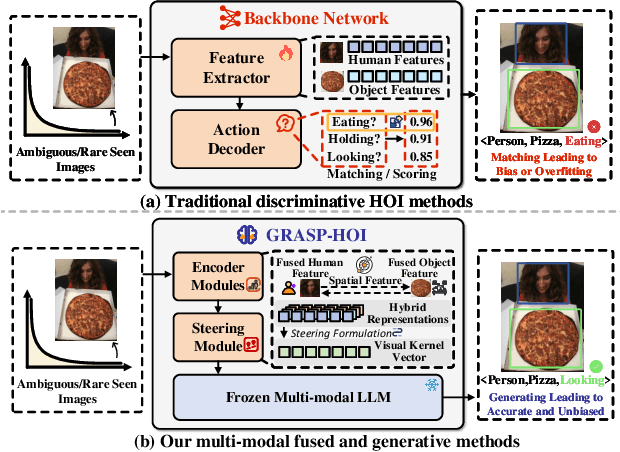
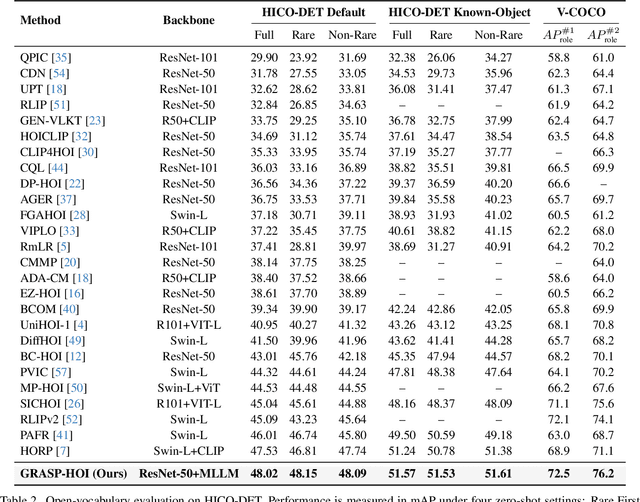
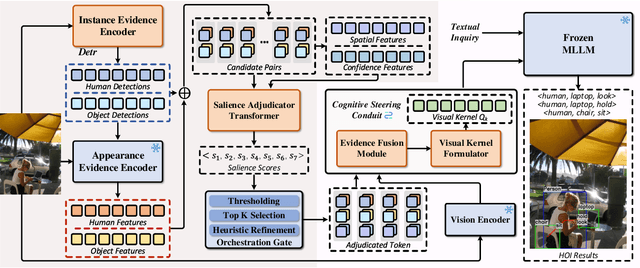
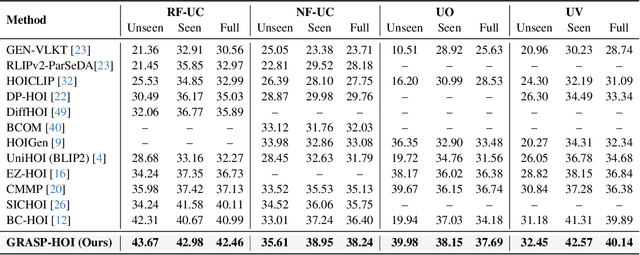
Human-object interaction (HOI) detection aims to localize human-object pairs and the interactions between them. Existing methods operate under a closed-world assumption, treating the task as a classification problem over a small, predefined verb set, which struggles to generalize to the long-tail of unseen or ambiguous interactions in the wild. While recent multi-modal large language models (MLLMs) possess the rich world knowledge required for open-vocabulary understanding, they remain decoupled from existing HOI detectors since fine-tuning them is computationally prohibitive. To address these constraints, we propose \GRASP-HO}, a novel Generative Reasoning And Steerable Perception framework that reformulates HOI detection from the closed-set classification task to the open-vocabulary generation problem. To bridge the vision and cognitive, we first extract hybrid interaction representations, then design a lightweight learnable cognitive steering conduit (CSC) module to inject the fine-grained visual evidence into a frozen MLLM for effective reasoning. To address the supervision mismatch between classification-based HOI datasets and open-vocabulary generative models, we introduce a hybrid guidance strategy that coupling the language modeling loss and auxiliary classification loss, enabling discriminative grounding without sacrificing generative flexibility. Experiments demonstrate state-of-the-art closed-set performance and strong zero-shot generalization, achieving a unified paradigm that seamlessly bridges discriminative perception and generative reasoning for open-world HOI detection.
Tracking large chemical reaction networks and rare events by neural networks
Dec 13, 2025Chemical reaction networks are widely used to model stochastic dynamics in chemical kinetics, systems biology and epidemiology. Solving the chemical master equation that governs these systems poses a significant challenge due to the large state space exponentially growing with system sizes. The development of autoregressive neural networks offers a flexible framework for this problem; however, its efficiency is limited especially for high-dimensional systems and in scenarios with rare events. Here, we push the frontier of neural-network approach by exploiting faster optimizations such as natural gradient descent and time-dependent variational principle, achieving a 5- to 22-fold speedup, and by leveraging enhanced-sampling strategies to capture rare events. We demonstrate reduced computational cost and higher accuracy over the previous neural-network method in challenging reaction networks, including the mitogen-activated protein kinase (MAPK) cascade network, the hitherto largest biological network handled by the previous approaches of solving the chemical master equation. We further apply the approach to spatially extended reaction-diffusion systems, the Schlögl model with rare events, on two-dimensional lattices, beyond the recent tensor-network approach that handles one-dimensional lattices. The present approach thus enables efficient modeling of chemical reaction networks in general.
Untethered thin dielectric elastomer actuated soft robot
Dec 12, 2025Thin dielectric elastomer actuator (DEA) features a unique in-plane configuration, enabling low-profile designs capable of accessing millimetre-scale narrow spaces. However, most existing DEA-powered soft robots require high voltages and wired power connections, limiting their ability to operate in confined environments. This study presents an untethered thin soft robot (UTS-Robot) powered by thin dielectric elastomer actuators (TS-DEA). The robot measures 38 mm in length, 6 mm in height, and weighs just 2.34 grams, integrating flexible onboard electronics to achieve fully untethered actuation. The TS-DEA, operating at resonant frequencies of 86 Hz under a low driving voltage of 220 V, adopts a dual-actuation sandwiched structure, comprising four dielectric elastomer layers bonded to a compressible tensioning mechanism at its core. This design enables high power density actuation and locomotion via three directional friction pads. The low-voltage actuation is achieved by fabricating each elastomer layer via spin coating to an initial thickness of 50 um, followed by biaxial stretching to 8 um. A comprehensive design and modelling framework has been developed to optimise TS-DEA performance. Experimental evaluations demonstrate that the bare TS-DEA achieves a locomotion speed of 12.36 mm/s at resonance, the untethered configuration achieves a locomotion speed of 0.5 mm/s, making it highly suitable for navigating confined and complex environments.
UrbanNav: Learning Language-Guided Urban Navigation from Web-Scale Human Trajectories
Dec 10, 2025
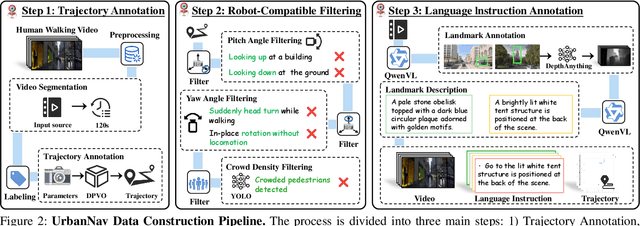
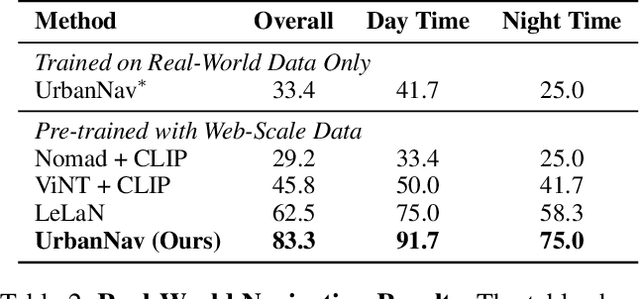
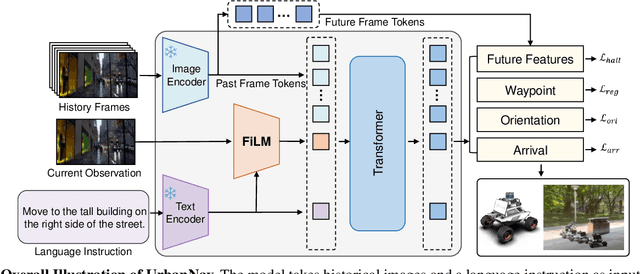
Navigating complex urban environments using natural language instructions poses significant challenges for embodied agents, including noisy language instructions, ambiguous spatial references, diverse landmarks, and dynamic street scenes. Current visual navigation methods are typically limited to simulated or off-street environments, and often rely on precise goal formats, such as specific coordinates or images. This limits their effectiveness for autonomous agents like last-mile delivery robots navigating unfamiliar cities. To address these limitations, we introduce UrbanNav, a scalable framework that trains embodied agents to follow free-form language instructions in diverse urban settings. Leveraging web-scale city walking videos, we develop an scalable annotation pipeline that aligns human navigation trajectories with language instructions grounded in real-world landmarks. UrbanNav encompasses over 1,500 hours of navigation data and 3 million instruction-trajectory-landmark triplets, capturing a wide range of urban scenarios. Our model learns robust navigation policies to tackle complex urban scenarios, demonstrating superior spatial reasoning, robustness to noisy instructions, and generalization to unseen urban settings. Experimental results show that UrbanNav significantly outperforms existing methods, highlighting the potential of large-scale web video data to enable language-guided, real-world urban navigation for embodied agents.
Transferable Dual-Domain Feature Importance Attack against AI-Generated Image Detector
Nov 19, 2025Recent AI-generated image (AIGI) detectors achieve impressive accuracy under clean condition. In view of antiforensics, it is significant to develop advanced adversarial attacks for evaluating the security of such detectors, which remains unexplored sufficiently. This letter proposes a Dual-domain Feature Importance Attack (DuFIA) scheme to invalidate AIGI detectors to some extent. Forensically important features are captured by the spatially interpolated gradient and frequency-aware perturbation. The adversarial transferability is enhanced by jointly modeling spatial and frequency-domain feature importances, which are fused to guide the optimization-based adversarial example generation. Extensive experiments across various AIGI detectors verify the cross-model transferability, transparency and robustness of DuFIA.
OmniSparse: Training-Aware Fine-Grained Sparse Attention for Long-Video MLLMs
Nov 18, 2025Existing sparse attention methods primarily target inference-time acceleration by selecting critical tokens under predefined sparsity patterns. However, they often fail to bridge the training-inference gap and lack the capacity for fine-grained token selection across multiple dimensions such as queries, key-values (KV), and heads, leading to suboptimal performance and limited acceleration gains. In this paper, we introduce OmniSparse, a training-aware fine-grained sparse attention framework for long-video MLLMs, which operates in both training and inference with dynamic token budget allocation. Specifically, OmniSparse contains three adaptive and complementary mechanisms: (1) query selection via lazy-active classification, retaining active queries that capture broad semantic similarity while discarding most lazy ones that focus on limited local context and exhibit high functional redundancy; (2) KV selection with head-level dynamic budget allocation, where a shared budget is determined based on the flattest head and applied uniformly across all heads to ensure attention recall; and (3) KV cache slimming to reduce head-level redundancy by selectively fetching visual KV cache according to the head-level decoding query pattern. Experimental results show that OmniSparse matches the performance of full attention while achieving up to 2.7x speedup during prefill and 2.4x memory reduction during decoding.
ManipShield: A Unified Framework for Image Manipulation Detection, Localization and Explanation
Nov 18, 2025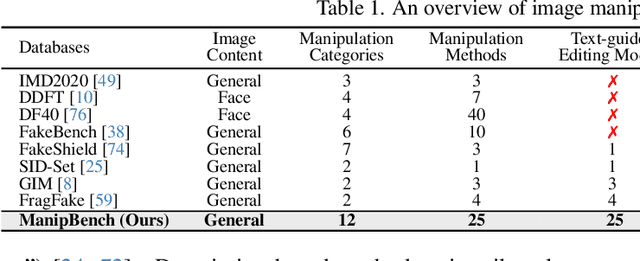
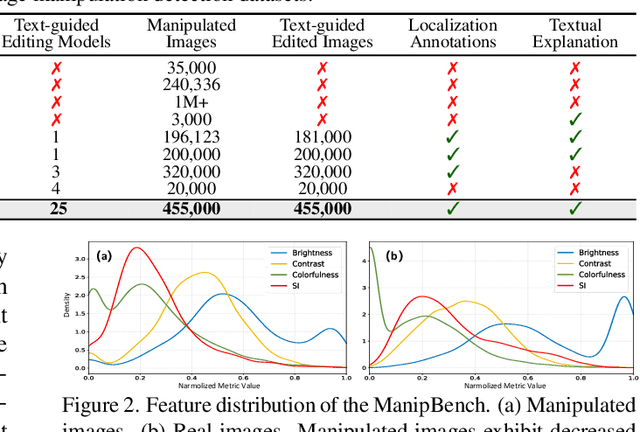
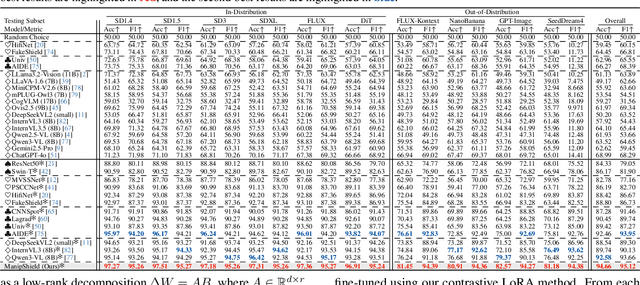
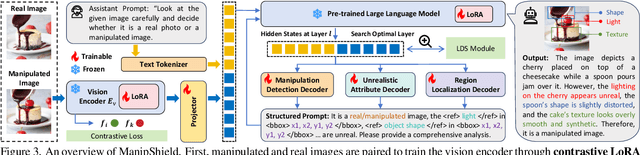
With the rapid advancement of generative models, powerful image editing methods now enable diverse and highly realistic image manipulations that far surpass traditional deepfake techniques, posing new challenges for manipulation detection. Existing image manipulation detection and localization (IMDL) benchmarks suffer from limited content diversity, narrow generative-model coverage, and insufficient interpretability, which hinders the generalization and explanation capabilities of current manipulation detection methods. To address these limitations, we introduce \textbf{ManipBench}, a large-scale benchmark for image manipulation detection and localization focusing on AI-edited images. ManipBench contains over 450K manipulated images produced by 25 state-of-the-art image editing models across 12 manipulation categories, among which 100K images are further annotated with bounding boxes, judgment cues, and textual explanations to support interpretable detection. Building upon ManipBench, we propose \textbf{ManipShield}, an all-in-one model based on a Multimodal Large Language Model (MLLM) that leverages contrastive LoRA fine-tuning and task-specific decoders to achieve unified image manipulation detection, localization, and explanation. Extensive experiments on ManipBench and several public datasets demonstrate that ManipShield achieves state-of-the-art performance and exhibits strong generality to unseen manipulation models. Both ManipBench and ManipShield will be released upon publication.
PIGEON: VLM-Driven Object Navigation via Points of Interest Selection
Nov 17, 2025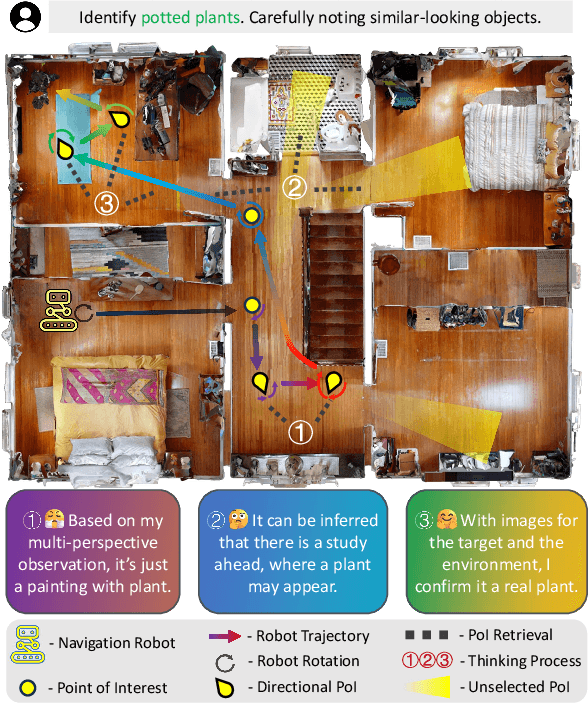
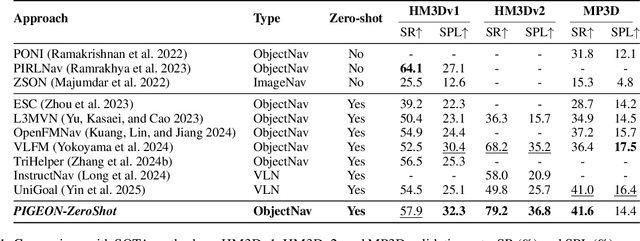
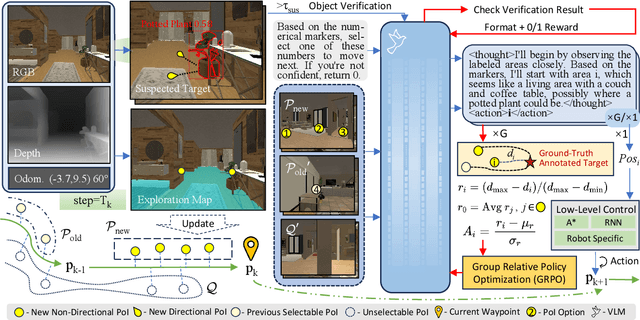
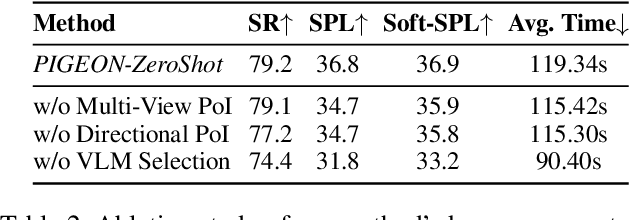
Navigating to a specified object in an unknown environment is a fundamental yet challenging capability of embodied intelligence. However, current methods struggle to balance decision frequency with intelligence, resulting in decisions lacking foresight or discontinuous actions. In this work, we propose PIGEON: Point of Interest Guided Exploration for Object Navigation with VLM, maintaining a lightweight and semantically aligned snapshot memory during exploration as semantic input for the exploration strategy. We use a large Visual-Language Model (VLM), named PIGEON-VL, to select Points of Interest (PoI) formed during exploration and then employ a lower-level planner for action output, increasing the decision frequency. Additionally, this PoI-based decision-making enables the generation of Reinforcement Learning with Verifiable Reward (RLVR) data suitable for simulators. Experiments on classic object navigation benchmarks demonstrate that our zero-shot transfer method achieves state-of-the-art performance, while RLVR further enhances the model's semantic guidance capabilities, enabling deep reasoning during real-time navigation.
GeoX-Bench: Benchmarking Cross-View Geo-Localization and Pose Estimation Capabilities of Large Multimodal Models
Nov 17, 2025Large multimodal models (LMMs) have demonstrated remarkable capabilities across a wide range of tasks, however their knowledge and abilities in the cross-view geo-localization and pose estimation domains remain unexplored, despite potential benefits for navigation, autonomous driving, outdoor robotics, \textit{etc}. To bridge this gap, we introduce \textbf{GeoX-Bench}, a comprehensive \underline{Bench}mark designed to explore and evaluate the capabilities of LMMs in \underline{cross}-view \underline{Geo}-localization and pose estimation. Specifically, GeoX-Bench contains 10,859 panoramic-satellite image pairs spanning 128 cities in 49 countries, along with corresponding 755,976 question-answering (QA) pairs. Among these, 42,900 QA pairs are designated for benchmarking, while the remaining are intended to enhance the capabilities of LMMs. Based on GeoX-Bench, we evaluate the capabilities of 25 state-of-the-art LMMs on cross-view geo-localization and pose estimation tasks, and further explore the empowered capabilities of instruction-tuning. Our benchmark demonstrate that while current LMMs achieve impressive performance in geo-localization tasks, their effectiveness declines significantly on the more complex pose estimation tasks, highlighting a critical area for future improvement, and instruction-tuning LMMs on the training data of GeoX-Bench can significantly improve the cross-view geo-sense abilities. The GeoX-Bench is available at \textcolor{magenta}{https://github.com/IntMeGroup/GeoX-Bench}.