 Add to Chrome
 Add to Firefox
 Add to Edge
CorePath: A Breast-Specialized Pathology Foundation Model for Core Needle Biopsy Diagnosis and Risk-Controlled Report Generation
Aug 04, 2026
Breast core needle biopsy (CNB) is central to breast cancer diagnosis yet remains challenging because limited tissue sampling, lesion heterogeneity, and subtle morphologic overlap can obscure subtype distinctions. We developed CorePath, a breast-specialized multimodal pathology foundation model fine-tuned from PRISM using 7901 paired CNB whole-slide images and diagnostic reports from two centers. Evaluated across six CNB cohorts and two public breast pathology benchmarks without task-specific retraining, CorePath consistently outperformed PRISM across cancer detection, invasion assessment, and histological subtyping. It achieved weighted area under the receiver operating characteristic curves (AUCs) of 0.9526-0.9735 for five-class CNB histological subtyping across private centers. On public benchmarks, CorePath outperformed leading pathology foundation models, achieving the highest weighted AUCs of 0.7780 for BCNB invasive carcinoma subtyping, 0.8178 for BRACS lesion stratification, and 0.8252 for BRACS fine-grained classification. In report generation, CorePath reduced the overall non-breast hallucinations from 30.1% to 2.8%, demonstrating improved domain fidelity after breast-specific adaptation. CorePath-CRG further combined conformal subtype-confidence gating with Learn-Then-Test risk control to enable selective report release, subtype-level fallback, and deferral. CorePath-CRG achieved zero non-breast hallucinations among released outputs and showed the strongest overall performance in pathologist-validated LLM-based Evaluation Scores and quantitative report-generation metrics across most centers. These results demonstrate that domain-specialized foundation models with statistical risk control offer a promising approach for accurate breast CNB diagnosis and reliable report generation.

OVEarth-Bench: Evaluating Category Breadth and Query Diversity for Open-Vocabulary Earth Observation
Jul 29, 2026Open-vocabulary Earth observation (EO) aims to localize geospatial concepts specified in natural language rather than a fixed label set. Existing benchmarks, however, usually cover narrow category vocabularies or limited query forms. To fill this gap, we introduce OVEarth-Bench, which extends existing evaluation in two directions: category breadth, through broad hierarchical category coverage with positive and negative expressions, and query diversity, through vocabulary, referring, and reasoning queries. The benchmark supports mask and box localization under a unified zero-shot protocol. We evaluate a broad set of general and EO-specific methods. The evaluation reveals that: (1) the performance of current methods remains limited, while broader category coverage yields more stable model rankings; (2) MLLM-based methods achieve the strongest overall performance; and (3) EO-specific methods generally underperform general models and rarely match the strongest methods. These findings provide guidance for future open-vocabulary EO method design and highlight the importance of developing more realistic, diverse, high-quality, and large-scale benchmarks for reliable evaluation. Our data and evaluation package are released at https://earth-insights.github.io/OVEarth-bench.
Act As a Real Researcher: A Suite of Benchmarks Evaluating Frontier LLMs and Agentic Harnesses in Research Lifecycle
Jun 05, 2026As foundation models advance and agent scaffolding becomes increasingly sophisticated, agents have demonstrated remarkable proficiency in complex, long-horizon coding tasks and even autonomous experiment execution. Despite their evolution from research assistants into autonomous research agents, these systems still exhibit significant limitations in field sensitivity, research ethics, and nuanced scientific judgment. Consequently, frontier agents remain unable to fully replace human researchers. To bridge this gap, we conceptualize the AARR (Act As a Real Researcher) benchmark series. Unlike existing benchmarks that primarily assess macro-level execution capabilities, AARR focuses on whether agents can emulate the professionalism, thoroughness, and nuanced reasoning that characterize human researchers in granular research scenarios. In this work, we propose AARRI-Bench (Act As a Real Research Intern), the first benchmark in this series. We conduct extensive experiments across frontier models and agentic systems, revealing that even the best-performing configuration (Mini-SWE-Agent with Claude Opus 4.7) achieves only 68.3\% success rate, frequently overlooking subtle yet critical details that are obvious to real human researchers. Our results indicate that developing researcher-like AI requires further exploration of research behavior, rather than merely complex scaffolding. Our data is released at https://github.com/AARR-bench/AARRI-bench.
Constructing a Question-Answering Simulator through the Distillation of LLMs
Sep 11, 2025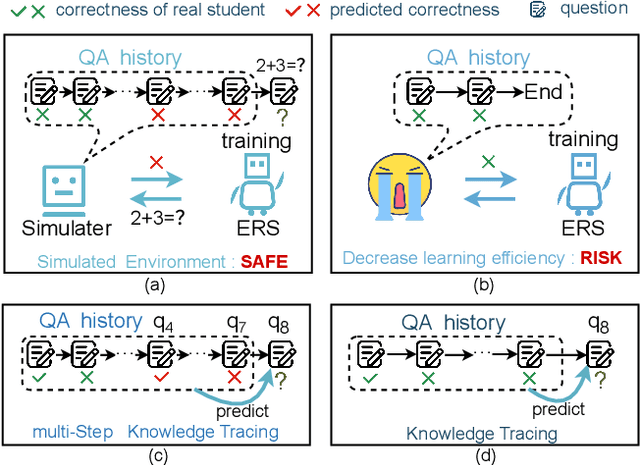
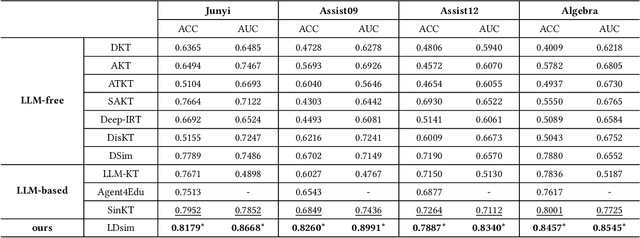
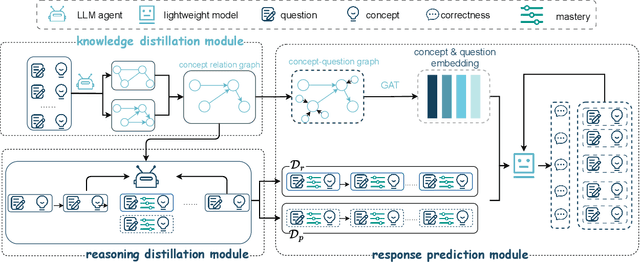
The question-answering (QA) simulator is a model that mimics real student learning behaviors and predicts their correctness of their responses to questions. QA simulators enable educational recommender systems (ERS) to collect large amounts of training data without interacting with real students, thereby preventing harmful recommendations made by an undertrained ERS from undermining actual student learning. Given the QA history, there are two categories of solutions to predict the correctness, conducting the simulation: (1) LLM-free methods, which apply a traditional sequential model to transfer the QA history into a vector representation first, and make predictions based on the representation; (2) LLM-based methods, which leverage the domain knowledge and reasoning capability of LLM to enhence the prediction. LLM-free methods offer fast inference but generally yield suboptimal performance. In contrast, most LLM-based methods achieve better results, but at the cost of slower inference speed and higher GPU memory consumption. In this paper, we propose a method named LLM Distillation based Simulator (LDSim), which distills domain knowledge and reasoning capability from an LLM to better assist prediction, thereby improving simulation performance. Extensive experiments demonstrate that our LDSim achieves strong results on both the simulation task and the knowledge tracing (KT) task. Our code is publicly available at https://anonymous.4open.science/r/LDSim-05A9.
NTIRE 2025 challenge on Text to Image Generation Model Quality Assessment
May 22, 2025This paper reports on the NTIRE 2025 challenge on Text to Image (T2I) generation model quality assessment, which will be held in conjunction with the New Trends in Image Restoration and Enhancement Workshop (NTIRE) at CVPR 2025. The aim of this challenge is to address the fine-grained quality assessment of text-to-image generation models. This challenge evaluates text-to-image models from two aspects: image-text alignment and image structural distortion detection, and is divided into the alignment track and the structural track. The alignment track uses the EvalMuse-40K, which contains around 40K AI-Generated Images (AIGIs) generated by 20 popular generative models. The alignment track has a total of 371 registered participants. A total of 1,883 submissions are received in the development phase, and 507 submissions are received in the test phase. Finally, 12 participating teams submitted their models and fact sheets. The structure track uses the EvalMuse-Structure, which contains 10,000 AI-Generated Images (AIGIs) with corresponding structural distortion mask. A total of 211 participants have registered in the structure track. A total of 1155 submissions are received in the development phase, and 487 submissions are received in the test phase. Finally, 8 participating teams submitted their models and fact sheets. Almost all methods have achieved better results than baseline methods, and the winning methods in both tracks have demonstrated superior prediction performance on T2I model quality assessment.
Uniform Planar Array Based Weighted Cooperative Spectrum Sensing for Cognitive Radio Networks
Apr 14, 2025Cooperative spectrum sensing (CSS) is essential for improving the spectrum efficiency and reliability of cognitive radio applications. Next-generation wireless communication networks increasingly employ uniform planar arrays (UPA) due to their ability to steer beamformers towards desired directions, mitigating interference and eavesdropping. However, the application of UPA-based CSS in cognitive radio remains largely unexplored. This paper proposes a multi-beam UPA-based weighted CSS (WCSS) framework to enhance detection reliability, applicable to various cognitive radio networks, including cellular, vehicular, and satellite communications. We first propose a weighting factor for commonly used energy detection (ED) and eigenvalue detection (EVD) techniques, based on the spatial variation of signal strengths resulting from UPA antenna beamforming. We then analytically characterize the performance of both weighted ED and weighted EVD by deriving closed-form expressions for false alarm and detection probabilities. Our numerical results, considering both static and dynamic user behaviors, demonstrate the superiority of WCSS in enhancing sensing performance compared to uniformly weighted detectors.
Multi-Action Restless Bandits with Weakly Coupled Constraints: Simultaneous Learning and Control
Dec 04, 2024We study a system with finitely many groups of multi-action bandit processes, each of which is a Markov decision process (MDP) with finite state and action spaces and potentially different transition matrices when taking different actions. The bandit processes of the same group share the same state and action spaces and, given the same action that is taken, the same transition matrix. All the bandit processes across various groups are subject to multiple weakly coupled constraints over their state and action variables. Unlike the past studies that focused on the offline case, we consider the online case without assuming full knowledge of transition matrices and reward functions a priori and propose an effective scheme that enables simultaneous learning and control. We prove the convergence of the relevant processes in both the timeline and the number of the bandit processes, referred to as the convergence in the time and the magnitude dimensions. Moreover, we prove that the relevant processes converge exponentially fast in the magnitude dimension, leading to exponentially diminishing performance deviation between the proposed online algorithms and offline optimality.
Deep Learning-Based Longitudinal Prediction of Childhood Myopia Progression Using Fundus Image Sequences and Baseline Refraction Data
Jul 31, 2024


Childhood myopia constitutes a significant global health concern. It exhibits an escalating prevalence and has the potential to evolve into severe, irreversible conditions that detrimentally impact familial well-being and create substantial economic costs. Contemporary research underscores the importance of precisely predicting myopia progression to enable timely and effective interventions, thereby averting severe visual impairment in children. Such predictions predominantly rely on subjective clinical assessments, which are inherently biased and resource-intensive, thus hindering their widespread application. In this study, we introduce a novel, high-accuracy method for quantitatively predicting the myopic trajectory and myopia risk in children using only fundus images and baseline refraction data. This approach was validated through a six-year longitudinal study of 3,408 children in Henan, utilizing 16,211 fundus images and corresponding refractive data. Our method based on deep learning demonstrated predictive accuracy with an error margin of 0.311D per year and AUC scores of 0.944 and 0.995 for forecasting the risks of developing myopia and high myopia, respectively. These findings confirm the utility of our model in supporting early intervention strategies and in significantly reducing healthcare costs, particularly by obviating the need for additional metadata and repeated consultations. Furthermore, our method was designed to rely only on fundus images and refractive error data, without the need for meta data or multiple inquiries from doctors, strongly reducing the associated medical costs and facilitating large-scale screening. Our model can even provide good predictions based on only a single time measurement. Consequently, the proposed method is an important means to reduce medical inequities caused by economic disparities.
Interference Mitigation in LEO Constellations with Limited Radio Environment Information
Feb 19, 2024This research paper delves into interference mitigation within Low Earth Orbit (LEO) satellite constellations, particularly when operating under constraints of limited radio environment information. Leveraging cognitive capabilities facilitated by the Radio Environment Map (REM), we explore strategies to mitigate the impact of both intentional and unintentional interference using planar antenna array (PAA) beamforming techniques. We address the complexities encountered in the design of beamforming weights, a challenge exacerbated by the array size and the increasing number of directions of interest and avoidance. Furthermore, we conduct an extensive analysis of beamforming performance from various perspectives associated with limited REM information: static versus dynamic, partial versus full, and perfect versus imperfect. To substantiate our findings, we provide simulation results and offer conclusions based on the outcomes of our investigation.
An Index Policy Based on Sarsa and Q-learning for Heterogeneous Smart Target Tracking
Feb 19, 2024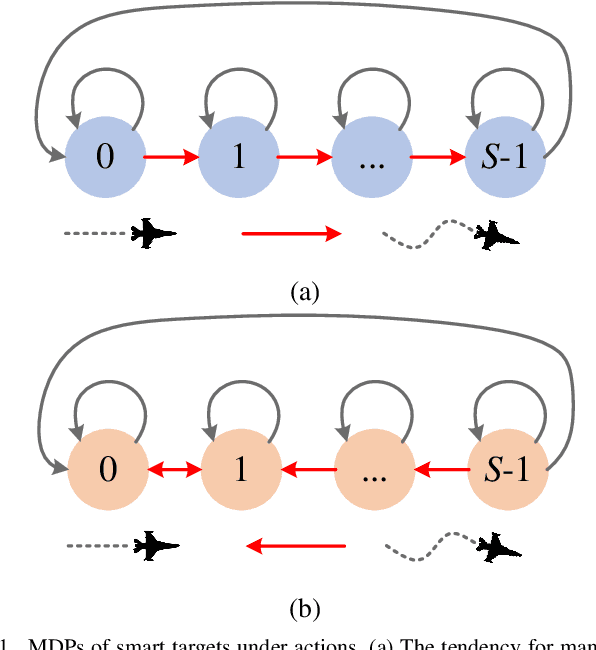
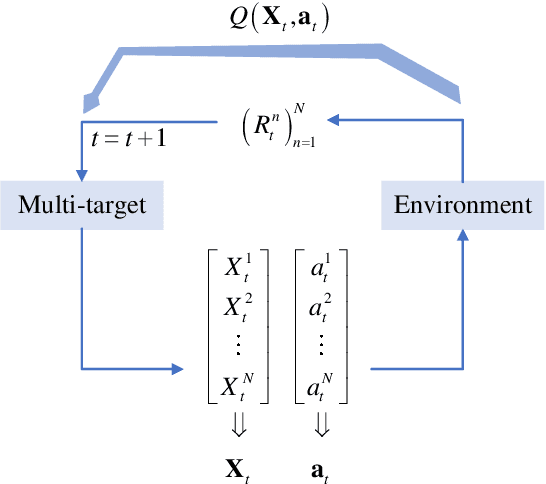
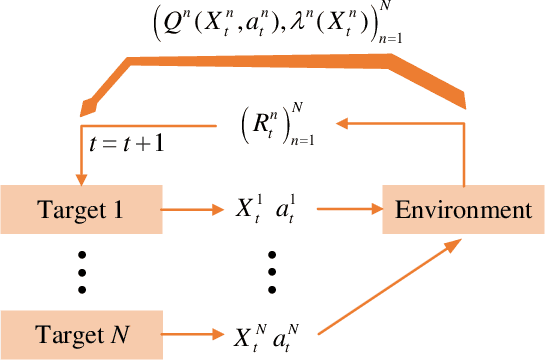
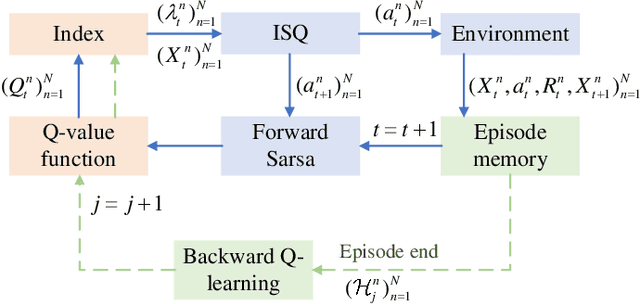
In solving the non-myopic radar scheduling for multiple smart target tracking within an active and passive radar network, we need to consider both short-term enhanced tracking performance and a higher probability of target maneuvering in the future with active tracking. Acquiring the long-term tracking performance while scheduling the beam resources of active and passive radars poses a challenge. To address this challenge, we model this problem as a Markov decision process consisting of parallel restless bandit processes. Each bandit process is associated with a smart target, of which the estimation state evolves according to different discrete dynamic models for different actions - whether or not the target is being tracked. The discrete state is defined by the dynamic mode. The problem exhibits the curse of dimensionality, where optimal solutions are in general intractable. We resort to heuristics through the famous restless multi-armed bandit techniques. It follows with efficient scheduling policies based on the indices that are real numbers representing the marginal rewards of taking different actions. For the inevitable practical case with unknown transition matrices, we propose a new method that utilizes the forward Sarsa and backward Q-learning to approximate the indices through adapting the state-action value functions, or equivalently the Q-functions, and propose a new policy, namely ISQ, aiming to maximize the long-term tracking rewards. Numerical results demonstrate that the proposed ISQ policy outperforms conventional Q-learning-based methods and rapidly converges to the well-known Whittle index policy with revealed state transition models, which is considered the benchmark.