 Add to Chrome
 Add to Firefox
 Add to Edge
CVSBench: A Comprehensive Benchmark for Cross-view Spatial Reasoning and Dreaming
Jun 21, 2026
Humans can effortlessly reason about scenes across different viewpoints, yet it remains unclear whether Vision-Language Models (VLMs) possess similar cross-view spatial abilities. Satellite-street scene pairs, with their complex contexts and extreme viewpoint variations, provide an ideal testbed. Motivated by this, we introduce CVSBench, a large-scale benchmark for evaluating cross-view spatial reasoning through satellite-street pairs. This benchmark supports multiple tasks, including cross-view VQA, cross-view grounding, and viewpoint identification. CVSBench comprises 3,297 cross-view image groups with 9,468 object-level annotations and 40,679 question-answer (QA) pairs, enabling systematic and controlled evaluation of cross-view spatial reasoning. Extensive evaluations reveal that advanced VLMs struggle to maintain object-level and layout consistency under drastic viewpoint changes. To bridge this gap towards human-like spatial cognition, we investigate two categories of approaches: spatially grounded reasoning and the incorporation of cognitive map inputs. Our findings demonstrate that language-only reasoning yields marginal improvements, while incorporating visual spatial imagination via a 3D scene imagination pipeline substantially improves cross-view reasoning. These results highlight the necessity of explicit visual-spatial representations for robust spatial cognition in VLMs. Our data and code are released at https://huggingface.co/datasets/zlyzlyzly/CVSBench.

Act As a Real Researcher: A Suite of Benchmarks Evaluating Frontier LLMs and Agentic Harnesses in Research Lifecycle
Jun 05, 2026As foundation models advance and agent scaffolding becomes increasingly sophisticated, agents have demonstrated remarkable proficiency in complex, long-horizon coding tasks and even autonomous experiment execution. Despite their evolution from research assistants into autonomous research agents, these systems still exhibit significant limitations in field sensitivity, research ethics, and nuanced scientific judgment. Consequently, frontier agents remain unable to fully replace human researchers. To bridge this gap, we conceptualize the AARR (Act As a Real Researcher) benchmark series. Unlike existing benchmarks that primarily assess macro-level execution capabilities, AARR focuses on whether agents can emulate the professionalism, thoroughness, and nuanced reasoning that characterize human researchers in granular research scenarios. In this work, we propose AARRI-Bench (Act As a Real Research Intern), the first benchmark in this series. We conduct extensive experiments across frontier models and agentic systems, revealing that even the best-performing configuration (Mini-SWE-Agent with Claude Opus 4.7) achieves only 68.3\% success rate, frequently overlooking subtle yet critical details that are obvious to real human researchers. Our results indicate that developing researcher-like AI requires further exploration of research behavior, rather than merely complex scaffolding. Our data is released at https://github.com/AARR-bench/AARRI-bench.
ZoomEarth: Active Perception for Ultra-High-Resolution Geospatial Vision-Language Tasks
Nov 15, 2025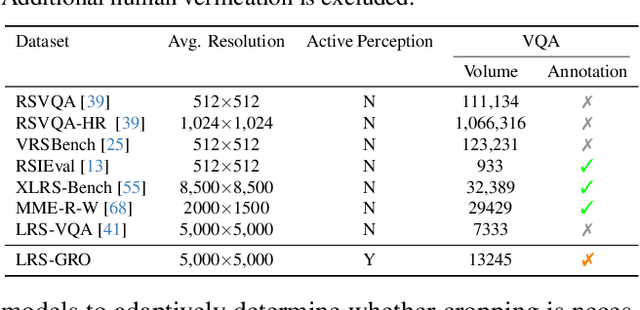
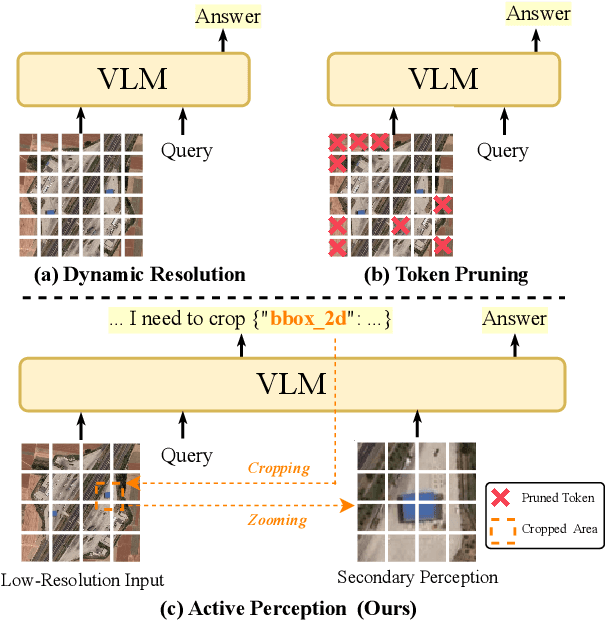
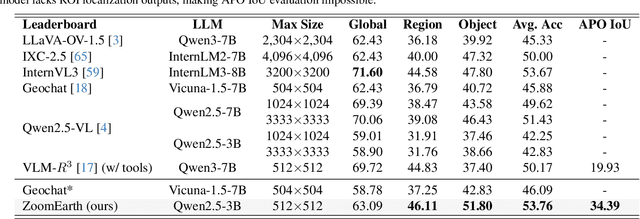
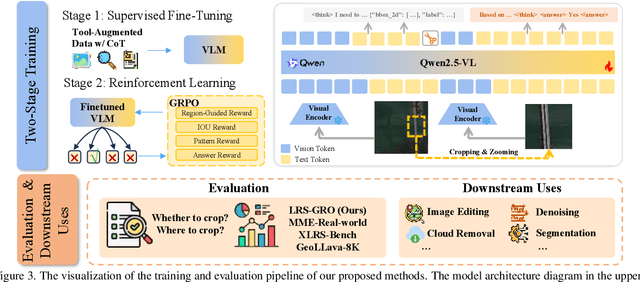
Ultra-high-resolution (UHR) remote sensing (RS) images offer rich fine-grained information but also present challenges in effective processing. Existing dynamic resolution and token pruning methods are constrained by a passive perception paradigm, suffering from increased redundancy when obtaining finer visual inputs. In this work, we explore a new active perception paradigm that enables models to revisit information-rich regions. First, we present LRS-GRO, a large-scale benchmark dataset tailored for active perception in UHR RS processing, encompassing 17 question types across global, region, and object levels, annotated via a semi-automatic pipeline. Building on LRS-GRO, we propose ZoomEarth, an adaptive cropping-zooming framework with a novel Region-Guided reward that provides fine-grained guidance. Trained via supervised fine-tuning (SFT) and Group Relative Policy Optimization (GRPO), ZoomEarth achieves state-of-the-art performance on LRS-GRO and, in the zero-shot setting, on three public UHR remote sensing benchmarks. Furthermore, ZoomEarth can be seamlessly integrated with downstream models for tasks such as cloud removal, denoising, segmentation, and image editing through simple tool interfaces, demonstrating strong versatility and extensibility.