 Add to Chrome
 Add to Firefox
 Add to Edge
LoKA: Low-precision Kernel Applications for Recommendation Models At Scale
May 11, 2026
Recent GPU generations deliver significantly higher FLOPs using lower-precision arithmetic, such as FP8. While successfully applied to large language models (LLMs), its adoption in large recommendation models (LRMs) has been limited. This is because LRMs are numerically sensitive, dominated by small matrix multiplications (GEMMs) followed by normalization, and trained in communication-intensive environments. Applying FP8 directly to LRMs often degrades model quality and prolongs training time. These challenges are inherent to LRM workloads and cannot be resolved merely by introducing better FP8 kernels. Instead, a system-model co-design approach is needed to successfully integrate FP8. We present LoKA (Low-precision Kernel Applications), a framework that makes FP8 practical for LRMs through three principles: profile under realistic distributions to know where low precision is safe, co-design model components with hardware to expand where it is safe, and orchestrate across kernel libraries to maximize the gains. Concretely, LoKA Probe is a statistically grounded, online benchmarking method that learns activation and weight statistics, and quantifies per-layer errors. This process pinpoints safe and unsafe, fast and slow sites for FP8 adoption. LoKA Mods is a set of reusable model adaptations that improve both numerical stability and execution efficiency with FP8. LoKA Dispatch is a runtime that leverages the statistical insights from LoKA Probe to select the fastest FP8 kernel that satisfies the accuracy requirements.

Scaling Multi-Node Mixture-of-Experts Inference Using Expert Activation Patterns
Apr 25, 2026Most recent state-of-the-art (SOTA) large language models (LLMs) use Mixture-of-Experts (MoE) architectures to scale model capacity without proportional per-token compute, enabling higher-quality outputs at manageable serving costs. However, MoE inference at scale is fundamentally bottlenecked by expert load imbalance and inefficient token routing, especially in multi-node deployments where tokens are not guaranteed to be routed to local experts, resulting in significant inter-node all-to-all communication overhead. To systematically characterize these challenges, we profile SOTA open-source MoE models, including Llama 4 Maverick, DeepSeek V3-671B, and Qwen3-230B-A22B, on various datasets and collected over 100k real expert activation traces. Upon studying the expert activation patterns, we uncover various persistent properties across all the frontier MoE models: variable expert load imbalance, domain-specific expert activation where expert popularity shifts across task families (code, math, chat, general), and a strong correlation between prefill and decode expert activations. Motivated by these findings, we propose workload-aware micro-batch grouping and an expert placement strategy to maximize token locality to the destination expert, thereby reducing inter-node communication. Across models and datasets, these optimizations help reduce all2all communication data up to 20, resulting in lower MoE decode latency and better accelerator utilization.
The Llama 4 Herd: Architecture, Training, Evaluation, and Deployment Notes
Jan 15, 2026This document consolidates publicly reported technical details about Metas Llama 4 model family. It summarizes (i) released variants (Scout and Maverick) and the broader herd context including the previewed Behemoth teacher model, (ii) architectural characteristics beyond a high-level MoE description covering routed/shared-expert structure, early-fusion multimodality, and long-context design elements reported for Scout (iRoPE and length generalization strategies), (iii) training disclosures spanning pre-training, mid-training for long-context extension, and post-training methodology (lightweight SFT, online RL, and lightweight DPO) as described in release materials, (iv) developer-reported benchmark results for both base and instruction-tuned checkpoints, and (v) practical deployment constraints observed across major serving environments, including provider-specific context limits and quantization packaging. The manuscript also summarizes licensing obligations relevant to redistribution and derivative naming, and reviews publicly described safeguards and evaluation practices. The goal is to provide a compact technical reference for researchers and practitioners who need precise, source-backed facts about Llama 4.
Fast and Simplex: 2-Simplicial Attention in Triton
Jul 03, 2025Recent work has shown that training loss scales as a power law with both model size and the number of tokens, and that achieving compute-optimal models requires scaling model size and token count together. However, these scaling laws assume an infinite supply of data and apply primarily in compute-bound settings. As modern large language models increasingly rely on massive internet-scale datasets, the assumption that they are compute-bound is becoming less valid. This shift highlights the need for architectures that prioritize token efficiency. In this work, we investigate the use of the 2-simplicial Transformer, an architecture that generalizes standard dot-product attention to trilinear functions through an efficient Triton kernel implementation. We demonstrate that the 2-simplicial Transformer achieves better token efficiency than standard Transformers: for a fixed token budget, similarly sized models outperform their dot-product counterparts on tasks involving mathematics, coding, reasoning, and logic. We quantify these gains by demonstrating that $2$-simplicial attention changes the exponent in the scaling laws for knowledge and reasoning tasks compared to dot product attention.
Accelerating Transformer Inference and Training with 2:4 Activation Sparsity
Mar 20, 2025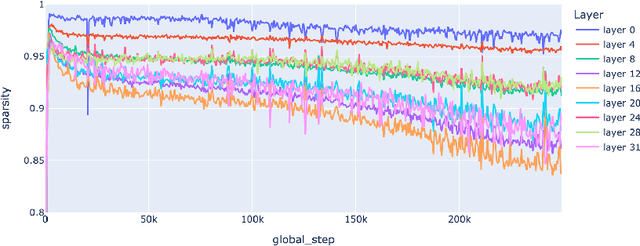
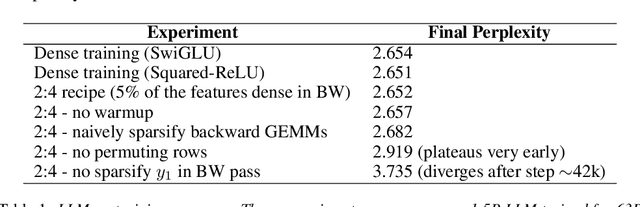
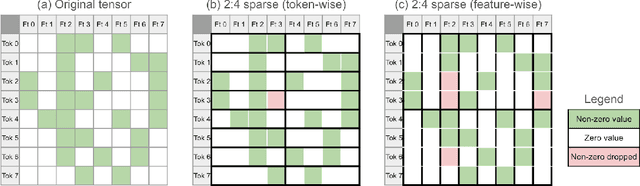
In this paper, we demonstrate how to leverage 2:4 sparsity, a popular hardware-accelerated GPU sparsity pattern, to activations to accelerate large language model training and inference. Crucially we exploit the intrinsic sparsity found in Squared-ReLU activations to provide this acceleration with no accuracy loss. Our approach achieves up to 1.3x faster Feed Forward Network (FFNs) in both the forwards and backwards pass. This work highlights the potential for sparsity to play a key role in accelerating large language model training and inference.
The Llama 3 Herd of Models
Jul 31, 2024Modern artificial intelligence (AI) systems are powered by foundation models. This paper presents a new set of foundation models, called Llama 3. It is a herd of language models that natively support multilinguality, coding, reasoning, and tool usage. Our largest model is a dense Transformer with 405B parameters and a context window of up to 128K tokens. This paper presents an extensive empirical evaluation of Llama 3. We find that Llama 3 delivers comparable quality to leading language models such as GPT-4 on a plethora of tasks. We publicly release Llama 3, including pre-trained and post-trained versions of the 405B parameter language model and our Llama Guard 3 model for input and output safety. The paper also presents the results of experiments in which we integrate image, video, and speech capabilities into Llama 3 via a compositional approach. We observe this approach performs competitively with the state-of-the-art on image, video, and speech recognition tasks. The resulting models are not yet being broadly released as they are still under development.
Alternate Model Growth and Pruning for Efficient Training of Recommendation Systems
May 04, 2021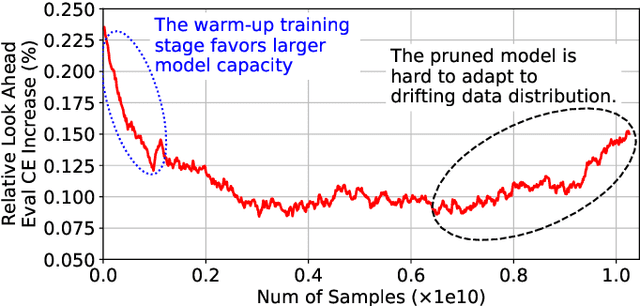

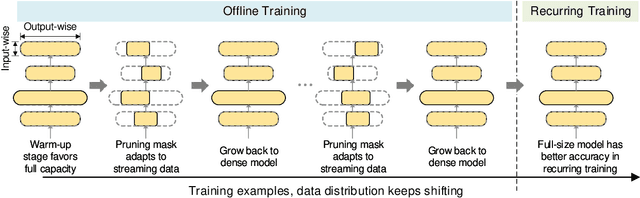

Deep learning recommendation systems at scale have provided remarkable gains through increasing model capacity (i.e. wider and deeper neural networks), but it comes at significant training cost and infrastructure cost. Model pruning is an effective technique to reduce computation overhead for deep neural networks by removing redundant parameters. However, modern recommendation systems are still thirsty for model capacity due to the demand for handling big data. Thus, pruning a recommendation model at scale results in a smaller model capacity and consequently lower accuracy. To reduce computation cost without sacrificing model capacity, we propose a dynamic training scheme, namely alternate model growth and pruning, to alternatively construct and prune weights in the course of training. Our method leverages structured sparsification to reduce computational cost without hurting the model capacity at the end of offline training so that a full-size model is available in the recurring training stage to learn new data in real-time. To the best of our knowledge, this is the first work to provide in-depth experiments and discussion of applying structural dynamics to recommendation systems at scale to reduce training cost. The proposed method is validated with an open-source deep-learning recommendation model (DLRM) and state-of-the-art industrial-scale production models.
Adaptive Dense-to-Sparse Paradigm for Pruning Online Recommendation System with Non-Stationary Data
Oct 21, 2020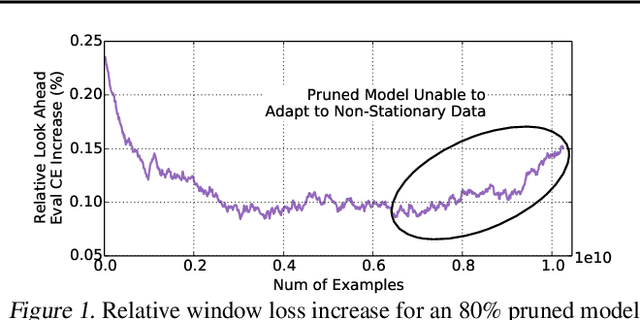
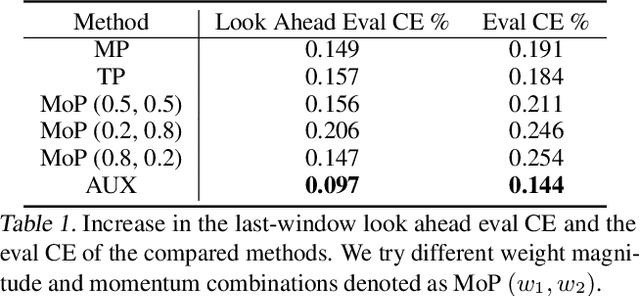
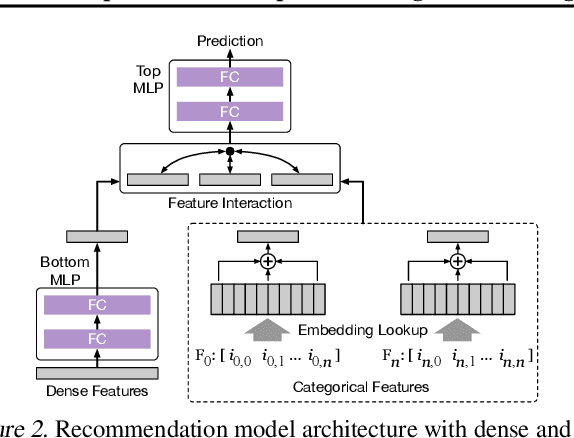
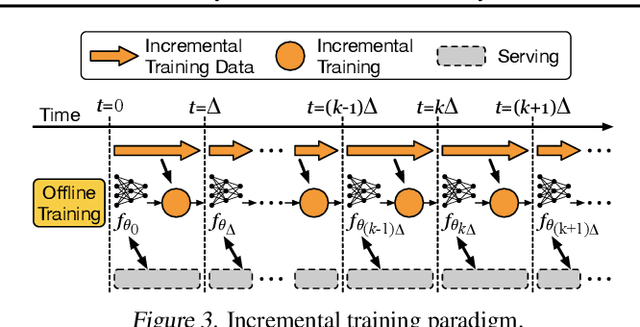
Large scale deep learning provides a tremendous opportunity to improve the quality of content recommendation systems by employing both wider and deeper models, but this comes at great infrastructural cost and carbon footprint in modern data centers. Pruning is an effective technique that reduces both memory and compute demand for model inference. However, pruning for online recommendation systems is challenging due to the continuous data distribution shift (a.k.a non-stationary data). Although incremental training on the full model is able to adapt to the non-stationary data, directly applying it on the pruned model leads to accuracy loss. This is because the sparsity pattern after pruning requires adjustment to learn new patterns. To the best of our knowledge, this is the first work to provide in-depth analysis and discussion of applying pruning to online recommendation systems with non-stationary data distribution. Overall, this work makes the following contributions: 1) We present an adaptive dense to sparse paradigm equipped with a novel pruning algorithm for pruning a large scale recommendation system with non-stationary data distribution; 2) We design the pruning algorithm to automatically learn the sparsity across layers to avoid repeating hand-tuning, which is critical for pruning the heterogeneous architectures of recommendation systems trained with non-stationary data.
Spatial-Winograd Pruning Enabling Sparse Winograd Convolution
Jan 08, 2019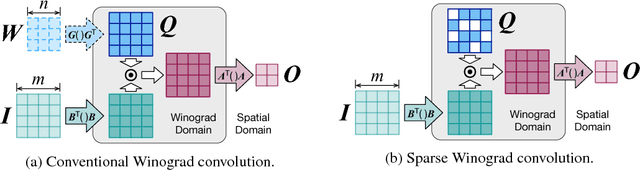
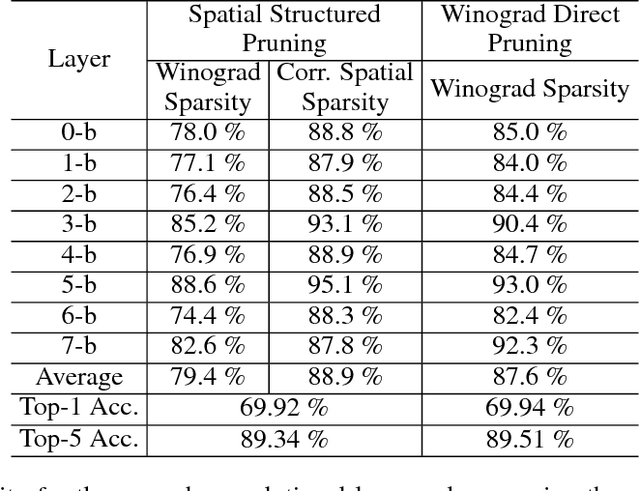
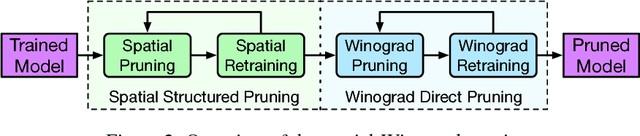
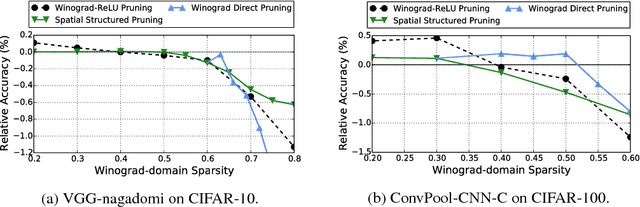
Deep convolutional neural networks (CNNs) are deployed in various applications but demand immense computational requirements. Pruning techniques and Winograd convolution are two typical methods to reduce the CNN computation. However, they cannot be directly combined because Winograd transformation fills in the sparsity resulting from pruning. Li et al. (2017) propose sparse Winograd convolution in which weights are directly pruned in the Winograd domain, but this technique is not very practical because Winograd-domain retraining requires low learning rates and hence significantly longer training time. Besides, Liu et al. (2018) move the ReLU function into the Winograd domain, which can help increase the weight sparsity but requires changes in the network structure. To achieve a high Winograd-domain weight sparsity without changing network structures, we propose a new pruning method, spatial-Winograd pruning. As the first step, spatial-domain weights are pruned in a structured way, which efficiently transfers the spatial-domain sparsity into the Winograd domain and avoids Winograd-domain retraining. For the next step, we also perform pruning and retraining directly in the Winograd domain but propose to use an importance factor matrix to adjust weight importance and weight gradients. This adjustment makes it possible to effectively retrain the pruned Winograd-domain network without changing the network structure. For the three models on the datasets of CIFAR10, CIFAR-100, and ImageNet, our proposed method can achieve the Winograd domain sparsities of 63%, 50%, and 74%, respectively.