 Add to Chrome
 Add to Firefox
 Add to Edge
LoKA: Low-precision Kernel Applications for Recommendation Models At Scale
May 11, 2026
Recent GPU generations deliver significantly higher FLOPs using lower-precision arithmetic, such as FP8. While successfully applied to large language models (LLMs), its adoption in large recommendation models (LRMs) has been limited. This is because LRMs are numerically sensitive, dominated by small matrix multiplications (GEMMs) followed by normalization, and trained in communication-intensive environments. Applying FP8 directly to LRMs often degrades model quality and prolongs training time. These challenges are inherent to LRM workloads and cannot be resolved merely by introducing better FP8 kernels. Instead, a system-model co-design approach is needed to successfully integrate FP8. We present LoKA (Low-precision Kernel Applications), a framework that makes FP8 practical for LRMs through three principles: profile under realistic distributions to know where low precision is safe, co-design model components with hardware to expand where it is safe, and orchestrate across kernel libraries to maximize the gains. Concretely, LoKA Probe is a statistically grounded, online benchmarking method that learns activation and weight statistics, and quantifies per-layer errors. This process pinpoints safe and unsafe, fast and slow sites for FP8 adoption. LoKA Mods is a set of reusable model adaptations that improve both numerical stability and execution efficiency with FP8. LoKA Dispatch is a runtime that leverages the statistical insights from LoKA Probe to select the fastest FP8 kernel that satisfies the accuracy requirements.

Two-dimensional Sparse Parallelism for Large Scale Deep Learning Recommendation Model Training
Aug 05, 2025The increasing complexity of deep learning recommendation models (DLRM) has led to a growing need for large-scale distributed systems that can efficiently train vast amounts of data. In DLRM, the sparse embedding table is a crucial component for managing sparse categorical features. Typically, these tables in industrial DLRMs contain trillions of parameters, necessitating model parallelism strategies to address memory constraints. However, as training systems expand with massive GPUs, the traditional fully parallelism strategies for embedding table post significant scalability challenges, including imbalance and straggler issues, intensive lookup communication, and heavy embedding activation memory. To overcome these limitations, we propose a novel two-dimensional sparse parallelism approach. Rather than fully sharding tables across all GPUs, our solution introduces data parallelism on top of model parallelism. This enables efficient all-to-all communication and reduces peak memory consumption. Additionally, we have developed the momentum-scaled row-wise AdaGrad algorithm to mitigate performance losses associated with the shift in training paradigms. Our extensive experiments demonstrate that the proposed approach significantly enhances training efficiency while maintaining model performance parity. It achieves nearly linear training speed scaling up to 4K GPUs, setting a new state-of-the-art benchmark for recommendation model training.
CubicML: Automated ML for Distributed ML Systems Co-design with ML Prediction of Performance
Sep 06, 2024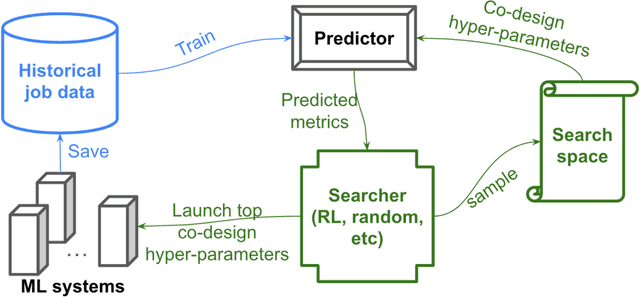
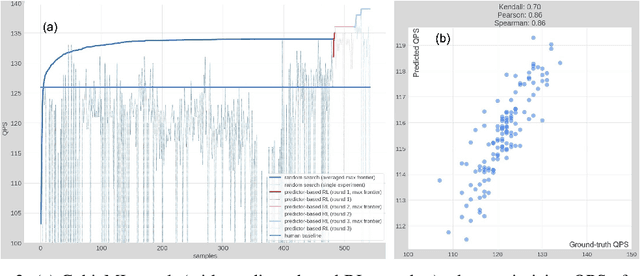
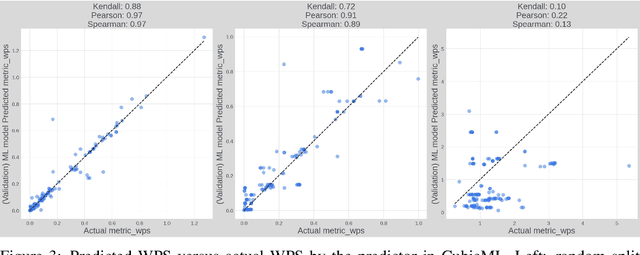
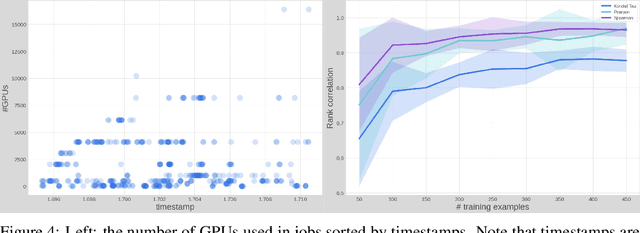
Scaling up deep learning models has been proven effective to improve intelligence of machine learning (ML) models, especially for industry recommendation models and large language models. The co-design of distributed ML systems and algorithms (to maximize training performance) plays a pivotal role for its success. As it scales, the number of co-design hyper-parameters grows rapidly which brings challenges to feasibly find the optimal setup for system performance maximization. In this paper, we propose CubicML which uses ML to automatically optimize training performance of distributed ML systems. In CubicML, we use a ML model as a proxy to predict the training performance for search efficiency and performance modeling flexibility. We proved that CubicML can effectively optimize training speed of in-house ads recommendation models and large language models at Meta.