 Add to Chrome
 Add to Firefox
 Add to Edge
InstanceGaussian: Appearance-Semantic Joint Gaussian Representation for 3D Instance-Level Perception
Nov 28, 2024


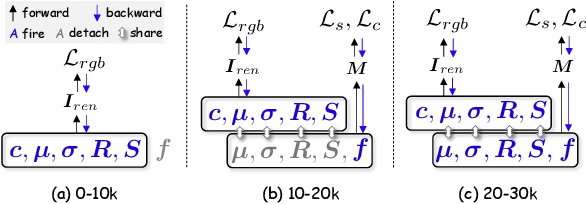
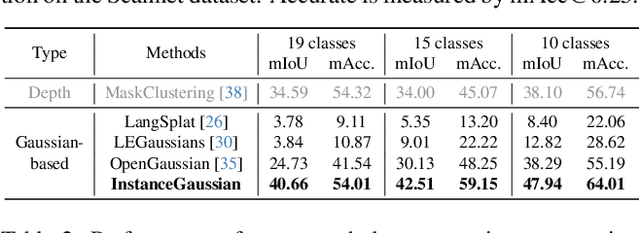
3D scene understanding has become an essential area of research with applications in autonomous driving, robotics, and augmented reality. Recently, 3D Gaussian Splatting (3DGS) has emerged as a powerful approach, combining explicit modeling with neural adaptability to provide efficient and detailed scene representations. However, three major challenges remain in leveraging 3DGS for scene understanding: 1) an imbalance between appearance and semantics, where dense Gaussian usage for fine-grained texture modeling does not align with the minimal requirements for semantic attributes; 2) inconsistencies between appearance and semantics, as purely appearance-based Gaussians often misrepresent object boundaries; and 3) reliance on top-down instance segmentation methods, which struggle with uneven category distributions, leading to over- or under-segmentation. In this work, we propose InstanceGaussian, a method that jointly learns appearance and semantic features while adaptively aggregating instances. Our contributions include: i) a novel Semantic-Scaffold-GS representation balancing appearance and semantics to improve feature representations and boundary delineation; ii) a progressive appearance-semantic joint training strategy to enhance stability and segmentation accuracy; and iii) a bottom-up, category-agnostic instance aggregation approach that addresses segmentation challenges through farthest point sampling and connected component analysis. Our approach achieves state-of-the-art performance in category-agnostic, open-vocabulary 3D point-level segmentation, highlighting the effectiveness of the proposed representation and training strategies. Project page: https://lhj-git.github.io/InstanceGaussian/

OSMamba: Omnidirectional Spectral Mamba with Dual-Domain Prior Generator for Exposure Correction
Nov 22, 2024
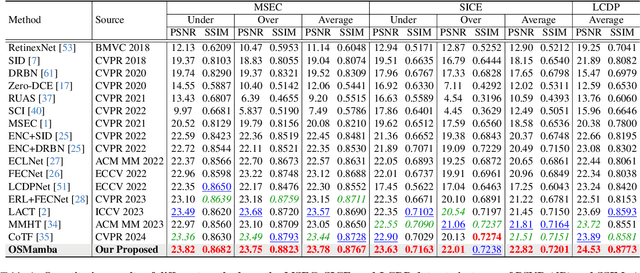
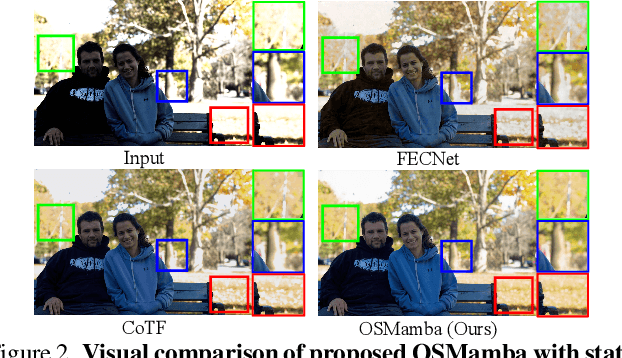
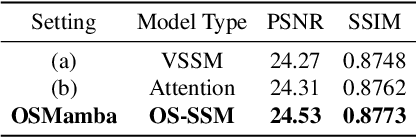
Exposure correction is a fundamental problem in computer vision and image processing. Recently, frequency domain-based methods have achieved impressive improvement, yet they still struggle with complex real-world scenarios under extreme exposure conditions. This is due to the local convolutional receptive fields failing to model long-range dependencies in the spectrum, and the non-generative learning paradigm being inadequate for retrieving lost details from severely degraded regions. In this paper, we propose Omnidirectional Spectral Mamba (OSMamba), a novel exposure correction network that incorporates the advantages of state space models and generative diffusion models to address these limitations. Specifically, OSMamba introduces an omnidirectional spectral scanning mechanism that adapts Mamba to the frequency domain to capture comprehensive long-range dependencies in both the amplitude and phase spectra of deep image features, hence enhancing illumination correction and structure recovery. Furthermore, we develop a dual-domain prior generator that learns from well-exposed images to generate a degradation-free diffusion prior containing correct information about severely under- and over-exposed regions for better detail restoration. Extensive experiments on multiple-exposure and mixed-exposure datasets demonstrate that the proposed OSMamba achieves state-of-the-art performance both quantitatively and qualitatively.
Adversarial Diffusion Compression for Real-World Image Super-Resolution
Nov 20, 2024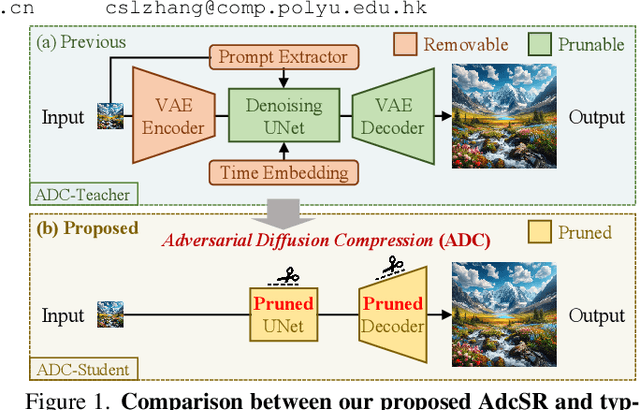
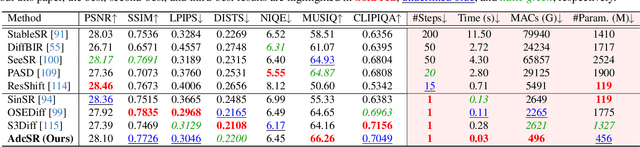
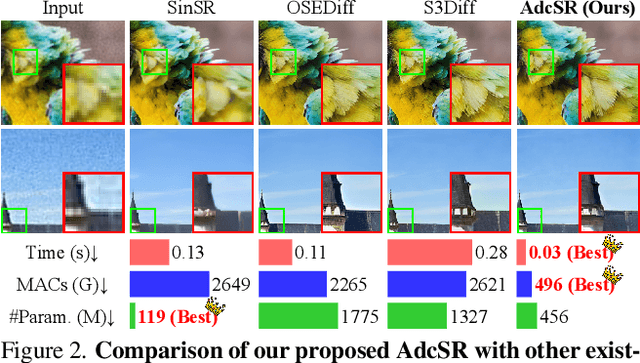
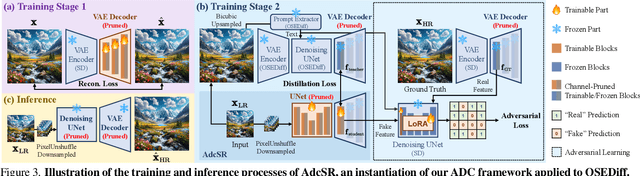
Real-world image super-resolution (Real-ISR) aims to reconstruct high-resolution images from low-resolution inputs degraded by complex, unknown processes. While many Stable Diffusion (SD)-based Real-ISR methods have achieved remarkable success, their slow, multi-step inference hinders practical deployment. Recent SD-based one-step networks like OSEDiff and S3Diff alleviate this issue but still incur high computational costs due to their reliance on large pretrained SD models. This paper proposes a novel Real-ISR method, AdcSR, by distilling the one-step diffusion network OSEDiff into a streamlined diffusion-GAN model under our Adversarial Diffusion Compression (ADC) framework. We meticulously examine the modules of OSEDiff, categorizing them into two types: (1) Removable (VAE encoder, prompt extractor, text encoder, etc.) and (2) Prunable (denoising UNet and VAE decoder). Since direct removal and pruning can degrade the model's generation capability, we pretrain our pruned VAE decoder to restore its ability to decode images and employ adversarial distillation to compensate for performance loss. This ADC-based diffusion-GAN hybrid design effectively reduces complexity by 73% in inference time, 78% in computation, and 74% in parameters, while preserving the model's generation capability. Experiments manifest that our proposed AdcSR achieves competitive recovery quality on both synthetic and real-world datasets, offering up to 9.3$\times$ speedup over previous one-step diffusion-based methods. Code and models will be made available.
Practical Compact Deep Compressed Sensing
Nov 20, 2024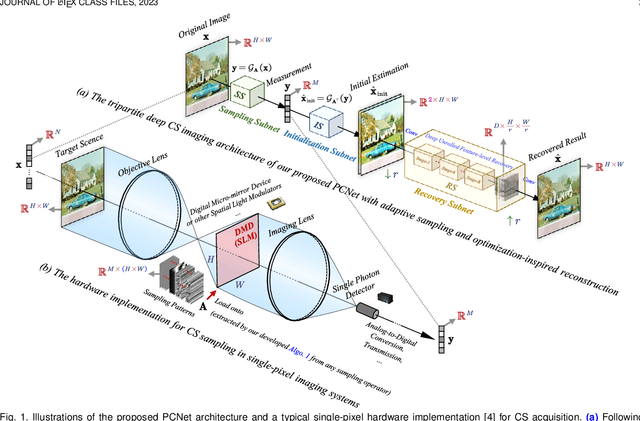
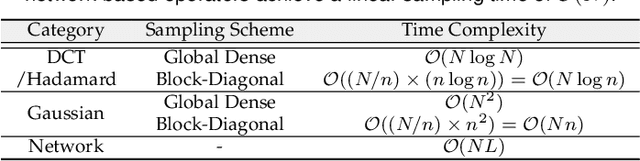
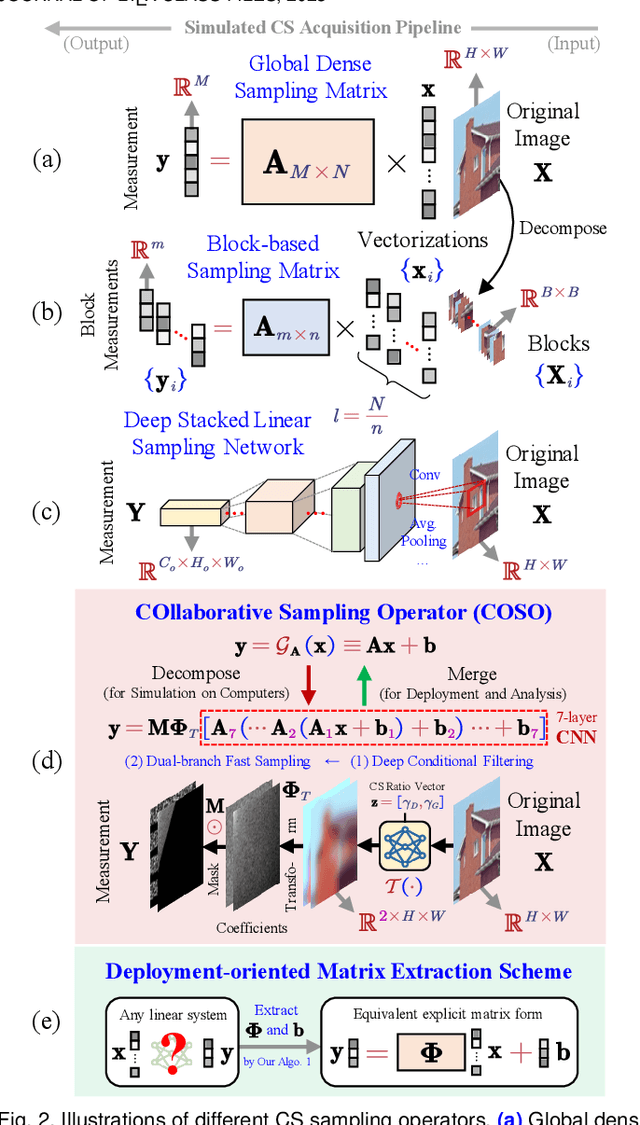
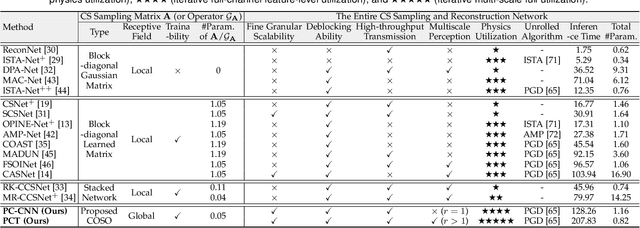
Recent years have witnessed the success of deep networks in compressed sensing (CS), which allows for a significant reduction in sampling cost and has gained growing attention since its inception. In this paper, we propose a new practical and compact network dubbed PCNet for general image CS. Specifically, in PCNet, a novel collaborative sampling operator is designed, which consists of a deep conditional filtering step and a dual-branch fast sampling step. The former learns an implicit representation of a linear transformation matrix into a few convolutions and first performs adaptive local filtering on the input image, while the latter then uses a discrete cosine transform and a scrambled block-diagonal Gaussian matrix to generate under-sampled measurements. Our PCNet is equipped with an enhanced proximal gradient descent algorithm-unrolled network for reconstruction. It offers flexibility, interpretability, and strong recovery performance for arbitrary sampling rates once trained. Additionally, we provide a deployment-oriented extraction scheme for single-pixel CS imaging systems, which allows for the convenient conversion of any linear sampling operator to its matrix form to be loaded onto hardware like digital micro-mirror devices. Extensive experiments on natural image CS, quantized CS, and self-supervised CS demonstrate the superior reconstruction accuracy and generalization ability of PCNet compared to existing state-of-the-art methods, particularly for high-resolution images. Code is available at https://github.com/Guaishou74851/PCNet.
HiCoM: Hierarchical Coherent Motion for Streamable Dynamic Scene with 3D Gaussian Splatting
Nov 12, 2024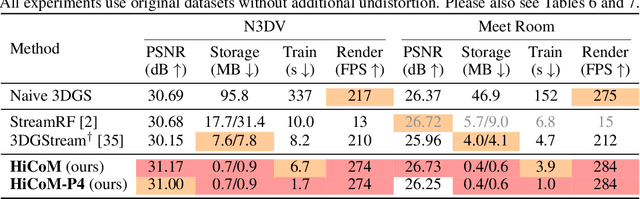
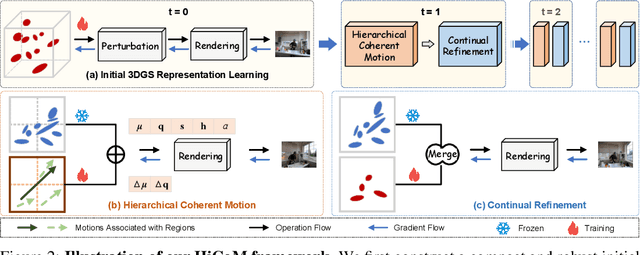
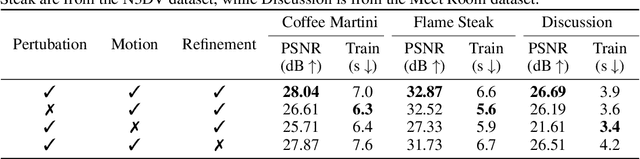
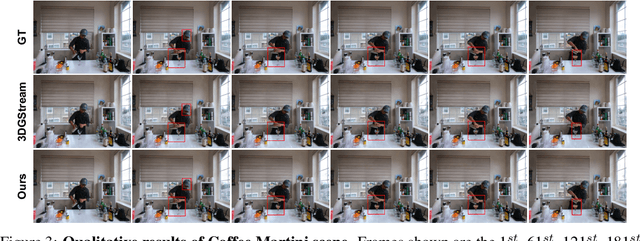
The online reconstruction of dynamic scenes from multi-view streaming videos faces significant challenges in training, rendering and storage efficiency. Harnessing superior learning speed and real-time rendering capabilities, 3D Gaussian Splatting (3DGS) has recently demonstrated considerable potential in this field. However, 3DGS can be inefficient in terms of storage and prone to overfitting by excessively growing Gaussians, particularly with limited views. This paper proposes an efficient framework, dubbed HiCoM, with three key components. First, we construct a compact and robust initial 3DGS representation using a perturbation smoothing strategy. Next, we introduce a Hierarchical Coherent Motion mechanism that leverages the inherent non-uniform distribution and local consistency of 3D Gaussians to swiftly and accurately learn motions across frames. Finally, we continually refine the 3DGS with additional Gaussians, which are later merged into the initial 3DGS to maintain consistency with the evolving scene. To preserve a compact representation, an equivalent number of low-opacity Gaussians that minimally impact the representation are removed before processing subsequent frames. Extensive experiments conducted on two widely used datasets show that our framework improves learning efficiency of the state-of-the-art methods by about $20\%$ and reduces the data storage by $85\%$, achieving competitive free-viewpoint video synthesis quality but with higher robustness and stability. Moreover, by parallel learning multiple frames simultaneously, our HiCoM decreases the average training wall time to $<2$ seconds per frame with negligible performance degradation, substantially boosting real-world applicability and responsiveness.
DIP: Diffusion Learning of Inconsistency Pattern for General DeepFake Detection
Oct 31, 2024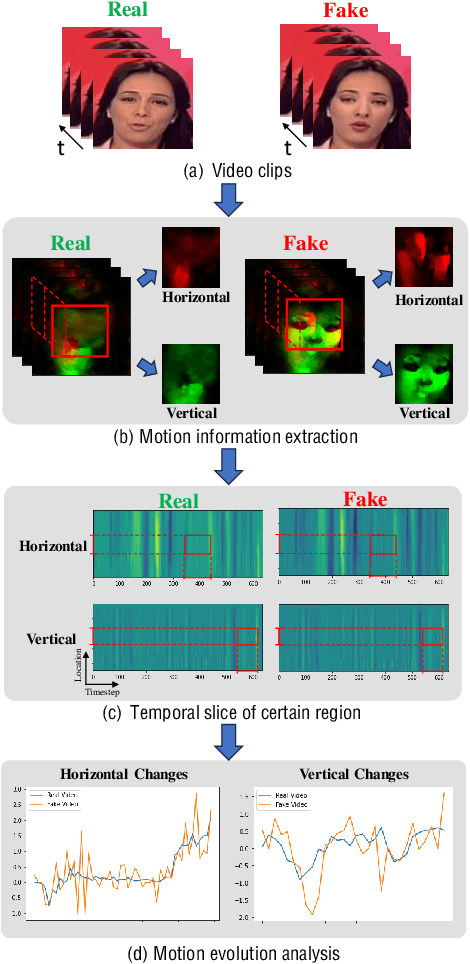
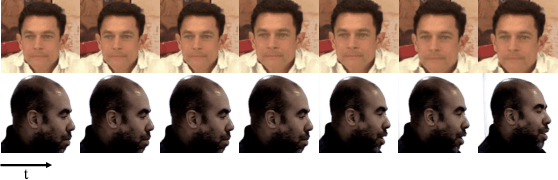
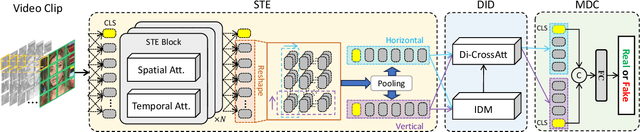
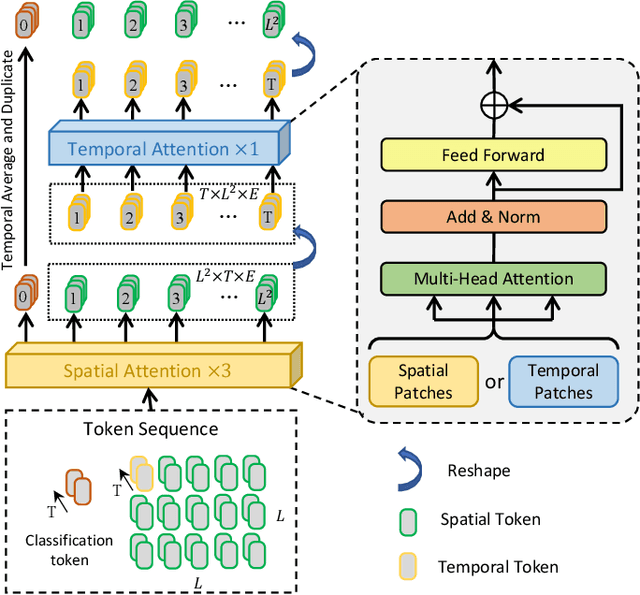
With the advancement of deepfake generation techniques, the importance of deepfake detection in protecting multimedia content integrity has become increasingly obvious. Recently, temporal inconsistency clues have been explored to improve the generalizability of deepfake video detection. According to our observation, the temporal artifacts of forged videos in terms of motion information usually exhibits quite distinct inconsistency patterns along horizontal and vertical directions, which could be leveraged to improve the generalizability of detectors. In this paper, a transformer-based framework for Diffusion Learning of Inconsistency Pattern (DIP) is proposed, which exploits directional inconsistencies for deepfake video detection. Specifically, DIP begins with a spatiotemporal encoder to represent spatiotemporal information. A directional inconsistency decoder is adopted accordingly, where direction-aware attention and inconsistency diffusion are incorporated to explore potential inconsistency patterns and jointly learn the inherent relationships. In addition, the SpatioTemporal Invariant Loss (STI Loss) is introduced to contrast spatiotemporally augmented sample pairs and prevent the model from overfitting nonessential forgery artifacts. Extensive experiments on several public datasets demonstrate that our method could effectively identify directional forgery clues and achieve state-of-the-art performance.
EMOTION: Expressive Motion Sequence Generation for Humanoid Robots with In-Context Learning
Oct 30, 2024


This paper introduces a framework, called EMOTION, for generating expressive motion sequences in humanoid robots, enhancing their ability to engage in humanlike non-verbal communication. Non-verbal cues such as facial expressions, gestures, and body movements play a crucial role in effective interpersonal interactions. Despite the advancements in robotic behaviors, existing methods often fall short in mimicking the diversity and subtlety of human non-verbal communication. To address this gap, our approach leverages the in-context learning capability of large language models (LLMs) to dynamically generate socially appropriate gesture motion sequences for human-robot interaction. We use this framework to generate 10 different expressive gestures and conduct online user studies comparing the naturalness and understandability of the motions generated by EMOTION and its human-feedback version, EMOTION++, against those by human operators. The results demonstrate that our approach either matches or surpasses human performance in generating understandable and natural robot motions under certain scenarios. We also provide design implications for future research to consider a set of variables when generating expressive robotic gestures.
Local Policies Enable Zero-shot Long-horizon Manipulation
Oct 29, 2024Sim2real for robotic manipulation is difficult due to the challenges of simulating complex contacts and generating realistic task distributions. To tackle the latter problem, we introduce ManipGen, which leverages a new class of policies for sim2real transfer: local policies. Locality enables a variety of appealing properties including invariances to absolute robot and object pose, skill ordering, and global scene configuration. We combine these policies with foundation models for vision, language and motion planning and demonstrate SOTA zero-shot performance of our method to Robosuite benchmark tasks in simulation (97%). We transfer our local policies from simulation to reality and observe they can solve unseen long-horizon manipulation tasks with up to 8 stages with significant pose, object and scene configuration variation. ManipGen outperforms SOTA approaches such as SayCan, OpenVLA, LLMTrajGen and VoxPoser across 50 real-world manipulation tasks by 36%, 76%, 62% and 60% respectively. Video results at https://mihdalal.github.io/manipgen/
Large Spatial Model: End-to-end Unposed Images to Semantic 3D
Oct 24, 2024


Reconstructing and understanding 3D structures from a limited number of images is a well-established problem in computer vision. Traditional methods usually break this task into multiple subtasks, each requiring complex transformations between different data representations. For instance, dense reconstruction through Structure-from-Motion (SfM) involves converting images into key points, optimizing camera parameters, and estimating structures. Afterward, accurate sparse reconstructions are required for further dense modeling, which is subsequently fed into task-specific neural networks. This multi-step process results in considerable processing time and increased engineering complexity. In this work, we present the Large Spatial Model (LSM), which processes unposed RGB images directly into semantic radiance fields. LSM simultaneously estimates geometry, appearance, and semantics in a single feed-forward operation, and it can generate versatile label maps by interacting with language at novel viewpoints. Leveraging a Transformer-based architecture, LSM integrates global geometry through pixel-aligned point maps. To enhance spatial attribute regression, we incorporate local context aggregation with multi-scale fusion, improving the accuracy of fine local details. To tackle the scarcity of labeled 3D semantic data and enable natural language-driven scene manipulation, we incorporate a pre-trained 2D language-based segmentation model into a 3D-consistent semantic feature field. An efficient decoder then parameterizes a set of semantic anisotropic Gaussians, facilitating supervised end-to-end learning. Extensive experiments across various tasks show that LSM unifies multiple 3D vision tasks directly from unposed images, achieving real-time semantic 3D reconstruction for the first time.
Enhancing LLM Agents for Code Generation with Possibility and Pass-rate Prioritized Experience Replay
Oct 16, 2024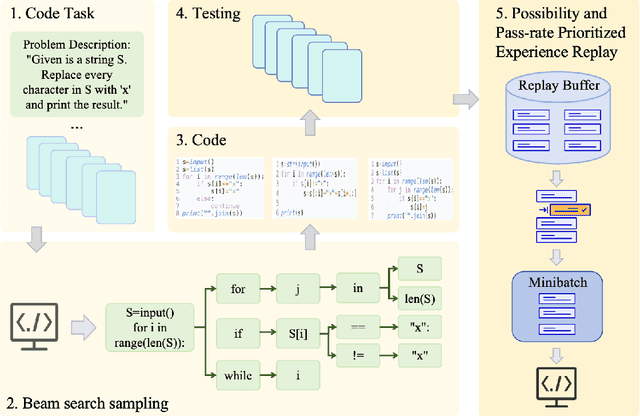
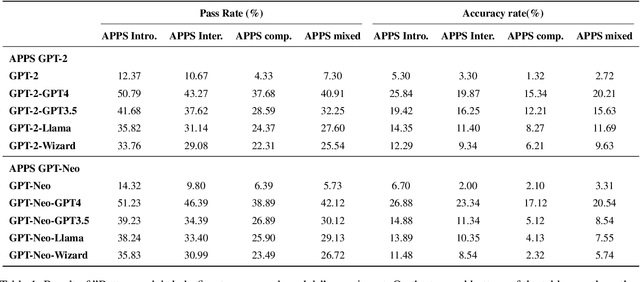

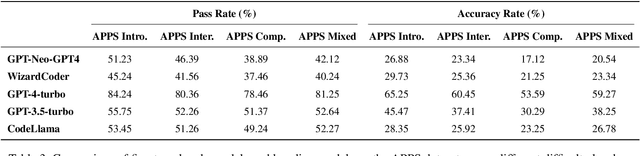
Nowadays transformer-based Large Language Models (LLM) for code generation tasks usually apply sampling and filtering pipelines. Due to the sparse reward problem in code generation tasks caused by one-token incorrectness, transformer-based models will sample redundant programs till they find a correct one, leading to low efficiency. To overcome the challenge, we incorporate Experience Replay (ER) in the fine-tuning phase, where codes and programs produced are stored and will be replayed to give the LLM agent a chance to learn from past experiences. Based on the spirit of ER, we introduce a novel approach called BTP pipeline which consists of three phases: beam search sampling, testing phase, and prioritized experience replay phase. The approach makes use of failed programs collected by code models and replays programs with high Possibility and Pass-rate Prioritized value (P2Value) from the replay buffer to improve efficiency. P2Value comprehensively considers the possibility of transformers' output and pass rate and can make use of the redundant resources caused by the problem that most programs collected by LLMs fail to pass any tests. We empirically apply our approach in several LLMs, demonstrating that it enhances their performance in code generation tasks and surpasses existing baselines.