 Add to Chrome
 Add to Firefox
 Add to Edge
MoMo: Dial Motion Mode in Robot Manipulation with Spatiotemporal Action Tokenization
Jul 28, 2026
To operate effectively across diverse contexts, robots must not only perform manipulation tasks accurately but also adapt how their actions unfold to the task, object, and interaction setting. We ask whether this execution-level variation can be learned as a reusable behavioral factor shared across tasks. We present \textbf{MoMo}, a two-stage imitation-learning framework consisting of a spatiotemporal action tokenizer and a behavior-cloning transformer that takes task and a continuous motion-mode condition as inputs. Across six real-robot manipulation tasks, varying this condition produces steady, dynamic, and intermediate behaviors that human raters can distinguish and that differ in joint speed, acceleration, and end-effector approach pitch. On tasks demonstrated in only one mode, MoMo transfers the unseen requested mode while largely preserving task success. Together, these results provide evidence of compositional generalization to unseen task--mode combinations and show that motion mode can be reused across tasks to control how a manipulation skill is performed.

EMOTION: Expressive Motion Sequence Generation for Humanoid Robots with In-Context Learning
Oct 30, 2024


This paper introduces a framework, called EMOTION, for generating expressive motion sequences in humanoid robots, enhancing their ability to engage in humanlike non-verbal communication. Non-verbal cues such as facial expressions, gestures, and body movements play a crucial role in effective interpersonal interactions. Despite the advancements in robotic behaviors, existing methods often fall short in mimicking the diversity and subtlety of human non-verbal communication. To address this gap, our approach leverages the in-context learning capability of large language models (LLMs) to dynamically generate socially appropriate gesture motion sequences for human-robot interaction. We use this framework to generate 10 different expressive gestures and conduct online user studies comparing the naturalness and understandability of the motions generated by EMOTION and its human-feedback version, EMOTION++, against those by human operators. The results demonstrate that our approach either matches or surpasses human performance in generating understandable and natural robot motions under certain scenarios. We also provide design implications for future research to consider a set of variables when generating expressive robotic gestures.
Privacy-Preserving Pose Estimation for Human-Robot Interaction
Nov 14, 2020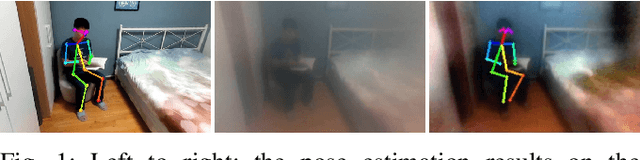
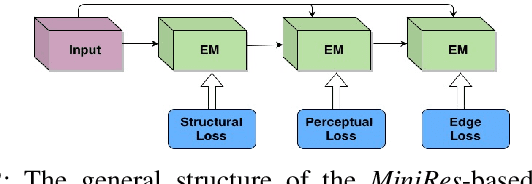

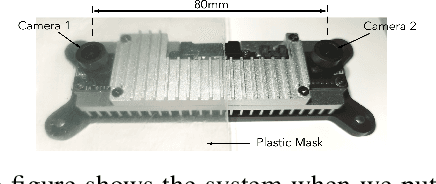
Pose estimation is an important technique for nonverbal human-robot interaction. That said, the presence of a camera in a person's space raises privacy concerns and could lead to distrust of the robot. In this paper, we propose a privacy-preserving camera-based pose estimation method. The proposed system consists of a user-controlled translucent filter that covers the camera and an image enhancement module designed to facilitate pose estimation from the filtered (shadow) images, while never capturing clear images of the user. We evaluate the system's performance on a new filtered image dataset, considering the effects of distance from the camera, background clutter, and film thickness. Based on our findings, we conclude that our system can protect humans' privacy while detecting humans' pose information effectively.