 Add to Chrome
 Add to Firefox
 Add to Edge
AgentCo-op: Retrieval-Based Synthesis of Interoperable Multi-Agent Workflows
May 19, 2026
Designing multi-agent workflows is especially difficult in open-ended scientific settings where tasks lack curated training sets, reliable scalar evaluation metrics, and standardized interfaces between existing tools and agents. We propose AgentCo-op, a retrieval-based synthesis framework that composes reusable skills, tools, and external agents into executable workflows through typed artifact handoffs, then applies bounded self-guided local repair to implicated components when execution evidence indicates failure. In two open-world genomics case studies, AgentCo-op composes independently developed scientific agents and external tool repositories into auditable workflows without redesigning them or running global topology search. It coordinates specialized agents for spatial transcriptomics and gene-set interpretation to enable collaborative discovery from spatial transcriptomics data, and builds a parallel workflow for cross-modality marker analysis on single-cell multiome data. AgentCo-op can also import a searched workflow as a structural prior and improve it by grounding nodes with retrieved components and applying local repair, showing that synthesis and search are complementary. On six coding, math, and question-answering benchmarks, AgentCo-op achieves the best result on four benchmarks and the best average score under a unified backbone setting, while consistently reducing per-task cost relative to multi-agent baselines. Together, these results suggest that retrieval-based synthesis can extend automated agentic workflow design beyond benchmark-optimized agent graphs to open-world workflows built from existing agents, tools, and typed artifacts.

expo: Exploration-prioritized policy optimization via adaptive kl regulation and gaussian curriculum sampling
May 11, 2026Reinforcement Learning with Verifiable Rewards (RLVR) has become the standard paradigm for LLM mathematical reasoning, where Group Relative Policy Optimization (GRPO) serves as the mainstream algorithm. We point out two understudied inefficiencies existing in GRPO. First, the fixed KL penalty coefficient overly restricts policy exploration at stages where the model requires significant deviation from the reference policy. Second, uniform sampling of training questions ignores that moderately difficult problems provide the most informative gradient signals for optimization. We propose Exploration-Prioritized Policy Optimization (EXPO) with two lightweight plug-in modules. The Accuracy-Conditioned KL Scaling (AKL) dynamically adjusts KL regularization strength through a smooth nonlinear function of batch average accuracy, relaxing the penalty when the model underperforms and strengthening it when the model achieves good results. The Gaussian Curriculum Sampling (GCS) assigns sampling weights to questions following a Gaussian distribution centered at moderate accuracy around 0.5, focusing training on the model's learning frontier. We conduct extensive experiments on DeepSeek-R1-Distill-Qwen-1.5B and Qwen3-8B-Base over six mathematical reasoning benchmarks. The results show EXPO steadily surpasses vanilla GRPO. It obtains an absolute gain of 13.34 on AIME 2025 pass@32, rising from 63.33 percent to 76.67 percent, and achieves an average pass@32 improvement of 2.66 on the 8B model. The much larger performance gains on pass@32 compared with pass@1 demonstrate that EXPO effectively enlarges the model's exploration boundary under a fixed inference cost budget.
SKILLFOUNDRY: Building Self-Evolving Agent Skill Libraries from Heterogeneous Scientific Resources
Apr 05, 2026Modern scientific ecosystems are rich in procedural knowledge across repositories, APIs, scripts, notebooks, documentation, databases, and papers, yet much of this knowledge remains fragmented across heterogeneous artifacts that agents cannot readily operationalize. This gap between abundant scientific know-how and usable agent capabilities is a key bottleneck for building effective scientific agents. We present SkillFoundry, a self-evolving framework that converts such resources into validated agent skills, reusable packages that encode task scope, inputs and outputs, execution steps, environment assumptions, provenance, and tests. SkillFoundry organizes a target domain as a domain knowledge tree, mines resources from high-value branches, extracts operational contracts, compiles them into executable skill packages, and then iteratively expands, repairs, merges, or prunes the resulting library through a closed-loop validation process. SkillFoundry produces a substantially novel and internally valid skill library, with 71.1\% of mined skills differing from existing skill libraries such as SkillHub and SkillSMP. We demonstrate that these mined skills improve coding agent performance on five of the six MoSciBench datasets. We further show that SkillFoundry can design new task-specific skills on demand for concrete scientific objectives, and that the resulting skills substantially improve performance on two challenging genomics tasks: cell type annotation and the scDRS workflow. Together, these results show that automatically mined skills improve agent performance on benchmarks and domain-specific tasks, expand coverage beyond hand-crafted skill libraries, and provide a practical foundation for more capable scientific agents.
CLEAR-Mamba:Towards Accurate, Adaptive and Trustworthy Multi-Sequence Ophthalmic Angiography Classification
Jan 28, 2026Medical image classification is a core task in computer-aided diagnosis (CAD), playing a pivotal role in early disease detection, treatment planning, and patient prognosis assessment. In ophthalmic practice, fluorescein fundus angiography (FFA) and indocyanine green angiography (ICGA) provide hemodynamic and lesion-structural information that conventional fundus photography cannot capture. However, due to the single-modality nature, subtle lesion patterns, and significant inter-device variability, existing methods still face limitations in generalization and high-confidence prediction. To address these challenges, we propose CLEAR-Mamba, an enhanced framework built upon MedMamba with optimizations in both architecture and training strategy. Architecturally, we introduce HaC, a hypernetwork-based adaptive conditioning layer that dynamically generates parameters according to input feature distributions, thereby improving cross-domain adaptability. From a training perspective, we develop RaP, a reliability-aware prediction scheme built upon evidential uncertainty learning, which encourages the model to emphasize low-confidence samples and improves overall stability and reliability. We further construct a large-scale ophthalmic angiography dataset covering both FFA and ICGA modalities, comprising multiple retinal disease categories for model training and evaluation. Experimental results demonstrate that CLEAR-Mamba consistently outperforms multiple baseline models, including the original MedMamba, across various metrics-showing particular advantages in multi-disease classification and reliability-aware prediction. This study provides an effective solution that balances generalizability and reliability for modality-specific medical image classification tasks.
Learning from Prompt itself: the Hierarchical Attribution Prompt Optimization
Jan 06, 2026Optimization is fundamental across numerous disciplines, typically following an iterative process of refining an initial solution to enhance performance. This principle is equally critical in prompt engineering, where designing effective prompts for large language models constitutes a complex optimization challenge. A structured optimization approach requires automated or semi-automated procedures to develop improved prompts, thereby reducing manual effort, improving performance, and yielding an interpretable process. However, current prompt optimization methods often induce prompt drift, where new prompts fix prior failures but impair performance on previously successful tasks. Additionally, generating prompts from scratch can compromise interpretability. To address these limitations, this study proposes the Hierarchical Attribution Prompt Optimization (HAPO) framework, which introduces three innovations: (1) a dynamic attribution mechanism targeting error patterns in training data and prompting history, (2) semantic-unit optimization for editing functional prompt segments, and (3) multimodal-friendly progression supporting both end-to-end LLM and LLM-MLLM workflows. Applied in contexts like single/multi-image QA (e.g., OCRV2) and complex task analysis (e.g., BBH), HAPO demonstrates enhanced optimization efficiency, outperforming comparable automated prompt optimization methods and establishing an extensible paradigm for scalable prompt engineering.
IKFST: IOO and KOO Algorithms for Accelerated and Precise WFST-based End-to-End Automatic Speech Recognition
Jan 01, 2026End-to-end automatic speech recognition has become the dominant paradigm in both academia and industry. To enhance recognition performance, the Weighted Finite-State Transducer (WFST) is widely adopted to integrate acoustic and language models through static graph composition, providing robust decoding and effective error correction. However, WFST decoding relies on a frame-by-frame autoregressive search over CTC posterior probabilities, which severely limits inference efficiency. Motivated by establishing a more principled compatibility between WFST decoding and CTC modeling, we systematically study the two fundamental components of CTC outputs, namely blank and non-blank frames, and identify a key insight: blank frames primarily encode positional information, while non-blank frames carry semantic content. Building on this observation, we introduce Keep-Only-One and Insert-Only-One, two decoding algorithms that explicitly exploit the structural roles of blank and non-blank frames to achieve significantly faster WFST-based inference without compromising recognition accuracy. Experiments on large-scale in-house, AISHELL-1, and LibriSpeech datasets demonstrate state-of-the-art recognition accuracy with substantially reduced decoding latency, enabling truly efficient and high-performance WFST decoding in modern speech recognition systems.
DICE: Discrete Interpretable Comparative Evaluation with Probabilistic Scoring for Retrieval-Augmented Generation
Dec 27, 2025As Retrieval-Augmented Generation (RAG) systems evolve toward more sophisticated architectures, ensuring their trustworthiness through explainable and robust evaluation becomes critical. Existing scalar metrics suffer from limited interpretability, inadequate uncertainty quantification, and computational inefficiency in multi-system comparisons, hindering responsible deployment of RAG technologies. We introduce DICE (Discrete Interpretable Comparative Evaluation), a two-stage, evidence-coupled framework that advances explainability and robustness in RAG evaluation. DICE combines deep analytical reasoning with probabilistic $\{A, B, Tie\}$ scoring to produce transparent, confidence-aware judgments that support accountable system improvement through interpretable reasoning traces, enabling systematic error diagnosis and actionable insights. To address efficiency challenges at scale, DICE employs a Swiss-system tournament that reduces computational complexity from $O(N^2)$ to $O(N \log N)$, achieving a 42.9% reduction in our eight-system evaluation while preserving ranking fidelity. Validation on a curated Chinese financial QA dataset demonstrates that DICE achieves 85.7% agreement with human experts, substantially outperforming existing LLM-based metrics such as RAGAS. Our results establish DICE as a responsible, explainable, and efficient paradigm for trustworthy RAG system assessment.
DyCrowd: Towards Dynamic Crowd Reconstruction from a Large-scene Video
Aug 18, 20253D reconstruction of dynamic crowds in large scenes has become increasingly important for applications such as city surveillance and crowd analysis. However, current works attempt to reconstruct 3D crowds from a static image, causing a lack of temporal consistency and inability to alleviate the typical impact caused by occlusions. In this paper, we propose DyCrowd, the first framework for spatio-temporally consistent 3D reconstruction of hundreds of individuals' poses, positions and shapes from a large-scene video. We design a coarse-to-fine group-guided motion optimization strategy for occlusion-robust crowd reconstruction in large scenes. To address temporal instability and severe occlusions, we further incorporate a VAE (Variational Autoencoder)-based human motion prior along with a segment-level group-guided optimization. The core of our strategy leverages collective crowd behavior to address long-term dynamic occlusions. By jointly optimizing the motion sequences of individuals with similar motion segments and combining this with the proposed Asynchronous Motion Consistency (AMC) loss, we enable high-quality unoccluded motion segments to guide the motion recovery of occluded ones, ensuring robust and plausible motion recovery even in the presence of temporal desynchronization and rhythmic inconsistencies. Additionally, in order to fill the gap of no existing well-annotated large-scene video dataset, we contribute a virtual benchmark dataset, VirtualCrowd, for evaluating dynamic crowd reconstruction from large-scene videos. Experimental results demonstrate that the proposed method achieves state-of-the-art performance in the large-scene dynamic crowd reconstruction task. The code and dataset will be available for research purposes.
X2Edit: Revisiting Arbitrary-Instruction Image Editing through Self-Constructed Data and Task-Aware Representation Learning
Aug 11, 2025Existing open-source datasets for arbitrary-instruction image editing remain suboptimal, while a plug-and-play editing module compatible with community-prevalent generative models is notably absent. In this paper, we first introduce the X2Edit Dataset, a comprehensive dataset covering 14 diverse editing tasks, including subject-driven generation. We utilize the industry-leading unified image generation models and expert models to construct the data. Meanwhile, we design reasonable editing instructions with the VLM and implement various scoring mechanisms to filter the data. As a result, we construct 3.7 million high-quality data with balanced categories. Second, to better integrate seamlessly with community image generation models, we design task-aware MoE-LoRA training based on FLUX.1, with only 8\% of the parameters of the full model. To further improve the final performance, we utilize the internal representations of the diffusion model and define positive/negative samples based on image editing types to introduce contrastive learning. Extensive experiments demonstrate that the model's editing performance is competitive among many excellent models. Additionally, the constructed dataset exhibits substantial advantages over existing open-source datasets. The open-source code, checkpoints, and datasets for X2Edit can be found at the following link: https://github.com/OPPO-Mente-Lab/X2Edit.
RESCUE: Crowd Evacuation Simulation via Controlling SDM-United Characters
Jul 27, 2025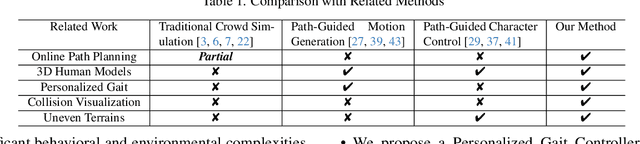
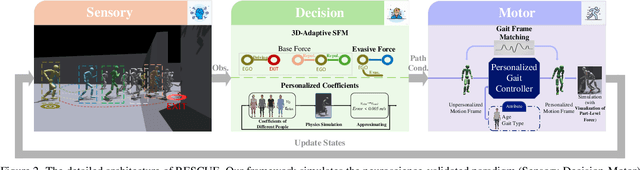
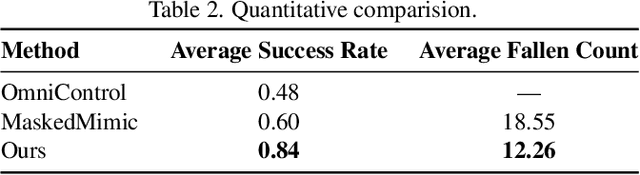
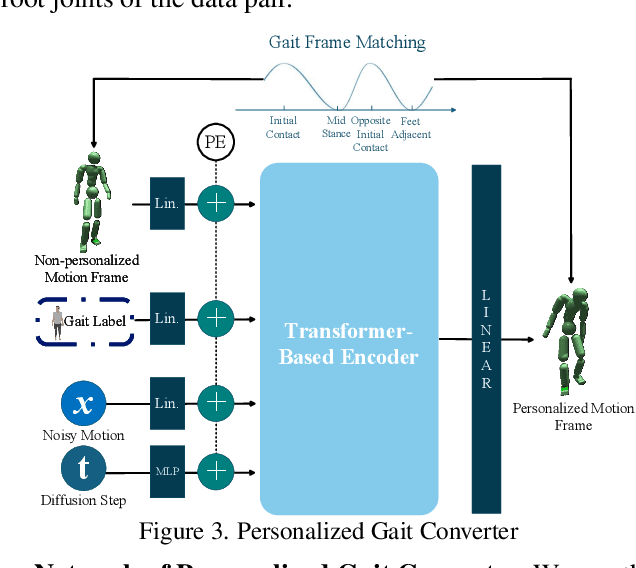
Crowd evacuation simulation is critical for enhancing public safety, and demanded for realistic virtual environments. Current mainstream evacuation models overlook the complex human behaviors that occur during evacuation, such as pedestrian collisions, interpersonal interactions, and variations in behavior influenced by terrain types or individual body shapes. This results in the failure to accurately simulate the escape of people in the real world. In this paper, aligned with the sensory-decision-motor (SDM) flow of the human brain, we propose a real-time 3D crowd evacuation simulation framework that integrates a 3D-adaptive SFM (Social Force Model) Decision Mechanism and a Personalized Gait Control Motor. This framework allows multiple agents to move in parallel and is suitable for various scenarios, with dynamic crowd awareness. Additionally, we introduce Part-level Force Visualization to assist in evacuation analysis. Experimental results demonstrate that our framework supports dynamic trajectory planning and personalized behavior for each agent throughout the evacuation process, and is compatible with uneven terrain. Visually, our method generates evacuation results that are more realistic and plausible, providing enhanced insights for crowd simulation. The code is available at http://cic.tju.edu.cn/faculty/likun/projects/RESCUE.