 Add to Chrome
 Add to Firefox
 Add to Edge
Can Dialects Be Steered Like Languages? Sparse Neurons and Distributed Directions in Arabic LLMs
Jul 04, 2026
A key challenge in Arabic NLP is the scarcity of dialectal data relative to Modern Standard Arabic (MSA), causing LLMs to overproduce MSA and struggle with dialectally accurate generation. From an interpretability perspective, this raises a fundamental question: where and how are dialectal features encoded within model internals, and can these representations be leveraged to improve dialect generation without fine-tuning? This study investigates two complementary inference-time approaches that serve simultaneously as interpretability probes and control mechanisms. First, we conduct a neuron-level analysis, identifying sparse neuron populations that encode dialect-specific features and showing that amplifying or suppressing these neurons can steer model outputs toward target dialects. Second, motivated by the entanglement of dialectal features at the single-neuron level, we apply a vector-steering approach that extracts dialect-specific activation directions and injects them during inference. Together, these methods illuminate the geometry of dialectal knowledge in Arabic LLMs and offer a principled, interpretability-grounded framework for dialect control without requiring dialect-specific fine-tuning.

Is Human-Like Text Liked by Humans? Multilingual Human Detection and Preference Against AI
Feb 17, 2025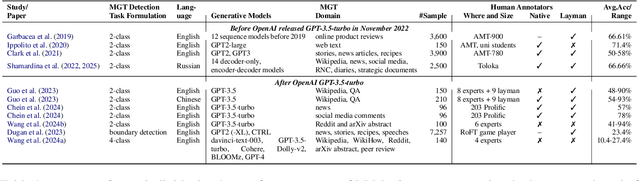
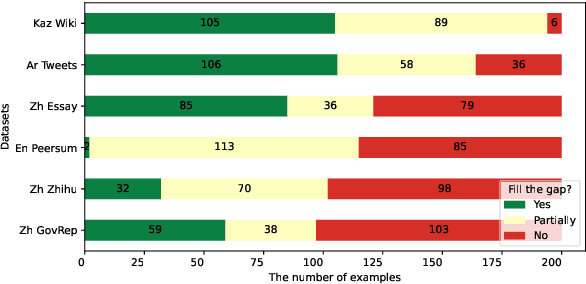
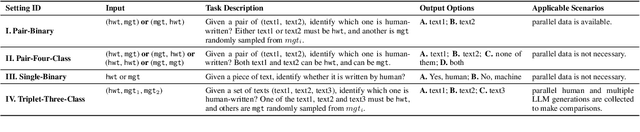
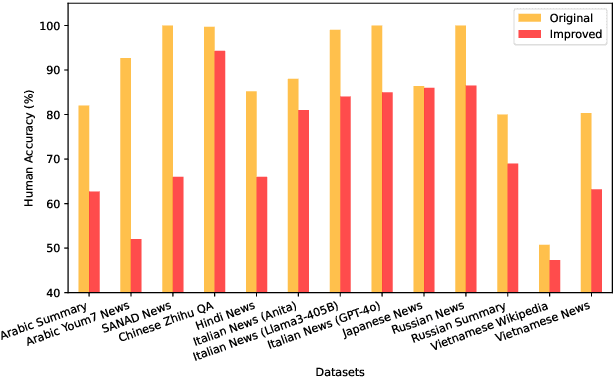
Prior studies have shown that distinguishing text generated by large language models (LLMs) from human-written one is highly challenging, and often no better than random guessing. To verify the generalizability of this finding across languages and domains, we perform an extensive case study to identify the upper bound of human detection accuracy. Across 16 datasets covering 9 languages and 9 domains, 19 annotators achieved an average detection accuracy of 87.6%, thus challenging previous conclusions. We find that major gaps between human and machine text lie in concreteness, cultural nuances, and diversity. Prompting by explicitly explaining the distinctions in the prompts can partially bridge the gaps in over 50% of the cases. However, we also find that humans do not always prefer human-written text, particularly when they cannot clearly identify its source.
LLM-DetectAIve: a Tool for Fine-Grained Machine-Generated Text Detection
Aug 08, 2024


The widespread accessibility of large language models (LLMs) to the general public has significantly amplified the dissemination of machine-generated texts (MGTs). Advancements in prompt manipulation have exacerbated the difficulty in discerning the origin of a text (human-authored vs machinegenerated). This raises concerns regarding the potential misuse of MGTs, particularly within educational and academic domains. In this paper, we present $\textbf{LLM-DetectAIve}$ -- a system designed for fine-grained MGT detection. It is able to classify texts into four categories: human-written, machine-generated, machine-written machine-humanized, and human-written machine-polished. Contrary to previous MGT detectors that perform binary classification, introducing two additional categories in LLM-DetectiAIve offers insights into the varying degrees of LLM intervention during the text creation. This might be useful in some domains like education, where any LLM intervention is usually prohibited. Experiments show that LLM-DetectAIve can effectively identify the authorship of textual content, proving its usefulness in enhancing integrity in education, academia, and other domains. LLM-DetectAIve is publicly accessible at https://huggingface.co/spaces/raj-tomar001/MGT-New. The video describing our system is available at https://youtu.be/E8eT_bE7k8c.