 Add to Chrome
 Add to Firefox
 Add to Edge
SciText2Eq: Assessing LLMs for Explainable Equation Generation for Scientific Creativity
Jun 14, 2026
This work investigates the ability of large language models (LLMs) to generate mathematical equations from scientific texts. Prior work faces challenges in unstructured grounding, multi-equation dependency, and humanaligned evaluation. To this end, we construct a dataset of AI research papers, pairing contextual passages with ground-truth equations and variable descriptions. We develop an explainable equation generation workflow and evaluate it across diverse open- and closed-source LLM backbones. We introduce an evaluation protocol combining automatic metrics, LLM-based rubrics, and human judgments to assess accuracy, explainability, and human-LLM alignment. Results indicate that LLMs perform moderately on lexical- and syntactic-based similarity, while struggling with semantic accuracy. Comparisons between LLM-based evaluations and human judgments reveal limited alignment, highlighting challenges in using LLMs to assess equation quality. These findings offer insights for improving equation generation models and developing more reliable evaluation methods for scientific text. We provide code and data for reproducibility.

IdioLink: Retrieving Meaning Beyond Words Across Idiomatic and Literal Expressions
May 21, 2026Idioms pose a fundamental challenge for language models, as their meaning cannot be inferred from surface form alone. Understanding such expressions, therefore, requires semantic abstraction beyond lexical overlap. We introduce IdioLink, a retrieval benchmark designed to test whether models can link idiomatic expressions to conceptually equivalent meanings expressed in literal or paraphrased forms. IdioLink comprises 10,700 documents and 2,140 queries, spanning 107 idioms with both literal and figurative uses. Each document and query is annotated with spans that convey the core meaning. Evaluating strong embedding baselines (e.g., BGE, E5, Contriever, and Qwen), we show that current models struggle to retrieve equivalent meanings across divergent surface realizations, relying instead on topical and shallow semantic cues. IdioLink exposes key gaps in idiom-aware semantic retrieval and provides a challenging testbed for future models.
Herculean: An Agentic Benchmark for Financial Intelligence
May 14, 2026As AI agents improve, the central question is no longer whether they can solve isolated well-defined financial tasks, but whether they can reliably carry out financial professional work. Existing financial benchmarks offer only a partial view of this ability, as they primarily evaluate static competencies such as question answering, retrieval, summarization, and classification. We introduce Herculean, the first skilled benchmark for agentic financial intelligence spanning four representative workflows, including Trading, Hedging, Market Insights, and Auditing. Each workflow is instantiated as a standardized MCP-based skill environment with its own tools, interaction dynamics, constraints, and success criteria, enabling consistent end-to-end assessment of heterogeneous agent systems. Across frontier agents, we find agents perform relatively well on Trading and Market Insights, but struggle substantially on Hedging and Auditing, where long-horizon coordination, state consistency, and structured verification are critical. Overall, our results point to a key gap in current agents in turning financial reasoning into dependable workflow execution in high-stakes financial workflows.
Aligning Human-AI-Interaction Trust for Mental Health Support: Survey and Position for Multi-Stakeholders
Apr 22, 2026Building trustworthy AI systems for mental health support is a shared priority across stakeholders from multiple disciplines. However, "trustworthy" remains loosely defined and inconsistently operationalized. AI research often focuses on technical criteria (e.g., robustness, explainability, and safety), while therapeutic practitioners emphasize therapeutic fidelity (e.g., appropriateness, empathy, and long-term user outcomes). To bridge the fragmented landscape, we propose a three-layer trust framework, covering human-oriented, AI-oriented, and interaction-oriented trust, integrating the viewpoints of key stakeholders (e.g., practitioners, researchers, regulators). Using this framework, we systematically review existing AI-driven research in mental health domain and examine evaluation practices for ``trustworthy'' ranging from automatic metrics to clinically validated approaches. We highlight critical gaps between what NLP currently measures and what real-world mental health contexts require, and outline a research agenda for building socio-technically aligned and genuinely trustworthy AI for mental health support.
NeuroWise: A Multi-Agent LLM "Glass-Box" System for Practicing Double-Empathy Communication with Autistic Partners
Feb 21, 2026The double empathy problem frames communication difficulties between neurodivergent and neurotypical individuals as arising from mutual misunderstanding, yet most interventions focus on autistic individuals. We present NeuroWise, a multi-agent LLM-based coaching system that supports neurotypical users through stress visualization, interpretation of internal experiences, and contextual guidance. In a between-subjects study (N=30), NeuroWise was rated as helpful by all participants and showed a significant condition-time effect on deficit-based attributions (p=0.02): NeuroWise users reduced deficit framing, while baseline users shifted toward blaming autistic "deficits" after difficult interactions. NeuroWise users also completed conversations more efficiently (37% fewer turns, p=0.03). These findings suggest that AI-based interpretation can support attributional change by helping users recognize communication challenges as mutual.
MultiJustice: A Chinese Dataset for Multi-Party, Multi-Charge Legal Prediction
Jul 09, 2025Legal judgment prediction offers a compelling method to aid legal practitioners and researchers. However, the research question remains relatively under-explored: Should multiple defendants and charges be treated separately in LJP? To address this, we introduce a new dataset namely multi-person multi-charge prediction (MPMCP), and seek the answer by evaluating the performance of several prevailing legal large language models (LLMs) on four practical legal judgment scenarios: (S1) single defendant with a single charge, (S2) single defendant with multiple charges, (S3) multiple defendants with a single charge, and (S4) multiple defendants with multiple charges. We evaluate the dataset across two LJP tasks, i.e., charge prediction and penalty term prediction. We have conducted extensive experiments and found that the scenario involving multiple defendants and multiple charges (S4) poses the greatest challenges, followed by S2, S3, and S1. The impact varies significantly depending on the model. For example, in S4 compared to S1, InternLM2 achieves approximately 4.5% lower F1-score and 2.8% higher LogD, while Lawformer demonstrates around 19.7% lower F1-score and 19.0% higher LogD. Our dataset and code are available at https://github.com/lololo-xiao/MultiJustice-MPMCP.
Script-Strategy Aligned Generation: Aligning LLMs with Expert-Crafted Dialogue Scripts and Therapeutic Strategies for Psychotherapy
Nov 11, 2024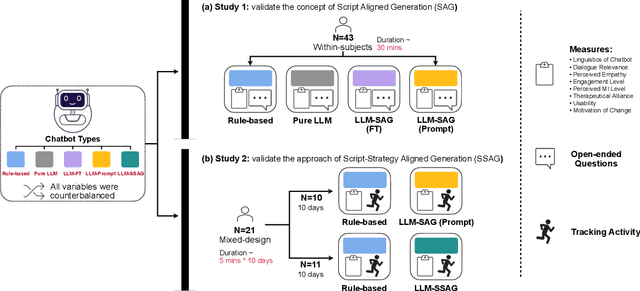
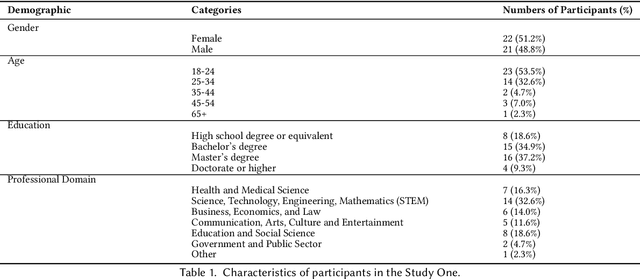
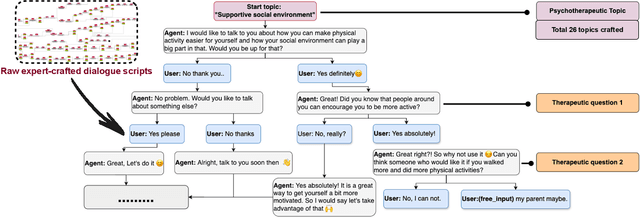
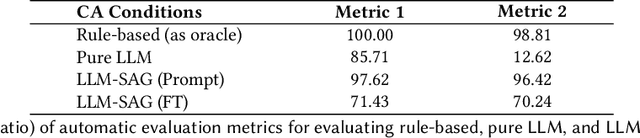
Chatbots or conversational agents (CAs) are increasingly used to improve access to digital psychotherapy. Many current systems rely on rigid, rule-based designs, heavily dependent on expert-crafted dialogue scripts for guiding therapeutic conversations. Although recent advances in large language models (LLMs) offer the potential for more flexible interactions, their lack of controllability and transparency poses significant challenges in sensitive areas like psychotherapy. In this work, we explored how aligning LLMs with expert-crafted scripts can enhance psychotherapeutic chatbot performance. Our comparative study showed that LLMs aligned with expert-crafted scripts through prompting and fine-tuning significantly outperformed both pure LLMs and rule-based chatbots, achieving a more effective balance between dialogue flexibility and adherence to therapeutic principles. Building on findings, we proposed ``Script-Strategy Aligned Generation (SSAG)'', a flexible alignment approach that reduces reliance on fully scripted content while enhancing LLMs' therapeutic adherence and controllability. In a 10-day field study, SSAG demonstrated performance comparable to full script alignment and outperformed rule-based chatbots, empirically supporting SSAG as an efficient approach for aligning LLMs with domain expertise. Our work advances LLM applications in psychotherapy by providing a controllable, adaptable, and scalable solution for digital interventions, reducing reliance on expert effort. It also provides a collaborative framework for domain experts and developers to efficiently build expertise-aligned chatbots, broadening access to psychotherapy and behavioral interventions.
A Comparative Analysis of Faithfulness Metrics and Humans in Citation Evaluation
Aug 22, 2024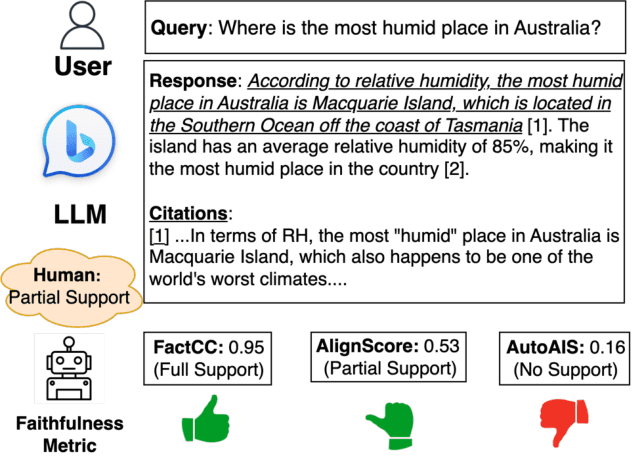
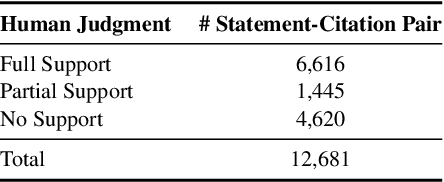
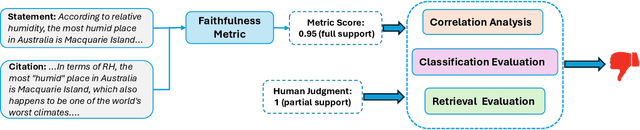
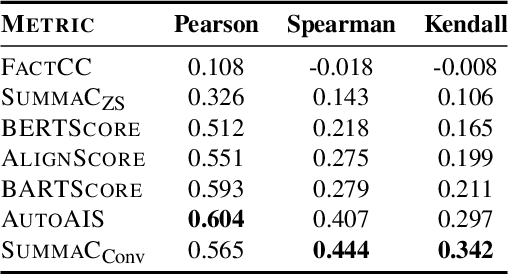
Large language models (LLMs) often generate content with unsupported or unverifiable content, known as "hallucinations." To address this, retrieval-augmented LLMs are employed to include citations in their content, grounding the content in verifiable sources. Despite such developments, manually assessing how well a citation supports the associated statement remains a major challenge. Previous studies tackle this challenge by leveraging faithfulness metrics to estimate citation support automatically. However, they limit this citation support estimation to a binary classification scenario, neglecting fine-grained citation support in practical scenarios. To investigate the effectiveness of faithfulness metrics in fine-grained scenarios, we propose a comparative evaluation framework that assesses the metric effectiveness in distinguishing citations between three-category support levels: full, partial, and no support. Our framework employs correlation analysis, classification evaluation, and retrieval evaluation to measure the alignment between metric scores and human judgments comprehensively. Our results indicate no single metric consistently excels across all evaluations, highlighting the complexity of accurately evaluating fine-grained support levels. Particularly, we find that the best-performing metrics struggle to distinguish partial support from full or no support. Based on these findings, we provide practical recommendations for developing more effective metrics.
Chain-of-Strategy Planning with LLMs: Aligning the Generation of Psychotherapy Dialogue with Strategy in Motivational Interviewing
Aug 12, 2024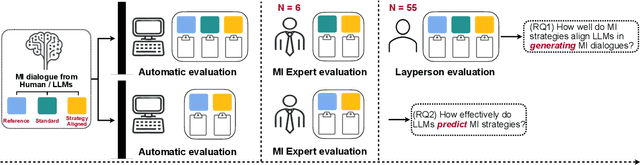
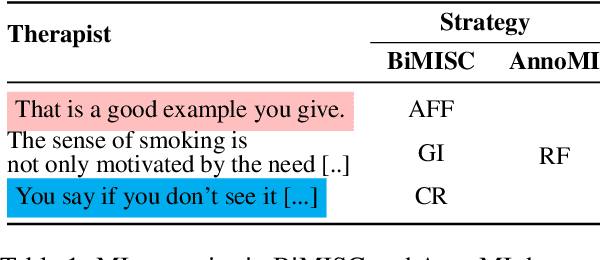
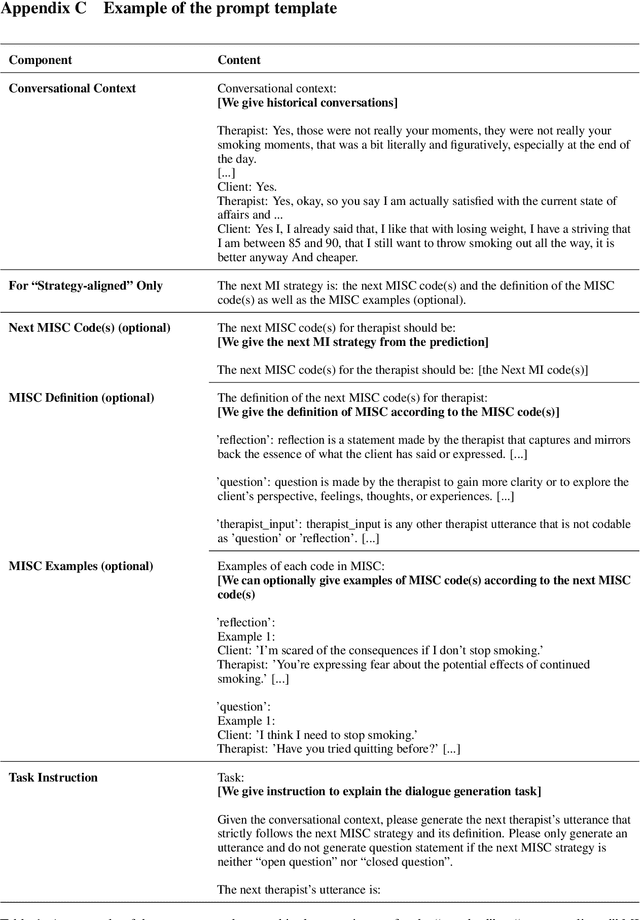
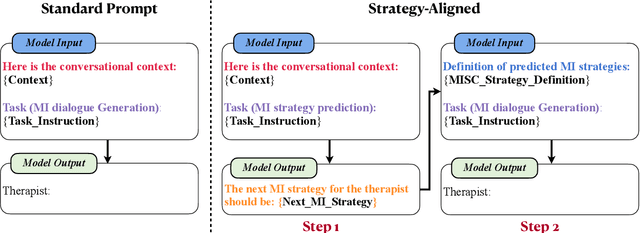
Recent advancements in large language models (LLMs) have shown promise in generating psychotherapeutic dialogues, especially in Motivational Interviewing (MI). However, how to employ strategies, a set of motivational interviewing (MI) skills, to generate therapeutic-adherent conversations with explainability is underexplored. We propose an approach called strategy-aware dialogue generation with Chain-of-Strategy (CoS) planning, which first predicts MI strategies as reasoning and utilizes these strategies to guide the subsequent dialogue generation. It brings the potential for controllable and explainable generation in psychotherapy by aligning the generated MI dialogues with therapeutic strategies. Extensive experiments including automatic and human evaluations are conducted to validate the effectiveness of the MI strategy. Our findings demonstrate the potential of LLMs in producing strategically aligned dialogues and suggest directions for practical applications in psychotherapeutic settings.
Assessing "Implicit" Retrieval Robustness of Large Language Models
Jun 26, 2024

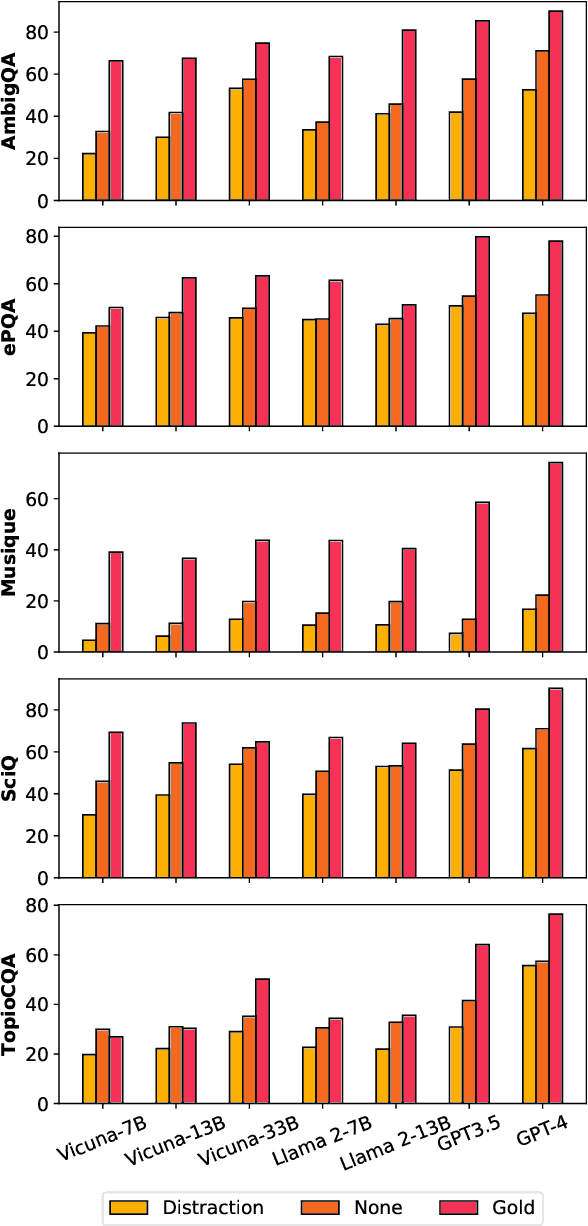
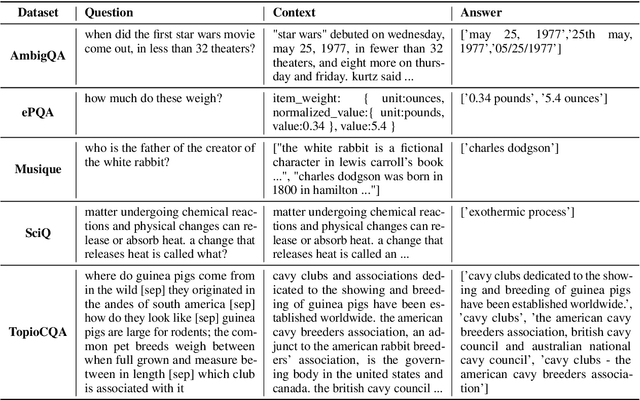
Retrieval-augmented generation has gained popularity as a framework to enhance large language models with external knowledge. However, its effectiveness hinges on the retrieval robustness of the model. If the model lacks retrieval robustness, its performance is constrained by the accuracy of the retriever, resulting in significant compromises when the retrieved context is irrelevant. In this paper, we evaluate the "implicit" retrieval robustness of various large language models, instructing them to directly output the final answer without explicitly judging the relevance of the retrieved context. Our findings reveal that fine-tuning on a mix of gold and distracting context significantly enhances the model's robustness to retrieval inaccuracies, while still maintaining its ability to extract correct answers when retrieval is accurate. This suggests that large language models can implicitly handle relevant or irrelevant retrieved context by learning solely from the supervision of the final answer in an end-to-end manner. Introducing an additional process for explicit relevance judgment can be unnecessary and disrupts the end-to-end approach.