 Add to Chrome
 Add to Firefox
 Add to Edge
An Agentic Generative Large Language Model for Treatment Planning of Colorectal Cancer
Aug 10, 2026
Treatment planning in precision oncology requires synthesizing heterogeneous patient information with rapidly evolving clinical guidelines to ensure guideline-concordant care. While large language models (LLMs) show promise in many diagnostic tasks, their adoption for high-stakes treatment planning is hindered by complex reasoning, adherence to timely clinical guidelines, and safety concerns. In this study, we present GatorOnco, an agentic LLM for colorectal cancer (CRC) treatment planning. GatorOnco is developed using a total of 282 billion tokens of biomedical text, including healthcare system-scale clinical text comprising 166 billion tokens from UF Health. We implemented a domain-adaptation method that integrates pre-training, model merging, a two-stage post-training approach, and agent-based reinforcement learning. An agentic retrieval-augmented generation (RAG) approach dynamically integrates time-sensitive clinical guidelines into the reasoning process. In a blind, randomized clinical evaluation conducted by five UF Health oncologists, GatorOnco significantly outperformed open-source LLMs (P < 0.01) and achieved expert-level performance comparable to UF Health oncologists. Compared with expert oncologists, GatorOnco received significantly higher ratings for readability (4.46 vs. 4.19, P < 0.01) and completeness (3.91 vs. 3.52, P < 0.01), while showing statistically comparable performance in correctness (4.09 vs. 4.11, P = 0.921), currency (4.04 vs. 3.98, P = 0.478), and safety (4.22 vs. 4.22, P = 0.999). These findings demonstrate that integrating agentic reasoning with large-scale domain adaptation can help bridge the gap for generative AI in high-stakes cancer treatment planning.

G-ReAct: Graph-Guided Deep Search via Structure-State Co-Evolution
Aug 02, 2026Deep search has become a fundamental capability of large language models (LLMs) for solving open-domain complex tasks. However, existing approaches typically rely on linear sequential reasoning for both trajectory generation and inference, making it difficult to consistently preserve intermediate states and constraints throughout long-horizon multi-hop search. Consequently, they often suffer from context forgetting, search drift, and inefficient exploration. To address these limitations, we propose $\textbf{G-ReAct}$, a reasoning framework for deep search that organizes reasoning as $\textbf{state evolution over a fixed-topology query graph}$. The evolving graph state explicitly tracks search progress and guides subsequent decisions, transforming exploratory search driven by textual history into graph-guided reasoning under explicit constraints. G-ReAct supports both training and inference: it generates high-quality deep-search trajectories for supervised fine-tuning and provides structured guidance for inference-time search without additional fine-tuning. Experiments demonstrate that with only 1.9K generated trajectories for fine-tuning, Qwen3-30B-A3B-Thinking-2507 achieves $52.6\%$ accuracy on BrowseComp-ZH and $79.0\%$ on XBench, outperforming comparable open-source methods trained on substantially larger datasets, including RL-enhanced methods. Furthermore, when applied at inference time, G-ReAct consistently improves the performance of existing strong LLMs on deep-search tasks. We will publicly release all code and model weights.
MemReranker: Reasoning-Aware Reranking for Agent Memory Retrieval
May 07, 2026In agent memory systems, the reranking model serves as the critical bridge connecting user queries with long-term memory. Most systems adopt the "retrieve-then-rerank" two-stage paradigm, but generic reranking models rely on semantic similarity matching and lack genuine reasoning capabilities, leading to a problem where recalled results are semantically highly relevant yet do not contain the key information needed to answer the question. This deficiency manifests in memory scenarios as three specific problems. First, relevance scores are miscalibrated, making threshold-based filtering difficult. Second, ranking degrades when facing temporal constraints, causal reasoning, and other complex queries. Third, the model cannot leverage dialogue context for semantic disambiguation. This report introduces MemReranker, a reranking model family (0.6B/4B) built on Qwen3-Reranker through multi-stage LLM knowledge distillation. Multi-teacher pairwise comparisons generate calibrated soft labels, BCE pointwise distillation establishes well-distributed scores, and InfoNCE contrastive learning enhances hard-sample discrimination. Training data combines general corpora with memory-specific multi-turn dialogue data covering temporal constraints, causal reasoning, and coreference resolution. On the memory retrieval benchmark, MemReranker-0.6B substantially outperforms BGE-Reranker and matches open-source 4B/8B models as well as GPT-4o-mini on key metrics. MemReranker-4B further achieves 0.737 MAP, with several metrics on par with Gemini-3-Flash, while maintaining inference latency at only 10--20\% of large models. On finance and healthcare vertical-domain benchmarks, the models preserve generalization capabilities on par with mainstream large-parameter rerankers.
Aligning Human-AI-Interaction Trust for Mental Health Support: Survey and Position for Multi-Stakeholders
Apr 22, 2026Building trustworthy AI systems for mental health support is a shared priority across stakeholders from multiple disciplines. However, "trustworthy" remains loosely defined and inconsistently operationalized. AI research often focuses on technical criteria (e.g., robustness, explainability, and safety), while therapeutic practitioners emphasize therapeutic fidelity (e.g., appropriateness, empathy, and long-term user outcomes). To bridge the fragmented landscape, we propose a three-layer trust framework, covering human-oriented, AI-oriented, and interaction-oriented trust, integrating the viewpoints of key stakeholders (e.g., practitioners, researchers, regulators). Using this framework, we systematically review existing AI-driven research in mental health domain and examine evaluation practices for ``trustworthy'' ranging from automatic metrics to clinically validated approaches. We highlight critical gaps between what NLP currently measures and what real-world mental health contexts require, and outline a research agenda for building socio-technically aligned and genuinely trustworthy AI for mental health support.
Detecting HIV-Related Stigma in Clinical Narratives Using Large Language Models
Apr 09, 2026Human immunodeficiency virus (HIV)-related stigma is a critical psychosocial determinant of health for people living with HIV (PLWH), influencing mental health, engagement in care, and treatment outcomes. Although stigma-related experiences are documented in clinical narratives, there is a lack of off-the-shelf tools to extract and categorize them. This study aims to develop a large language model (LLM)-based tool for identifying HIV stigma from clinical notes. We identified clinical notes from PLWH receiving care at the University of Florida (UF) Health between 2012 and 2022. Candidate sentences were identified using expert-curated stigma-related keywords and iteratively expanded via clinical word embeddings. A total of 1,332 sentences were manually annotated across four stigma subscales: Concern with Public Attitudes, Disclosure Concerns, Negative Self-Image, and Personalized Stigma. We compared GatorTron-large and BERT as encoder-based baselines, and GPT-OSS-20B, LLaMA-8B, and MedGemma-27B as generative LLMs, under zero-shot and few-shot prompting. GatorTron-large achieved the best overall performance (Micro F1 = 0.62). Few-shot prompting substantially improved generative model performance, with 5-shot GPT-OSS-20B and LLaMA-8B achieving Micro-F1 scores of 0.57 and 0.59, respectively. Performance varied by stigma subscale, with Negative Self-Image showing the highest predictability and Personalized Stigma remaining the most challenging. Zero-shot generative inference exhibited non-trivial failure rates (up to 32%). This study develops the first practical NLP tool for identifying HIV stigma in clinical notes.
Countering Catastrophic Forgetting of Large Language Models for Better Instruction Following via Weight-Space Model Merging
Apr 02, 2026Large language models have been adopted in the medical domain for clinical documentation to reduce clinician burden. However, studies have reported that LLMs often "forget" a significant amount of instruction-following ability when fine-tuned using a task-specific medical dataset, a critical challenge in adopting general-purpose LLMs for clinical applications. This study presents a model merging framework to efficiently adapt general-purpose LLMs to the medical domain by countering this forgetting issue. By merging a clinical foundation model (GatorTronLlama) with a general instruct model (Llama-3.1-8B-Instruct) via interpolation-based merge methods, we seek to derive a domain-adapted model with strong performance on clinical tasks while retaining instruction-following ability. Comprehensive evaluation across medical benchmarks and five clinical generation tasks (e.g., radiology and discharge summarization) shows that merged models can effectively mitigate catastrophic forgetting, preserve clinical domain expertise, and retain instruction-following ability. In addition, our model merging strategies demonstrate training efficiency, achieving performance on par with fully fine-tuned baselines under severely constrained supervision (e.g., 64-shot vs. 256-shot). Consequently, weight-space merging constitutes a highly scalable solution for adapting open-source LLMs to clinical applications, facilitating broader deployment in resource-constrained healthcare environments.
NeuroWise: A Multi-Agent LLM "Glass-Box" System for Practicing Double-Empathy Communication with Autistic Partners
Feb 21, 2026The double empathy problem frames communication difficulties between neurodivergent and neurotypical individuals as arising from mutual misunderstanding, yet most interventions focus on autistic individuals. We present NeuroWise, a multi-agent LLM-based coaching system that supports neurotypical users through stress visualization, interpretation of internal experiences, and contextual guidance. In a between-subjects study (N=30), NeuroWise was rated as helpful by all participants and showed a significant condition-time effect on deficit-based attributions (p=0.02): NeuroWise users reduced deficit framing, while baseline users shifted toward blaming autistic "deficits" after difficult interactions. NeuroWise users also completed conversations more efficiently (37% fewer turns, p=0.03). These findings suggest that AI-based interpretation can support attributional change by helping users recognize communication challenges as mutual.
FutureMind: Equipping Small Language Models with Strategic Thinking-Pattern Priors via Adaptive Knowledge Distillation
Feb 01, 2026Small Language Models (SLMs) are attractive for cost-sensitive and resource-limited settings due to their efficient, low-latency inference. However, they often struggle with complex, knowledge-intensive tasks that require structured reasoning and effective retrieval. To address these limitations, we propose FutureMind, a modular reasoning framework that equips SLMs with strategic thinking-pattern priors via adaptive knowledge distillation from large language models (LLMs). FutureMind introduces a dynamic reasoning pipeline composed of four key modules: Problem Analysis, Logical Reasoning, Strategy Planning, and Retrieval Guidance. This pipeline is augmented by three distinct retrieval paradigms that decompose complex queries into tractable subproblems, ensuring efficient and accurate retrieval execution. Extensive experiments on multi-hop QA benchmarks, including 2WikiMultihopQA, MuSiQue, Bamboogle, and Frames, demonstrate the superiority of FutureMind. It consistently outperforms strong baselines such as Search-o1, achieving state-of-the-art results under free training conditions across diverse SLM architectures and scales. Beyond empirical gains, our analysis reveals that the process of thinking-pattern distillation is restricted by the cognitive bias bottleneck between the teacher (LLMs) and student (SLMs) models. This provides new perspectives on the transferability of reasoning skills, paving the way for the development of SLMs that combine efficiency with genuine cognitive capability.
MM-Eval: A Hierarchical Benchmark for Modern Mongolian Evaluation in LLMs
Nov 14, 2024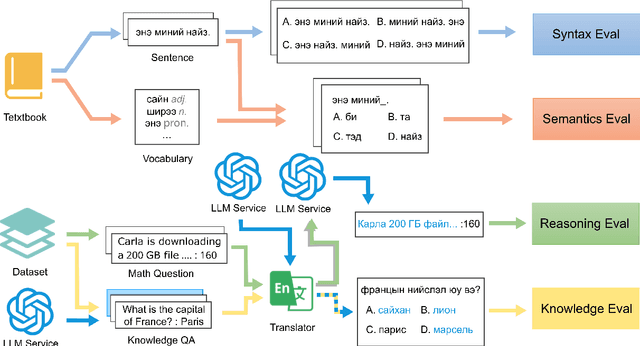
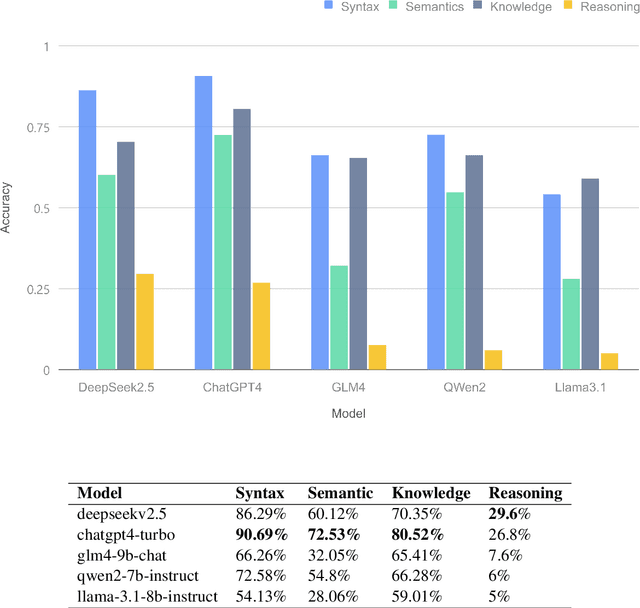

Large language models (LLMs) excel in high-resource languages but face notable challenges in low-resource languages like Mongolian. This paper addresses these challenges by categorizing capabilities into language abilities (syntax and semantics) and cognitive abilities (knowledge and reasoning). To systematically evaluate these areas, we developed MM-Eval, a specialized dataset based on Modern Mongolian Language Textbook I and enriched with WebQSP and MGSM datasets. Preliminary experiments on models including Qwen2-7B-Instruct, GLM4-9b-chat, Llama3.1-8B-Instruct, GPT-4, and DeepseekV2.5 revealed that: 1) all models performed better on syntactic tasks than semantic tasks, highlighting a gap in deeper language understanding; and 2) knowledge tasks showed a moderate decline, suggesting that models can transfer general knowledge from high-resource to low-resource contexts. The release of MM-Eval, comprising 569 syntax, 677 semantics, 344 knowledge, and 250 reasoning tasks, offers valuable insights for advancing NLP and LLMs in low-resource languages like Mongolian. The dataset is available at https://github.com/joenahm/MM-Eval.
Hybrid Classification-Regression Adaptive Loss for Dense Object Detection
Aug 30, 2024


For object detection detectors, enhancing model performance hinges on the ability to simultaneously consider inconsistencies across tasks and focus on difficult-to-train samples. Achieving this necessitates incorporating information from both the classification and regression tasks. However, prior work tends to either emphasize difficult-to-train samples within their respective tasks or simply compute classification scores with IoU, often leading to suboptimal model performance. In this paper, we propose a Hybrid Classification-Regression Adaptive Loss, termed as HCRAL. Specifically, we introduce the Residual of Classification and IoU (RCI) module for cross-task supervision, addressing task inconsistencies, and the Conditioning Factor (CF) to focus on difficult-to-train samples within each task. Furthermore, we introduce a new strategy named Expanded Adaptive Training Sample Selection (EATSS) to provide additional samples that exhibit classification and regression inconsistencies. To validate the effectiveness of the proposed method, we conduct extensive experiments on COCO test-dev. Experimental evaluations demonstrate the superiority of our approachs. Additionally, we designed experiments by separately combining the classification and regression loss with regular loss functions in popular one-stage models, demonstrating improved performance.