 Add to Chrome
 Add to Firefox
 Add to Edge
Graph-Augmented LLMs for Swiss MP Ideology Prediction
May 06, 2026
Approximating the ideological position of Members of Parliament (MPs) is a fundamental task in political science, helping researchers understand legislative behavior, party alignment, and policy preferences. While Large Language Models (LLMs) have shown promising results in estimating MPs' ideological stances, there are more actors and elements in the parliamentary system, and relations between them, that could provide a wider and more informative picture. However, due to the complexity of integrating them in the prediction task, these additional elements are generally ignored. In this work, we propose an LLM framework, PG-RAG, that implements a retrieval-augmented generation pipeline: it first queries a political knowledge graph (KG) and then integrates the resulting graph-structured information into the context. This allows for capturing both textual semantics and inter-MP relationships, another relevant information source in any parliamentary system. We evaluate the approach on the task of ideology prediction, using data from a Swiss parliamentary dataset. When comparing graph-augmented models against several state-of-the-art baselines, the results demonstrate that incorporating this enriched information, which encodes information about different entities and relations, improves prediction performance. These results help to highlight the value of domain-specific relational information in modeling political behavior.

SMAT: Staged Multi-Agent Training for Co-Adaptive Exoskeleton Control
Mar 08, 2026Effective exoskeleton assistance requires co-adaptation: as the device alters joint dynamics, the user reorganizes neuromuscular coordination, creating a non-stationary learning problem. Most learning-based approaches do not explicitly account for the sequential nature of human motor adaptation, leading to training instability and poorly timed assistance. We propose Staged Multi-Agent Training (SMAT), a four-stage curriculum designed to mirror how users naturally acclimate to a wearable device. In SMAT, a musculoskeletal human actor and a bilateral hip exoskeleton actor are trained progressively: the human first learns unassisted gait, then adapts to the added device mass; the exoskeleton subsequently learns a positive assistance pattern against a stabilized human policy, and finally both agents co-adapt with full torque capacity and bidirectional feedback. We implement SMAT in the MyoAssist simulation environment using a 26-muscle lower-limb model and an attached hip exoskeleton. Our musculoskeletal simulations demonstrate that the learned exoskeleton control policy produces an average 10.1% reduction in hip muscle activation relative to the no-assist condition. We validated the learned controller in an offline setting using open-source gait data, then deployed it to a physical hip exoskeleton for treadmill experiments with five subjects. The resulting policy delivers consistent assistance and predominantly positive mechanical power without the need for any explicitly imposed timing shift (mean positive power: 13.6 W at 6 Nm RMS torque to 23.8 W at 9.3 Nm RMS torque, with minimal negative power) consistently across all subjects without subject-specific retraining.
Do Images Clarify? A Study on the Effect of Images on Clarifying Questions in Conversational Search
Feb 09, 2026Conversational search systems increasingly employ clarifying questions to refine user queries and improve the search experience. Previous studies have demonstrated the usefulness of text-based clarifying questions in enhancing both retrieval performance and user experience. While images have been shown to improve retrieval performance in various contexts, their impact on user performance when incorporated into clarifying questions remains largely unexplored. We conduct a user study with 73 participants to investigate the role of images in conversational search, specifically examining their effects on two search-related tasks: (i) answering clarifying questions and (ii) query reformulation. We compare the effect of multimodal and text-only clarifying questions in both tasks within a conversational search context from various perspectives. Our findings reveal that while participants showed a strong preference for multimodal questions when answering clarifying questions, preferences were more balanced in the query reformulation task. The impact of images varied with both task type and user expertise. In answering clarifying questions, images helped maintain engagement across different expertise levels, while in query reformulation they led to more precise queries and improved retrieval performance. Interestingly, for clarifying question answering, text-only setups demonstrated better user performance as they provided more comprehensive textual information in the absence of images. These results provide valuable insights for designing effective multimodal conversational search systems, highlighting that the benefits of visual augmentation are task-dependent and should be strategically implemented based on the specific search context and user characteristics.
Summarize-Exemplify-Reflect: Data-driven Insight Distillation Empowers LLMs for Few-shot Tabular Classification
Aug 29, 2025Recent studies show the promise of large language models (LLMs) for few-shot tabular classification but highlight challenges due to the variability in structured data. To address this, we propose distilling data into actionable insights to enable robust and effective classification by LLMs. Drawing inspiration from human learning processes, we introduce InsightTab, an insight distillation framework guided by principles of divide-and-conquer, easy-first, and reflective learning. Our approach integrates rule summarization, strategic exemplification, and insight reflection through deep collaboration between LLMs and data modeling techniques. The obtained insights enable LLMs to better align their general knowledge and capabilities with the particular requirements of specific tabular tasks. We extensively evaluate InsightTab on nine datasets. The results demonstrate consistent improvement over state-of-the-art methods. Ablation studies further validate the principle-guided distillation process, while analyses emphasize InsightTab's effectiveness in leveraging labeled data and managing bias.
RAVENEA: A Benchmark for Multimodal Retrieval-Augmented Visual Culture Understanding
May 20, 2025As vision-language models (VLMs) become increasingly integrated into daily life, the need for accurate visual culture understanding is becoming critical. Yet, these models frequently fall short in interpreting cultural nuances effectively. Prior work has demonstrated the effectiveness of retrieval-augmented generation (RAG) in enhancing cultural understanding in text-only settings, while its application in multimodal scenarios remains underexplored. To bridge this gap, we introduce RAVENEA (Retrieval-Augmented Visual culturE uNdErstAnding), a new benchmark designed to advance visual culture understanding through retrieval, focusing on two tasks: culture-focused visual question answering (cVQA) and culture-informed image captioning (cIC). RAVENEA extends existing datasets by integrating over 10,000 Wikipedia documents curated and ranked by human annotators. With RAVENEA, we train and evaluate seven multimodal retrievers for each image query, and measure the downstream impact of retrieval-augmented inputs across fourteen state-of-the-art VLMs. Our results show that lightweight VLMs, when augmented with culture-aware retrieval, outperform their non-augmented counterparts (by at least 3.2% absolute on cVQA and 6.2% absolute on cIC). This highlights the value of retrieval-augmented methods and culturally inclusive benchmarks for multimodal understanding.
Query Understanding in LLM-based Conversational Information Seeking
Apr 08, 2025Query understanding in Conversational Information Seeking (CIS) involves accurately interpreting user intent through context-aware interactions. This includes resolving ambiguities, refining queries, and adapting to evolving information needs. Large Language Models (LLMs) enhance this process by interpreting nuanced language and adapting dynamically, improving the relevance and precision of search results in real-time. In this tutorial, we explore advanced techniques to enhance query understanding in LLM-based CIS systems. We delve into LLM-driven methods for developing robust evaluation metrics to assess query understanding quality in multi-turn interactions, strategies for building more interactive systems, and applications like proactive query management and query reformulation. We also discuss key challenges in integrating LLMs for query understanding in conversational search systems and outline future research directions. Our goal is to deepen the audience's understanding of LLM-based conversational query understanding and inspire discussions to drive ongoing advancements in this field.
Revisiting the Othello World Model Hypothesis
Mar 06, 2025Li et al. (2023) used the Othello board game as a test case for the ability of GPT-2 to induce world models, and were followed up by Nanda et al. (2023b). We briefly discuss the original experiments, expanding them to include more language models with more comprehensive probing. Specifically, we analyze sequences of Othello board states and train the model to predict the next move based on previous moves. We evaluate seven language models (GPT-2, T5, Bart, Flan-T5, Mistral, LLaMA-2, and Qwen2.5) on the Othello task and conclude that these models not only learn to play Othello, but also induce the Othello board layout. We find that all models achieve up to 99% accuracy in unsupervised grounding and exhibit high similarity in the board features they learned. This provides considerably stronger evidence for the Othello World Model Hypothesis than previous works.
Multi-Turn Multi-Modal Question Clarification for Enhanced Conversational Understanding
Feb 17, 2025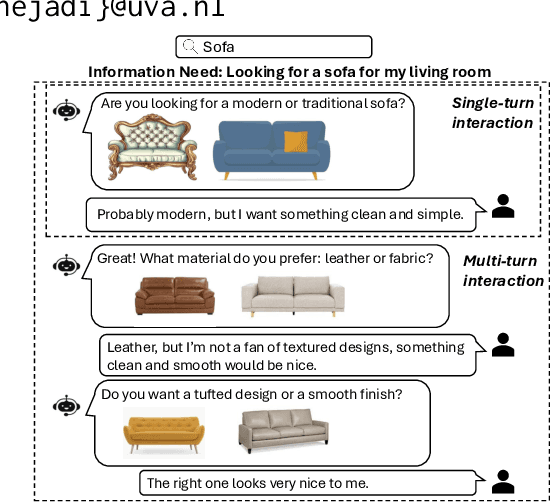
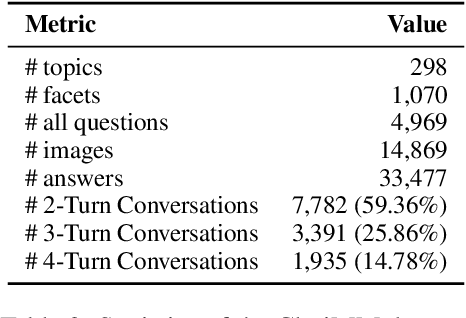
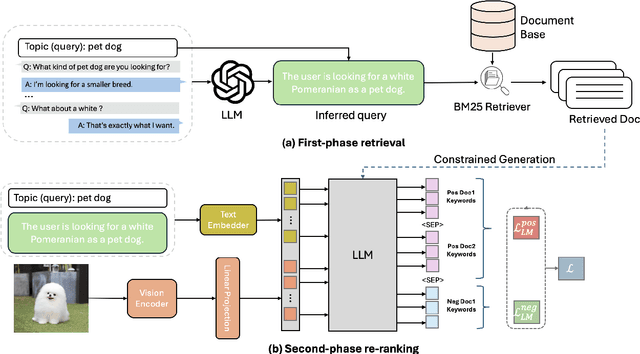
Conversational query clarification enables users to refine their search queries through interactive dialogue, improving search effectiveness. Traditional approaches rely on text-based clarifying questions, which often fail to capture complex user preferences, particularly those involving visual attributes. While recent work has explored single-turn multi-modal clarification with images alongside text, such methods do not fully support the progressive nature of user intent refinement over multiple turns. Motivated by this, we introduce the Multi-turn Multi-modal Clarifying Questions (MMCQ) task, which combines text and visual modalities to refine user queries in a multi-turn conversation. To facilitate this task, we create a large-scale dataset named ClariMM comprising over 13k multi-turn interactions and 33k question-answer pairs containing multi-modal clarifying questions. We propose Mario, a retrieval framework that employs a two-phase ranking strategy: initial retrieval with BM25, followed by a multi-modal generative re-ranking model that integrates textual and visual information from conversational history. Our experiments show that multi-turn multi-modal clarification outperforms uni-modal and single-turn approaches, improving MRR by 12.88%. The gains are most significant in longer interactions, demonstrating the value of progressive refinement for complex queries.
Intelligent Reflecting Surfaces Aided Wireless Network: Deployment Architectures and Solutions
Jan 15, 2025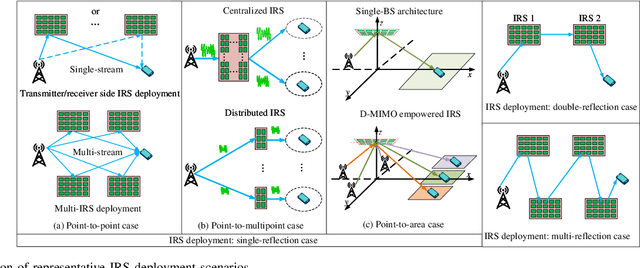
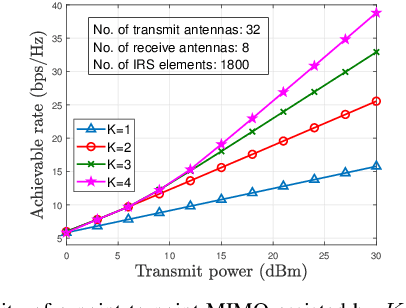
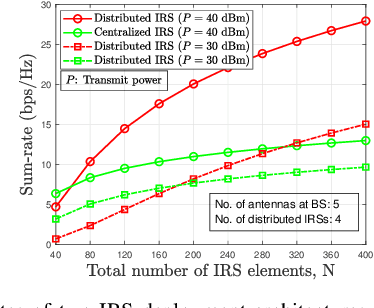
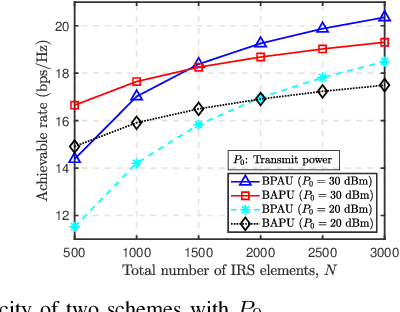
Intelligent reflecting surfaces (IRSs) have emerged as a transformative technology for wireless networks by improving coverage, capacity, and energy efficiency through intelligent manipulation of wireless propagation environments. This paper provides a comprehensive study on the deployment and coordination of IRSs for wireless networks. By addressing both single- and multi-reflection IRS architectures, we examine their deployment strategies across diverse scenarios, including point-to-point, point-to-multipoint, and point-to-area setups. For the single-reflection case, we highlight the trade-offs between passive and active IRS architectures in terms of beamforming gain, coverage extension, and spatial multiplexing. For the multi-reflection case, we discuss practical strategies to optimize IRS deployment and element allocation, balancing cooperative beamforming gains and path loss. The paper further discusses practical challenges in IRS implementation, including environmental conditions, system compatibility, and hardware limitations. Numerical results and field tests validate the effectiveness of IRS-aided wireless networks and demonstrate their capacity and coverage improvements. Lastly, promising research directions, including movable IRSs, near-field deployments, and network-level optimization, are outlined to guide future investigations.
AGENT-CQ: Automatic Generation and Evaluation of Clarifying Questions for Conversational Search with LLMs
Oct 25, 2024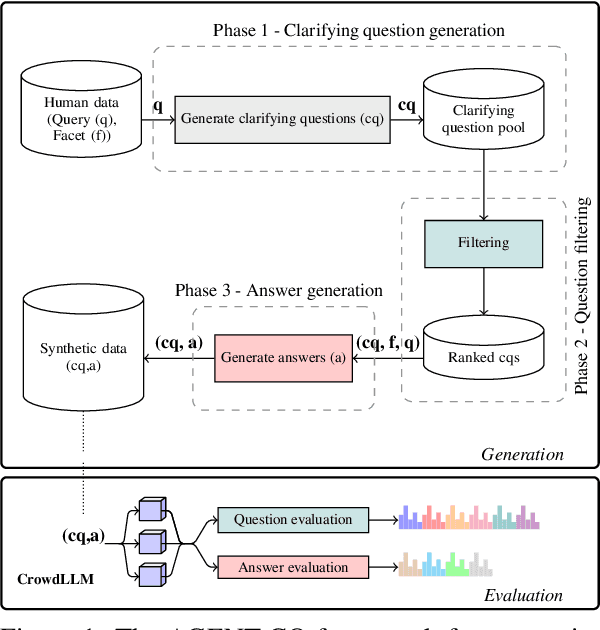
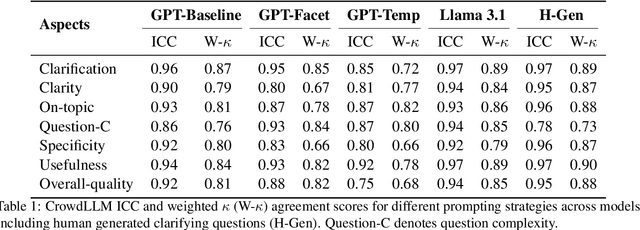
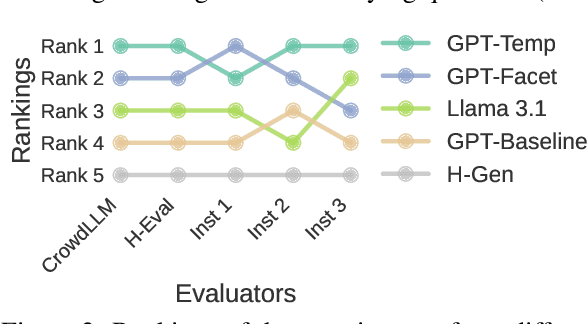
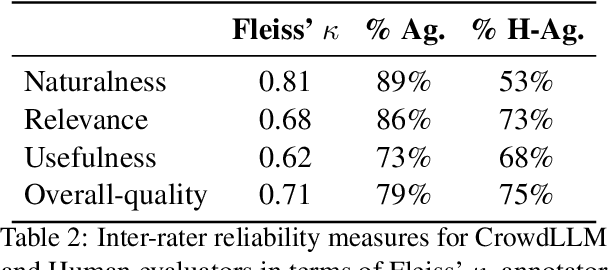
Generating diverse and effective clarifying questions is crucial for improving query understanding and retrieval performance in open-domain conversational search (CS) systems. We propose AGENT-CQ (Automatic GENeration, and evaluaTion of Clarifying Questions), an end-to-end LLM-based framework addressing the challenges of scalability and adaptability faced by existing methods that rely on manual curation or template-based approaches. AGENT-CQ consists of two stages: a generation stage employing LLM prompting strategies to generate clarifying questions, and an evaluation stage (CrowdLLM) that simulates human crowdsourcing judgments using multiple LLM instances to assess generated questions and answers based on comprehensive quality metrics. Extensive experiments on the ClariQ dataset demonstrate CrowdLLM's effectiveness in evaluating question and answer quality. Human evaluation and CrowdLLM show that the AGENT-CQ - generation stage, consistently outperforms baselines in various aspects of question and answer quality. In retrieval-based evaluation, LLM-generated questions significantly enhance retrieval effectiveness for both BM25 and cross-encoder models compared to human-generated questions.