 Add to Chrome
 Add to Firefox
 Add to Edge
SciText2Eq: Assessing LLMs for Explainable Equation Generation for Scientific Creativity
Jun 14, 2026
This work investigates the ability of large language models (LLMs) to generate mathematical equations from scientific texts. Prior work faces challenges in unstructured grounding, multi-equation dependency, and humanaligned evaluation. To this end, we construct a dataset of AI research papers, pairing contextual passages with ground-truth equations and variable descriptions. We develop an explainable equation generation workflow and evaluate it across diverse open- and closed-source LLM backbones. We introduce an evaluation protocol combining automatic metrics, LLM-based rubrics, and human judgments to assess accuracy, explainability, and human-LLM alignment. Results indicate that LLMs perform moderately on lexical- and syntactic-based similarity, while struggling with semantic accuracy. Comparisons between LLM-based evaluations and human judgments reveal limited alignment, highlighting challenges in using LLMs to assess equation quality. These findings offer insights for improving equation generation models and developing more reliable evaluation methods for scientific text. We provide code and data for reproducibility.

Aligning Human-AI-Interaction Trust for Mental Health Support: Survey and Position for Multi-Stakeholders
Apr 22, 2026Building trustworthy AI systems for mental health support is a shared priority across stakeholders from multiple disciplines. However, "trustworthy" remains loosely defined and inconsistently operationalized. AI research often focuses on technical criteria (e.g., robustness, explainability, and safety), while therapeutic practitioners emphasize therapeutic fidelity (e.g., appropriateness, empathy, and long-term user outcomes). To bridge the fragmented landscape, we propose a three-layer trust framework, covering human-oriented, AI-oriented, and interaction-oriented trust, integrating the viewpoints of key stakeholders (e.g., practitioners, researchers, regulators). Using this framework, we systematically review existing AI-driven research in mental health domain and examine evaluation practices for ``trustworthy'' ranging from automatic metrics to clinically validated approaches. We highlight critical gaps between what NLP currently measures and what real-world mental health contexts require, and outline a research agenda for building socio-technically aligned and genuinely trustworthy AI for mental health support.
Gaze-Aware Task Progression Detection Framework for Human-Robot Interaction Using RGB Cameras
Mar 16, 2026In human-robot interaction (HRI), detecting a human's gaze helps robots interpret user attention and intent. However, most gaze detection approaches rely on specialized eye-tracking hardware, limiting deployment in everyday settings. Appearance-based gaze estimation methods remove this dependency by using standard RGB cameras, but their practicality in HRI remains underexplored. We present a calibration-free framework for detecting task progression when information is conveyed via integrated display interfaces. The framework uses only the robot's built-in monocular RGB camera (640x480 resolution) and state-of-the-art gaze estimation to monitor attention patterns. It leverages natural behavior, where users shift focus from task interfaces to the robot's face to signal task completion, formalized through three Areas of Interest (AOI): tablet, robot face, and elsewhere. Systematic parameter optimization identifies configurations that balance detection accuracy and interaction latency. We validate our framework in a "First Day at Work" scenario, comparing it to button-based interaction. Results show a task completion detection accuracy of 77.6%. Compared to button-based interaction, the proposed system exhibits slightly higher response latency but preserves information retention and significantly improves comfort, social presence, and perceived naturalness. Notably, most participants reported that they did not consciously use eye movements to guide the interaction, underscoring the intuitive role of gaze as a communicative cue. This work demonstrates the feasibility of intuitive, low-cost, RGB-only gaze-based HRI for natural and engaging interactions.
NeuroWise: A Multi-Agent LLM "Glass-Box" System for Practicing Double-Empathy Communication with Autistic Partners
Feb 21, 2026The double empathy problem frames communication difficulties between neurodivergent and neurotypical individuals as arising from mutual misunderstanding, yet most interventions focus on autistic individuals. We present NeuroWise, a multi-agent LLM-based coaching system that supports neurotypical users through stress visualization, interpretation of internal experiences, and contextual guidance. In a between-subjects study (N=30), NeuroWise was rated as helpful by all participants and showed a significant condition-time effect on deficit-based attributions (p=0.02): NeuroWise users reduced deficit framing, while baseline users shifted toward blaming autistic "deficits" after difficult interactions. NeuroWise users also completed conversations more efficiently (37% fewer turns, p=0.03). These findings suggest that AI-based interpretation can support attributional change by helping users recognize communication challenges as mutual.
Exploring the Effect of Robotic Embodiment and Empathetic Tone of LLMs on Empathy Elicitation
Mar 26, 2025This study investigates the elicitation of empathy toward a third party through interaction with social agents. Participants engaged with either a physical robot or a voice-enabled chatbot, both driven by a large language model (LLM) programmed to exhibit either an empathetic tone or remain neutral. The interaction is focused on a fictional character, Katie Banks, who is in a challenging situation and in need of financial donations. The willingness to help Katie, measured by the number of hours participants were willing to volunteer, along with their perceptions of the agent, were assessed for 60 participants. Results indicate that neither robotic embodiment nor empathetic tone significantly influenced participants' willingness to volunteer. While the LLM effectively simulated human empathy, fostering genuine empathetic responses in participants proved challenging.
* *Liza Darwesh, Jaspreet Singh, Marin Marian, and Eduard Alexa contributed equally to this work.*
Robot Policy Transfer with Online Demonstrations: An Active Reinforcement Learning Approach
Mar 17, 2025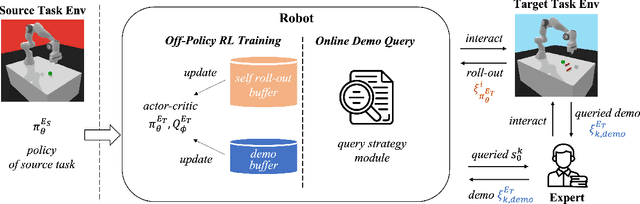
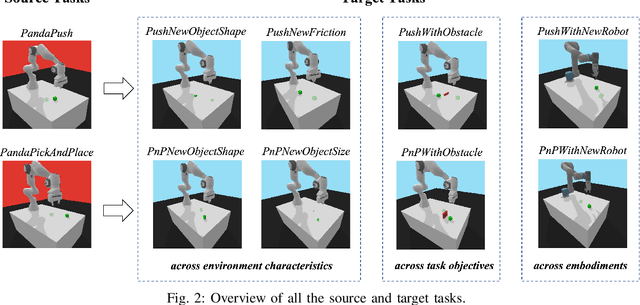
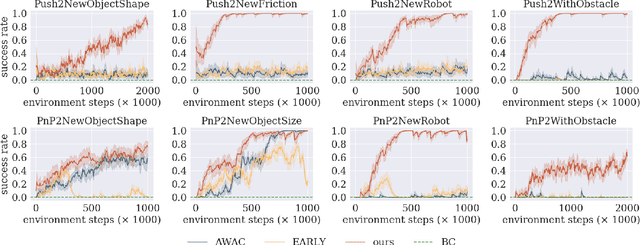
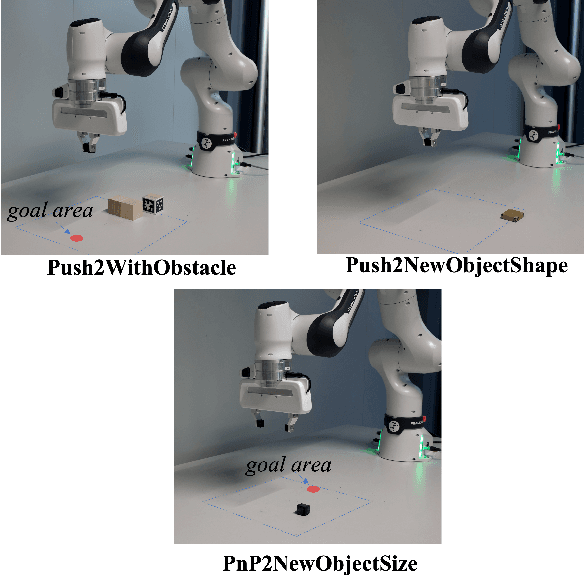
Transfer Learning (TL) is a powerful tool that enables robots to transfer learned policies across different environments, tasks, or embodiments. To further facilitate this process, efforts have been made to combine it with Learning from Demonstrations (LfD) for more flexible and efficient policy transfer. However, these approaches are almost exclusively limited to offline demonstrations collected before policy transfer starts, which may suffer from the intrinsic issue of covariance shift brought by LfD and harm the performance of policy transfer. Meanwhile, extensive work in the learning-from-scratch setting has shown that online demonstrations can effectively alleviate covariance shift and lead to better policy performance with improved sample efficiency. This work combines these insights to introduce online demonstrations into a policy transfer setting. We present Policy Transfer with Online Demonstrations, an active LfD algorithm for policy transfer that can optimize the timing and content of queries for online episodic expert demonstrations under a limited demonstration budget. We evaluate our method in eight robotic scenarios, involving policy transfer across diverse environment characteristics, task objectives, and robotic embodiments, with the aim to transfer a trained policy from a source task to a related but different target task. The results show that our method significantly outperforms all baselines in terms of average success rate and sample efficiency, compared to two canonical LfD methods with offline demonstrations and one active LfD method with online demonstrations. Additionally, we conduct preliminary sim-to-real tests of the transferred policy on three transfer scenarios in the real-world environment, demonstrating the policy effectiveness on a real robot manipulator.
Active Robot Curriculum Learning from Online Human Demonstrations
Mar 04, 2025Learning from Demonstrations (LfD) allows robots to learn skills from human users, but its effectiveness can suffer due to sub-optimal teaching, especially from untrained demonstrators. Active LfD aims to improve this by letting robots actively request demonstrations to enhance learning. However, this may lead to frequent context switches between various task situations, increasing the human cognitive load and introducing errors to demonstrations. Moreover, few prior studies in active LfD have examined how these active query strategies may impact human teaching in aspects beyond user experience, which can be crucial for developing algorithms that benefit both robot learning and human teaching. To tackle these challenges, we propose an active LfD method that optimizes the query sequence of online human demonstrations via Curriculum Learning (CL), where demonstrators are guided to provide demonstrations in situations of gradually increasing difficulty. We evaluate our method across four simulated robotic tasks with sparse rewards and conduct a user study (N=26) to investigate the influence of active LfD methods on human teaching regarding teaching performance, post-guidance teaching adaptivity, and teaching transferability. Our results show that our method significantly improves learning performance compared to three other LfD baselines in terms of the final success rate of the converged policy and sample efficiency. Additionally, results from our user study indicate that our method significantly reduces the time required from human demonstrators and decreases failed demonstration attempts. It also enhances post-guidance human teaching in both seen and unseen scenarios compared to another active LfD baseline, indicating enhanced teaching performance, greater post-guidance teaching adaptivity, and better teaching transferability achieved by our method.
"Give Me an Example Like This": Episodic Active Reinforcement Learning from Demonstrations
Jun 06, 2024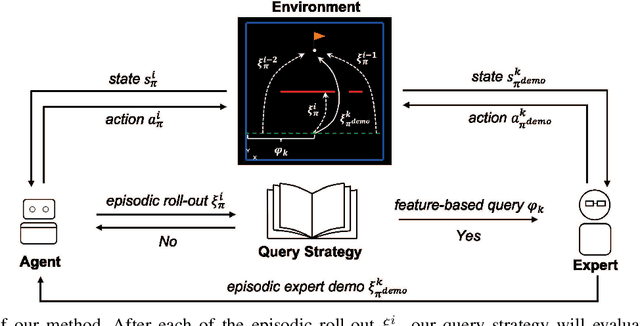
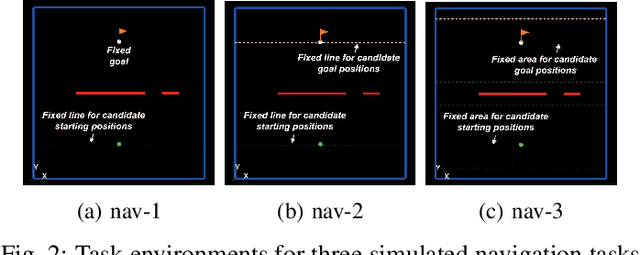
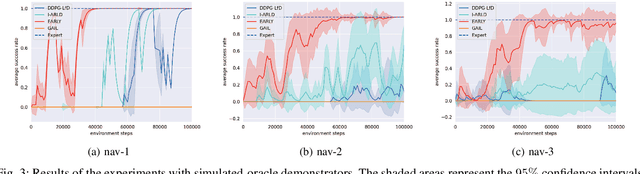
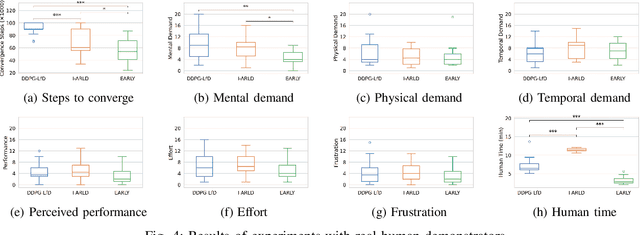
Reinforcement Learning (RL) has achieved great success in sequential decision-making problems, but often at the cost of a large number of agent-environment interactions. To improve sample efficiency, methods like Reinforcement Learning from Expert Demonstrations (RLED) introduce external expert demonstrations to facilitate agent exploration during the learning process. In practice, these demonstrations, which are often collected from human users, are costly and hence often constrained to a limited amount. How to select the best set of human demonstrations that is most beneficial for learning therefore becomes a major concern. This paper presents EARLY (Episodic Active Learning from demonstration querY), an algorithm that enables a learning agent to generate optimized queries of expert demonstrations in a trajectory-based feature space. Based on a trajectory-level estimate of uncertainty in the agent's current policy, EARLY determines the optimized timing and content for feature-based queries. By querying episodic demonstrations as opposed to isolated state-action pairs, EARLY improves the human teaching experience and achieves better learning performance. We validate the effectiveness of our method in three simulated navigation tasks of increasing difficulty. The results show that our method is able to achieve expert-level performance for all three tasks with convergence over 30\% faster than other baseline methods when demonstrations are generated by simulated oracle policies. The results of a follow-up pilot user study (N=18) further validate that our method can still maintain a significantly better convergence in the case of human expert demonstrators while achieving a better user experience in perceived task load and consuming significantly less human time.