 Add to Chrome
 Add to Firefox
 Add to Edge
Scaling CrossQ with Weight Normalization
Jun 04, 2025
Reinforcement learning has achieved significant milestones, but sample efficiency remains a bottleneck for real-world applications. Recently, CrossQ has demonstrated state-of-the-art sample efficiency with a low update-to-data (UTD) ratio of 1. In this work, we explore CrossQ's scaling behavior with higher UTD ratios. We identify challenges in the training dynamics which are emphasized by higher UTDs, particularly Q-bias explosion and the growing magnitude of critic network weights. To address this, we integrate weight normalization into the CrossQ framework, a solution that stabilizes training, prevents potential loss of plasticity and keeps the effective learning rate constant. Our proposed approach reliably scales with increasing UTD ratios, achieving competitive or superior performance across a range of challenging tasks on the DeepMind control benchmark, notably the complex dog and humanoid environments. This work eliminates the need for drastic interventions, such as network resets, and offers a robust pathway for improving sample efficiency and scalability in model-free reinforcement learning.

Deep Reinforcement Learning Agents are not even close to Human Intelligence
May 27, 2025Deep reinforcement learning (RL) agents achieve impressive results in a wide variety of tasks, but they lack zero-shot adaptation capabilities. While most robustness evaluations focus on tasks complexifications, for which human also struggle to maintain performances, no evaluation has been performed on tasks simplifications. To tackle this issue, we introduce HackAtari, a set of task variations of the Arcade Learning Environments. We use it to demonstrate that, contrary to humans, RL agents systematically exhibit huge performance drops on simpler versions of their training tasks, uncovering agents' consistent reliance on shortcuts. Our analysis across multiple algorithms and architectures highlights the persistent gap between RL agents and human behavioral intelligence, underscoring the need for new benchmarks and methodologies that enforce systematic generalization testing beyond static evaluation protocols. Training and testing in the same environment is not enough to obtain agents equipped with human-like intelligence.
Maximum Total Correlation Reinforcement Learning
May 22, 2025Simplicity is a powerful inductive bias. In reinforcement learning, regularization is used for simpler policies, data augmentation for simpler representations, and sparse reward functions for simpler objectives, all that, with the underlying motivation to increase generalizability and robustness by focusing on the essentials. Supplementary to these techniques, we investigate how to promote simple behavior throughout the episode. To that end, we introduce a modification of the reinforcement learning problem that additionally maximizes the total correlation within the induced trajectories. We propose a practical algorithm that optimizes all models, including policy and state representation, based on a lower-bound approximation. In simulated robot environments, our method naturally generates policies that induce periodic and compressible trajectories, and that exhibit superior robustness to noise and changes in dynamics compared to baseline methods, while also improving performance in the original tasks.
Investigating Active Sampling for Hardness Classification with Vision-Based Tactile Sensors
May 19, 2025One of the most important object properties that humans and robots perceive through touch is hardness. This paper investigates information-theoretic active sampling strategies for sample-efficient hardness classification with vision-based tactile sensors. We evaluate three probabilistic classifier models and two model-uncertainty-based sampling strategies on a robotic setup as well as on a previously published dataset of samples collected by human testers. Our findings indicate that the active sampling approaches, driven by uncertainty metrics, surpass a random sampling baseline in terms of accuracy and stability. Additionally, while in our human study, the participants achieve an average accuracy of 48.00%, our best approach achieves an average accuracy of 88.78% on the same set of objects, demonstrating the effectiveness of vision-based tactile sensors for object hardness classification.
Towards Safe Robot Foundation Models Using Inductive Biases
May 15, 2025Safety is a critical requirement for the real-world deployment of robotic systems. Unfortunately, while current robot foundation models show promising generalization capabilities across a wide variety of tasks, they fail to address safety, an important aspect for ensuring long-term operation. Current robot foundation models assume that safe behavior should emerge by learning from a sufficiently large dataset of demonstrations. However, this approach has two clear major drawbacks. Firstly, there are no formal safety guarantees for a behavior cloning policy trained using supervised learning. Secondly, without explicit knowledge of any safety constraints, the policy may require an unreasonable number of additional demonstrations to even approximate the desired constrained behavior. To solve these key issues, we show how we can instead combine robot foundation models with geometric inductive biases using ATACOM, a safety layer placed after the foundation policy that ensures safe state transitions by enforcing action constraints. With this approach, we can ensure formal safety guarantees for generalist policies without providing extensive demonstrations of safe behavior, and without requiring any specific fine-tuning for safety. Our experiments show that our approach can be beneficial both for classical manipulation tasks, where we avoid unwanted collisions with irrelevant objects, and for dynamic tasks, such as the robot air hockey environment, where we can generate fast trajectories respecting complex tasks and joint space constraints.
Active Perception for Tactile Sensing: A Task-Agnostic Attention-Based Approach
May 09, 2025Humans make extensive use of haptic exploration to map and identify the properties of the objects that we touch. In robotics, active tactile perception has emerged as an important research domain that complements vision for tasks such as object classification, shape reconstruction, and manipulation. This work introduces TAP (Task-agnostic Active Perception) -- a novel framework that leverages reinforcement learning (RL) and transformer-based architectures to address the challenges posed by partially observable environments. TAP integrates Soft Actor-Critic (SAC) and CrossQ algorithms within a unified optimization objective, jointly training a perception module and decision-making policy. By design, TAP is completely task-agnostic and can, in principle, generalize to any active perception problem. We evaluate TAP across diverse tasks, including toy examples and realistic applications involving haptic exploration of 3D models from the Tactile MNIST benchmark. Experiments demonstrate the efficacy of TAP, achieving high accuracies on the Tactile MNIST haptic digit recognition task and a tactile pose estimation task. These findings underscore the potential of TAP as a versatile and generalizable framework for advancing active tactile perception in robotics.
Towards Embodiment Scaling Laws in Robot Locomotion
May 09, 2025Developing generalist agents that can operate across diverse tasks, environments, and physical embodiments is a grand challenge in robotics and artificial intelligence. In this work, we focus on the axis of embodiment and investigate embodiment scaling laws$\unicode{x2013}$the hypothesis that increasing the number of training embodiments improves generalization to unseen ones. Using robot locomotion as a test bed, we procedurally generate a dataset of $\sim$1,000 varied embodiments, spanning humanoids, quadrupeds, and hexapods, and train generalist policies capable of handling diverse observation and action spaces on random subsets. We find that increasing the number of training embodiments improves generalization to unseen ones, and scaling embodiments is more effective in enabling embodiment-level generalization than scaling data on small, fixed sets of embodiments. Notably, our best policy, trained on the full dataset, zero-shot transfers to novel embodiments in the real world, such as Unitree Go2 and H1. These results represent a step toward general embodied intelligence, with potential relevance to adaptive control for configurable robots, co-design of morphology and control, and beyond.
Robust Localization, Mapping, and Navigation for Quadruped Robots
May 04, 2025Quadruped robots are currently a widespread platform for robotics research, thanks to powerful Reinforcement Learning controllers and the availability of cheap and robust commercial platforms. However, to broaden the adoption of the technology in the real world, we require robust navigation stacks relying only on low-cost sensors such as depth cameras. This paper presents a first step towards a robust localization, mapping, and navigation system for low-cost quadruped robots. In pursuit of this objective we combine contact-aided kinematic, visual-inertial odometry, and depth-stabilized vision, enhancing stability and accuracy of the system. Our results in simulation and two different real-world quadruped platforms show that our system can generate an accurate 2D map of the environment, robustly localize itself, and navigate autonomously. Furthermore, we present in-depth ablation studies of the important components of the system and their impact on localization accuracy. Videos, code, and additional experiments can be found on the project website: https://sites.google.com/view/low-cost-quadruped-slam
Model Tensor Planning
May 02, 2025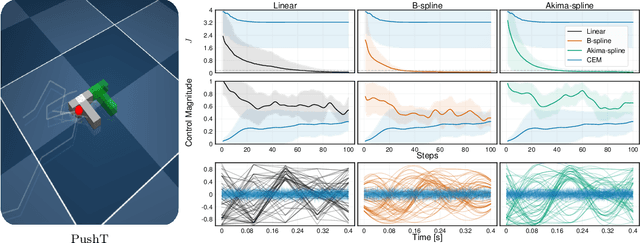
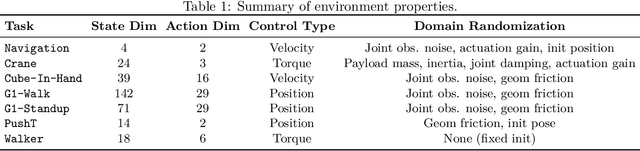
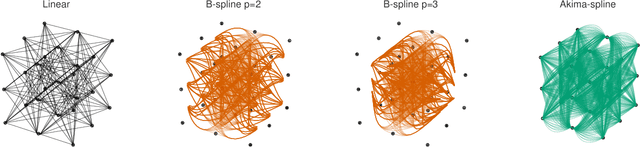
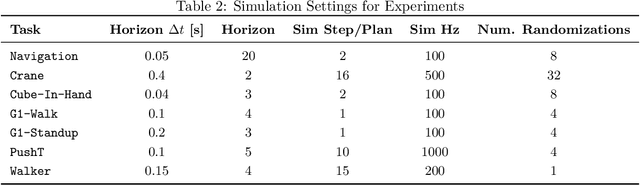
Sampling-based model predictive control (MPC) offers strong performance in nonlinear and contact-rich robotic tasks, yet often suffers from poor exploration due to locally greedy sampling schemes. We propose \emph{Model Tensor Planning} (MTP), a novel sampling-based MPC framework that introduces high-entropy control trajectory generation through structured tensor sampling. By sampling over randomized multipartite graphs and interpolating control trajectories with B-splines and Akima splines, MTP ensures smooth and globally diverse control candidates. We further propose a simple $\beta$-mixing strategy that blends local exploitative and global exploratory samples within the modified Cross-Entropy Method (CEM) update, balancing control refinement and exploration. Theoretically, we show that MTP achieves asymptotic path coverage and maximum entropy in the control trajectory space in the limit of infinite tensor depth and width. Our implementation is fully vectorized using JAX and compatible with MuJoCo XLA, supporting \emph{Just-in-time} (JIT) compilation and batched rollouts for real-time control with online domain randomization. Through experiments on various challenging robotic tasks, ranging from dexterous in-hand manipulation to humanoid locomotion, we demonstrate that MTP outperforms standard MPC and evolutionary strategy baselines in task success and control robustness. Design and sensitivity ablations confirm the effectiveness of MTP tensor sampling structure, spline interpolation choices, and mixing strategy. Altogether, MTP offers a scalable framework for robust exploration in model-based planning and control.
On the Importance of Tactile Sensing for Imitation Learning: A Case Study on Robotic Match Lighting
Apr 18, 2025The field of robotic manipulation has advanced significantly in the last years. At the sensing level, several novel tactile sensors have been developed, capable of providing accurate contact information. On a methodological level, learning from demonstrations has proven an efficient paradigm to obtain performant robotic manipulation policies. The combination of both holds the promise to extract crucial contact-related information from the demonstration data and actively exploit it during policy rollouts. However, despite its potential, it remains an underexplored direction. This work therefore proposes a multimodal, visuotactile imitation learning framework capable of efficiently learning fast and dexterous manipulation policies. We evaluate our framework on the dynamic, contact-rich task of robotic match lighting - a task in which tactile feedback influences human manipulation performance. The experimental results show that adding tactile information into the policies significantly improves performance by over 40%, thereby underlining the importance of tactile sensing for contact-rich manipulation tasks. Project website: https://sites.google.com/view/tactile-il .