 Add to Chrome
 Add to Firefox
 Add to Edge
Learning Explicit Behavioral Models with Adaptive Questions and World-Model Probes
Jun 05, 2026
Interactive agents trained only against task return can achieve high scores while failing to represent the mechanisms that make their actions succeed. This makes brittle behavior difficult to diagnose and limits adaptation when environment dynamics change. Existing LLM reflection and policy-code repair can revise behavior from failed trajectories, but questions and world-understanding tests are usually used only after training. We introduce an Explicit Symbolic Behavioral Model (ESBM), a trainable behavioral model that couples task performance with evidence-grounded question answering and executable mechanism prediction. An ESBM represents behavior through typed predicates, weighted rules, bounded options and mechanism memory; the mechanism layer predicts symbolic events, object changes, rewards and terminal consequences under action interventions. After each rollout, adaptive questions and active world-model probes convert score failures, QA errors and transition-prediction errors into constraints for local ESBM edits. Candidate models are selected by a multi-criterion rule that jointly evaluates task score, answerability and active world-model consistency. Under the tested Atari-style protocols, ESBM learns high-scoring policies while producing explicit answers and executable mechanism predictions, indicating that adaptive questions can serve as both training pressure and reusable benchmarks for mechanistic policy learning in this setting.

Kintsugi: Learning Policies by Repairing Executable Knowledge Bases
May 10, 2026Modern embodied agents achieve impressive performance, but their task knowledge is often stored in neural weights, latent state, or prompt-bound memory, making individual policy knowledge difficult to inspect, validate, recombine, and reuse. We introduce \textbf{Kintsugi}, a white-box policy-learning framework that treats embodied policy improvement as verifier-gated construction of a typed executable Knowledge Base (KB). Kintsugi represents task-level policy knowledge as composable typed entries -- predicates, operators, policy schemas, monitors, recovery rules, experience records, and goals -- and improves this artifact through localized typed edits induced from rollout evidence, rather than relying on test-time language-model reasoning. Between rollouts, a tool-constrained agentic editing loop diagnoses trajectory failures, localizes them to editable KB layers, and proposes candidate edits. A deterministic verification gate admits an edit only when the candidate type-checks, the resulting KB executes, and focused validation success or trajectory-health metrics improve without violating protected-regression checks. At inference, the accepted KB is executed by a deterministic symbolic executor with zero LLM calls. Across long-horizon text-agent benchmarks and representative object-centric manipulation settings, Kintsugi achieves strong endpoint performance while preserving inspectability, local editability, and verifier-gated deployment. These results suggest that embodied policy improvement can be organized around executable task knowledge.
LLMs Gaming Verifiers: RLVR can Lead to Reward Hacking
Apr 16, 2026As reinforcement Learning with Verifiable Rewards (RLVR) has become the dominant paradigm for scaling reasoning capabilities in LLMs, a new failure mode emerges: LLMs gaming verifiers. We study this phenomenon on inductive reasoning tasks, where models must induce and output logical rules. We find that RLVR-trained models systematically abandon rule induction. Instead of learning generalizable patterns (e.g., ``trains carrying red cars go east''), they enumerate instance-level labels, producing outputs that pass verifiers without capturing the relational patterns required by the task. We show that this behavior is not a failure of understanding but a form of reward hacking: imperfect verifiers that check only extensional correctness admit false positives. To detect such shortcuts, we introduce Isomorphic Perturbation Testing (IPT), which evaluates a single model output under both extensional and isomorphic verification, where the latter enforces invariance under logically isomorphic tasks. While genuine rule induction remains invariant, shortcut strategies fail. We find that shortcut behavior is specific to RLVR-trained reasoning models (e.g., GPT-5, Olmo3) and absent in non-RLVR models (e.g., GPT-4o, GPT-4.5, Ministral). Moreover, shortcut prevalence increases with task complexity and inference-time compute. In controlled training experiments, extensional verification directly induces shortcut strategies, while isomorphic verification eliminates them. These results show that RLVR can incentivize reward hacking not only through overt manipulation but also by exploiting what the verifier fails to enforce.
STORM: Segment, Track, and Object Re-Localization from a Single 3D Model
Nov 12, 2025Accurate 6D pose estimation and tracking are fundamental capabilities for physical AI systems such as robots. However, existing approaches typically rely on a manually annotated segmentation mask of the target in the first frame, which is labor-intensive and leads to reduced performance when faced with occlusions or rapid movement. To address these limi- tations, we propose STORM (Segment, Track, and Object Re-localization from a single 3D Model), an open-source robust real-time 6D pose estimation system that requires no manual annotation. STORM employs a novel three-stage pipeline combining vision-language understanding with self-supervised feature matching: contextual object descriptions guide localization, self-cross-attention mechanisms identify candidate regions, and a segmentation model produces precise masks for accurate pose estimation. Another key innovation is our automatic re-registration mechanism that detects tracking failures through feature similarity monitoring and recovers from severe occlusions or rapid motion. STORM achieves state-of-the-art accuracy on challenging industrial datasets featuring multi-object occlusions, high-speed motion, and varying illumination, while operating at real-time speeds without additional training. This annotation-free approach significantly reduces deployment overhead, providing a practical solution for modern applications, such as flexible manufacturing and intelligent quality control.
Deep Reinforcement Learning Agents are not even close to Human Intelligence
May 27, 2025Deep reinforcement learning (RL) agents achieve impressive results in a wide variety of tasks, but they lack zero-shot adaptation capabilities. While most robustness evaluations focus on tasks complexifications, for which human also struggle to maintain performances, no evaluation has been performed on tasks simplifications. To tackle this issue, we introduce HackAtari, a set of task variations of the Arcade Learning Environments. We use it to demonstrate that, contrary to humans, RL agents systematically exhibit huge performance drops on simpler versions of their training tasks, uncovering agents' consistent reliance on shortcuts. Our analysis across multiple algorithms and architectures highlights the persistent gap between RL agents and human behavioral intelligence, underscoring the need for new benchmarks and methodologies that enforce systematic generalization testing beyond static evaluation protocols. Training and testing in the same environment is not enough to obtain agents equipped with human-like intelligence.
Better Decisions through the Right Causal World Model
Apr 09, 2025Reinforcement learning (RL) agents have shown remarkable performances in various environments, where they can discover effective policies directly from sensory inputs. However, these agents often exploit spurious correlations in the training data, resulting in brittle behaviours that fail to generalize to new or slightly modified environments. To address this, we introduce the Causal Object-centric Model Extraction Tool (COMET), a novel algorithm designed to learn the exact interpretable causal world models (CWMs). COMET first extracts object-centric state descriptions from observations and identifies the environment's internal states related to the depicted objects' properties. Using symbolic regression, it models object-centric transitions and derives causal relationships governing object dynamics. COMET further incorporates large language models (LLMs) for semantic inference, annotating causal variables to enhance interpretability. By leveraging these capabilities, COMET constructs CWMs that align with the true causal structure of the environment, enabling agents to focus on task-relevant features. The extracted CWMs mitigate the danger of shortcuts, permitting the development of RL systems capable of better planning and decision-making across dynamic scenarios. Our results, validated in Atari environments such as Pong and Freeway, demonstrate the accuracy and robustness of COMET, highlighting its potential to bridge the gap between object-centric reasoning and causal inference in reinforcement learning.
Evaluating Interpretable Reinforcement Learning by Distilling Policies into Programs
Mar 11, 2025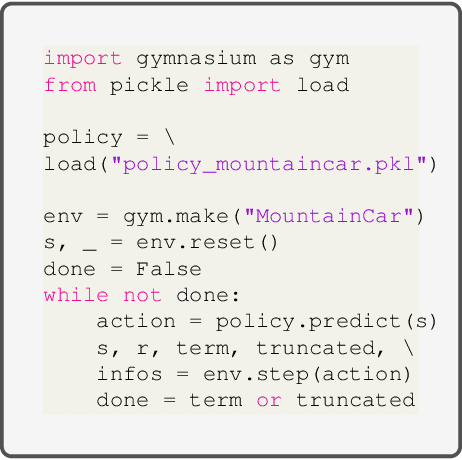
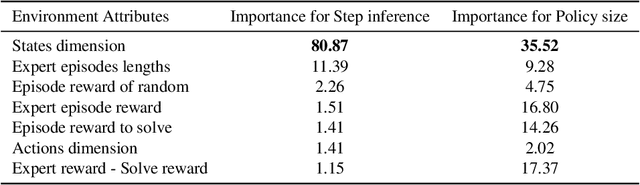
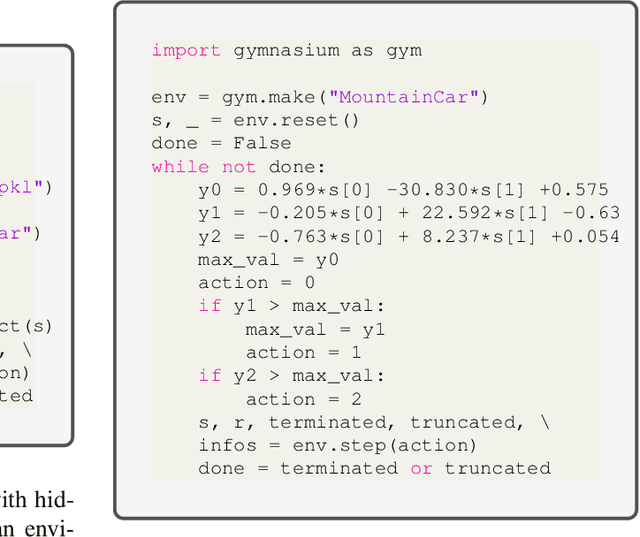

There exist applications of reinforcement learning like medicine where policies need to be ''interpretable'' by humans. User studies have shown that some policy classes might be more interpretable than others. However, it is costly to conduct human studies of policy interpretability. Furthermore, there is no clear definition of policy interpretabiliy, i.e., no clear metrics for interpretability and thus claims depend on the chosen definition. We tackle the problem of empirically evaluating policies interpretability without humans. Despite this lack of clear definition, researchers agree on the notions of ''simulatability'': policy interpretability should relate to how humans understand policy actions given states. To advance research in interpretable reinforcement learning, we contribute a new methodology to evaluate policy interpretability. This new methodology relies on proxies for simulatability that we use to conduct a large-scale empirical evaluation of policy interpretability. We use imitation learning to compute baseline policies by distilling expert neural networks into small programs. We then show that using our methodology to evaluate the baselines interpretability leads to similar conclusions as user studies. We show that increasing interpretability does not necessarily reduce performances and can sometimes increase them. We also show that there is no policy class that better trades off interpretability and performance across tasks making it necessary for researcher to have methodologies for comparing policies interpretability.
Interpretable end-to-end Neurosymbolic Reinforcement Learning agents
Oct 18, 2024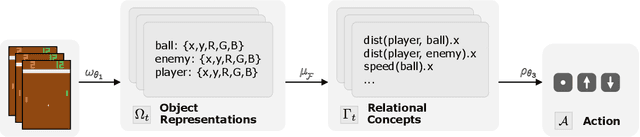
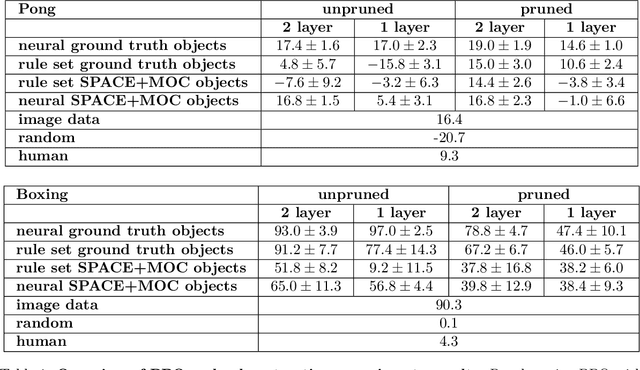
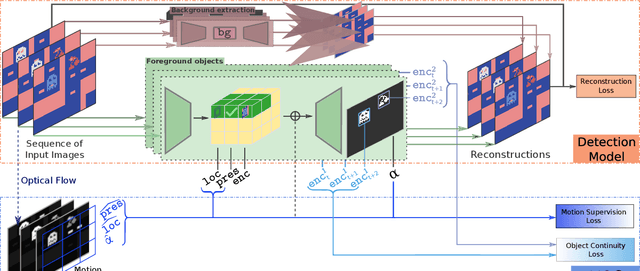
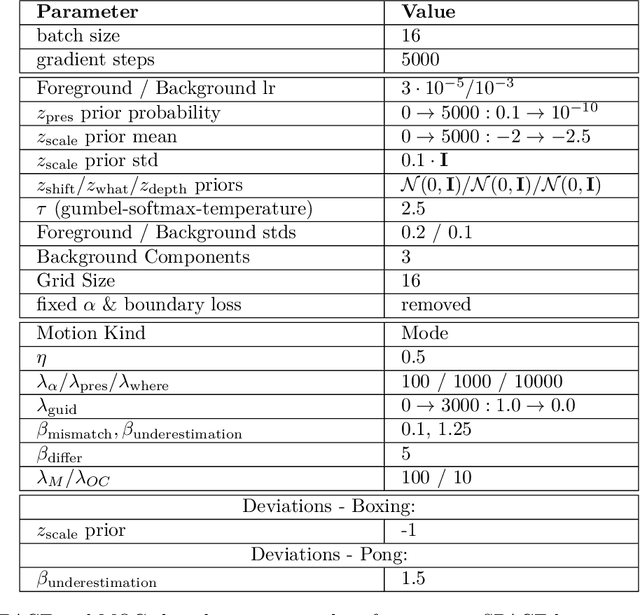
Deep reinforcement learning (RL) agents rely on shortcut learning, preventing them from generalizing to slightly different environments. To address this problem, symbolic method, that use object-centric states, have been developed. However, comparing these methods to deep agents is not fair, as these last operate from raw pixel-based states. In this work, we instantiate the symbolic SCoBots framework. SCoBots decompose RL tasks into intermediate, interpretable representations, culminating in action decisions based on a comprehensible set of object-centric relational concepts. This architecture aids in demystifying agent decisions. By explicitly learning to extract object-centric representations from raw states, object-centric RL, and policy distillation via rule extraction, this work places itself within the neurosymbolic AI paradigm, blending the strengths of neural networks with symbolic AI. We present the first implementation of an end-to-end trained SCoBot, separately evaluate of its components, on different Atari games. The results demonstrate the framework's potential to create interpretable and performing RL systems, and pave the way for future research directions in obtaining end-to-end interpretable RL agents.
BlendRL: A Framework for Merging Symbolic and Neural Policy Learning
Oct 15, 2024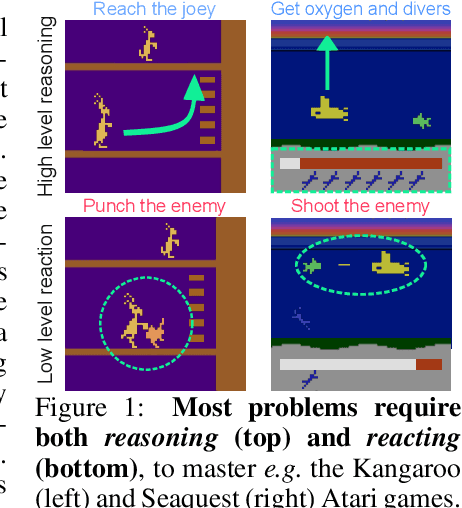
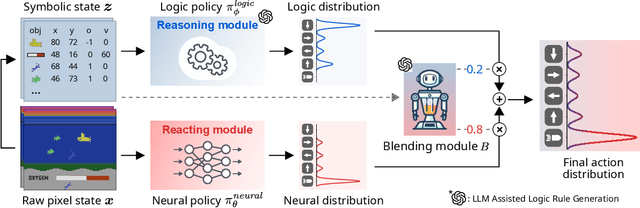
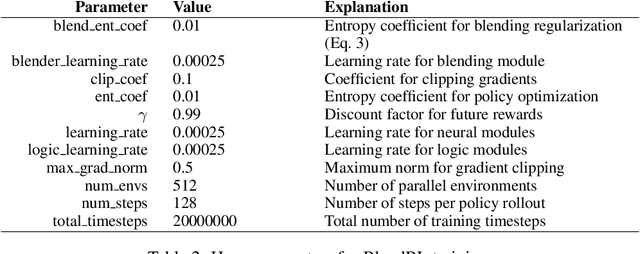
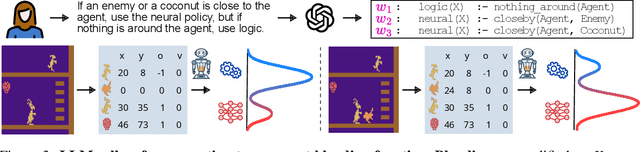
Humans can leverage both symbolic reasoning and intuitive reactions. In contrast, reinforcement learning policies are typically encoded in either opaque systems like neural networks or symbolic systems that rely on predefined symbols and rules. This disjointed approach severely limits the agents' capabilities, as they often lack either the flexible low-level reaction characteristic of neural agents or the interpretable reasoning of symbolic agents. To overcome this challenge, we introduce BlendRL, a neuro-symbolic RL framework that harmoniously integrates both paradigms within RL agents that use mixtures of both logic and neural policies. We empirically demonstrate that BlendRL agents outperform both neural and symbolic baselines in standard Atari environments, and showcase their robustness to environmental changes. Additionally, we analyze the interaction between neural and symbolic policies, illustrating how their hybrid use helps agents overcome each other's limitations.
OCALM: Object-Centric Assessment with Language Models
Jun 24, 2024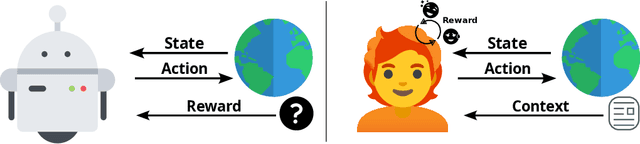

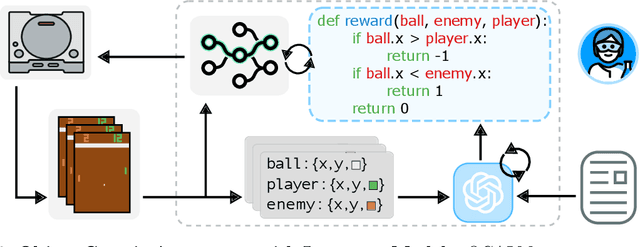
Properly defining a reward signal to efficiently train a reinforcement learning (RL) agent is a challenging task. Designing balanced objective functions from which a desired behavior can emerge requires expert knowledge, especially for complex environments. Learning rewards from human feedback or using large language models (LLMs) to directly provide rewards are promising alternatives, allowing non-experts to specify goals for the agent. However, black-box reward models make it difficult to debug the reward. In this work, we propose Object-Centric Assessment with Language Models (OCALM) to derive inherently interpretable reward functions for RL agents from natural language task descriptions. OCALM uses the extensive world-knowledge of LLMs while leveraging the object-centric nature common to many environments to derive reward functions focused on relational concepts, providing RL agents with the ability to derive policies from task descriptions.