 Add to Chrome
 Add to Firefox
 Add to Edge
Large Language Model as an Assignment Evaluator: Insights, Feedback, and Challenges in a 1000+ Student Course
Jul 07, 2024


Using large language models (LLMs) for automatic evaluation has become an important evaluation method in NLP research. However, it is unclear whether these LLM-based evaluators can be applied in real-world classrooms to assess student assignments. This empirical report shares how we use GPT-4 as an automatic assignment evaluator in a university course with 1,028 students. Based on student responses, we find that LLM-based assignment evaluators are generally acceptable to students when students have free access to these LLM-based evaluators. However, students also noted that the LLM sometimes fails to adhere to the evaluation instructions. Additionally, we observe that students can easily manipulate the LLM-based evaluator to output specific strings, allowing them to achieve high scores without meeting the assignment rubric. Based on student feedback and our experience, we provide several recommendations for integrating LLM-based evaluators into future classrooms.

Investigating the Effects of Large-Scale Pseudo-Stereo Data and Different Speech Foundation Model on Dialogue Generative Spoken Language Model
Jul 02, 2024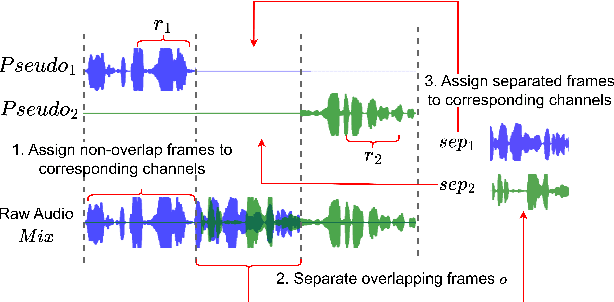

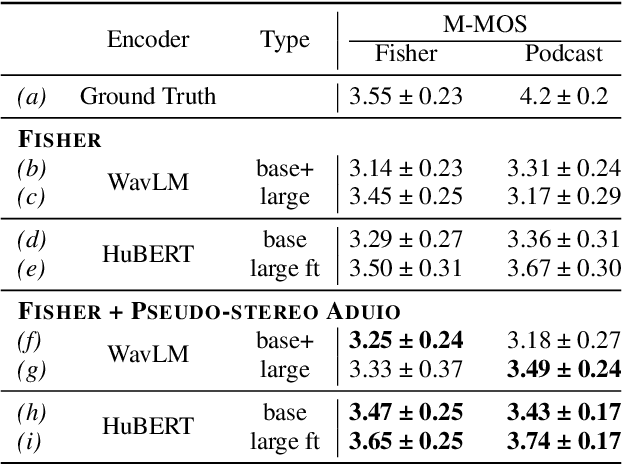
Recent efforts in Spoken Dialogue Modeling aim to synthesize spoken dialogue without the need for direct transcription, thereby preserving the wealth of non-textual information inherent in speech. However, this approach faces a challenge when speakers talk simultaneously, requiring stereo dialogue data with speakers recorded on separate channels, a notably scarce resource. To address this, we have developed an innovative pipeline capable of transforming single-channel dialogue data into pseudo-stereo data. This expanded our training dataset from a mere 2,000 to an impressive 17,600 hours, significantly enriching the diversity and quality of the training examples available. The inclusion of this pseudo-stereo data has proven to be effective in improving the performance of spoken dialogue language models. Additionally, we explored the use of discrete units of different speech foundation models for spoken dialogue generation.
DogeRM: Equipping Reward Models with Domain Knowledge through Model Merging
Jul 01, 2024Reinforcement learning from human feedback (RLHF) is a popular strategy for aligning large language models (LLMs) with desired behaviors. Reward modeling is a crucial step in RLHF. However, collecting paired preference data for training reward models is often costly and time-consuming, especially for domain-specific preferences requiring expert annotation. To address this challenge, we propose the \textbf{Do}main knowled\textbf{ge} merged \textbf{R}eward \textbf{M}odel (DogeRM), a novel framework that integrates domain-specific knowledge into a general reward model by model merging. The experiments demonstrate that DogeRM enhances performance across different benchmarks and provide a detailed analysis showcasing the effects of model merging, showing the great potential of facilitating model alignment.
DeSTA: Enhancing Speech Language Models through Descriptive Speech-Text Alignment
Jun 27, 2024Recent speech language models (SLMs) typically incorporate pre-trained speech models to extend the capabilities from large language models (LLMs). In this paper, we propose a Descriptive Speech-Text Alignment approach that leverages speech captioning to bridge the gap between speech and text modalities, enabling SLMs to interpret and generate comprehensive natural language descriptions, thereby facilitating the capability to understand both linguistic and non-linguistic features in speech. Enhanced with the proposed approach, our model demonstrates superior performance on the Dynamic-SUPERB benchmark, particularly in generalizing to unseen tasks. Moreover, we discover that the aligned model exhibits a zero-shot instruction-following capability without explicit speech instruction tuning. These findings highlight the potential to reshape instruction-following SLMs by incorporating rich, descriptive speech captions.
Can LLMs Understand the Implication of Emphasized Sentences in Dialogue?
Jun 16, 2024


Emphasis is a crucial component in human communication, which indicates the speaker's intention and implication beyond pure text in dialogue. While Large Language Models (LLMs) have revolutionized natural language processing, their ability to understand emphasis in dialogue remains unclear. This paper introduces Emphasized-Talk, a benchmark with emphasis-annotated dialogue samples capturing the implications of emphasis. We evaluate various LLMs, both open-source and commercial, to measure their performance in understanding emphasis. Additionally, we propose an automatic evaluation pipeline using GPT-4, which achieves a high correlation with human rating. Our findings reveal that although commercial LLMs generally perform better, there is still significant room for improvement in comprehending emphasized sentences.
Continual Test-time Adaptation for End-to-end Speech Recognition on Noisy Speech
Jun 16, 2024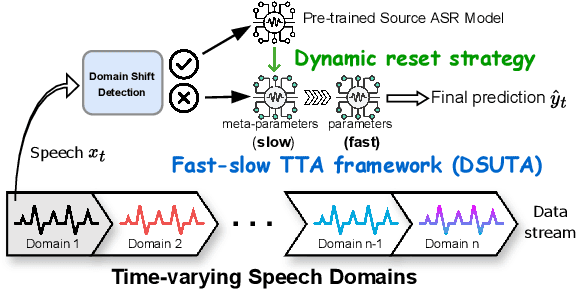
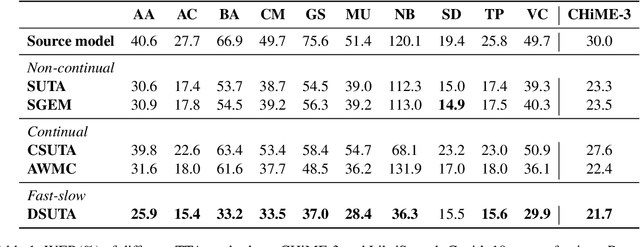
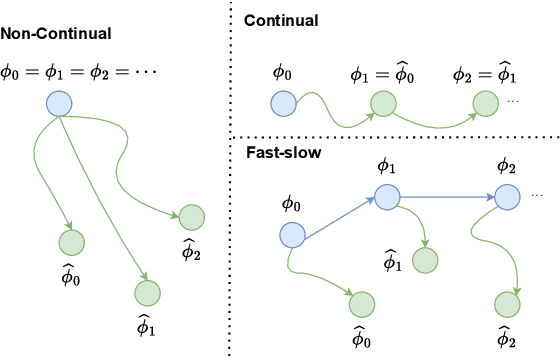
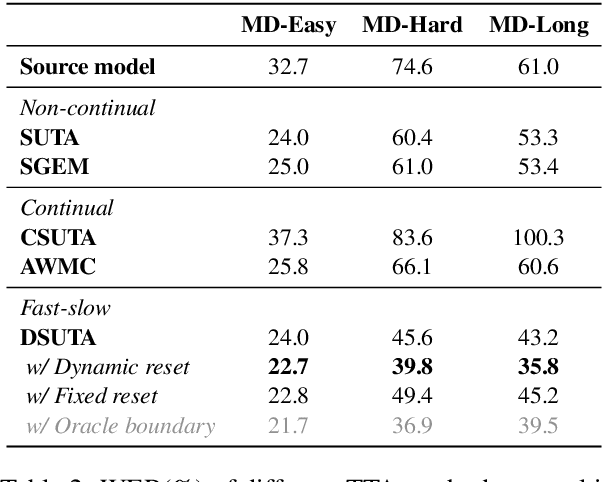
Deep learning-based end-to-end automatic speech recognition (ASR) has made significant strides but still struggles with performance on out-of-domain (OOD) samples due to domain shifts in real-world scenarios. Test-Time Adaptation (TTA) methods address this issue by adapting models using test samples at inference time. However, current ASR TTA methods have largely focused on non-continual TTA, which limits cross-sample knowledge learning compared to continual TTA. In this work, we propose a Fast-slow TTA framework for ASR, which leverages the advantage of continual and non-continual TTA. Within this framework, we introduce Dynamic SUTA (DSUTA), an entropy-minimization-based continual TTA method for ASR. To enhance DSUTA's robustness on time-varying data, we propose a dynamic reset strategy that automatically detects domain shifts and resets the model, making it more effective at handling multi-domain data. Our method demonstrates superior performance on various noisy ASR datasets, outperforming both non-continual and continual TTA baselines while maintaining robustness to domain changes without requiring domain boundary information.
On the Evaluation of Speech Foundation Models for Spoken Language Understanding
Jun 14, 2024The Spoken Language Understanding Evaluation (SLUE) suite of benchmark tasks was recently introduced to address the need for open resources and benchmarking of complex spoken language understanding (SLU) tasks, including both classification and sequence generation tasks, on natural speech. The benchmark has demonstrated preliminary success in using pre-trained speech foundation models (SFM) for these SLU tasks. However, the community still lacks a fine-grained understanding of the comparative utility of different SFMs. Inspired by this, we ask: which SFMs offer the most benefits for these complex SLU tasks, and what is the most effective approach for incorporating these SFMs? To answer this, we perform an extensive evaluation of multiple supervised and self-supervised SFMs using several evaluation protocols: (i) frozen SFMs with a lightweight prediction head, (ii) frozen SFMs with a complex prediction head, and (iii) fine-tuned SFMs with a lightweight prediction head. Although the supervised SFMs are pre-trained on much more speech recognition data (with labels), they do not always outperform self-supervised SFMs; the latter tend to perform at least as well as, and sometimes better than, supervised SFMs, especially on the sequence generation tasks in SLUE. While there is no universally optimal way of incorporating SFMs, the complex prediction head gives the best performance for most tasks, although it increases the inference time. We also introduce an open-source toolkit and performance leaderboard, SLUE-PERB, for these tasks and modeling strategies.
StreamBench: Towards Benchmarking Continuous Improvement of Language Agents
Jun 13, 2024Recent works have shown that large language model (LLM) agents are able to improve themselves from experience, which is an important ability for continuous enhancement post-deployment. However, existing benchmarks primarily evaluate their innate capabilities and do not assess their ability to improve over time. To address this gap, we introduce StreamBench, a pioneering benchmark designed to evaluate the continuous improvement of LLM agents over an input-feedback sequence. StreamBench simulates an online learning environment where LLMs receive a continuous flow of feedback stream and iteratively enhance their performance. In addition, we propose several simple yet effective baselines for improving LLMs on StreamBench, and provide a comprehensive analysis to identify critical components that contribute to successful streaming strategies. Our work serves as a stepping stone towards developing effective online learning strategies for LLMs, paving the way for more adaptive AI systems in streaming scenarios.
Understanding Sounds, Missing the Questions: The Challenge of Object Hallucination in Large Audio-Language Models
Jun 12, 2024
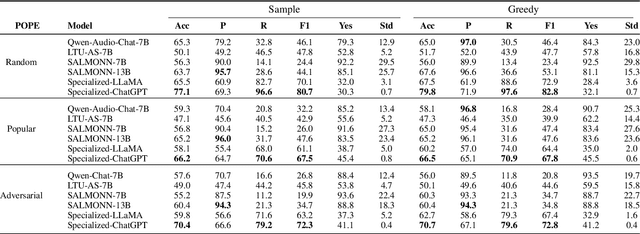
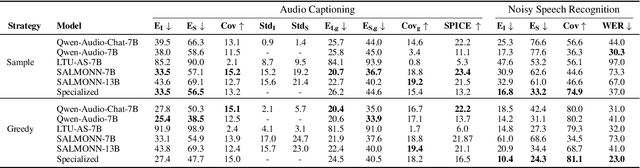
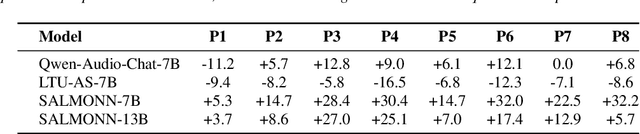
Large audio-language models (LALMs) enhance traditional large language models by integrating audio perception capabilities, allowing them to tackle audio-related tasks. Previous research has primarily focused on assessing the performance of LALMs across various tasks, yet overlooking their reliability, particularly concerning issues like object hallucination. In our study, we introduce methods to assess the extent of object hallucination of publicly available LALMs. Our findings reveal that LALMs are comparable to specialized audio captioning models in their understanding of audio content, but struggle to answer discriminative questions, specifically those requiring the identification of the presence of particular object sounds within an audio clip. This limitation highlights a critical weakness in current LALMs: their inadequate understanding of discriminative queries. Moreover, we explore the potential of prompt engineering to enhance LALMs' performance on discriminative questions.
ML-SUPERB 2.0: Benchmarking Multilingual Speech Models Across Modeling Constraints, Languages, and Datasets
Jun 12, 2024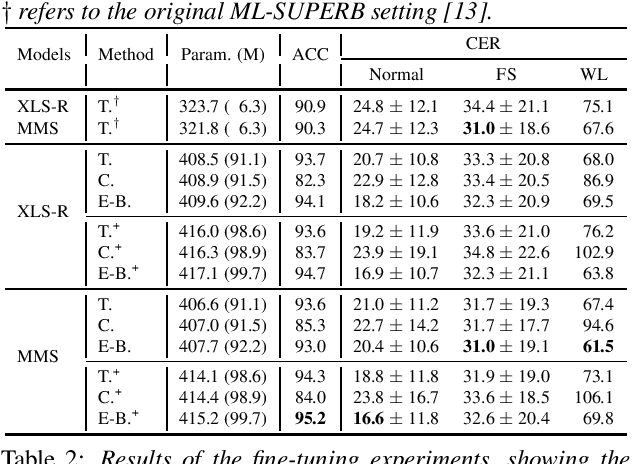
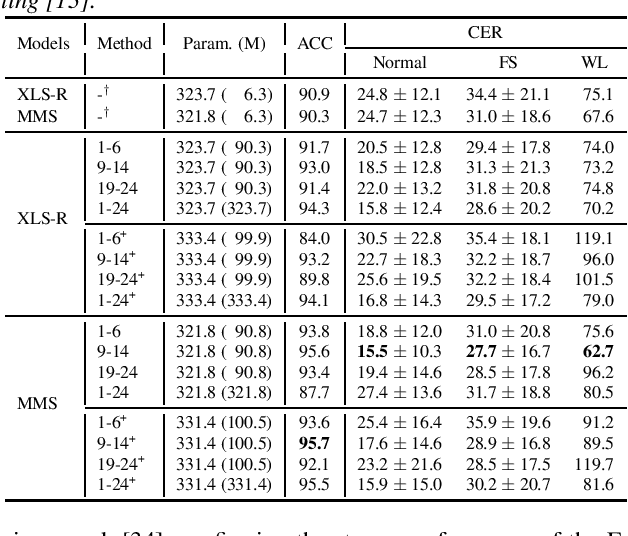
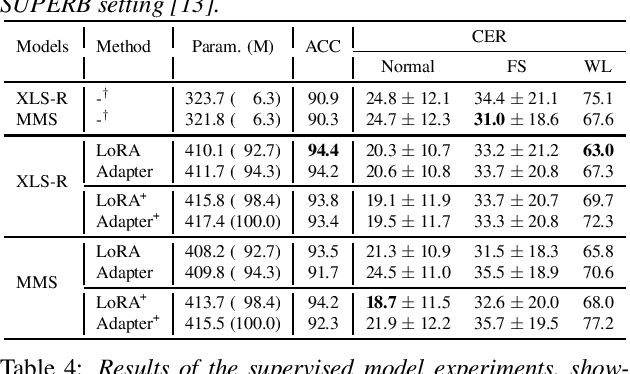
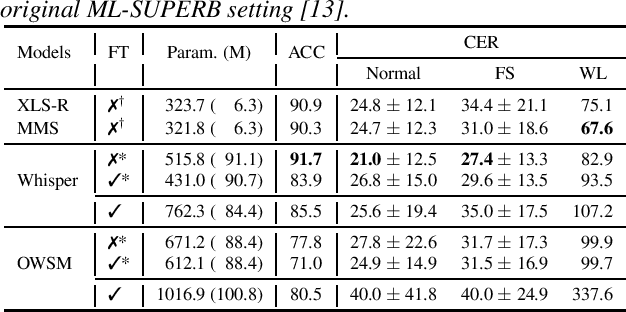
ML-SUPERB evaluates self-supervised learning (SSL) models on the tasks of language identification and automatic speech recognition (ASR). This benchmark treats the models as feature extractors and uses a single shallow downstream model, which can be fine-tuned for a downstream task. However, real-world use cases may require different configurations. This paper presents ML-SUPERB~2.0, which is a new benchmark for evaluating pre-trained SSL and supervised speech models across downstream models, fine-tuning setups, and efficient model adaptation approaches. We find performance improvements over the setup of ML-SUPERB. However, performance depends on the downstream model design. Also, we find large performance differences between languages and datasets, suggesting the need for more targeted approaches to improve multilingual ASR performance.