 Add to Chrome
 Add to Firefox
 Add to Edge
MaskMoE: Boosting Token-Level Learning via Routing Mask in Mixture-of-Experts
Jul 13, 2024
Scaling model capacity enhances its capabilities but significantly increases computation. Mixture-of-Experts models (MoEs) address this by allowing model capacity to scale without substantially increasing training or inference costs. Despite their promising results, MoE models encounter several challenges. Primarily, the dispersion of training tokens across multiple experts can lead to underfitting, particularly for infrequent tokens. Additionally, while fixed routing mechanisms can mitigate this issue, they compromise on the diversity of representations. In this paper, we propose MaskMoE, a method designed to enhance token-level learning by employing a routing masking technique within the Mixture-of-Experts model. MaskMoE is capable of maintaining representation diversity while achieving more comprehensive training. Experimental results demonstrate that our method outperforms previous dominant Mixture-of-Experts models in both perplexity (PPL) and downstream tasks.

AoA-Based Physical Layer Authentication in Analog Arrays under Impersonation Attacks
Jul 11, 2024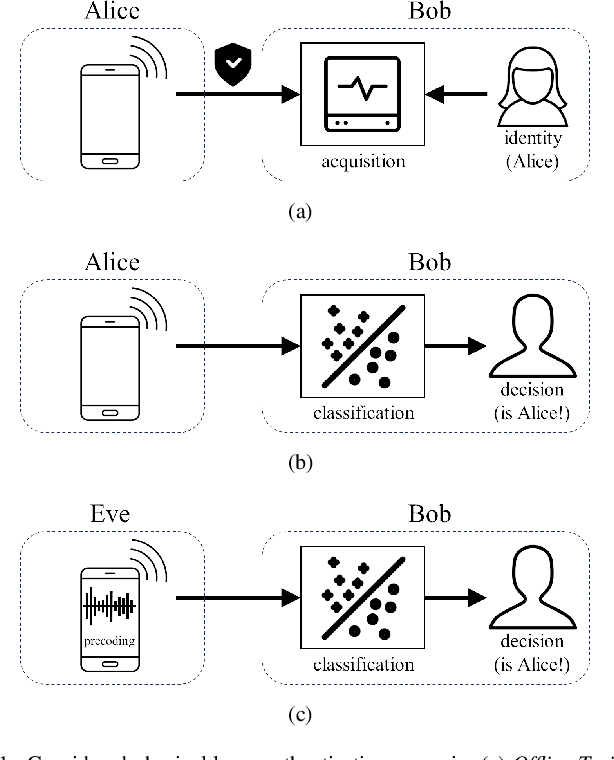
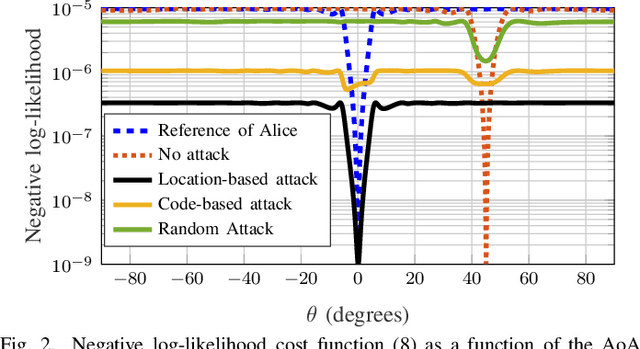
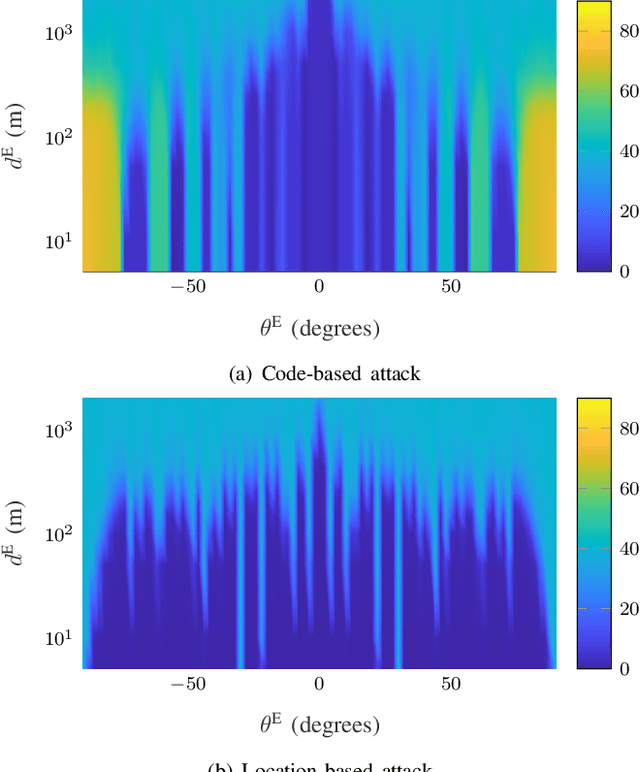

We discuss the use of angle of arrival (AoA) as an authentication measure in analog array multiple-input multiple-output (MIMO) systems. A base station equipped with an analog array authenticates users based on the AoA estimated from certified pilot transmissions, while active attackers manipulate their transmitted signals to mount impersonation attacks. We study several attacks of increasing intensity (captured through the availability of side information at the attackers) and assess the performance of AoA-based authentication using one-class classifiers. Our results show that some attack techniques with knowledge of the combiners at the verifier are effective in falsifying the AoA and compromising the security of the considered type of physical layer authentication.
V2X Sidelink Positioning in FR1: From Ray-Tracing and Channel Estimation to Bayesian Tracking
Jun 25, 2024Sidelink positioning research predominantly focuses on the snapshot positioning problem, often within the mmWave band. Only a limited number of studies have delved into vehicle-to-anything (V2X) tracking within sub-6 GHz bands. In this paper, we investigate the V2X sidelink tracking challenges over sub-6 GHz frequencies. We propose a Kalman-filter-based tracking approach that leverages the estimated error covariance lower bounds (EECLBs) as measurement covariance, alongside a gating method to augment tracking performance. Through simulations employing ray-tracing data and super-resolution channel parameter estimation, we validate the feasibility of sidelink tracking using our proposed tracking filter with two novel EECLBs. Additionally, we demonstrate the efficacy of the gating method in identifying line-of-sight paths and enhancing tracking performance.
Perceiver-Prompt: Flexible Speaker Adaptation in Whisper for Chinese Disordered Speech Recognition
Jun 14, 2024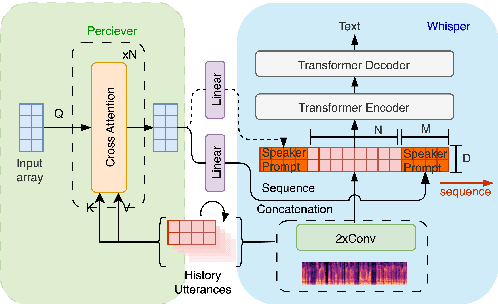
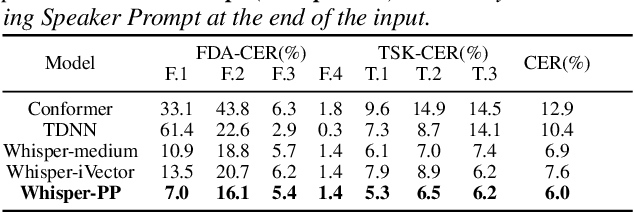
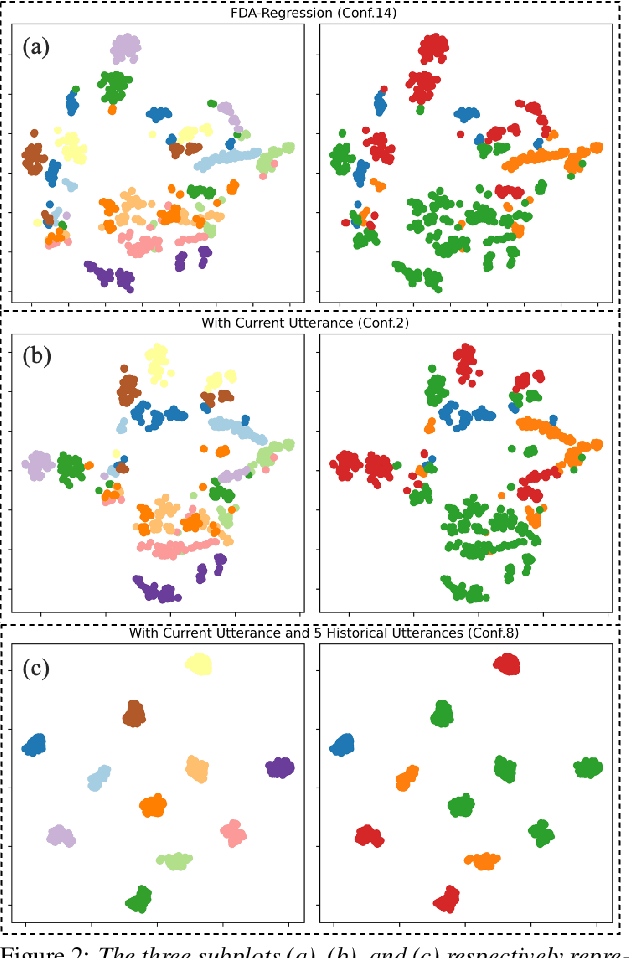
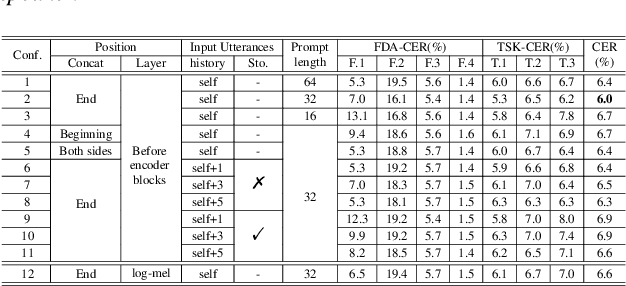
Disordered speech recognition profound implications for improving the quality of life for individuals afflicted with, for example, dysarthria. Dysarthric speech recognition encounters challenges including limited data, substantial dissimilarities between dysarthric and non-dysarthric speakers, and significant speaker variations stemming from the disorder. This paper introduces Perceiver-Prompt, a method for speaker adaptation that utilizes P-Tuning on the Whisper large-scale model. We first fine-tune Whisper using LoRA and then integrate a trainable Perceiver to generate fixed-length speaker prompts from variable-length inputs, to improve model recognition of Chinese dysarthric speech. Experimental results from our Chinese dysarthric speech dataset demonstrate consistent improvements in recognition performance with Perceiver-Prompt. Relative reduction up to 13.04% in CER is obtained over the fine-tuned Whisper.
Ghost imaging-based Non-contact Heart Rate Detection
Jun 04, 2024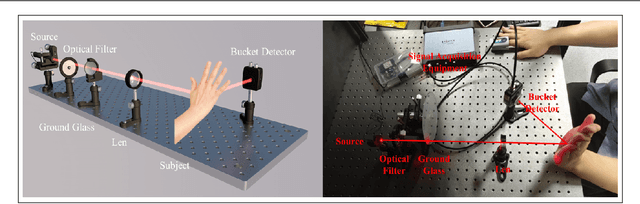
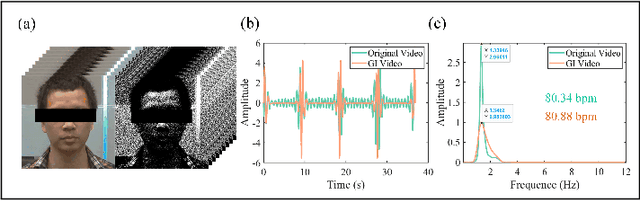
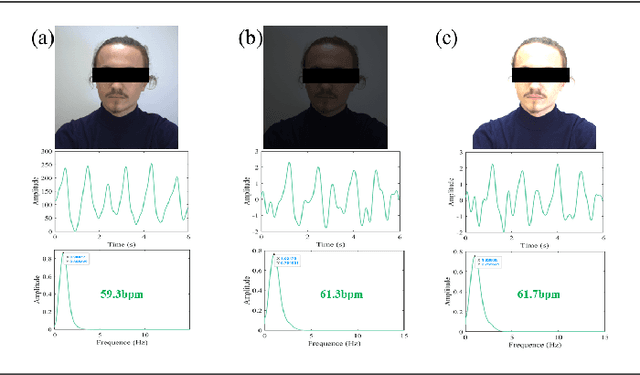
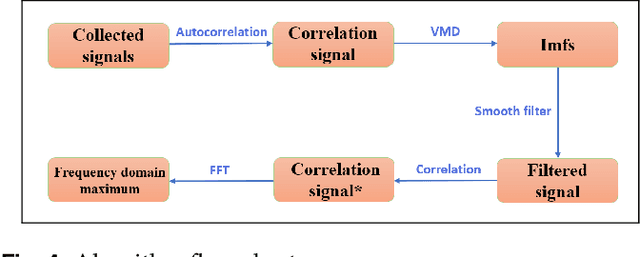
Remote heart rate measurement is an increasingly concerned research field, usually using remote photoplethysmography (rPPG) to collect heart rate information through video data collection. However, in certain specific scenarios (such as low light conditions, intense lighting, and non-line-of-sight situations), traditional imaging methods fail to capture image information effectively, that may lead to difficulty or inability in measuring heart rate. To address these limitations, this study proposes using ghost imaging as a substitute for traditional imaging in the aforementioned scenarios. The mean absolute error between experimental measurements and reference true values is 4.24 bpm.Additionally, the bucket signals obtained by the ghost imaging system can be directly processed using digital signal processing techniques, thereby enhancing personal privacy protection.
ParamReL: Learning Parameter Space Representation via Progressively Encoding Bayesian Flow Networks
May 24, 2024The recently proposed Bayesian Flow Networks~(BFNs) show great potential in modeling parameter spaces, offering a unified strategy for handling continuous, discretized, and discrete data. However, BFNs cannot learn high-level semantic representation from the parameter space since {common encoders, which encode data into one static representation, cannot capture semantic changes in parameters.} This motivates a new direction: learning semantic representations hidden in the parameter spaces to characterize mixed-typed noisy data. {Accordingly, we propose a representation learning framework named ParamReL, which operates in the parameter space to obtain parameter-wise latent semantics that exhibit progressive structures. Specifically, ParamReL proposes a \emph{self-}encoder to learn latent semantics directly from parameters, rather than from observations. The encoder is then integrated into BFNs, enabling representation learning with various formats of observations. Mutual information terms further promote the disentanglement of latent semantics and capture meaningful semantics simultaneously.} We illustrate {conditional generation and reconstruction} in ParamReL via expanding BFNs, and extensive {quantitative} experimental results demonstrate the {superior effectiveness} of ParamReL in learning parameter representation.
YOLOv10: Real-Time End-to-End Object Detection
May 23, 2024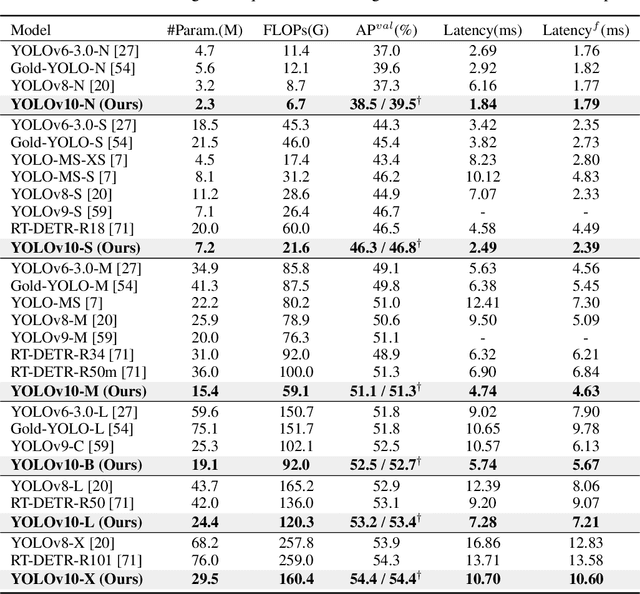
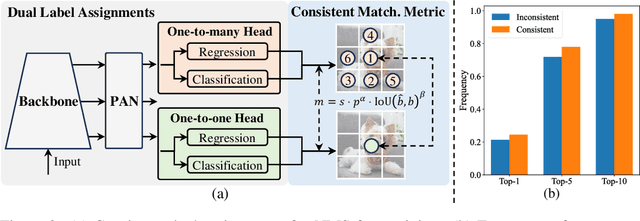
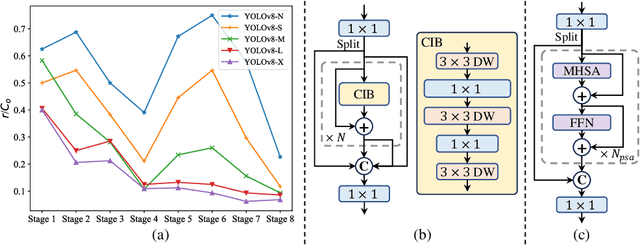
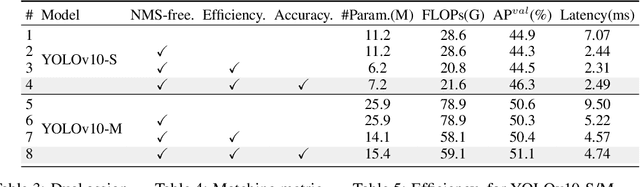
Over the past years, YOLOs have emerged as the predominant paradigm in the field of real-time object detection owing to their effective balance between computational cost and detection performance. Researchers have explored the architectural designs, optimization objectives, data augmentation strategies, and others for YOLOs, achieving notable progress. However, the reliance on the non-maximum suppression (NMS) for post-processing hampers the end-to-end deployment of YOLOs and adversely impacts the inference latency. Besides, the design of various components in YOLOs lacks the comprehensive and thorough inspection, resulting in noticeable computational redundancy and limiting the model's capability. It renders the suboptimal efficiency, along with considerable potential for performance improvements. In this work, we aim to further advance the performance-efficiency boundary of YOLOs from both the post-processing and model architecture. To this end, we first present the consistent dual assignments for NMS-free training of YOLOs, which brings competitive performance and low inference latency simultaneously. Moreover, we introduce the holistic efficiency-accuracy driven model design strategy for YOLOs. We comprehensively optimize various components of YOLOs from both efficiency and accuracy perspectives, which greatly reduces the computational overhead and enhances the capability. The outcome of our effort is a new generation of YOLO series for real-time end-to-end object detection, dubbed YOLOv10. Extensive experiments show that YOLOv10 achieves state-of-the-art performance and efficiency across various model scales. For example, our YOLOv10-S is 1.8$\times$ faster than RT-DETR-R18 under the similar AP on COCO, meanwhile enjoying 2.8$\times$ smaller number of parameters and FLOPs. Compared with YOLOv9-C, YOLOv10-B has 46\% less latency and 25\% fewer parameters for the same performance.
More is Better: Deep Domain Adaptation with Multiple Sources
May 01, 2024In many practical applications, it is often difficult and expensive to obtain large-scale labeled data to train state-of-the-art deep neural networks. Therefore, transferring the learned knowledge from a separate, labeled source domain to an unlabeled or sparsely labeled target domain becomes an appealing alternative. However, direct transfer often results in significant performance decay due to domain shift. Domain adaptation (DA) aims to address this problem by aligning the distributions between the source and target domains. Multi-source domain adaptation (MDA) is a powerful and practical extension in which the labeled data may be collected from multiple sources with different distributions. In this survey, we first define various MDA strategies. Then we systematically summarize and compare modern MDA methods in the deep learning era from different perspectives, followed by commonly used datasets and a brief benchmark. Finally, we discuss future research directions for MDA that are worth investigating.
Beamforming Inferring by Conditional WGAN-GP for Holographic Antenna Arrays
May 01, 2024The beamforming technology with large holographic antenna arrays is one of the key enablers for the next generation of wireless systems, which can significantly improve the spectral efficiency. However, the deployment of large antenna arrays implies high algorithm complexity and resource overhead at both receiver and transmitter ends. To address this issue, advanced technologies such as artificial intelligence have been developed to reduce beamforming overhead. Intuitively, if we can implement the near-optimal beamforming only using a tiny subset of the all channel information, the overhead for channel estimation and beamforming would be reduced significantly compared with the traditional beamforming methods that usually need full channel information and the inversion of large dimensional matrix. In light of this idea, we propose a novel scheme that utilizes Wasserstein generative adversarial network with gradient penalty to infer the full beamforming matrices based on very little of channel information. Simulation results confirm that it can accomplish comparable performance with the weighted minimum mean-square error algorithm, while reducing the overhead by over 50%.
Scaffold-BPE: Enhancing Byte Pair Encoding with Simple and Effective Scaffold Token Removal
Apr 27, 2024Byte Pair Encoding (BPE) serves as a foundation method for text tokenization in the Natural Language Processing (NLP) field. Despite its wide adoption, the original BPE algorithm harbors an inherent flaw: it inadvertently introduces a frequency imbalance for tokens in the text corpus. Since BPE iteratively merges the most frequent token pair in the text corpus while keeping all tokens that have been merged in the vocabulary, it unavoidably holds tokens that primarily represent subwords of complete words and appear infrequently on their own in the text corpus. We term such tokens as Scaffold Tokens. Due to their infrequent appearance in the text corpus, Scaffold Tokens pose a learning imbalance issue for language models. To address that issue, we propose Scaffold-BPE, which incorporates a dynamic scaffold token removal mechanism by parameter-free, computation-light, and easy-to-implement modifications to the original BPE. This novel approach ensures the exclusion of low-frequency Scaffold Tokens from the token representations for the given texts, thereby mitigating the issue of frequency imbalance and facilitating model training. On extensive experiments across language modeling tasks and machine translation tasks, Scaffold-BPE consistently outperforms the original BPE, well demonstrating its effectiveness and superiority.