 Add to Chrome
 Add to Firefox
 Add to Edge
Temporal Leakage in Financial News NLP: A Multi-Architecture Audit with a Regime-Specific M&A Signal
Aug 18, 2026
Financial-news direction prediction has become a popular NLP benchmark, yet reported gains depend critically on whether the train-test split is chronological or random, i.e., on temporal leakage. We audit this dependence on a 49,799-article corpus across 16 feature-model combinations spanning TF-IDF, MiniLM, FinBERT, and fine-tuned RoBERTa-large / DeBERTa-v3-large, plus separate zero/few-shot and LoRA probes of Llama-3 and Qwen2.5 LLMs: random splits inflate MCC by $1.1\times$ to $6.5\times$, tracking model capacity and feature richness, and end-to-end FinBERT fine-tuning re-amplifies rather than closes the gap (size-matched ratio $1.75\times$). Conditioning on event type, mergers and acquisitions (M&A) is the only audited category with a positive locked-test signal under near-temporal chronological evaluation (TF-IDF MCC $= 0.138$ train-only, $0.068$ under train$\cup$val refit; 10,000-permutation $p < 10^{-3}$); the signal does not transfer to FNSPID's 2009-2020 U.S. corpus, localising the headline to our 2024-2025 European-tilted M&A semantics rather than a universal predictor. Three independent role labellers converge on acquirer-tagged articles as the signal locus, a power-limited qualitative convergence rather than a hypothesis-tested asymmetry. Chronological splitting plays for financial NLP the role characteristics-purging plays for asset pricing: it strips the predictable, stale component of news and leaves a residual that is small, event-localized, and lexically shallow. We advocate leakage audits as a required disclosure for financial-NLP benchmarks.

From Single- to Cross-Document: Benchmarking Multi-Granularity Event Analysis of Large Language Models
Jul 30, 2026Event analysis is an essential and fundamental direction of information extraction, involving various event-centric tasks at different granularity of documents. While large language models (LLMs) have preliminarily achieved promising performance in part of these tasks individually, their capability in event analysis still lacks comprehensive understanding due to restricted document granularity, task designs, and data source of existing benchmarks. To address these limitations, we introduce MiGUE-Bench, a systematic benchmark for assessing the performance of LLMs in multi-granularity event analysis. To support large-scale evaluation, we first develop an LLM-driven self-correcting annotation framework called MiGUE-Pipeline, enabling scalable acquisition of high-quality source data of events with automatic labels. Then, we design four core tasks in our benchmark, i.e., event detection, relation reasoning, structure induction, and future prediction, to probe model competence at different levels, from atomic event details to complex cross-document narratives. Extensive experiments on state-of-the-art LLMs and retrieval-augmented generation (RAG) methods delineate the current capability boundary and identify critical deficiencies, providing insights into the future improvement of LLMs in challenging event analysis tasks.
* 9 pages. Published in the Proceedings of the 49th International ACM SIGIR Conference on Research and Development in Information Retrieval (SIGIR 2026)
QSVideo: Query-Conditioned Semantic Temporal Retrieval for Video Understanding
Jul 06, 2026The performance of vision-language models (VLMs) in video understanding declines with increasing video duration, as video moments unrelated to the query confuse their language components. Multimodal retrieval has emerged as a critical component of video understanding, addressing this challenge by localizing key visual evidence. However, existing multimodal retrieval methods suffer from biased relevance estimation, limited diversity, and temporal collapse. In this paper, we propose QSVideo, a unified framework that systematically addresses relevance, diversity, and temporal modeling in video retrieval. We first introduce a query-conditioned semantic ranker, QSRanker, which reformulates arbitrary questions into retrieval-friendly queries and estimates structured relevance along object, action, and location dimensions. Building upon this, we design QSRetrieval to jointly optimize relevance and diversity for more informative frame selection. Moreover, we propose temporal alignment strategies tailored for both long and streaming videos to improve evidence recall. Extensive experiments on long and streaming video benchmarks demonstrate that QSVideo greatly enhances video VLM performance under strict frame limit constraints. The code is available at https://github.com/human-analysis/QSVideo.
Looping Back to Move Forward: Recursive Transformers for Efficient and Flexible Large Multimodal Models
Feb 09, 2026Large Multimodal Models (LMMs) have achieved remarkable success in vision-language tasks, yet their vast parameter counts are often underutilized during both training and inference. In this work, we embrace the idea of looping back to move forward: reusing model parameters through recursive refinement to extract stronger multimodal representations without increasing model size. We propose RecursiveVLM, a recursive Transformer architecture tailored for LMMs. Two key innovations enable effective looping: (i) a Recursive Connector that aligns features across recursion steps by fusing intermediate-layer hidden states and applying modality-specific projections, respecting the distinct statistical structures of vision and language tokens; (ii) a Monotonic Recursion Loss that supervises every step and guarantees performance improves monotonically with recursion depth. This design transforms recursion into an on-demand refinement mechanism: delivering strong results with few loops on resource-constrained devices and progressively improving outputs when more computation resources are available. Experiments show consistent gains of +3% over standard Transformers and +7% over vanilla recursive baselines, demonstrating that strategic looping is a powerful path toward efficient, deployment-adaptive LMMs.
Double Fairness Policy Learning: Integrating Action Fairness and Outcome Fairness in Decision-making
Jan 27, 2026Fairness is a central pillar of trustworthy machine learning, especially in domains where accuracy- or profit-driven optimization is insufficient. While most fairness research focuses on supervised learning, fairness in policy learning remains less explored. Because policy learning is interventional, it induces two distinct fairness targets: action fairness (equitable action assignments) and outcome fairness (equitable downstream consequences). Crucially, equalizing actions does not generally equalize outcomes when groups face different constraints or respond differently to the same action. We propose a novel double fairness learning (DFL) framework that explicitly manages the trade-off among three objectives: action fairness, outcome fairness, and value maximization. We integrate fairness directly into a multi-objective optimization problem for policy learning and employ a lexicographic weighted Tchebyshev method that recovers Pareto solutions beyond convex settings, with theoretical guarantees on the regret bounds. Our framework is flexible and accommodates various commonly used fairness notions. Extensive simulations demonstrate improved performance relative to competing methods. In applications to a motor third-party liability insurance dataset and an entrepreneurship training dataset, DFL substantially improves both action and outcome fairness while incurring only a modest reduction in overall value.
Causally-Grounded Dual-Path Attention Intervention for Object Hallucination Mitigation in LVLMs
Nov 12, 2025Object hallucination remains a critical challenge in Large Vision-Language Models (LVLMs), where models generate content inconsistent with visual inputs. Existing language-decoder based mitigation approaches often regulate visual or textual attention independently, overlooking their interaction as two key causal factors. To address this, we propose Owl (Bi-mOdal attention reWeighting for Layer-wise hallucination mitigation), a causally-grounded framework that models hallucination process via a structural causal graph, treating decomposed visual and textual attentions as mediators. We introduce VTACR (Visual-to-Textual Attention Contribution Ratio), a novel metric that quantifies the modality contribution imbalance during decoding. Our analysis reveals that hallucinations frequently occur in low-VTACR scenarios, where textual priors dominate and visual grounding is weakened. To mitigate this, we design a fine-grained attention intervention mechanism that dynamically adjusts token- and layer-wise attention guided by VTACR signals. Finally, we propose a dual-path contrastive decoding strategy: one path emphasizes visually grounded predictions, while the other amplifies hallucinated ones -- letting visual truth shine and hallucination collapse. Experimental results on the POPE and CHAIR benchmarks show that Owl achieves significant hallucination reduction, setting a new SOTA in faithfulness while preserving vision-language understanding capability. Our code is available at https://github.com/CikZ2023/OWL
Ming-Omni: A Unified Multimodal Model for Perception and Generation
Jun 11, 2025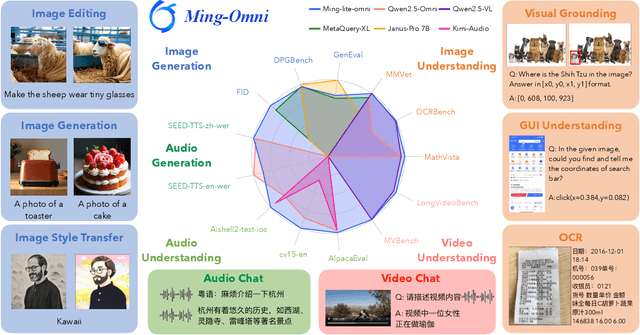
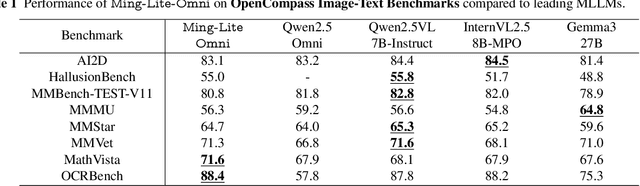
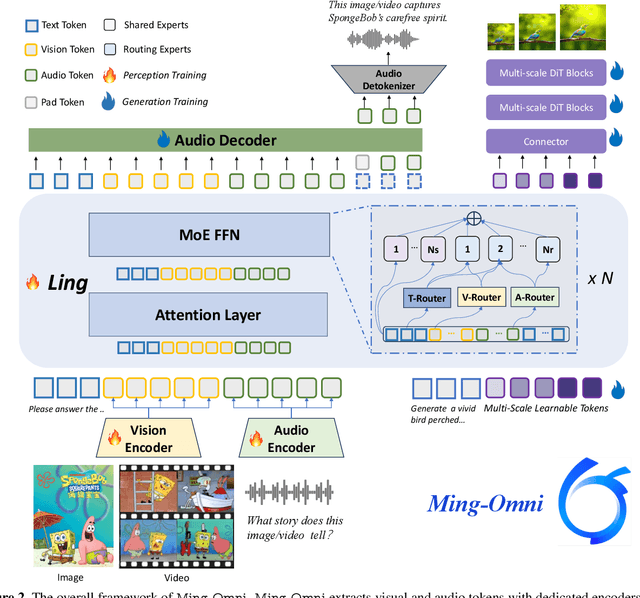
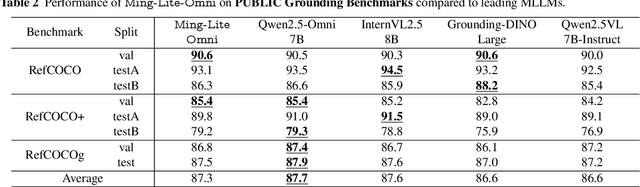
We propose Ming-Omni, a unified multimodal model capable of processing images, text, audio, and video, while demonstrating strong proficiency in both speech and image generation. Ming-Omni employs dedicated encoders to extract tokens from different modalities, which are then processed by Ling, an MoE architecture equipped with newly proposed modality-specific routers. This design enables a single model to efficiently process and fuse multimodal inputs within a unified framework, thereby facilitating diverse tasks without requiring separate models, task-specific fine-tuning, or structural redesign. Importantly, Ming-Omni extends beyond conventional multimodal models by supporting audio and image generation. This is achieved through the integration of an advanced audio decoder for natural-sounding speech and Ming-Lite-Uni for high-quality image generation, which also allow the model to engage in context-aware chatting, perform text-to-speech conversion, and conduct versatile image editing. Our experimental results showcase Ming-Omni offers a powerful solution for unified perception and generation across all modalities. Notably, our proposed Ming-Omni is the first open-source model we are aware of to match GPT-4o in modality support, and we release all code and model weights to encourage further research and development in the community.
Multimodal Transformers are Hierarchical Modal-wise Heterogeneous Graphs
May 02, 2025Multimodal Sentiment Analysis (MSA) is a rapidly developing field that integrates multimodal information to recognize sentiments, and existing models have made significant progress in this area. The central challenge in MSA is multimodal fusion, which is predominantly addressed by Multimodal Transformers (MulTs). Although act as the paradigm, MulTs suffer from efficiency concerns. In this work, from the perspective of efficiency optimization, we propose and prove that MulTs are hierarchical modal-wise heterogeneous graphs (HMHGs), and we introduce the graph-structured representation pattern of MulTs. Based on this pattern, we propose an Interlaced Mask (IM) mechanism to design the Graph-Structured and Interlaced-Masked Multimodal Transformer (GsiT). It is formally equivalent to MulTs which achieves an efficient weight-sharing mechanism without information disorder through IM, enabling All-Modal-In-One fusion with only 1/3 of the parameters of pure MulTs. A Triton kernel called Decomposition is implemented to ensure avoiding additional computational overhead. Moreover, it achieves significantly higher performance than traditional MulTs. To further validate the effectiveness of GsiT itself and the HMHG concept, we integrate them into multiple state-of-the-art models and demonstrate notable performance improvements and parameter reduction on widely used MSA datasets.
Dynamic QoS Prediction via a Non-Negative Tensor Snowflake Factorization
Apr 24, 2025Dynamic quality of service (QoS) data exhibit rich temporal patterns in user-service interactions, which are crucial for a comprehensive understanding of user behavior and service conditions in Web service. As the number of users and services increases, there is a large amount of unobserved QoS data, which significantly affects users'choice of services. To predict unobserved QoS data, we propose a Non-negative Snowflake Factorization of tensors model. This method designs a snowflake core tensor to enhance the model's learning capability. Additionally, it employs a single latent factor-based, nonnegative multiplication update on tensor (SLF-NMUT) for parameter learning. Empirical results demonstrate that the proposed model more accurately learns dynamic user-service interaction patterns, thereby yielding improved predictions for missing QoS data.
Water Quality Data Imputation via A Fast Latent Factorization of Tensors with PID-based Optimizer
Mar 10, 2025Water quality data can supply a substantial decision support for water resources utilization and pollution prevention. However, there are numerous missing values in water quality data due to inescapable factors like sensor failure, thereby leading to biased result for hydrological analysis and failing to support environmental governance decision accurately. A Latent Factorization of Tensors (LFT) with Stochastic Gradient Descent (SGD) proves to be an efficient imputation method. However, a standard SGD-based LFT model commonly surfers from the slow convergence that impairs its efficiency. To tackle this issue, this paper proposes a Fast Latent Factorization of Tensors (FLFT) model. It constructs an adjusted instance error into SGD via leveraging a nonlinear PID controller to incorporates the past, current and future information of prediction error for improving convergence rate. Comparing with state-of-art models in real world datasets, the results of experiment indicate that the FLFT model achieves a better convergence rate and higher accuracy.