 Add to Chrome
 Add to Firefox
 Add to Edge
Towards Physically Plausible Video Generation via VLM Planning
Mar 30, 2025
Video diffusion models (VDMs) have advanced significantly in recent years, enabling the generation of highly realistic videos and drawing the attention of the community in their potential as world simulators. However, despite their capabilities, VDMs often fail to produce physically plausible videos due to an inherent lack of understanding of physics, resulting in incorrect dynamics and event sequences. To address this limitation, we propose a novel two-stage image-to-video generation framework that explicitly incorporates physics. In the first stage, we employ a Vision Language Model (VLM) as a coarse-grained motion planner, integrating chain-of-thought and physics-aware reasoning to predict a rough motion trajectories/changes that approximate real-world physical dynamics while ensuring the inter-frame consistency. In the second stage, we use the predicted motion trajectories/changes to guide the video generation of a VDM. As the predicted motion trajectories/changes are rough, noise is added during inference to provide freedom to the VDM in generating motion with more fine details. Extensive experimental results demonstrate that our framework can produce physically plausible motion, and comparative evaluations highlight the notable superiority of our approach over existing methods. More video results are available on our Project Page: https://madaoer.github.io/projects/physically_plausible_video_generation.

Mono2Stereo: A Benchmark and Empirical Study for Stereo Conversion
Mar 28, 2025With the rapid proliferation of 3D devices and the shortage of 3D content, stereo conversion is attracting increasing attention. Recent works introduce pretrained Diffusion Models (DMs) into this task. However, due to the scarcity of large-scale training data and comprehensive benchmarks, the optimal methodologies for employing DMs in stereo conversion and the accurate evaluation of stereo effects remain largely unexplored. In this work, we introduce the Mono2Stereo dataset, providing high-quality training data and benchmark to support in-depth exploration of stereo conversion. With this dataset, we conduct an empirical study that yields two primary findings. 1) The differences between the left and right views are subtle, yet existing metrics consider overall pixels, failing to concentrate on regions critical to stereo effects. 2) Mainstream methods adopt either one-stage left-to-right generation or warp-and-inpaint pipeline, facing challenges of degraded stereo effect and image distortion respectively. Based on these findings, we introduce a new evaluation metric, Stereo Intersection-over-Union, which prioritizes disparity and achieves a high correlation with human judgments on stereo effect. Moreover, we propose a strong baseline model, harmonizing the stereo effect and image quality simultaneously, and notably surpassing current mainstream methods. Our code and data will be open-sourced to promote further research in stereo conversion. Our models are available at mono2stereo-bench.github.io.
IDEA: Inverted Text with Cooperative Deformable Aggregation for Multi-modal Object Re-Identification
Mar 13, 2025Multi-modal object Re-IDentification (ReID) aims to retrieve specific objects by utilizing complementary information from various modalities. However, existing methods focus on fusing heterogeneous visual features, neglecting the potential benefits of text-based semantic information. To address this issue, we first construct three text-enhanced multi-modal object ReID benchmarks. To be specific, we propose a standardized multi-modal caption generation pipeline for structured and concise text annotations with Multi-modal Large Language Models (MLLMs). Besides, current methods often directly aggregate multi-modal information without selecting representative local features, leading to redundancy and high complexity. To address the above issues, we introduce IDEA, a novel feature learning framework comprising the Inverted Multi-modal Feature Extractor (IMFE) and Cooperative Deformable Aggregation (CDA). The IMFE utilizes Modal Prefixes and an InverseNet to integrate multi-modal information with semantic guidance from inverted text. The CDA adaptively generates sampling positions, enabling the model to focus on the interplay between global features and discriminative local features. With the constructed benchmarks and the proposed modules, our framework can generate more robust multi-modal features under complex scenarios. Extensive experiments on three multi-modal object ReID benchmarks demonstrate the effectiveness of our proposed method.
CineMaster: A 3D-Aware and Controllable Framework for Cinematic Text-to-Video Generation
Feb 12, 2025In this work, we present CineMaster, a novel framework for 3D-aware and controllable text-to-video generation. Our goal is to empower users with comparable controllability as professional film directors: precise placement of objects within the scene, flexible manipulation of both objects and camera in 3D space, and intuitive layout control over the rendered frames. To achieve this, CineMaster operates in two stages. In the first stage, we design an interactive workflow that allows users to intuitively construct 3D-aware conditional signals by positioning object bounding boxes and defining camera movements within the 3D space. In the second stage, these control signals--comprising rendered depth maps, camera trajectories and object class labels--serve as the guidance for a text-to-video diffusion model, ensuring to generate the user-intended video content. Furthermore, to overcome the scarcity of in-the-wild datasets with 3D object motion and camera pose annotations, we carefully establish an automated data annotation pipeline that extracts 3D bounding boxes and camera trajectories from large-scale video data. Extensive qualitative and quantitative experiments demonstrate that CineMaster significantly outperforms existing methods and implements prominent 3D-aware text-to-video generation. Project page: https://cinemaster-dev.github.io/.
EVEv2: Improved Baselines for Encoder-Free Vision-Language Models
Feb 10, 2025


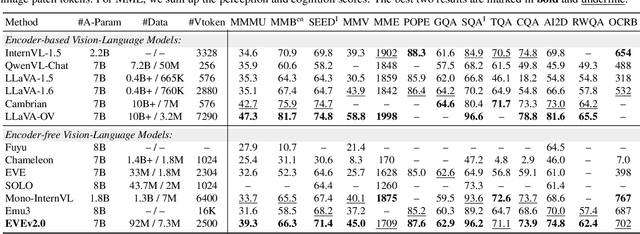
Existing encoder-free vision-language models (VLMs) are rapidly narrowing the performance gap with their encoder-based counterparts, highlighting the promising potential for unified multimodal systems with structural simplicity and efficient deployment. We systematically clarify the performance gap between VLMs using pre-trained vision encoders, discrete tokenizers, and minimalist visual layers from scratch, deeply excavating the under-examined characteristics of encoder-free VLMs. We develop efficient strategies for encoder-free VLMs that rival mainstream encoder-based ones. After an in-depth investigation, we launch EVEv2.0, a new and improved family of encoder-free VLMs. We show that: (i) Properly decomposing and hierarchically associating vision and language within a unified model reduces interference between modalities. (ii) A well-designed training strategy enables effective optimization for encoder-free VLMs. Through extensive evaluation, our EVEv2.0 represents a thorough study for developing a decoder-only architecture across modalities, demonstrating superior data efficiency and strong vision-reasoning capability. Code is publicly available at: https://github.com/baaivision/EVE.
KARST: Multi-Kernel Kronecker Adaptation with Re-Scaling Transmission for Visual Classification
Feb 10, 2025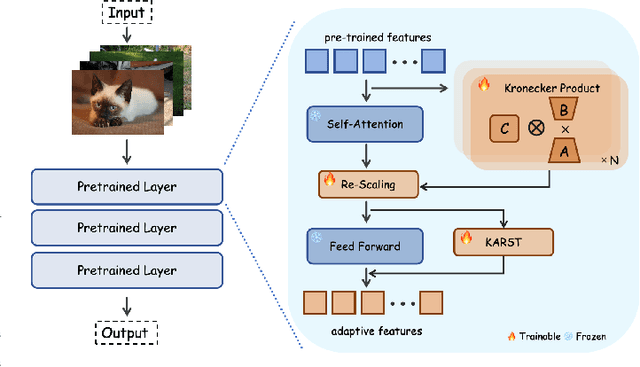
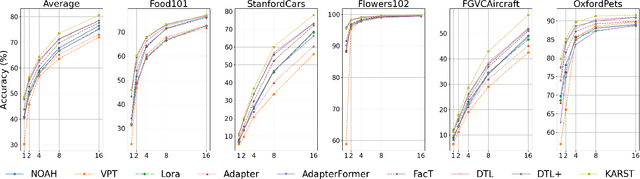
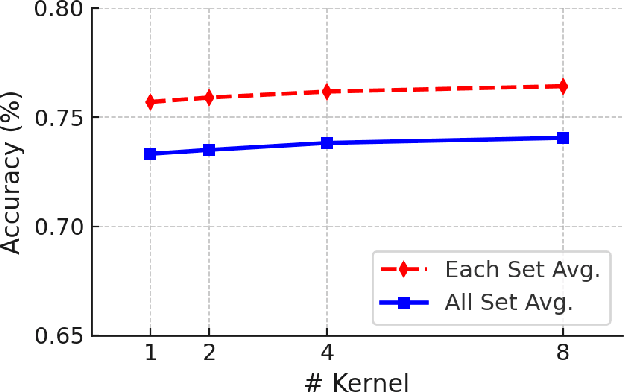
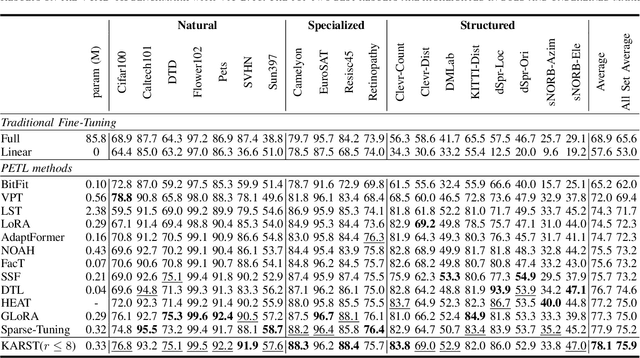
Fine-tuning pre-trained vision models for specific tasks is a common practice in computer vision. However, this process becomes more expensive as models grow larger. Recently, parameter-efficient fine-tuning (PEFT) methods have emerged as a popular solution to improve training efficiency and reduce storage needs by tuning additional low-rank modules within pre-trained backbones. Despite their advantages, they struggle with limited representation capabilities and misalignment with pre-trained intermediate features. To address these issues, we introduce an innovative Multi-Kernel Kronecker Adaptation with Re-Scaling Transmission (KARST) for various recognition tasks. Specifically, its multi-kernel design extends Kronecker projections horizontally and separates adaptation matrices into multiple complementary spaces, reducing parameter dependency and creating more compact subspaces. Besides, it incorporates extra learnable re-scaling factors to better align with pre-trained feature distributions, allowing for more flexible and balanced feature aggregation. Extensive experiments validate that our KARST outperforms other PEFT counterparts with a negligible inference cost due to its re-parameterization characteristics. Code is publicly available at: https://github.com/Lucenova/KARST.
The Devil is in Temporal Token: High Quality Video Reasoning Segmentation
Jan 15, 2025


Existing methods for Video Reasoning Segmentation rely heavily on a single special token to represent the object in the keyframe or the entire video, inadequately capturing spatial complexity and inter-frame motion. To overcome these challenges, we propose VRS-HQ, an end-to-end video reasoning segmentation approach that leverages Multimodal Large Language Models (MLLMs) to inject rich spatiotemporal features into hierarchical tokens.Our key innovations include a Temporal Dynamic Aggregation (TDA) and a Token-driven Keyframe Selection (TKS). Specifically, we design frame-level <SEG> and temporal-level <TAK> tokens that utilize MLLM's autoregressive learning to effectively capture both local and global information. Subsequently, we apply a similarity-based weighted fusion and frame selection strategy, then utilize SAM2 to perform keyframe segmentation and propagation. To enhance keyframe localization accuracy, the TKS filters keyframes based on SAM2's occlusion scores during inference. VRS-HQ achieves state-of-the-art performance on ReVOS, surpassing VISA by 5.9%/12.5%/9.1% in J&F scores across the three subsets. These results highlight the strong temporal reasoning and segmentation capabilities of our method. Code and model weights will be released at VRS-HQ.
AVS-Mamba: Exploring Temporal and Multi-modal Mamba for Audio-Visual Segmentation
Jan 14, 2025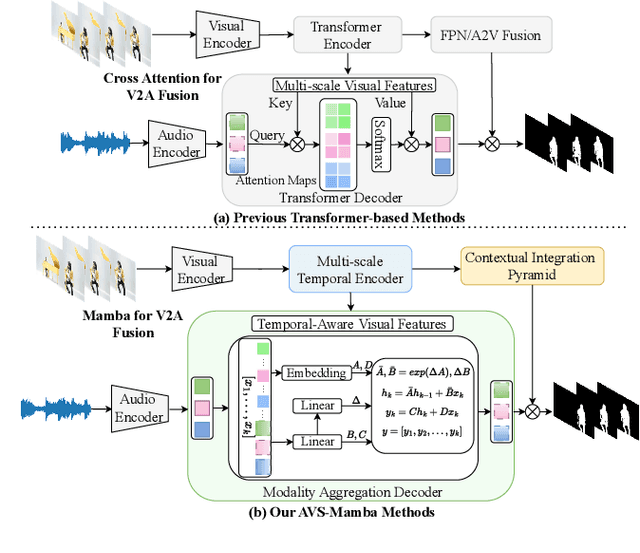


The essence of audio-visual segmentation (AVS) lies in locating and delineating sound-emitting objects within a video stream. While Transformer-based methods have shown promise, their handling of long-range dependencies struggles due to quadratic computational costs, presenting a bottleneck in complex scenarios. To overcome this limitation and facilitate complex multi-modal comprehension with linear complexity, we introduce AVS-Mamba, a selective state space model to address the AVS task. Our framework incorporates two key components for video understanding and cross-modal learning: Temporal Mamba Block for sequential video processing and Vision-to-Audio Fusion Block for advanced audio-vision integration. Building on this, we develop the Multi-scale Temporal Encoder, aimed at enhancing the learning of visual features across scales, facilitating the perception of intra- and inter-frame information. To perform multi-modal fusion, we propose the Modality Aggregation Decoder, leveraging the Vision-to-Audio Fusion Block to integrate visual features into audio features across both frame and temporal levels. Further, we adopt the Contextual Integration Pyramid to perform audio-to-vision spatial-temporal context collaboration. Through these innovative contributions, our approach achieves new state-of-the-art results on the AVSBench-object and AVSBench-semantic datasets. Our source code and model weights are available at AVS-Mamba.
Learning Motion and Temporal Cues for Unsupervised Video Object Segmentation
Jan 14, 2025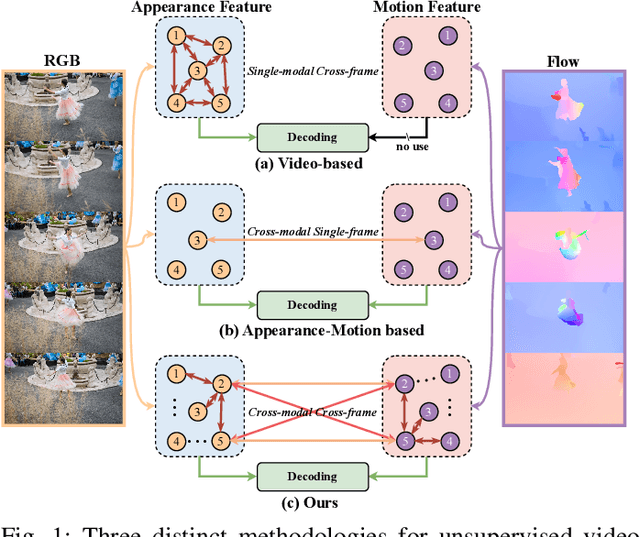
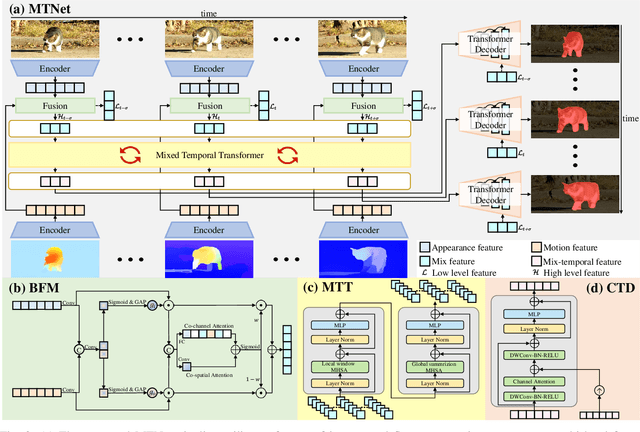
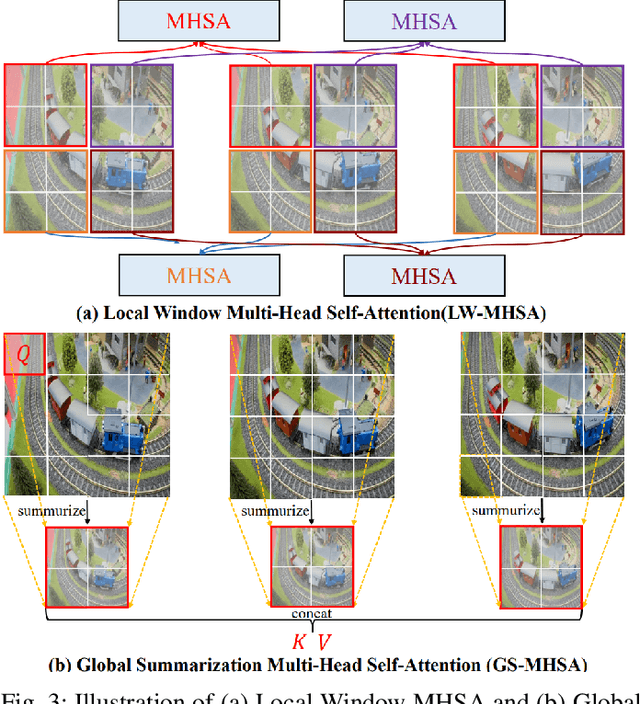
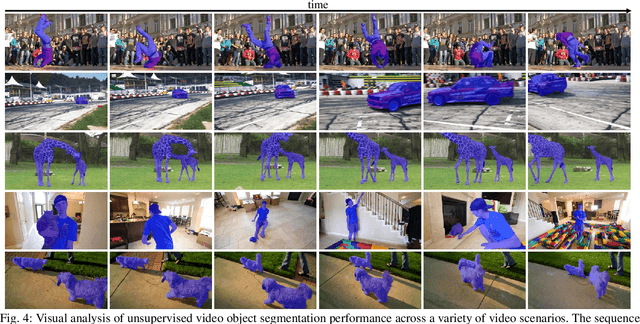
In this paper, we address the challenges in unsupervised video object segmentation (UVOS) by proposing an efficient algorithm, termed MTNet, which concurrently exploits motion and temporal cues. Unlike previous methods that focus solely on integrating appearance with motion or on modeling temporal relations, our method combines both aspects by integrating them within a unified framework. MTNet is devised by effectively merging appearance and motion features during the feature extraction process within encoders, promoting a more complementary representation. To capture the intricate long-range contextual dynamics and information embedded within videos, a temporal transformer module is introduced, facilitating efficacious inter-frame interactions throughout a video clip. Furthermore, we employ a cascade of decoders all feature levels across all feature levels to optimally exploit the derived features, aiming to generate increasingly precise segmentation masks. As a result, MTNet provides a strong and compact framework that explores both temporal and cross-modality knowledge to robustly localize and track the primary object accurately in various challenging scenarios efficiently. Extensive experiments across diverse benchmarks conclusively show that our method not only attains state-of-the-art performance in unsupervised video object segmentation but also delivers competitive results in video salient object detection. These findings highlight the method's robust versatility and its adeptness in adapting to a range of segmentation tasks. Source code is available on https://github.com/hy0523/MTNet.
3UR-LLM: An End-to-End Multimodal Large Language Model for 3D Scene Understanding
Jan 14, 2025Multi-modal Large Language Models (MLLMs) exhibit impressive capabilities in 2D tasks, yet encounter challenges in discerning the spatial positions, interrelations, and causal logic in scenes when transitioning from 2D to 3D representations. We find that the limitations mainly lie in: i) the high annotation cost restricting the scale-up of volumes of 3D scene data, and ii) the lack of a straightforward and effective way to perceive 3D information which results in prolonged training durations and complicates the streamlined framework. To this end, we develop pipeline based on open-source 2D MLLMs and LLMs to generate high-quality 3D-text pairs and construct 3DS-160K , to enhance the pre-training process. Leveraging this high-quality pre-training data, we introduce the 3UR-LLM model, an end-to-end 3D MLLM designed for precise interpretation of 3D scenes, showcasing exceptional capability in navigating the complexities of the physical world. 3UR-LLM directly receives 3D point cloud as input and project 3D features fused with text instructions into a manageable set of tokens. Considering the computation burden derived from these hybrid tokens, we design a 3D compressor module to cohesively compress the 3D spatial cues and textual narrative. 3UR-LLM achieves promising performance with respect to the previous SOTAs, for instance, 3UR-LLM exceeds its counterparts by 7.1\% CIDEr on ScanQA, while utilizing fewer training resources. The code and model weights for 3UR-LLM and the 3DS-160K benchmark are available at 3UR-LLM.