 Add to Chrome
 Add to Firefox
 Add to Edge
Hide&Seek: Remove Image Watermarks with Negligible Cost via Pixel-wise Reconstruction
Mar 01, 2026
Watermarking has emerged as a key defense against the misuse of machine-generated images (MGIs). Yet the robustness of these protections remains underexplored. To reveal the limits of SOTA proactive image watermarking defenses, we propose HIDE&SEEK (HS), a suite of versatile and cost-effective attacks that reliably remove embedded watermarks while preserving high visual fidelity.

Private and Communication-Efficient Federated Learning based on Differentially Private Sketches
Oct 10, 2024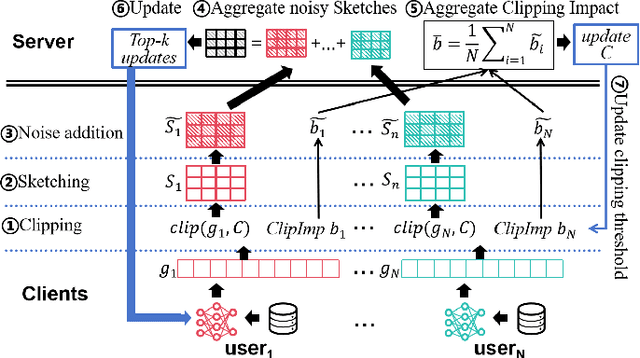
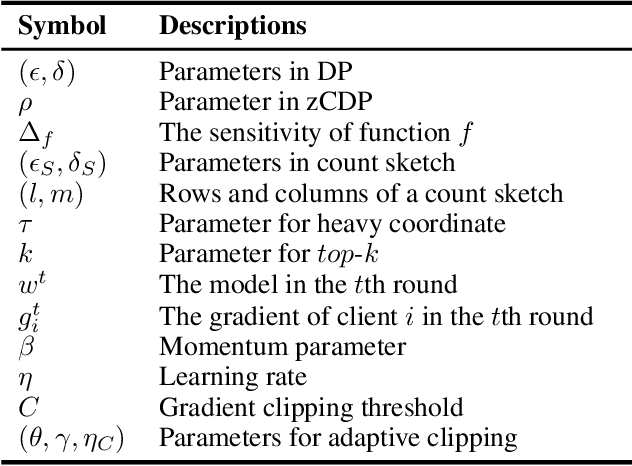
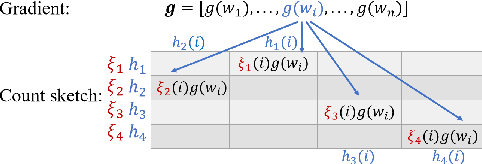
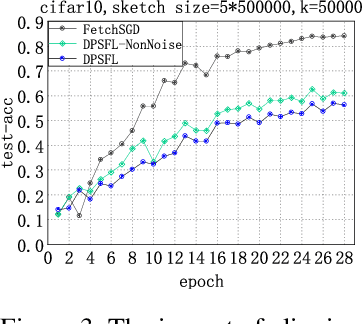
Federated learning (FL) faces two primary challenges: the risk of privacy leakage due to parameter sharing and communication inefficiencies. To address these challenges, we propose DPSFL, a federated learning method that utilizes differentially private sketches. DPSFL compresses the local gradients of each client using a count sketch, thereby improving communication efficiency, while adding noise to the sketches to ensure differential privacy (DP). We provide a theoretical analysis of privacy and convergence for the proposed method. Gradient clipping is essential in DP learning to limit sensitivity and constrain the addition of noise. However, clipping introduces bias into the gradients, negatively impacting FL performance. To mitigate the impact of clipping, we propose an enhanced method, DPSFL-AC, which employs an adaptive clipping strategy. Experimental comparisons with existing techniques demonstrate the superiority of our methods concerning privacy preservation, communication efficiency, and model accuracy.
Partition-based differentially private synthetic data generation
Oct 10, 2023Private synthetic data sharing is preferred as it keeps the distribution and nuances of original data compared to summary statistics. The state-of-the-art methods adopt a select-measure-generate paradigm, but measuring large domain marginals still results in much error and allocating privacy budget iteratively is still difficult. To address these issues, our method employs a partition-based approach that effectively reduces errors and improves the quality of synthetic data, even with a limited privacy budget. Results from our experiments demonstrate the superiority of our method over existing approaches. The synthetic data produced using our approach exhibits improved quality and utility, making it a preferable choice for private synthetic data sharing.