 Add to Chrome
 Add to Firefox
 Add to Edge
Business Arena: Benchmarking LLM Agents in a Realistic Marketplace
Aug 09, 2026
Running a business is a challenging form of intelligent work. Operators must infer opportunities from partial signals, commit capital under uncertainty, adapt to delayed outcomes in a changing market, and satisfy regulatory obligations before trading legally. Frontier LLM agents can increasingly complete complex workflows, yet business-related capabilities are rarely evaluated in existing agent benchmarks. We introduce \textbf{Business Arena}, a controlled environment where an AI agent runs a cross-border shop, buying from suppliers and selling to buyers over a long horizon. We ground the arena in real Alibaba.com sourcing data and market conditions calibrated from authoritative sources. Delayed and coupled consequences make individual business decisions difficult to judge, but their combined outcome is measurable through profit. Because profit alone cannot explain why an agent succeeds or fails, we compare agents with human-designed strategies to estimate available opportunity, use skill-level metrics to reveal underlying strengths and weaknesses, and trace realized gains and losses to the actions that produced them. We use mechanism ablations to establish that strong results reflect genuine business intelligence rather than neglect or simulator-specific shortcuts. We evaluate 15 frontier models and find a ninefold difference in mean final net worth. Even the best model falls behind human-designed strategies, indicating that business operation remains challenging for LLM agents. Skill-level analysis reveals operating styles, from margin-focused premium sellers to high-turnover wholesalers and customer-service specialists, while action-level attribution identifies the sourcing, pricing, and recovery decisions that create or destroy value. Together, Business Arena takes a first step toward a realistic and trustworthy testbed for evaluating end-to-end business agents.

Act Wisely: Cultivating Meta-Cognitive Tool Use in Agentic Multimodal Models
Apr 09, 2026The advent of agentic multimodal models has empowered systems to actively interact with external environments. However, current agents suffer from a profound meta-cognitive deficit: they struggle to arbitrate between leveraging internal knowledge and querying external utilities. Consequently, they frequently fall prey to blind tool invocation, resorting to reflexive tool execution even when queries are resolvable from the raw visual context. This pathological behavior precipitates severe latency bottlenecks and injects extraneous noise that derails sound reasoning. Existing reinforcement learning protocols attempt to mitigate this via a scalarized reward that penalizes tool usage. Yet, this coupled formulation creates an irreconcilable optimization dilemma: an aggressive penalty suppresses essential tool use, whereas a mild penalty is entirely subsumed by the variance of the accuracy reward during advantage normalization, rendering it impotent against tool overuse. To transcend this bottleneck, we propose HDPO, a framework that reframes tool efficiency from a competing scalar objective to a strictly conditional one. By eschewing reward scalarization, HDPO maintains two orthogonal optimization channels: an accuracy channel that maximizes task correctness, and an efficiency channel that enforces execution economy exclusively within accurate trajectories via conditional advantage estimation. This decoupled architecture naturally induces a cognitive curriculum-compelling the agent to first master task resolution before refining its self-reliance. Extensive evaluations demonstrate that our resulting model, Metis, reduces tool invocations by orders of magnitude while simultaneously elevating reasoning accuracy.
Beyond Scattered Acceptance: Fast and Coherent Inference for DLMs via Longest Stable Prefixes
Mar 05, 2026Diffusion Language Models (DLMs) promise highly parallel text generation, yet their practical inference speed is often bottlenecked by suboptimal decoding schedulers. Standard approaches rely on 'scattered acceptance'-committing high confidence tokens at disjoint positions throughout the sequence. This approach inadvertently fractures the Key-Value (KV) cache, destroys memory locality, and forces the model into costly, repeated repairs across unstable token boundaries. To resolve this, we present the Longest Stable Prefix (LSP) scheduler, a training-free and model-agnostic inference paradigm based on monolithic prefix absorption. In each denoising step, LSP evaluates token stability via a single forward pass, dynamically identifies a contiguous left-aligned block of stable predictions, and snaps its boundary to natural linguistic or structural delimiters before an atomic commitment. This prefix-first topology yields dual benefits: systemically, it converts fragmented KV cache updates into efficient, contiguous appends; algorithmically, it preserves bidirectional lookahead over a geometrically shrinking active suffix, drastically reducing token flip rates and denoiser calls. Extensive evaluations on LLaDA-8B and Dream-7B demonstrate that LSP accelerates inference by up to 3.4x across rigorous benchmarks including mathematical reasoning, code generation, multilingual (CJK) tasks, and creative writing while matching or slightly improving output quality. By fundamentally restructuring the commitment topology, LSP bridges the gap between the theoretical parallelism of DLMs and practical hardware efficiency.
SwimBird: Eliciting Switchable Reasoning Mode in Hybrid Autoregressive MLLMs
Feb 05, 2026Multimodal Large Language Models (MLLMs) have made remarkable progress in multimodal perception and reasoning by bridging vision and language. However, most existing MLLMs perform reasoning primarily with textual CoT, which limits their effectiveness on vision-intensive tasks. Recent approaches inject a fixed number of continuous hidden states as "visual thoughts" into the reasoning process and improve visual performance, but often at the cost of degraded text-based logical reasoning. We argue that the core limitation lies in a rigid, pre-defined reasoning pattern that cannot adaptively choose the most suitable thinking modality for different user queries. We introduce SwimBird, a reasoning-switchable MLLM that dynamically switches among three reasoning modes conditioned on the input: (1) text-only reasoning, (2) vision-only reasoning (continuous hidden states as visual thoughts), and (3) interleaved vision-text reasoning. To enable this capability, we adopt a hybrid autoregressive formulation that unifies next-token prediction for textual thoughts with next-embedding prediction for visual thoughts, and design a systematic reasoning-mode curation strategy to construct SwimBird-SFT-92K, a diverse supervised fine-tuning dataset covering all three reasoning patterns. By enabling flexible, query-adaptive mode selection, SwimBird preserves strong textual logic while substantially improving performance on vision-dense tasks. Experiments across diverse benchmarks covering textual reasoning and challenging visual understanding demonstrate that SwimBird achieves state-of-the-art results and robust gains over prior fixed-pattern multimodal reasoning methods.
Enhancing Vision-Language Pre-training with Rich Supervisions
Mar 05, 2024


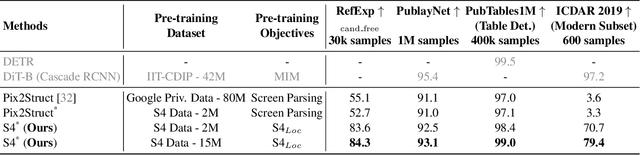
We propose Strongly Supervised pre-training with ScreenShots (S4) - a novel pre-training paradigm for Vision-Language Models using data from large-scale web screenshot rendering. Using web screenshots unlocks a treasure trove of visual and textual cues that are not present in using image-text pairs. In S4, we leverage the inherent tree-structured hierarchy of HTML elements and the spatial localization to carefully design 10 pre-training tasks with large scale annotated data. These tasks resemble downstream tasks across different domains and the annotations are cheap to obtain. We demonstrate that, compared to current screenshot pre-training objectives, our innovative pre-training method significantly enhances performance of image-to-text model in nine varied and popular downstream tasks - up to 76.1% improvements on Table Detection, and at least 1% on Widget Captioning.
Non-autoregressive Sequence-to-Sequence Vision-Language Models
Mar 04, 2024
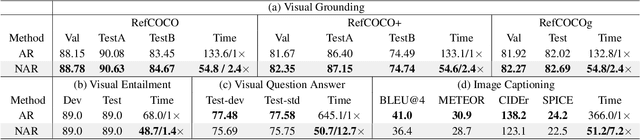

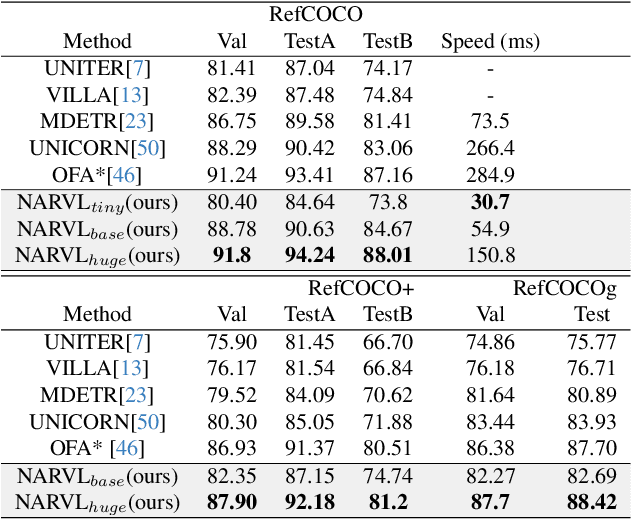
Sequence-to-sequence vision-language models are showing promise, but their applicability is limited by their inference latency due to their autoregressive way of generating predictions. We propose a parallel decoding sequence-to-sequence vision-language model, trained with a Query-CTC loss, that marginalizes over multiple inference paths in the decoder. This allows us to model the joint distribution of tokens, rather than restricting to conditional distribution as in an autoregressive model. The resulting model, NARVL, achieves performance on-par with its state-of-the-art autoregressive counterpart, but is faster at inference time, reducing from the linear complexity associated with the sequential generation of tokens to a paradigm of constant time joint inference.
Musketeer (All for One, and One for All): A Generalist Vision-Language Model with Task Explanation Prompts
May 11, 2023We present a sequence-to-sequence vision-language model whose parameters are jointly trained on all tasks (all for one) and fully shared among multiple tasks (one for all), resulting in a single model which we named Musketeer. The integration of knowledge across heterogeneous tasks is enabled by a novel feature called Task Explanation Prompt (TEP). TEP reduces interference among tasks, allowing the model to focus on their shared structure. With a single model, Musketeer achieves results comparable to or better than strong baselines trained on single tasks, almost uniformly across multiple tasks.