 Add to Chrome
 Add to Firefox
 Add to Edge
Hitem3D 2.0: Multi-View Guided Native 3D Texture Generation
Apr 10, 2026
Although recent advances have improved the quality of 3D texture generation, existing methods still struggle with incomplete texture coverage, cross-view inconsistency, and misalignment between geometry and texture. To address these limitations, we propose Hitem3D 2.0, a multi-view guided native 3D texture generation framework that enhances texture quality through the integration of 2D multi-view generation priors and native 3D texture representations. Hitem3D 2.0 comprises two key components: a multi-view synthesis framework and a native 3D texture generation model. The multi-view generation is built upon a pre-trained image editing backbone and incorporates plug-and-play modules that explicitly promote geometric alignment, cross-view consistency, and illumination uniformity, thereby enabling the synthesis of high-fidelity multi-view images. Conditioned on the generated views and 3D geometry, the native 3D texture generation model projects multi-view textures onto 3D surfaces while plausibly completing textures in unseen regions. Through the integration of multi-view consistency constraints with native 3D texture modeling, Hitem3D 2.0 significantly improves texture completeness, cross-view coherence, and geometric alignment. Experimental results demonstrate that Hitem3D 2.0 outperforms existing methods in terms of texture detail, fidelity, consistency, coherence, and alignment.

EI-Part: Explode for Completion and Implode for Refinement
Mar 14, 2026Part-level 3D generation is crucial for various downstream applications, including gaming, film production, and industrial design. However, decomposing a 3D shape into geometrically plausible and meaningful components remains a significant challenge. Previous part-based generation methods often struggle to produce well-constructed parts, exhibiting poor structural coherence, geometric implausibility, inaccuracy, or inefficiency. To address these challenges, we introduce EI-Part, a novel framework specifically designed to generate high-quality 3D shapes with components, characterized by strong structural coherence, geometric plausibility, geometric fidelity, and generation efficiency. We propose utilizing distinct representations at different stages: an Explode state for part completion and an Implode state for geometry refinement. This strategy fully leverages spatial resolution, enabling flexible part completion and fine geometric detail generation. To maintain structural coherence between parts, a self-attention mechanism is incorporated in both exploded and imploded states, facilitating effective information perception and feature fusion among components during generation. Extensive experiments on multiple benchmarks demonstrate that EI-Part efficiently produces semantically meaningful and structurally coherent parts with fine-grained geometric details, achieving state-of-the-art performance in part-level 3D generation. Project page: https://cvhadessun.github.io/EI-Part/
Semantix: An Energy Guided Sampler for Semantic Style Transfer
Mar 28, 2025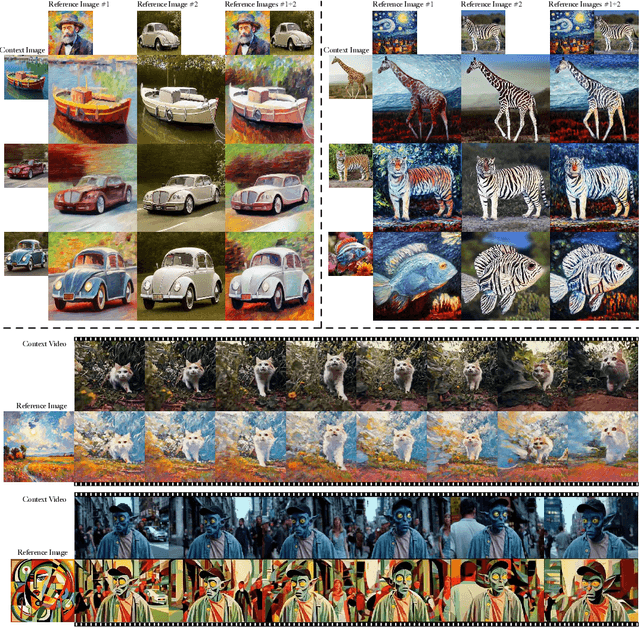
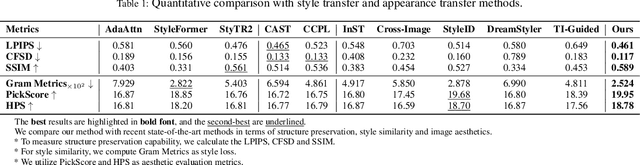
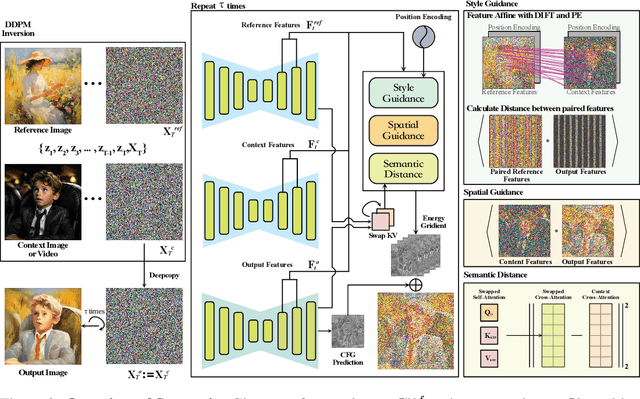
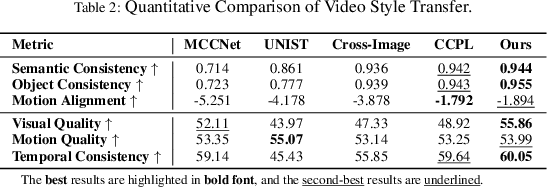
Recent advances in style and appearance transfer are impressive, but most methods isolate global style and local appearance transfer, neglecting semantic correspondence. Additionally, image and video tasks are typically handled in isolation, with little focus on integrating them for video transfer. To address these limitations, we introduce a novel task, Semantic Style Transfer, which involves transferring style and appearance features from a reference image to a target visual content based on semantic correspondence. We subsequently propose a training-free method, Semantix an energy-guided sampler designed for Semantic Style Transfer that simultaneously guides both style and appearance transfer based on semantic understanding capacity of pre-trained diffusion models. Additionally, as a sampler, Semantix be seamlessly applied to both image and video models, enabling semantic style transfer to be generic across various visual media. Specifically, once inverting both reference and context images or videos to noise space by SDEs, Semantix utilizes a meticulously crafted energy function to guide the sampling process, including three key components: Style Feature Guidance, Spatial Feature Guidance and Semantic Distance as a regularisation term. Experimental results demonstrate that Semantix not only effectively accomplishes the task of semantic style transfer across images and videos, but also surpasses existing state-of-the-art solutions in both fields. The project website is available at https://huiang-he.github.io/semantix/