 Add to Chrome
 Add to Firefox
 Add to Edge
PerceptDrive: Perception Prior World-Action Modeling with Adaptive Expert Routing for End-to-End Autonomous Driving
Jul 22, 2026
Frozen perception foundation models encode rich geometric, semantic, and dynamic knowledge. Yet narrow conditioning interfaces may attenuate task-relevant cues, while static fusion cannot adjust expert contributions to each scene. We cast this challenge as the prior-to-plan transfer problem and introduce PerceptDrive, a perception prior world-action modeling framework with adaptive expert routing. PerceptDrive feeds teacher-distilled priors from a frozen, driving-adapted provider and dense observation latents from a frozen self-supervised video encoder into a trainable expert-routed world-action model. Expert-specific query branches process these signals, while a prior-retention objective anchors each branch to its prior. A router predicts soft gates from a shared scene representation and combines the expert conditions before trajectory generation. During training, privileged rule-based sub-metric estimates for branch-specific trajectory drafts provide soft-gate distillation targets. The predicted action-free future latent conditions a flow-matching actor. At inference, privileged components are absent; with one front-facing camera, PerceptDrive generates one trajectory per planning step without test-time scoring, reranking, or search. Experiments show that PerceptDrive achieves state-of-the-art performance with 90.4 PDMS on NAVSIM v1 and 90.2 EPDMS on NAVSIM v2, outperforming existing methods. Ablations confirm complementary gains from prior retention and scene-conditioned routing, alongside differential reliance on the three priors. These results demonstrate that preserving and adaptively routing perception priors improves direct planning without test-time candidate selection.

ForgeDrive: Bidirectional Cross-Conditioning for Unified Visual-Action Generation in Autonomous Driving
Jun 30, 2026World-model-based autonomous driving endows the model with the ability to understand scene evolution. Yet this promise is undermined by the prevailing imagine-then-act paradigm, which allows errors from the more challenging visual generation stage to cascade into action planning. We introduce ForgeDrive, a unified autoregressive diffusion framework with visual-action cross-conditioning that closes this gap through act-then-imagine paradigm. ForgeDrive factorizes the future as a sequence of per-timestep frame-action pairs, intertwining each action with its corresponding visual observation. During training, we decouple the diffusion timesteps of the two modalities and introduce a UniDiffuser-style noise scheduler to get the ability to infer either modality from its counterpart and deepen understanding of relationships between images and actions. At inference, we propose a novel act-then-imagine inference paradigm, and find that at each step, action generation is a capability internalized during training, requiring no clean future frame as a prerequisite at inference time; instead, the generated action can improve the accuracy of future frame generation, which in turn enhances the quality of the next action. Additionally, we augment each step with future ego-status prediction, further sharpening planning ability. Extensive experiments on NAVSIM demonstrate that ForgeDrive not only unifies driving simulation, planning, and visual odometry into a single model, but also outperforms existing strong planners without any post-training strategy.
AIM 2022 Challenge on Super-Resolution of Compressed Image and Video: Dataset, Methods and Results
Aug 25, 2022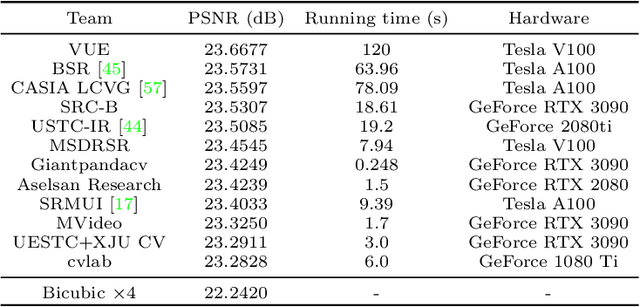
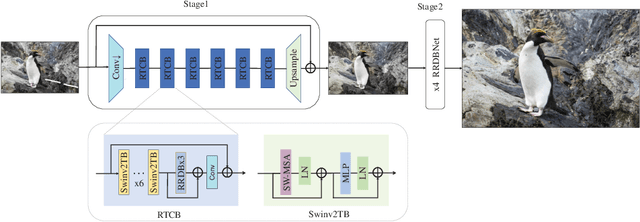
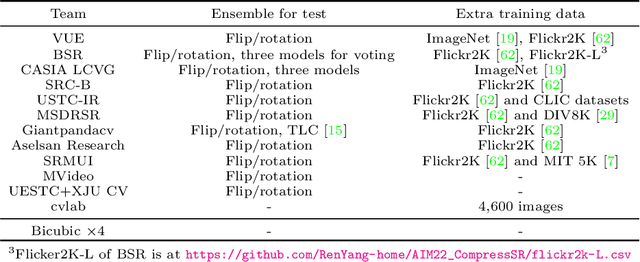
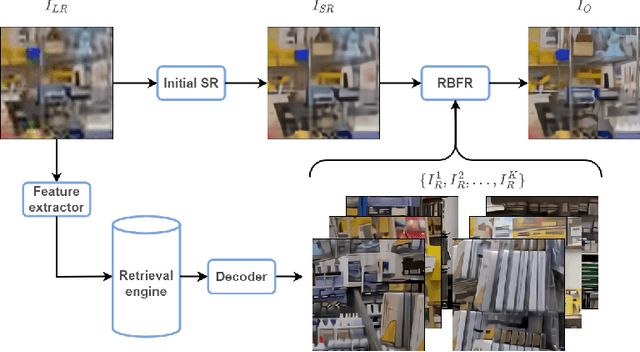
This paper reviews the Challenge on Super-Resolution of Compressed Image and Video at AIM 2022. This challenge includes two tracks. Track 1 aims at the super-resolution of compressed image, and Track~2 targets the super-resolution of compressed video. In Track 1, we use the popular dataset DIV2K as the training, validation and test sets. In Track 2, we propose the LDV 3.0 dataset, which contains 365 videos, including the LDV 2.0 dataset (335 videos) and 30 additional videos. In this challenge, there are 12 teams and 2 teams that submitted the final results to Track 1 and Track 2, respectively. The proposed methods and solutions gauge the state-of-the-art of super-resolution on compressed image and video. The proposed LDV 3.0 dataset is available at https://github.com/RenYang-home/LDV_dataset. The homepage of this challenge is at https://github.com/RenYang-home/AIM22_CompressSR.
NTIRE 2021 Challenge on Quality Enhancement of Compressed Video: Methods and Results
May 02, 2021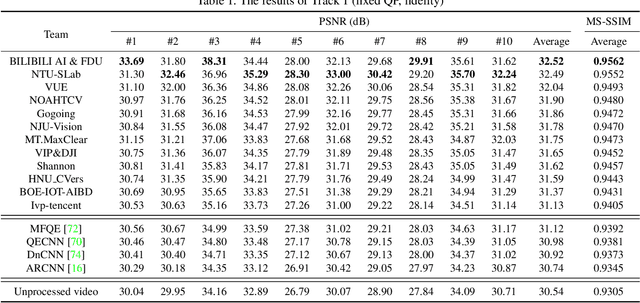
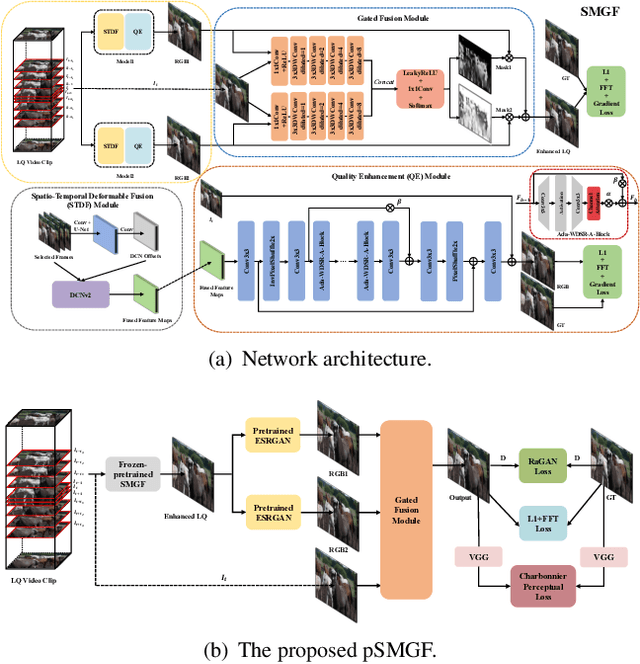
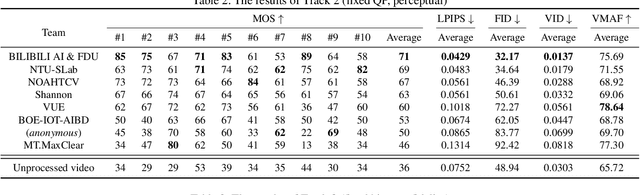
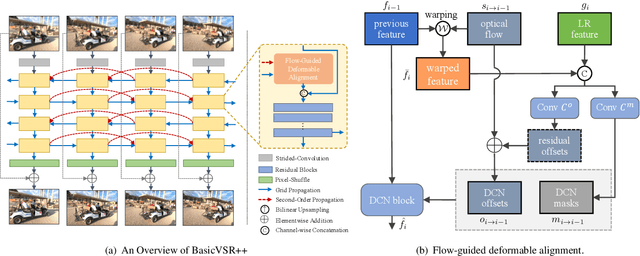
This paper reviews the first NTIRE challenge on quality enhancement of compressed video, with a focus on the proposed methods and results. In this challenge, the new Large-scale Diverse Video (LDV) dataset is employed. The challenge has three tracks. Tracks 1 and 2 aim at enhancing the videos compressed by HEVC at a fixed QP, while Track 3 is designed for enhancing the videos compressed by x265 at a fixed bit-rate. Besides, the quality enhancement of Tracks 1 and 3 targets at improving the fidelity (PSNR), and Track 2 targets at enhancing the perceptual quality. The three tracks totally attract 482 registrations. In the test phase, 12 teams, 8 teams and 11 teams submitted the final results of Tracks 1, 2 and 3, respectively. The proposed methods and solutions gauge the state-of-the-art of video quality enhancement. The homepage of the challenge: https://github.com/RenYang-home/NTIRE21_VEnh
AI Challenger : A Large-scale Dataset for Going Deeper in Image Understanding
Nov 17, 2017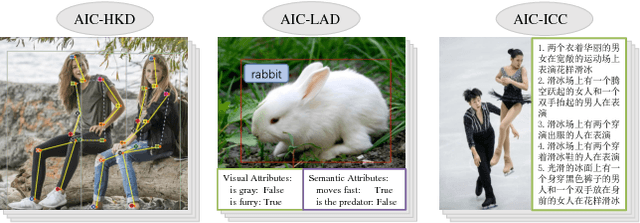
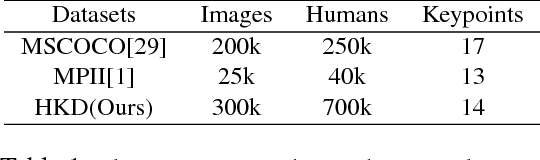
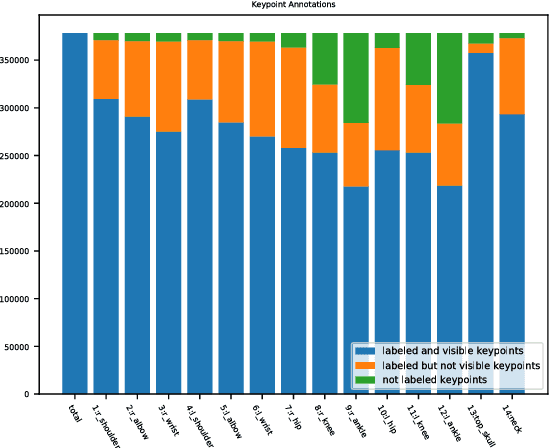
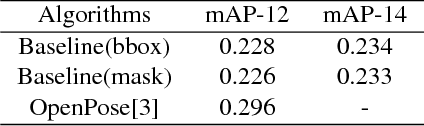
Significant progress has been achieved in Computer Vision by leveraging large-scale image datasets. However, large-scale datasets for complex Computer Vision tasks beyond classification are still limited. This paper proposed a large-scale dataset named AIC (AI Challenger) with three sub-datasets, human keypoint detection (HKD), large-scale attribute dataset (LAD) and image Chinese captioning (ICC). In this dataset, we annotate class labels (LAD), keypoint coordinate (HKD), bounding box (HKD and LAD), attribute (LAD) and caption (ICC). These rich annotations bridge the semantic gap between low-level images and high-level concepts. The proposed dataset is an effective benchmark to evaluate and improve different computational methods. In addition, for related tasks, others can also use our dataset as a new resource to pre-train their models.
A Fusion Method Based on Decision Reliability Ratio for Finger Vein Verification
Dec 17, 2016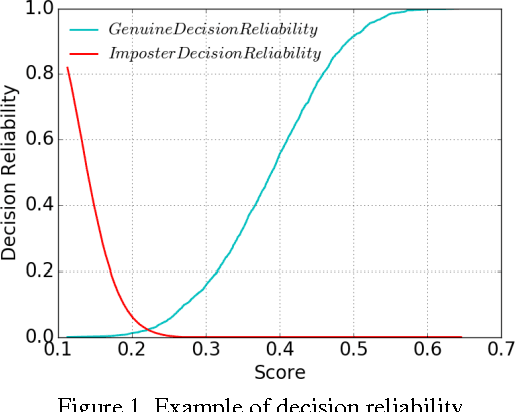
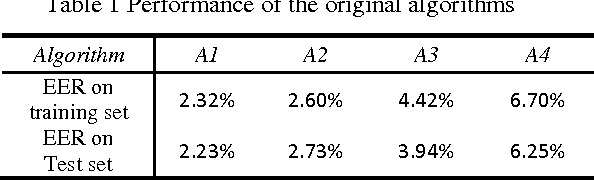
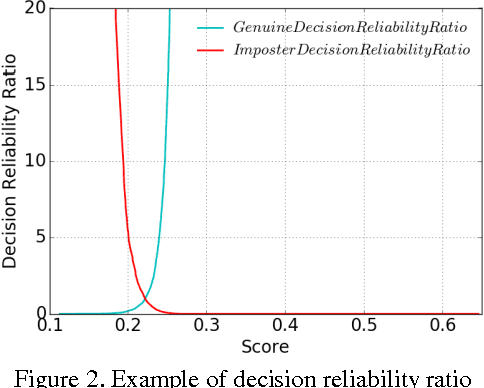
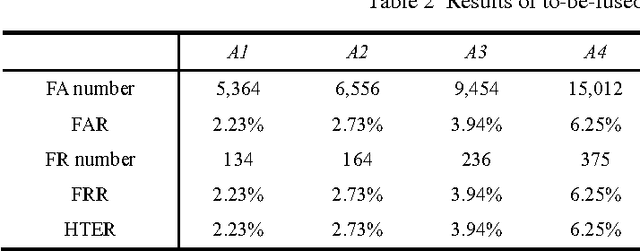
Finger vein verification has developed a lot since its first proposal, but there is still not a perfect algorithm. It is proved that algorithms with the same overall accuracy may have different misclassified patterns. We could make use of this complementation to fuse individual algorithms together for more precise result. According to our observation, algorithm has different confidence on its decisions but it is seldom considered in fusion methods. Our work is first to define decision reliability ratio to quantify this confidence, and then propose the Maximum Decision Reliability Ratio (MDRR) fusion method incorporating Weighted Voting. Experiment conducted on a data set of 1000 fingers and 5 images per finger proves the effectiveness of the method. The classifier obtained by MDRR method gets an accuracy of 99.42% while the maximum accuracy of the original individual classifiers is 97.77%. The experiment results also show the MDRR outperforms the traditional fusion methods as Voting, Weighted Voting, Sum and Weighted Sum.