 Add to Chrome
 Add to Firefox
 Add to Edge
PriGo: Test-Time Primitive Guidance to Diffusion and Flow Policies for Adaptive Robotic Manipulation
Jul 08, 2026
Imitation learning has enabled remarkable progress in robotic manipulation, especially with diffusion and flow-based policies that generate complex visuomotor behaviors directly from demonstrations. Yet, despite their strong performance, these policies often fail to generalize across tasks and environments. A key reason is that existing policies tend to imitate superficial action correlations rather than the underlying intent. Inspired by the compositional structure of human behaviors, we propose PriGo, a primitive-guided test-time adaptive framework for robust robotic manipulation. PriGo introduces PANet, a lightweight primitive prediction module that infers primitive distributions directly from observations. We further propose a differentiable primitive guidance mechanism that refines generated actions during inference, steering trajectories toward semantically consistent behaviors. Unlike prior primitive-conditioned approaches, PriGo operates entirely at test time and can be seamlessly integrated into pretrained diffusion and flow policies without retraining. Extensive experiments on LIBERO, CALVIN, SIMPLER, and real-world robotic tasks demonstrate that PriGo consistently improves robustness, long-horizon execution, and generalization ability across both diffusion and flow-based policies.

GraspLDP: Towards Generalizable Grasping Policy via Latent Diffusion
Feb 26, 2026This paper focuses on enhancing the grasping precision and generalization of manipulation policies learned via imitation learning. Diffusion-based policy learning methods have recently become the mainstream approach for robotic manipulation tasks. As grasping is a critical subtask in manipulation, the ability of imitation-learned policies to execute precise and generalizable grasps merits particular attention. Existing imitation learning techniques for grasping often suffer from imprecise grasp executions, limited spatial generalization, and poor object generalization. To address these challenges, we incorporate grasp prior knowledge into the diffusion policy framework. In particular, we employ a latent diffusion policy to guide action chunk decoding with grasp pose prior, ensuring that generated motion trajectories adhere closely to feasible grasp configurations. Furthermore, we introduce a self-supervised reconstruction objective during diffusion to embed the graspness prior: at each reverse diffusion step, we reconstruct wrist-camera images back-projected the graspness from the intermediate representations. Both simulation and real robot experiments demonstrate that our approach significantly outperforms baseline methods and exhibits strong dynamic grasping capabilities.
Robotic Manipulation via Imitation Learning: Taxonomy, Evolution, Benchmark, and Challenges
Aug 24, 2025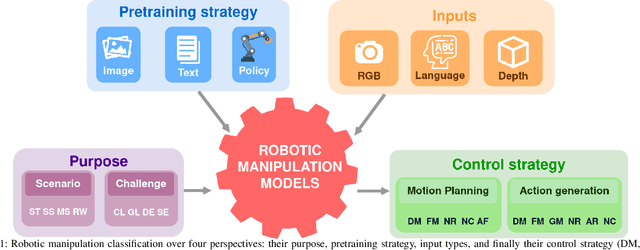
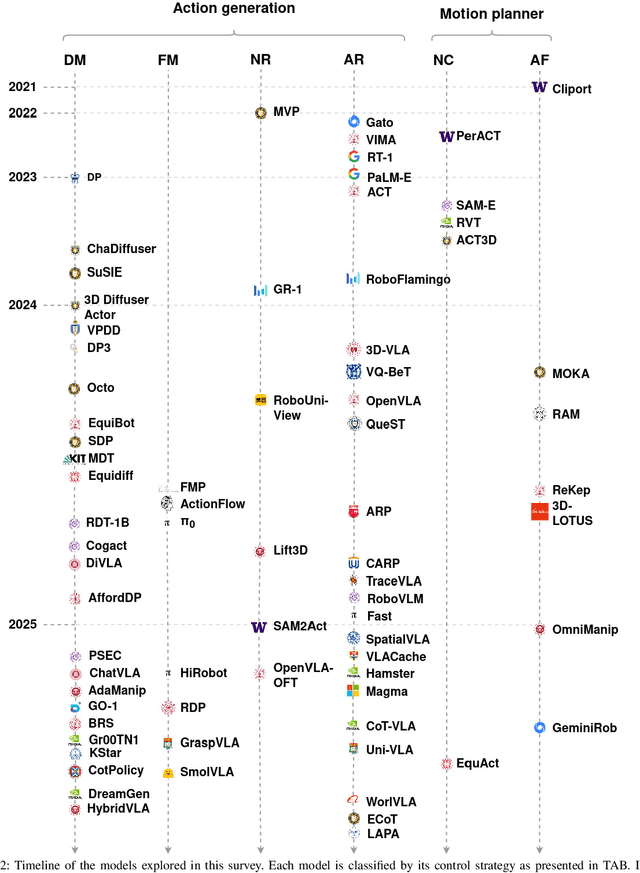
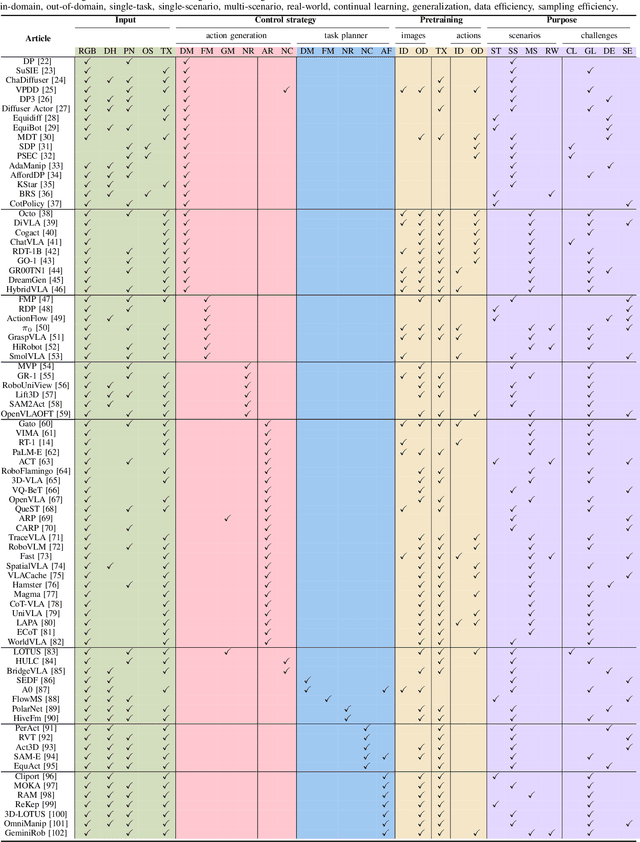
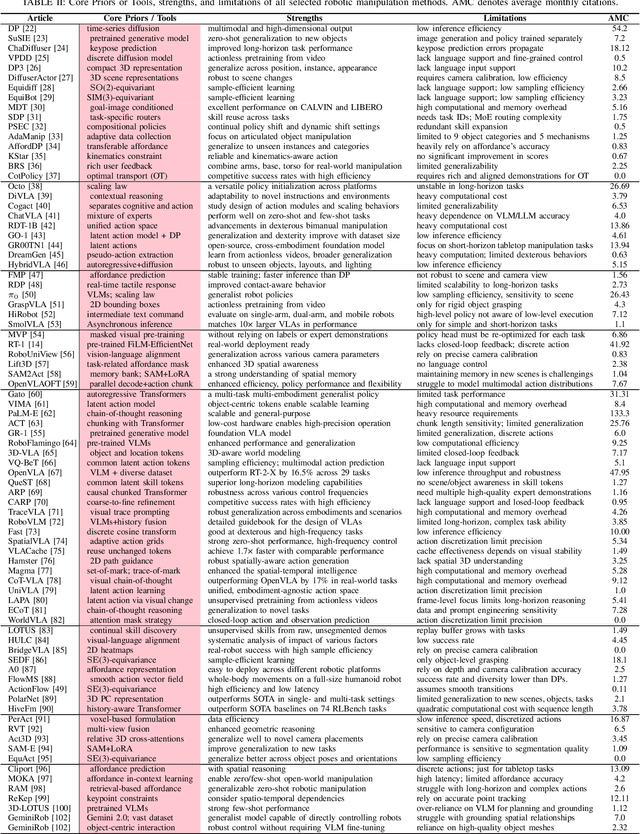
Robotic Manipulation (RM) is central to the advancement of autonomous robots, enabling them to interact with and manipulate objects in real-world environments. This survey focuses on RM methodologies that leverage imitation learning, a powerful technique that allows robots to learn complex manipulation skills by mimicking human demonstrations. We identify and analyze the most influential studies in this domain, selected based on community impact and intrinsic quality. For each paper, we provide a structured summary, covering the research purpose, technical implementation, hierarchical classification, input formats, key priors, strengths and limitations, and citation metrics. Additionally, we trace the chronological development of imitation learning techniques within RM policy (RMP), offering a timeline of key technological advancements. Where available, we report benchmark results and perform quantitative evaluations to compare existing methods. By synthesizing these insights, this review provides a comprehensive resource for researchers and practitioners, highlighting both the state of the art and the challenges that lie ahead in the field of robotic manipulation through imitation learning.