 Add to Chrome
 Add to Firefox
 Add to Edge
Executable Code Actions Elicit Better LLM Agents
Feb 01, 2024
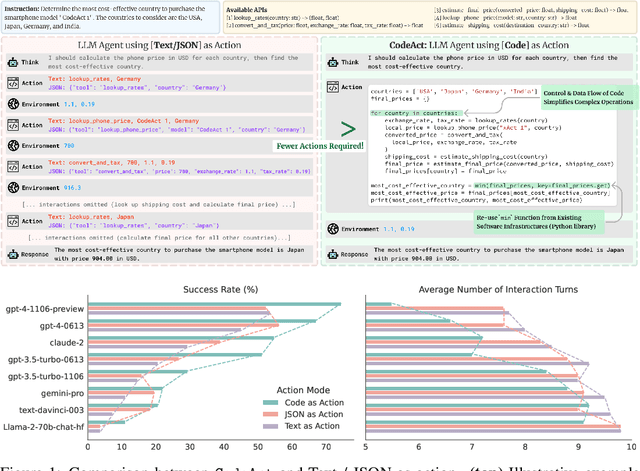
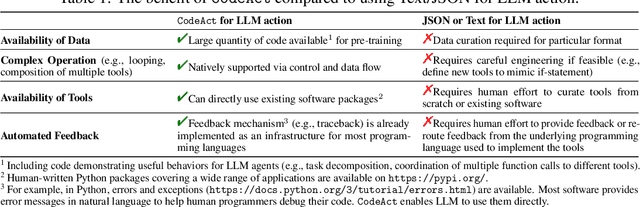
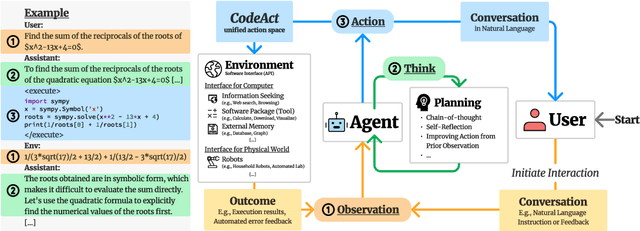
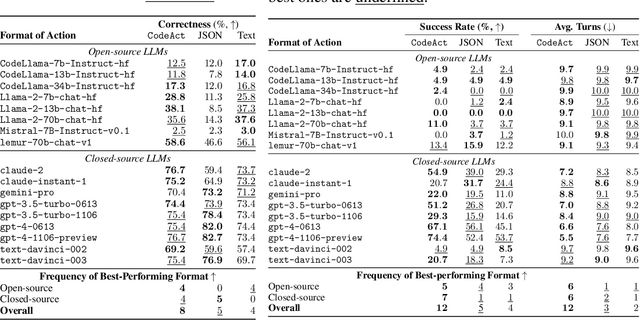
Large Language Model (LLM) agents, capable of performing a broad range of actions, such as invoking tools and controlling robots, show great potential in tackling real-world challenges. LLM agents are typically prompted to produce actions by generating JSON or text in a pre-defined format, which is usually limited by constrained action space (e.g., the scope of pre-defined tools) and restricted flexibility (e.g., inability to compose multiple tools). This work proposes to use executable Python code to consolidate LLM agents' actions into a unified action space (CodeAct). Integrated with a Python interpreter, CodeAct can execute code actions and dynamically revise prior actions or emit new actions upon new observations through multi-turn interactions. Our extensive analysis of 17 LLMs on API-Bank and a newly curated benchmark shows that CodeAct outperforms widely used alternatives (up to 20% higher success rate). The encouraging performance of CodeAct motivates us to build an open-source LLM agent that interacts with environments by executing interpretable code and collaborates with users using natural language. To this end, we collect an instruction-tuning dataset CodeActInstruct that consists of 7k multi-turn interactions using CodeAct. We show that it can be used with existing data to improve models in agent-oriented tasks without compromising their general capability. CodeActAgent, finetuned from Llama2 and Mistral, is integrated with Python interpreter and uniquely tailored to perform sophisticated tasks (e.g., model training) using existing libraries and autonomously self-debug.

DeepRicci: Self-supervised Graph Structure-Feature Co-Refinement for Alleviating Over-squashing
Jan 23, 2024Graph Neural Networks (GNNs) have shown great power for learning and mining on graphs, and Graph Structure Learning (GSL) plays an important role in boosting GNNs with a refined graph. In the literature, most GSL solutions either primarily focus on structure refinement with task-specific supervision (i.e., node classification), or overlook the inherent weakness of GNNs themselves (e.g., over-squashing), resulting in suboptimal performance despite sophisticated designs. In light of these limitations, we propose to study self-supervised graph structure-feature co-refinement for effectively alleviating the issue of over-squashing in typical GNNs. In this paper, we take a fundamentally different perspective of the Ricci curvature in Riemannian geometry, in which we encounter the challenges of modeling, utilizing and computing Ricci curvature. To tackle these challenges, we present a self-supervised Riemannian model, DeepRicci. Specifically, we introduce a latent Riemannian space of heterogeneous curvatures to model various Ricci curvatures, and propose a gyrovector feature mapping to utilize Ricci curvature for typical GNNs. Thereafter, we refine node features by geometric contrastive learning among different geometric views, and simultaneously refine graph structure by backward Ricci flow based on a novel formulation of differentiable Ricci curvature. Finally, extensive experiments on public datasets show the superiority of DeepRicci, and the connection between backward Ricci flow and over-squashing. Codes of our work are given in https://github.com/RiemanGraph/.
CLIP-Driven Semantic Discovery Network for Visible-Infrared Person Re-Identification
Jan 12, 2024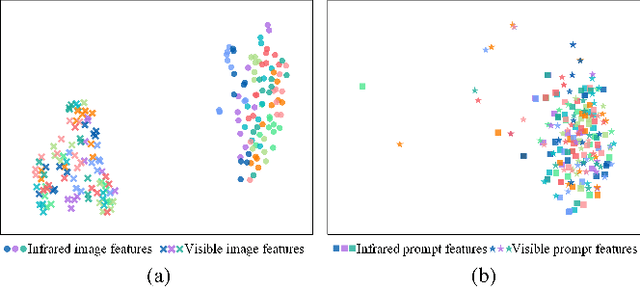
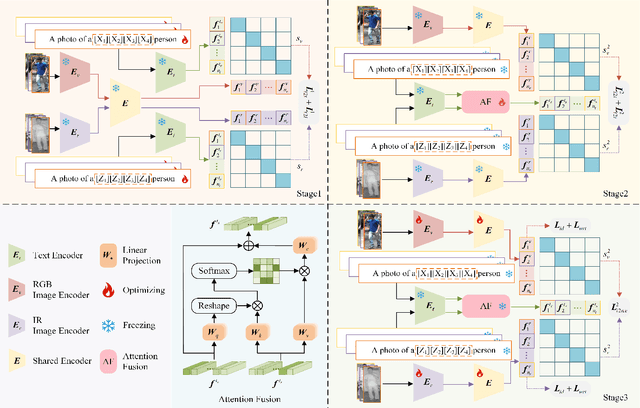
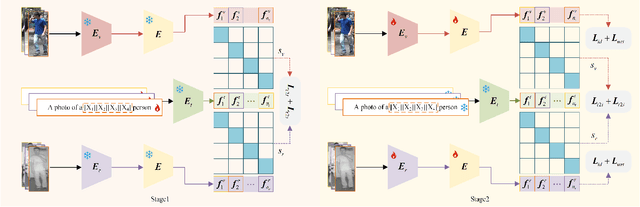

Visible-infrared person re-identification (VIReID) primarily deals with matching identities across person images from different modalities. Due to the modality gap between visible and infrared images, cross-modality identity matching poses significant challenges. Recognizing that high-level semantics of pedestrian appearance, such as gender, shape, and clothing style, remain consistent across modalities, this paper intends to bridge the modality gap by infusing visual features with high-level semantics. Given the capability of CLIP to sense high-level semantic information corresponding to visual representations, we explore the application of CLIP within the domain of VIReID. Consequently, we propose a CLIP-Driven Semantic Discovery Network (CSDN) that consists of Modality-specific Prompt Learner, Semantic Information Integration (SII), and High-level Semantic Embedding (HSE). Specifically, considering the diversity stemming from modality discrepancies in language descriptions, we devise bimodal learnable text tokens to capture modality-private semantic information for visible and infrared images, respectively. Additionally, acknowledging the complementary nature of semantic details across different modalities, we integrate text features from the bimodal language descriptions to achieve comprehensive semantics. Finally, we establish a connection between the integrated text features and the visual features across modalities. This process embed rich high-level semantic information into visual representations, thereby promoting the modality invariance of visual representations. The effectiveness and superiority of our proposed CSDN over existing methods have been substantiated through experimental evaluations on multiple widely used benchmarks. The code will be released at \url{https://github.com/nengdong96/CSDN}.
Motif-aware Riemannian Graph Neural Network with Generative-Contrastive Learning
Jan 02, 2024Graphs are typical non-Euclidean data of complex structures. In recent years, Riemannian graph representation learning has emerged as an exciting alternative to Euclidean ones. However, Riemannian methods are still in an early stage: most of them present a single curvature (radius) regardless of structural complexity, suffer from numerical instability due to the exponential/logarithmic map, and lack the ability to capture motif regularity. In light of the issues above, we propose the problem of \emph{Motif-aware Riemannian Graph Representation Learning}, seeking a numerically stable encoder to capture motif regularity in a diverse-curvature manifold without labels. To this end, we present a novel Motif-aware Riemannian model with Generative-Contrastive learning (MotifRGC), which conducts a minmax game in Riemannian manifold in a self-supervised manner. First, we propose a new type of Riemannian GCN (D-GCN), in which we construct a diverse-curvature manifold by a product layer with the diversified factor, and replace the exponential/logarithmic map by a stable kernel layer. Second, we introduce a motif-aware Riemannian generative-contrastive learning to capture motif regularity in the constructed manifold and learn motif-aware node representation without external labels. Empirical results show the superiority of MofitRGC.
EnchantDance: Unveiling the Potential of Music-Driven Dance Movement
Dec 26, 2023The task of music-driven dance generation involves creating coherent dance movements that correspond to the given music. While existing methods can produce physically plausible dances, they often struggle to generalize to out-of-set data. The challenge arises from three aspects: 1) the high diversity of dance movements and significant differences in the distribution of music modalities, which make it difficult to generate music-aligned dance movements. 2) the lack of a large-scale music-dance dataset, which hinders the generation of generalized dance movements from music. 3) The protracted nature of dance movements poses a challenge to the maintenance of a consistent dance style. In this work, we introduce the EnchantDance framework, a state-of-the-art method for dance generation. Due to the redundancy of the original dance sequence along the time axis, EnchantDance first constructs a strong dance latent space and then trains a dance diffusion model on the dance latent space. To address the data gap, we construct a large-scale music-dance dataset, ChoreoSpectrum3D Dataset, which includes four dance genres and has a total duration of 70.32 hours, making it the largest reported music-dance dataset to date. To enhance consistency between music genre and dance style, we pre-train a music genre prediction network using transfer learning and incorporate music genre as extra conditional information in the training of the dance diffusion model. Extensive experiments demonstrate that our proposed framework achieves state-of-the-art performance on dance quality, diversity, and consistency.
Prompt Based Tri-Channel Graph Convolution Neural Network for Aspect Sentiment Triplet Extraction
Dec 24, 2023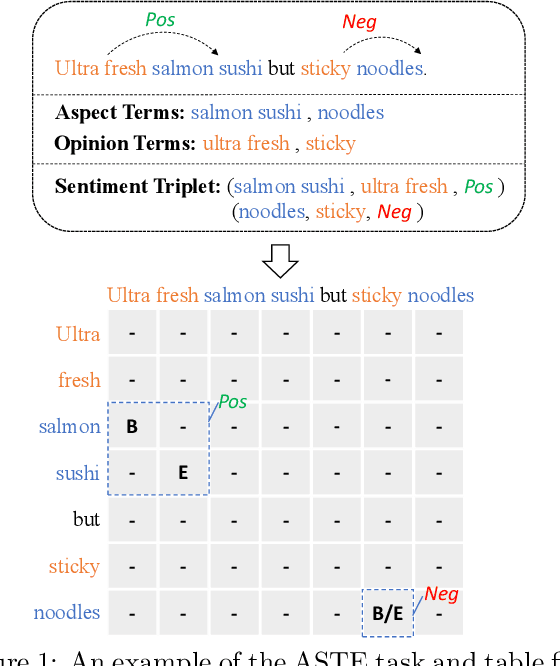
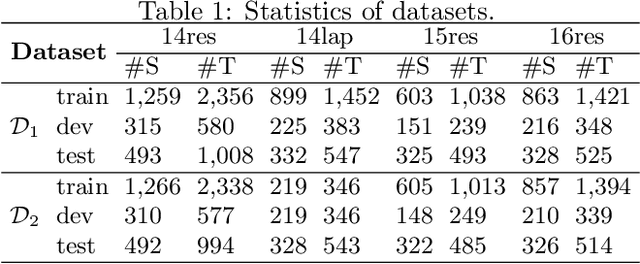
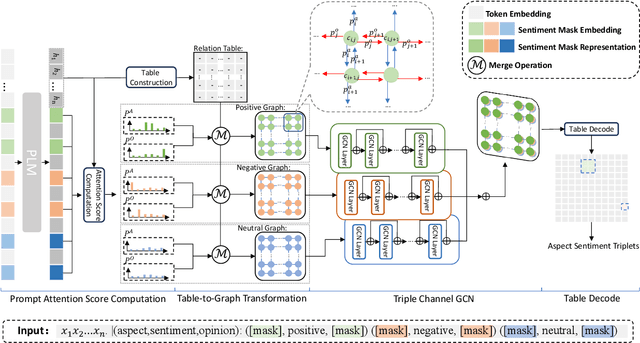
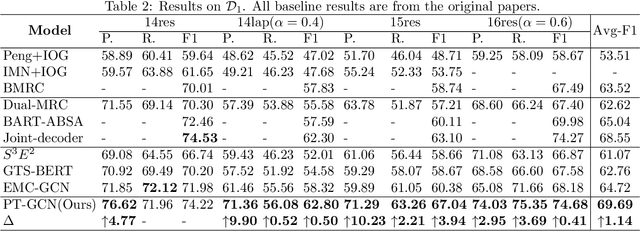
Aspect Sentiment Triplet Extraction (ASTE) is an emerging task to extract a given sentence's triplets, which consist of aspects, opinions, and sentiments. Recent studies tend to address this task with a table-filling paradigm, wherein word relations are encoded in a two-dimensional table, and the process involves clarifying all the individual cells to extract triples. However, these studies ignore the deep interaction between neighbor cells, which we find quite helpful for accurate extraction. To this end, we propose a novel model for the ASTE task, called Prompt-based Tri-Channel Graph Convolution Neural Network (PT-GCN), which converts the relation table into a graph to explore more comprehensive relational information. Specifically, we treat the original table cells as nodes and utilize a prompt attention score computation module to determine the edges' weights. This enables us to construct a target-aware grid-like graph to enhance the overall extraction process. After that, a triple-channel convolution module is conducted to extract precise sentiment knowledge. Extensive experiments on the benchmark datasets show that our model achieves state-of-the-art performance. The code is available at https://github.com/KunPunCN/PT-GCN.
Poincaré Differential Privacy for Hierarchy-Aware Graph Embedding
Dec 20, 2023Hierarchy is an important and commonly observed topological property in real-world graphs that indicate the relationships between supervisors and subordinates or the organizational behavior of human groups. As hierarchy is introduced as a new inductive bias into the Graph Neural Networks (GNNs) in various tasks, it implies latent topological relations for attackers to improve their inference attack performance, leading to serious privacy leakage issues. In addition, existing privacy-preserving frameworks suffer from reduced protection ability in hierarchical propagation due to the deficiency of adaptive upper-bound estimation of the hierarchical perturbation boundary. It is of great urgency to effectively leverage the hierarchical property of data while satisfying privacy guarantees. To solve the problem, we propose the Poincar\'e Differential Privacy framework, named PoinDP, to protect the hierarchy-aware graph embedding based on hyperbolic geometry. Specifically, PoinDP first learns the hierarchy weights for each entity based on the Poincar\'e model in hyperbolic space. Then, the Personalized Hierarchy-aware Sensitivity is designed to measure the sensitivity of the hierarchical structure and adaptively allocate the privacy protection strength. Besides, the Hyperbolic Gaussian Mechanism (HGM) is proposed to extend the Gaussian mechanism in Euclidean space to hyperbolic space to realize random perturbations that satisfy differential privacy under the hyperbolic space metric. Extensive experiment results on five real-world datasets demonstrate the proposed PoinDP's advantages of effective privacy protection while maintaining good performance on the node classification task.
Hierarchical and Incremental Structural Entropy Minimization for Unsupervised Social Event Detection
Dec 19, 2023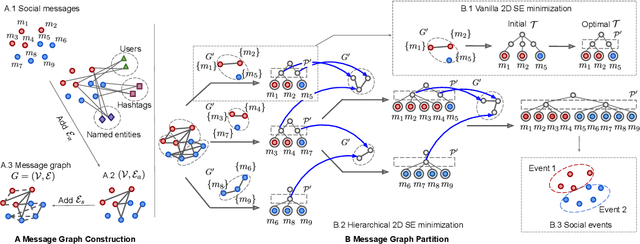

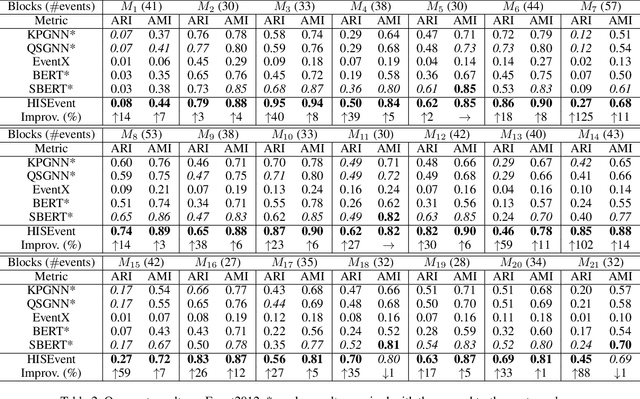
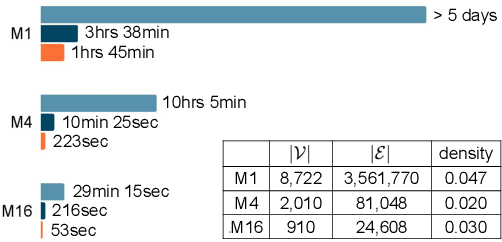
As a trending approach for social event detection, graph neural network (GNN)-based methods enable a fusion of natural language semantics and the complex social network structural information, thus showing SOTA performance. However, GNN-based methods can miss useful message correlations. Moreover, they require manual labeling for training and predetermining the number of events for prediction. In this work, we address social event detection via graph structural entropy (SE) minimization. While keeping the merits of the GNN-based methods, the proposed framework, HISEvent, constructs more informative message graphs, is unsupervised, and does not require the number of events given a priori. Specifically, we incrementally explore the graph neighborhoods using 1-dimensional (1D) SE minimization to supplement the existing message graph with edges between semantically related messages. We then detect events from the message graph by hierarchically minimizing 2-dimensional (2D) SE. Our proposed 1D and 2D SE minimization algorithms are customized for social event detection and effectively tackle the efficiency problem of the existing SE minimization algorithms. Extensive experiments show that HISEvent consistently outperforms GNN-based methods and achieves the new SOTA for social event detection under both closed- and open-set settings while being efficient and robust.
Semi-Supervised Clustering via Structural Entropy with Different Constraints
Dec 18, 2023



Semi-supervised clustering techniques have emerged as valuable tools for leveraging prior information in the form of constraints to improve the quality of clustering outcomes. Despite the proliferation of such methods, the ability to seamlessly integrate various types of constraints remains limited. While structural entropy has proven to be a powerful clustering approach with wide-ranging applications, it has lacked a variant capable of accommodating these constraints. In this work, we present Semi-supervised clustering via Structural Entropy (SSE), a novel method that can incorporate different types of constraints from diverse sources to perform both partitioning and hierarchical clustering. Specifically, we formulate a uniform view for the commonly used pairwise and label constraints for both types of clustering. Then, we design objectives that incorporate these constraints into structural entropy and develop tailored algorithms for their optimization. We evaluate SSE on nine clustering datasets and compare it with eleven semi-supervised partitioning and hierarchical clustering methods. Experimental results demonstrate the superiority of SSE on clustering accuracy with different types of constraints. Additionally, the functionality of SSE for biological data analysis is demonstrated by cell clustering experiments conducted on four single-cell RNAseq datasets.
Catwalk: A Unified Language Model Evaluation Framework for Many Datasets
Dec 15, 2023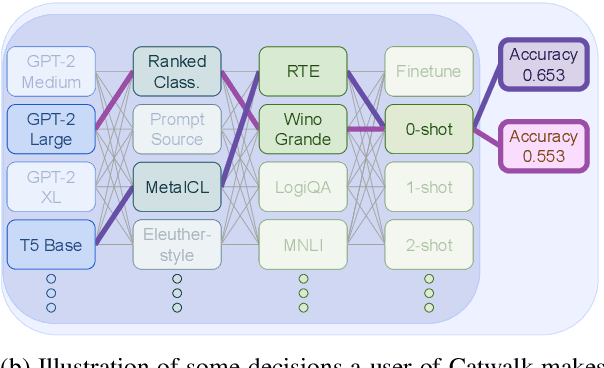
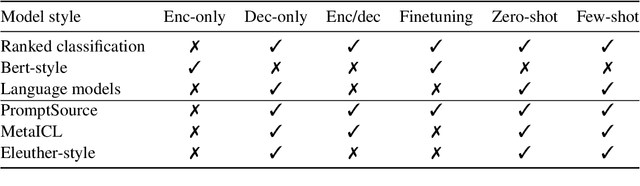
The success of large language models has shifted the evaluation paradigms in natural language processing (NLP). The community's interest has drifted towards comparing NLP models across many tasks, domains, and datasets, often at an extreme scale. This imposes new engineering challenges: efforts in constructing datasets and models have been fragmented, and their formats and interfaces are incompatible. As a result, it often takes extensive (re)implementation efforts to make fair and controlled comparisons at scale. Catwalk aims to address these issues. Catwalk provides a unified interface to a broad range of existing NLP datasets and models, ranging from both canonical supervised training and fine-tuning, to more modern paradigms like in-context learning. Its carefully-designed abstractions allow for easy extensions to many others. Catwalk substantially lowers the barriers to conducting controlled experiments at scale. For example, we finetuned and evaluated over 64 models on over 86 datasets with a single command, without writing any code. Maintained by the AllenNLP team at the Allen Institute for Artificial Intelligence (AI2), Catwalk is an ongoing open-source effort: https://github.com/allenai/catwalk.