 Add to Chrome
 Add to Firefox
 Add to Edge
Is Spurious Correlation Removal Always Learnable?
Jun 11, 2026
Invariant learning can fail even when the invariant structure is statistically identifiable. We show a conditional computational barrier: under a black-box samplable supervised sparse recovery primitive motivated by average-case sparse-recovery reductions, there exist \emph{samplable} multi-environment instances with a one-dimensional predictive invariant subspace ($k=1$) that are learnable with polynomial samples by exhaustive search, while any polynomial-time constant-accuracy recovery algorithm would contradict the primitive. We further quantify environment diversity by a separation parameter $γ$, which controls identifiability and the curvature of invariance objectives. Under sufficient diversity and local Gaussian regularity, the minimax risk is $\mathbb{E}[\dist(\hat{V},V_{\mathrm{inv}})^2]=Θ(k(d-k)/(n|\mathcal{E}|))$, and under label-induced shifts a phase transition occurs at $n^*\propto k(d-k)/(|\mathcal{E}|γ^2)$ with refined estimation error scaling proportional to $1/γ^2$. Synthetic and real datasets illustrate the predicted gaps and transitions and motivate simple diversity diagnostics.

Pedestrian Attribute Recognition as Label-balanced Multi-label Learning
May 08, 2024
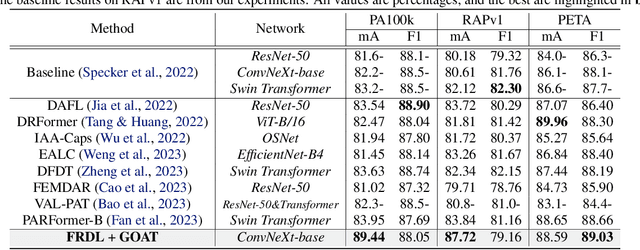
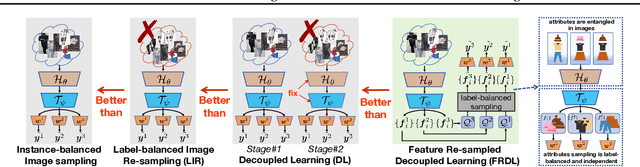
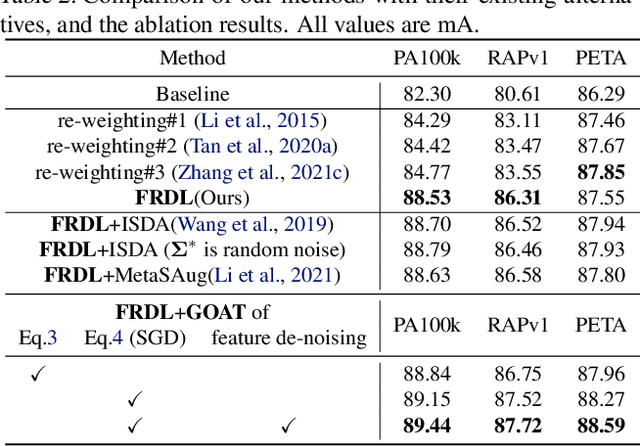
Rooting in the scarcity of most attributes, realistic pedestrian attribute datasets exhibit unduly skewed data distribution, from which two types of model failures are delivered: (1) label imbalance: model predictions lean greatly towards the side of majority labels; (2) semantics imbalance: model is easily overfitted on the under-represented attributes due to their insufficient semantic diversity. To render perfect label balancing, we propose a novel framework that successfully decouples label-balanced data re-sampling from the curse of attributes co-occurrence, i.e., we equalize the sampling prior of an attribute while not biasing that of the co-occurred others. To diversify the attributes semantics and mitigate the feature noise, we propose a Bayesian feature augmentation method to introduce true in-distribution novelty. Handling both imbalances jointly, our work achieves best accuracy on various popular benchmarks, and importantly, with minimal computational budget.
A Solution to Co-occurrence Bias: Attributes Disentanglement via Mutual Information Minimization for Pedestrian Attribute Recognition
Jul 28, 2023Recent studies on pedestrian attribute recognition progress with either explicit or implicit modeling of the co-occurrence among attributes. Considering that this known a prior is highly variable and unforeseeable regarding the specific scenarios, we show that current methods can actually suffer in generalizing such fitted attributes interdependencies onto scenes or identities off the dataset distribution, resulting in the underlined bias of attributes co-occurrence. To render models robust in realistic scenes, we propose the attributes-disentangled feature learning to ensure the recognition of an attribute not inferring on the existence of others, and which is sequentially formulated as a problem of mutual information minimization. Rooting from it, practical strategies are devised to efficiently decouple attributes, which substantially improve the baseline and establish state-of-the-art performance on realistic datasets like PETAzs and RAPzs. Code is released on https://github.com/SDret/A-Solution-to-Co-occurence-Bias-in-Pedestrian-Attribute-Recognition.
One-shot neural band selection for spectral recovery
May 16, 2023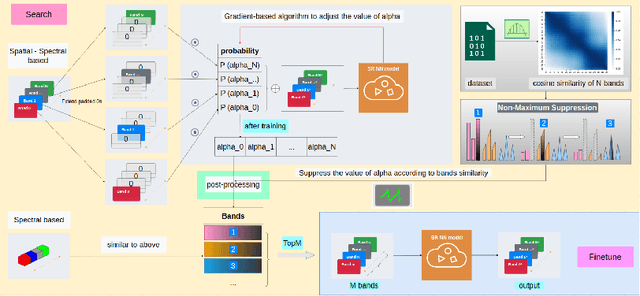

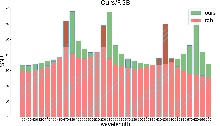

Band selection has a great impact on the spectral recovery quality. To solve this ill-posed inverse problem, most band selection methods adopt hand-crafted priors or exploit clustering or sparse regularization constraints to find most prominent bands. These methods are either very slow due to the computational cost of repeatedly training with respect to different selection frequencies or different band combinations. Many traditional methods rely on the scene prior and thus are not applicable to other scenarios. In this paper, we present a novel one-shot Neural Band Selection (NBS) framework for spectral recovery. Unlike conventional searching approaches with a discrete search space and a non-differentiable search strategy, our NBS is based on the continuous relaxation of the band selection process, thus allowing efficient band search using gradient descent. To enable the compatibility for se- lecting any number of bands in one-shot, we further exploit the band-wise correlation matrices to progressively suppress similar adjacent bands. Extensive evaluations on the NTIRE 2022 Spectral Reconstruction Challenge demonstrate that our NBS achieves consistent performance gains over competitive baselines when examined with four different spectral recov- ery methods. Our code will be publicly available.