 Add to Chrome
 Add to Firefox
 Add to Edge
HCSG: Human-Centric Semantic-Geometric Reasoning for Vision-Language Navigation
May 13, 2026
VLN has achieved remarkable progress by scaling data and model capacity. However, the assumption of a static environment breaks down in real-world indoor scenarios, where robots inevitably encounter dynamic pedestrians. Existing human-aware approaches typically treat humans merely as moving obstacles based on implicit visual cues, lacking the explicit reasoning required to interpret human intentions or maintain social norms. To address this, we propose HCSG, the first human-centric framework for VLN. This framework provides a robust foundation for safe, socially intelligent navigation in dynamic human-robot environments that shifts the paradigm from passive collision avoidance to active human behavior understanding. Specifically, HCSG introduces a unified Human Understanding Module that synergizes two key capabilities: (i) geometric forecasting, which predicts human pose and trajectory to anticipate future motion dynamics; and (ii) semantic interpretation, which leverages a Vision-Language Model (VLM) to generate natural language descriptions of human actions and intentions. These semantic-geometric representations are fused into the agent's topological map for instruction-conditioned planning. Furthermore, a social distance loss is introduced to enforce socially compliant interaction distances. Extensive experiments on the HA-VLNCE benchmark demonstrate that HCSG significantly outperforms state-of-the-art methods, achieving a 14% improvement in Success Rate and a 34% reduction in Collision Rate. Our project can be seen at https://haoxuanxu1024.github.io/HCSG/.

Mask World Model: Predicting What Matters for Robust Robot Policy Learning
Apr 22, 2026World models derived from large-scale video generative pre-training have emerged as a promising paradigm for generalist robot policy learning. However, standard approaches often focus on high-fidelity RGB video prediction, this can result in overfitting to irrelevant factors, such as dynamic backgrounds and illumination changes. These distractions reduce the model's ability to generalize, ultimately leading to unreliable and fragile control policies. To address this, we introduce the Mask World Model (MWM), which leverages video diffusion architectures to predict the evolution of semantic masks instead of pixels. This shift imposes a geometric information bottleneck, forcing the model to capture essential physical dynamics and contact relations while filtering out visual noise. We seamlessly integrate this mask dynamics backbone with a diffusion-based policy head to enable robust end-to-end control. Extensive evaluations demonstrate the superiority of MWM on the LIBERO and RLBench simulation benchmarks, significantly outperforming the state-of-the-art RGB-based world models. Furthermore, real-world experiments and robustness evaluation (via random token pruning) reveal that MWM exhibits superior generalization capabilities and robust resilience to texture information loss.
Towards Robust Text-to-Image Person Retrieval: Multi-View Reformulation for Semantic Compensation
Apr 20, 2026In text-to-image person retrieval tasks, the diversity of natural language expressions and the implicitness of visual semantics often lead to the problem of Expression Drift, where semantically equivalent texts exhibit significant feature discrepancies in the embedding space due to phrasing variations, thereby degrading the robustness of image-text alignment. This paper proposes a semantic compensation framework (MVR) driven by Large Language Models (LLMs), which enhances cross-modal representation consistency through multi-view semantic reformulation and feature compensation. The core methodology comprises three components: Multi-View Reformulation (MVR): A dual-branch prompting strategy combines key feature guidance (extracting visually critical components via feature similarity) and diversity-aware rewriting to generate semantically equivalent yet distributionally diverse textual variants; Textual Feature Robustness Enhancement: A training-free latent space compensation mechanism suppresses noise interference through multi-view feature mean-pooling and residual connections, effectively capturing "Semantic Echoes"; Visual Semantic Compensation: VLM generates multi-perspective image descriptions, which are further enhanced through shared text reformulation to address visual semantic gaps. Experiments demonstrate that our method can improve the accuracy of the original model well without training and performs SOTA on three text-to-image person retrieval datasets.
GGD-SLAM: Monocular 3DGS SLAM Powered by Generalizable Motion Model for Dynamic Environments
Apr 14, 2026Visual SLAM algorithms achieve significant improvements through the exploration of 3D Gaussian Splatting (3DGS) representations, particularly in generating high-fidelity dense maps. However, they depend on a static environment assumption and experience significant performance degradation in dynamic environments. This paper presents GGD-SLAM, a framework that employs a generalizable motion model to address the challenges of localization and dense mapping in dynamic environments - without predefined semantic annotations or depth input. Specifically, the proposed system employs a First-In-First-Out (FIFO) queue to manage incoming frames, facilitating dynamic semantic feature extraction through a sequential attention mechanism. This is integrated with a dynamic feature enhancer to separate static and dynamic components. Additionally, to minimize dynamic distractors' impact on the static components, we devise a method to fill occluded areas via static information sampling and design a distractor-adaptive Structure Similarity Index Measure (SSIM) loss tailored for dynamic environments, significantly enhancing the system's resilience. Experiments conducted on real-world dynamic datasets demonstrate that the proposed system achieves state-of-the-art performance in camera pose estimation and dense reconstruction in dynamic scenes.
CMCC-ReID: Cross-Modality Clothing-Change Person Re-Identification
Apr 03, 2026Person Re-Identification (ReID) faces severe challenges from modality discrepancy and clothing variation in long-term surveillance scenario. While existing studies have made significant progress in either Visible-Infrared ReID (VI-ReID) or Clothing-Change ReID (CC-ReID), real-world surveillance system often face both challenges simultaneously. To address this overlooked yet realistic problem, we define a new task, termed Cross-Modality Clothing-Change Re-Identification (CMCC-ReID), which targets pedestrian matching across variations in both modality and clothing. To advance research in this direction, we construct a new benchmark SYSU-CMCC, where each identity is captured in both visible and infrared domains with distinct outfits, reflecting the dual heterogeneity of long-term surveillance. To tackle CMCC-ReID, we propose a Progressive Identity Alignment Network (PIA) that progressively mitigates the issues of clothing variation and modality discrepancy. Specifically, a Dual-Branch Disentangling Learning (DBDL) module separates identity-related cues from clothing-related factors to achieve clothing-agnostic representation, and a Bi-Directional Prototype Learning (BPL) module performs intra-modality and inter-modality contrast in the embedding space to bridge the modality gap while further suppressing clothing interference. Extensive experiments on the SYSU-CMCC dataset demonstrate that PIA establishes a strong baseline for this new task and significantly outperforms existing methods.
P$^{3}$Nav: End-to-End Perception, Prediction and Planning for Vision-and-Language Navigation
Mar 18, 2026In Vision-and-Language Navigation (VLN), an agent is required to plan a path to the target specified by the language instruction, using its visual observations. Consequently, prevailing VLN methods primarily focus on building powerful planners through visual-textual alignment. However, these approaches often bypass the imperative of comprehensive scene understanding prior to planning, leaving the agent with insufficient perception or prediction capabilities. Thus, we propose P$^{3}$Nav, a novel end-to-end framework integrating perception, prediction, and planning in a unified pipeline to strengthen the VLN agent's scene understanding and boost navigation success. Specifically, P$^{3}$Nav augments perception by extracting complementary cues from object-level and map-level perspectives. Subsequently, our P$^{3}$Nav predicts waypoints to model the agent's potential future states, endowing the agent with intrinsic awareness of candidate positions during navigation. Conditioned on these future waypoints, P$^{3}$Nav further forecasts semantic map cues, enabling proactive planning and reducing the strict reliance on purely historical context. Integrating these perceptual and predictive cues, a holistic planning module finally carries out the VLN tasks. Extensive experiments demonstrate that our P$^{3}$Nav achieves new state-of-the-art performance on the REVERIE, R2R-CE, and RxR-CE benchmarks.
BIT: Matching-based Bi-directional Interaction Transformation Network for Visible-Infrared Person Re-Identification
Mar 15, 2026Visible-Infrared Person Re-Identification (VI-ReID) is a challenging retrieval task due to the substantial modality gap between visible and infrared images. While existing methods attempt to bridge this gap by learning modality-invariant features within a shared embedding space, they often overlook the complex and implicit correlations between modalities. This limitation becomes more severe under distribution shifts, where infrared samples are often far fewer than visible ones. To address these challenges, we propose a novel network termed Bi-directional Interaction Transformation (BIT). Instead of relying on rigid feature alignment, BIT adopts a matching-based strategy that explicitly models the interaction between visible and infrared image pairs. Specifically, BIT employs an encoder-decoder architecture where the encoder extracts preliminary feature representations, and the decoder performs bi-directional feature integration and query aware scoring to enhance cross-modality correspondence. To our best knowledge, BIT is the first to introduce such pairwise matching-driven interaction in VI-ReID. Extensive experiments on several benchmarks demonstrate that our BIT achieves state-of-the-art performance, highlighting its effectiveness in the VI-ReID task.
Enhancing Vision-Language Navigation with Multimodal Event Knowledge from Real-World Indoor Tour Videos
Feb 27, 2026Vision-Language Navigation (VLN) agents often struggle with long-horizon reasoning in unseen environments, particularly when facing ambiguous, coarse-grained instructions. While recent advances use knowledge graph to enhance reasoning, the potential of multimodal event knowledge inspired by human episodic memory remains underexplored. In this work, we propose an event-centric knowledge enhancement strategy for automated process knowledge mining and feature fusion to solve coarse-grained instruction and long-horizon reasoning in VLN task. First, we construct YE-KG, the first large-scale multimodal spatiotemporal knowledge graph, with over 86k nodes and 83k edges, derived from real-world indoor videos. By leveraging multimodal large language models (i.e., LLaVa, GPT4), we extract unstructured video streams into structured semantic-action-effect events to serve as explicit episodic memory. Second, we introduce STE-VLN, which integrates the above graph into VLN models via a Coarse-to-Fine Hierarchical Retrieval mechanism. This allows agents to retrieve causal event sequences and dynamically fuse them with egocentric visual observations. Experiments on REVERIE, R2R, and R2R-CE benchmarks demonstrate the efficiency of our event-centric strategy, outperforming state-of-the-art approaches across diverse action spaces. Our data and code are available on the project website https://sites.google.com/view/y-event-kg/.
Identity-aware Feature Decoupling Learning for Clothing-change Person Re-identification
Jan 10, 2025Clothing-change person re-identification (CC Re-ID) has attracted increasing attention in recent years due to its application prospect. Most existing works struggle to adequately extract the ID-related information from the original RGB images. In this paper, we propose an Identity-aware Feature Decoupling (IFD) learning framework to mine identity-related features. Particularly, IFD exploits a dual stream architecture that consists of a main stream and an attention stream. The attention stream takes the clothing-masked images as inputs and derives the identity attention weights for effectively transferring the spatial knowledge to the main stream and highlighting the regions with abundant identity-related information. To eliminate the semantic gap between the inputs of two streams, we propose a clothing bias diminishing module specific to the main stream to regularize the features of clothing-relevant regions. Extensive experimental results demonstrate that our framework outperforms other baseline models on several widely-used CC Re-ID datasets.
Classifying Crime Types using Judgment Documents from Social Media
Jun 29, 2023
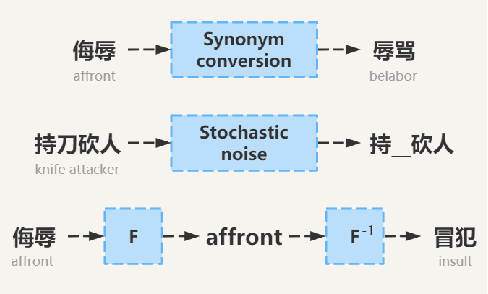
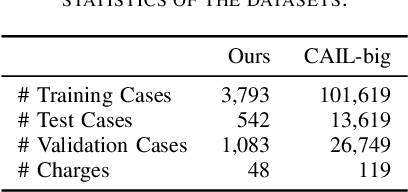
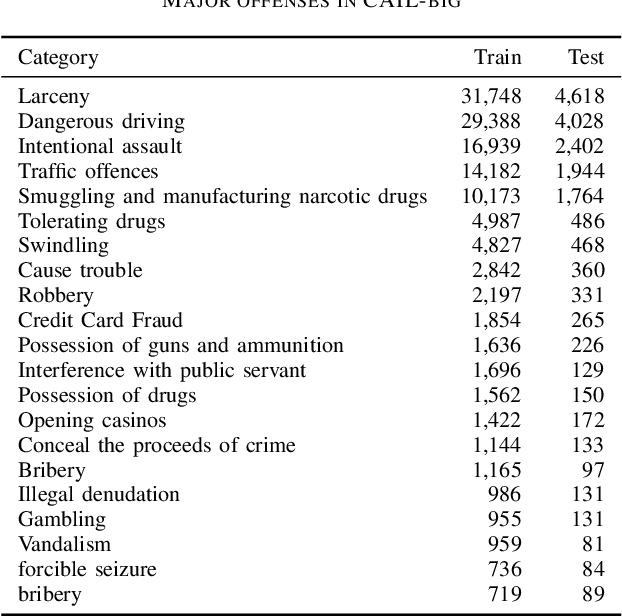
The task of determining crime types based on criminal behavior facts has become a very important and meaningful task in social science. But the problem facing the field now is that the data samples themselves are unevenly distributed, due to the nature of the crime itself. At the same time, data sets in the judicial field are less publicly available, and it is not practical to produce large data sets for direct training. This article proposes a new training model to solve this problem through NLP processing methods. We first propose a Crime Fact Data Preprocessing Module (CFDPM), which can balance the defects of uneven data set distribution by generating new samples. Then we use a large open source dataset (CAIL-big) as our pretraining dataset and a small dataset collected by ourselves for Fine-tuning, giving it good generalization ability to unfamiliar small datasets. At the same time, we use the improved Bert model with dynamic masking to improve the model. Experiments show that the proposed method achieves state-of-the-art results on the present dataset. At the same time, the effectiveness of module CFDPM is proved by experiments. This article provides a valuable methodology contribution for classifying social science texts such as criminal behaviors. Extensive experiments on public benchmarks show that the proposed method achieves new state-of-the-art results.