 Add to Chrome
 Add to Firefox
 Add to Edge
Controllable Relation Disentanglement for Few-Shot Class-Incremental Learning
Mar 17, 2024
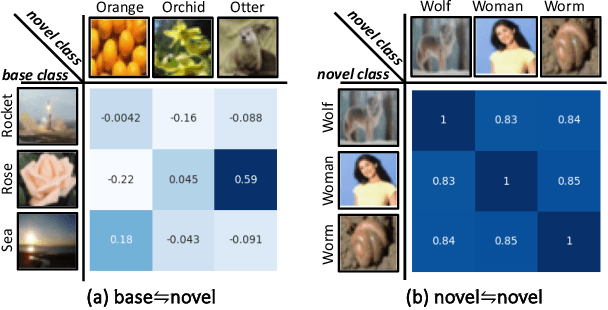
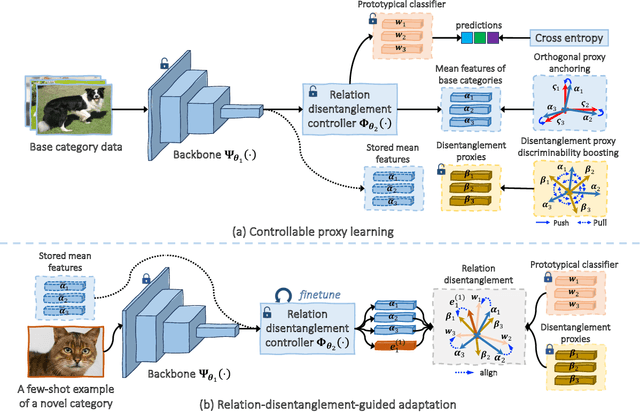


In this paper, we propose to tackle Few-Shot Class-Incremental Learning (FSCIL) from a new perspective, i.e., relation disentanglement, which means enhancing FSCIL via disentangling spurious relation between categories. The challenge of disentangling spurious correlations lies in the poor controllability of FSCIL. On one hand, an FSCIL model is required to be trained in an incremental manner and thus it is very hard to directly control relationships between categories of different sessions. On the other hand, training samples per novel category are only in the few-shot setting, which increases the difficulty of alleviating spurious relation issues as well. To overcome this challenge, in this paper, we propose a new simple-yet-effective method, called ConTrollable Relation-disentangLed Few-Shot Class-Incremental Learning (CTRL-FSCIL). Specifically, during the base session, we propose to anchor base category embeddings in feature space and construct disentanglement proxies to bridge gaps between the learning for category representations in different sessions, thereby making category relation controllable. During incremental learning, the parameters of the backbone network are frozen in order to relieve the negative impact of data scarcity. Moreover, a disentanglement loss is designed to effectively guide a relation disentanglement controller to disentangle spurious correlations between the embeddings encoded by the backbone. In this way, the spurious correlation issue in FSCIL can be suppressed. Extensive experiments on CIFAR-100, mini-ImageNet, and CUB-200 datasets demonstrate the effectiveness of our CTRL-FSCIL method.

Discriminative Probing and Tuning for Text-to-Image Generation
Mar 14, 2024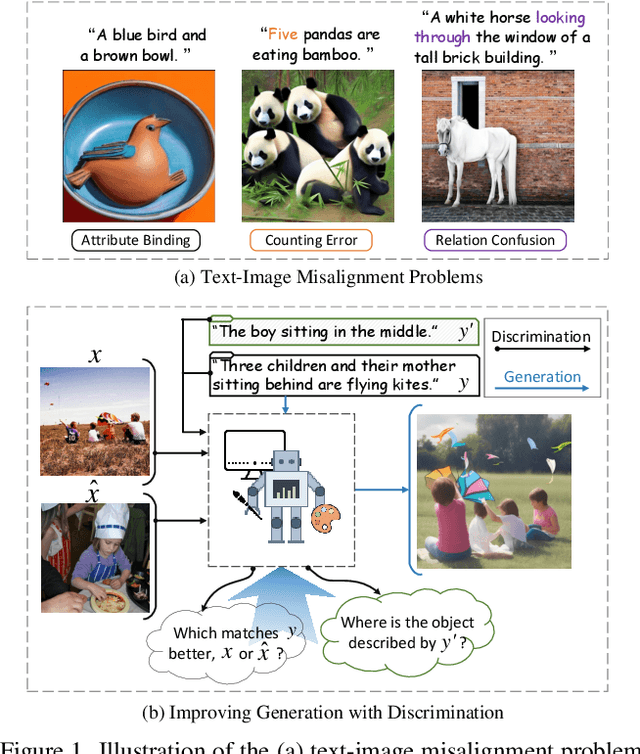
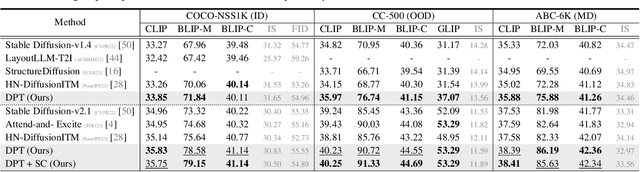
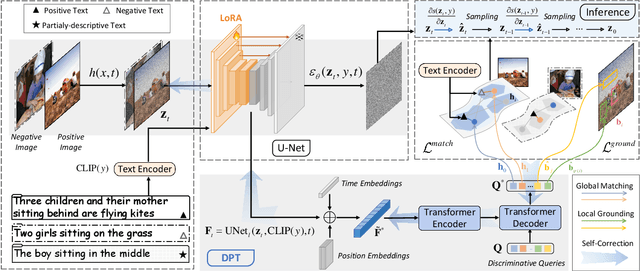
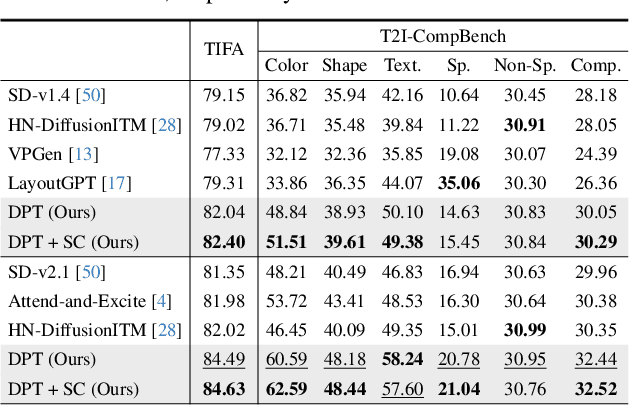
Despite advancements in text-to-image generation (T2I), prior methods often face text-image misalignment problems such as relation confusion in generated images. Existing solutions involve cross-attention manipulation for better compositional understanding or integrating large language models for improved layout planning. However, the inherent alignment capabilities of T2I models are still inadequate. By reviewing the link between generative and discriminative modeling, we posit that T2I models' discriminative abilities may reflect their text-image alignment proficiency during generation. In this light, we advocate bolstering the discriminative abilities of T2I models to achieve more precise text-to-image alignment for generation. We present a discriminative adapter built on T2I models to probe their discriminative abilities on two representative tasks and leverage discriminative fine-tuning to improve their text-image alignment. As a bonus of the discriminative adapter, a self-correction mechanism can leverage discriminative gradients to better align generated images to text prompts during inference. Comprehensive evaluations across three benchmark datasets, including both in-distribution and out-of-distribution scenarios, demonstrate our method's superior generation performance. Meanwhile, it achieves state-of-the-art discriminative performance on the two discriminative tasks compared to other generative models.
Classes Are Not Equal: An Empirical Study on Image Recognition Fairness
Mar 13, 2024In this paper, we present an empirical study on image recognition fairness, i.e., extreme class accuracy disparity on balanced data like ImageNet. We experimentally demonstrate that classes are not equal and the fairness issue is prevalent for image classification models across various datasets, network architectures, and model capacities. Moreover, several intriguing properties of fairness are identified. First, the unfairness lies in problematic representation rather than classifier bias. Second, with the proposed concept of Model Prediction Bias, we investigate the origins of problematic representation during optimization. Our findings reveal that models tend to exhibit greater prediction biases for classes that are more challenging to recognize. It means that more other classes will be confused with harder classes. Then the False Positives (FPs) will dominate the learning in optimization, thus leading to their poor accuracy. Further, we conclude that data augmentation and representation learning algorithms improve overall performance by promoting fairness to some degree in image classification. The Code is available at https://github.com/dvlab-research/Parametric-Contrastive-Learning.
Distributionally Generative Augmentation for Fair Facial Attribute Classification
Mar 11, 2024
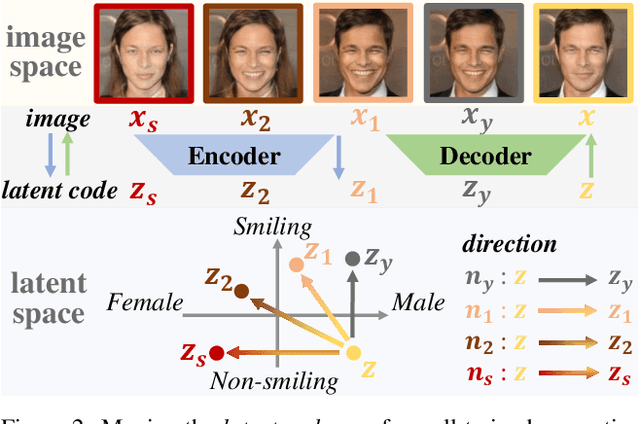


Facial Attribute Classification (FAC) holds substantial promise in widespread applications. However, FAC models trained by traditional methodologies can be unfair by exhibiting accuracy inconsistencies across varied data subpopulations. This unfairness is largely attributed to bias in data, where some spurious attributes (e.g., Male) statistically correlate with the target attribute (e.g., Smiling). Most of existing fairness-aware methods rely on the labels of spurious attributes, which may be unavailable in practice. This work proposes a novel, generation-based two-stage framework to train a fair FAC model on biased data without additional annotation. Initially, we identify the potential spurious attributes based on generative models. Notably, it enhances interpretability by explicitly showing the spurious attributes in image space. Following this, for each image, we first edit the spurious attributes with a random degree sampled from a uniform distribution, while keeping target attribute unchanged. Then we train a fair FAC model by fostering model invariance to these augmentation. Extensive experiments on three common datasets demonstrate the effectiveness of our method in promoting fairness in FAC without compromising accuracy. Codes are in https://github.com/heqianpei/DiGA.
Doubly Abductive Counterfactual Inference for Text-based Image Editing
Mar 05, 2024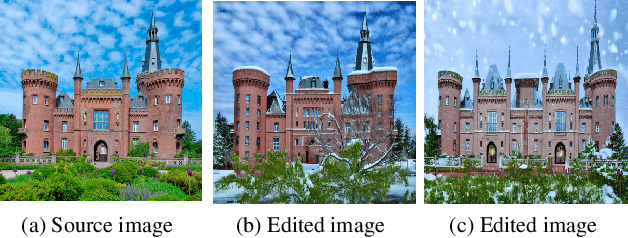
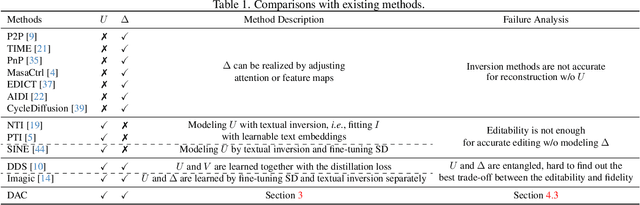
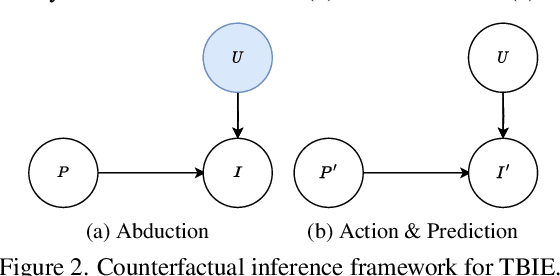
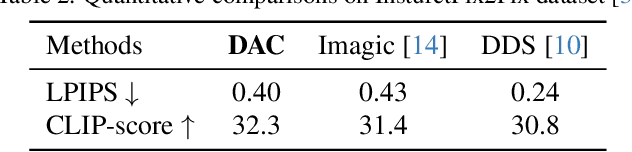
We study text-based image editing (TBIE) of a single image by counterfactual inference because it is an elegant formulation to precisely address the requirement: the edited image should retain the fidelity of the original one. Through the lens of the formulation, we find that the crux of TBIE is that existing techniques hardly achieve a good trade-off between editability and fidelity, mainly due to the overfitting of the single-image fine-tuning. To this end, we propose a Doubly Abductive Counterfactual inference framework (DAC). We first parameterize an exogenous variable as a UNet LoRA, whose abduction can encode all the image details. Second, we abduct another exogenous variable parameterized by a text encoder LoRA, which recovers the lost editability caused by the overfitted first abduction. Thanks to the second abduction, which exclusively encodes the visual transition from post-edit to pre-edit, its inversion -- subtracting the LoRA -- effectively reverts pre-edit back to post-edit, thereby accomplishing the edit. Through extensive experiments, our DAC achieves a good trade-off between editability and fidelity. Thus, we can support a wide spectrum of user editing intents, including addition, removal, manipulation, replacement, style transfer, and facial change, which are extensively validated in both qualitative and quantitative evaluations. Codes are in https://github.com/xuesong39/DAC.
Few-shot Learner Parameterization by Diffusion Time-steps
Mar 05, 2024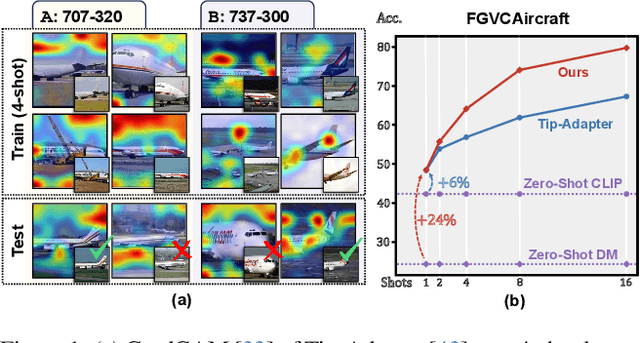
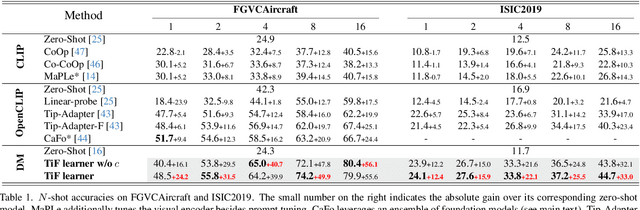
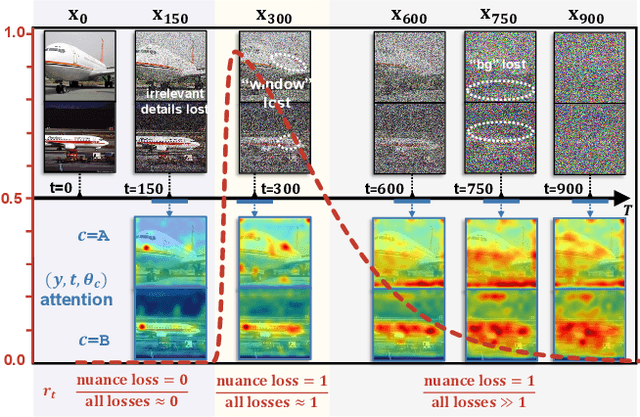

Even when using large multi-modal foundation models, few-shot learning is still challenging -- if there is no proper inductive bias, it is nearly impossible to keep the nuanced class attributes while removing the visually prominent attributes that spuriously correlate with class labels. To this end, we find an inductive bias that the time-steps of a Diffusion Model (DM) can isolate the nuanced class attributes, i.e., as the forward diffusion adds noise to an image at each time-step, nuanced attributes are usually lost at an earlier time-step than the spurious attributes that are visually prominent. Building on this, we propose Time-step Few-shot (TiF) learner. We train class-specific low-rank adapters for a text-conditioned DM to make up for the lost attributes, such that images can be accurately reconstructed from their noisy ones given a prompt. Hence, at a small time-step, the adapter and prompt are essentially a parameterization of only the nuanced class attributes. For a test image, we can use the parameterization to only extract the nuanced class attributes for classification. TiF learner significantly outperforms OpenCLIP and its adapters on a variety of fine-grained and customized few-shot learning tasks. Codes are in https://github.com/yue-zhongqi/tif.
Exploring Diffusion Time-steps for Unsupervised Representation Learning
Jan 21, 2024Representation learning is all about discovering the hidden modular attributes that generate the data faithfully. We explore the potential of Denoising Diffusion Probabilistic Model (DM) in unsupervised learning of the modular attributes. We build a theoretical framework that connects the diffusion time-steps and the hidden attributes, which serves as an effective inductive bias for unsupervised learning. Specifically, the forward diffusion process incrementally adds Gaussian noise to samples at each time-step, which essentially collapses different samples into similar ones by losing attributes, e.g., fine-grained attributes such as texture are lost with less noise added (i.e., early time-steps), while coarse-grained ones such as shape are lost by adding more noise (i.e., late time-steps). To disentangle the modular attributes, at each time-step t, we learn a t-specific feature to compensate for the newly lost attribute, and the set of all 1,...,t-specific features, corresponding to the cumulative set of lost attributes, are trained to make up for the reconstruction error of a pre-trained DM at time-step t. On CelebA, FFHQ, and Bedroom datasets, the learned feature significantly improves attribute classification and enables faithful counterfactual generation, e.g., interpolating only one specified attribute between two images, validating the disentanglement quality. Codes are in https://github.com/yue-zhongqi/diti.
Consistent3D: Towards Consistent High-Fidelity Text-to-3D Generation with Deterministic Sampling Prior
Jan 17, 2024Score distillation sampling (SDS) and its variants have greatly boosted the development of text-to-3D generation, but are vulnerable to geometry collapse and poor textures yet. To solve this issue, we first deeply analyze the SDS and find that its distillation sampling process indeed corresponds to the trajectory sampling of a stochastic differential equation (SDE): SDS samples along an SDE trajectory to yield a less noisy sample which then serves as a guidance to optimize a 3D model. However, the randomness in SDE sampling often leads to a diverse and unpredictable sample which is not always less noisy, and thus is not a consistently correct guidance, explaining the vulnerability of SDS. Since for any SDE, there always exists an ordinary differential equation (ODE) whose trajectory sampling can deterministically and consistently converge to the desired target point as the SDE, we propose a novel and effective "Consistent3D" method that explores the ODE deterministic sampling prior for text-to-3D generation. Specifically, at each training iteration, given a rendered image by a 3D model, we first estimate its desired 3D score function by a pre-trained 2D diffusion model, and build an ODE for trajectory sampling. Next, we design a consistency distillation sampling loss which samples along the ODE trajectory to generate two adjacent samples and uses the less noisy sample to guide another more noisy one for distilling the deterministic prior into the 3D model. Experimental results show the efficacy of our Consistent3D in generating high-fidelity and diverse 3D objects and large-scale scenes, as shown in Fig. 1. The codes are available at https://github.com/sail-sg/Consistent3D.
MGNet: Learning Correspondences via Multiple Graphs
Jan 10, 2024Learning correspondences aims to find correct correspondences (inliers) from the initial correspondence set with an uneven correspondence distribution and a low inlier rate, which can be regarded as graph data. Recent advances usually use graph neural networks (GNNs) to build a single type of graph or simply stack local graphs into the global one to complete the task. But they ignore the complementary relationship between different types of graphs, which can effectively capture potential relationships among sparse correspondences. To address this problem, we propose MGNet to effectively combine multiple complementary graphs. To obtain information integrating implicit and explicit local graphs, we construct local graphs from implicit and explicit aspects and combine them effectively, which is used to build a global graph. Moreover, we propose Graph~Soft~Degree~Attention (GSDA) to make full use of all sparse correspondence information at once in the global graph, which can capture and amplify discriminative features. Extensive experiments demonstrate that MGNet outperforms state-of-the-art methods in different visual tasks. The code is provided in https://github.com/DAILUANYUAN/MGNet-2024AAAI.
Dual-Perspective Knowledge Enrichment for Semi-Supervised 3D Object Detection
Jan 10, 2024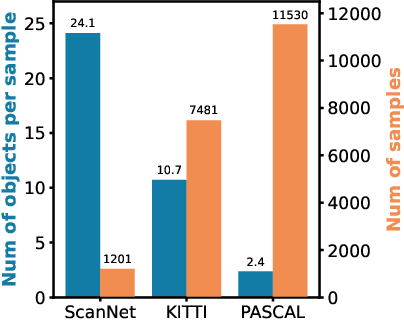


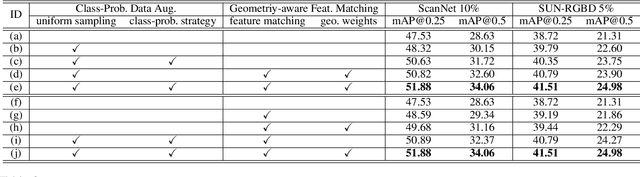
Semi-supervised 3D object detection is a promising yet under-explored direction to reduce data annotation costs, especially for cluttered indoor scenes. A few prior works, such as SESS and 3DIoUMatch, attempt to solve this task by utilizing a teacher model to generate pseudo-labels for unlabeled samples. However, the availability of unlabeled samples in the 3D domain is relatively limited compared to its 2D counterpart due to the greater effort required to collect 3D data. Moreover, the loose consistency regularization in SESS and restricted pseudo-label selection strategy in 3DIoUMatch lead to either low-quality supervision or a limited amount of pseudo labels. To address these issues, we present a novel Dual-Perspective Knowledge Enrichment approach named DPKE for semi-supervised 3D object detection. Our DPKE enriches the knowledge of limited training data, particularly unlabeled data, from two perspectives: data-perspective and feature-perspective. Specifically, from the data-perspective, we propose a class-probabilistic data augmentation method that augments the input data with additional instances based on the varying distribution of class probabilities. Our DPKE achieves feature-perspective knowledge enrichment by designing a geometry-aware feature matching method that regularizes feature-level similarity between object proposals from the student and teacher models. Extensive experiments on the two benchmark datasets demonstrate that our DPKE achieves superior performance over existing state-of-the-art approaches under various label ratio conditions. The source code will be made available to the public.