 Add to Chrome
 Add to Firefox
 Add to Edge
Parameter Importance is Not Static: Evolving Parameter Isolation for Supervised Fine-Tuning
Apr 15, 2026
Supervised Fine-Tuning (SFT) of large language models often suffers from task interference and catastrophic forgetting. Recent approaches alleviate this issue by isolating task-critical parameters during training. However, these methods represent a static solution to a dynamic problem, assuming that parameter importance remains fixed once identified. In this work, we empirically demonstrate that parameter importance exhibits temporal drift over the course of training. To address this, we propose Evolving Parameter Isolation (EPI), a fine-tuning framework that adapts isolation decisions based on online estimates of parameter importance. Instead of freezing a fixed subset of parameters, EPI periodically updates isolation masks using gradient-based signals, enabling the model to protect emerging task-critical parameters while releasing outdated ones to recover plasticity. Experiments on diverse multi-task benchmarks demonstrate that EPI consistently reduces interference and forgetting compared to static isolation and standard fine-tuning, while improving overall generalization. Our analysis highlights the necessity of synchronizing isolation mechanisms with the evolving dynamics of learning diverse abilities.

Reason Only When Needed: Efficient Generative Reward Modeling via Model-Internal Uncertainty
Apr 11, 2026Recent advancements in the Generative Reward Model (GRM) have demonstrated its potential to enhance the reasoning abilities of LLMs through Chain-of-Thought (CoT) prompting. Despite these gains, existing implementations of GRM suffer from two critical limitations. First, CoT prompting is applied indiscriminately to all inputs regardless of their inherent complexity. This introduces unnecessary computational costs for tasks amenable to fast, direct inference. Second, existing approaches primarily rely on voting-based mechanisms to evaluate CoT outputs, which often lack granularity and precision in assessing reasoning quality. In this paper, we propose E-GRM, an efficient generative reward modeling framework grounded in model-internal uncertainty. E-GRM leverages the convergence behavior of parallel model generations to estimate uncertainty and selectively trigger CoT reasoning only when needed, without relying on handcrafted features or task-dependent signals. To improve reward fidelity, we introduce a lightweight discriminative scorer trained with a hybrid regression--ranking objective to provide fine-grained evaluation of reasoning paths. Experiments on multiple reasoning benchmarks show that E-GRM substantially reduces inference cost while consistently improving answer accuracy, demonstrating that model-internal uncertainty is an effective and general signal for efficient reasoning-aware reward modeling.
Why Supervised Fine-Tuning Fails to Learn: A Systematic Study of Incomplete Learning in Large Language Models
Apr 11, 2026Supervised Fine-Tuning (SFT) is the standard approach for adapting large language models (LLMs) to downstream tasks. However, we observe a persistent failure mode: even after convergence, models often fail to correctly reproduce a subset of their own supervised training data. We refer to this behavior as the Incomplete Learning Phenomenon(ILP). This paper presents the first systematic study of ILP in LLM fine-tuning. We formalize ILP as post-training failure to internalize supervised instances and demonstrate its prevalence across multiple model families, domains, and datasets. Through controlled analyses, we identify five recurrent sources of incomplete learning: (1) missing prerequisite knowledge in the pre-trained model, (2) conflicts between SFT supervision and pre-training knowledge, (3) internal inconsistencies within SFT data, (4) left-side forgetting during sequential fine-tuning, and (5) insufficient optimization for rare or complex patterns. We introduce a diagnostic-first framework that maps unlearned samples to these causes using observable training and inference signals, and study several targeted mitigation strategies as causal interventions. Experiments on Qwen, LLaMA, and OLMo2 show that incomplete learning is widespread and heterogeneous, and that improvements in aggregate metrics can mask persistent unlearned subsets. The findings highlight the need for fine-grained diagnosis of what supervised fine-tuning fails to learn, and why.
A Dual-Task Synergy-Driven Generalization Framework for Pancreatic Cancer Segmentation in CT Scans
May 03, 2025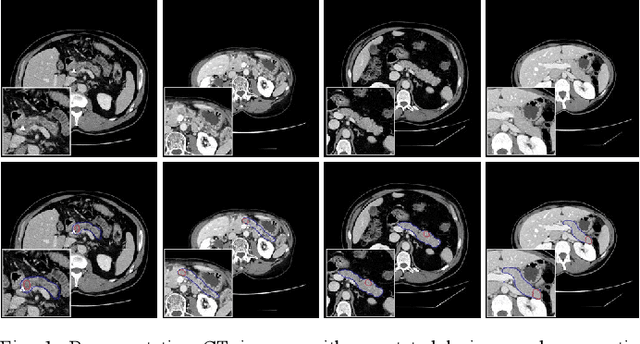
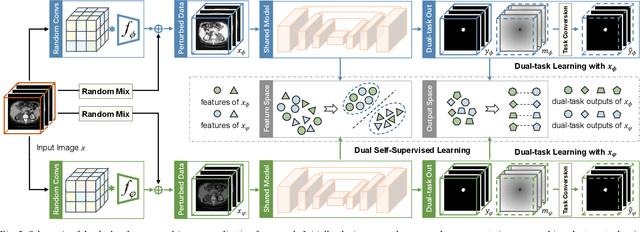
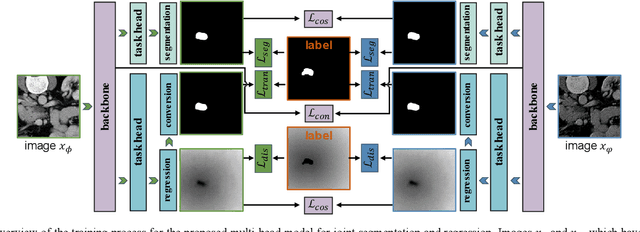
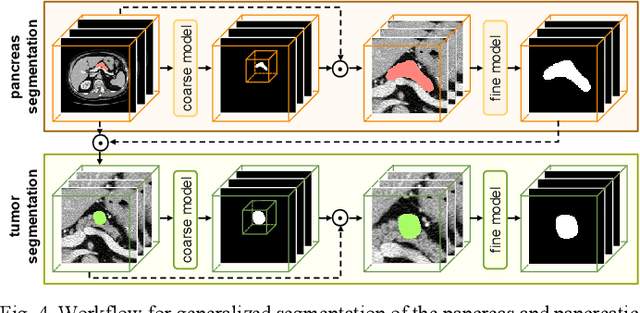
Pancreatic cancer, characterized by its notable prevalence and mortality rates, demands accurate lesion delineation for effective diagnosis and therapeutic interventions. The generalizability of extant methods is frequently compromised due to the pronounced variability in imaging and the heterogeneous characteristics of pancreatic lesions, which may mimic normal tissues and exhibit significant inter-patient variability. Thus, we propose a generalization framework that synergizes pixel-level classification and regression tasks, to accurately delineate lesions and improve model stability. This framework not only seeks to align segmentation contours with actual lesions but also uses regression to elucidate spatial relationships between diseased and normal tissues, thereby improving tumor localization and morphological characterization. Enhanced by the reciprocal transformation of task outputs, our approach integrates additional regression supervision within the segmentation context, bolstering the model's generalization ability from a dual-task perspective. Besides, dual self-supervised learning in feature spaces and output spaces augments the model's representational capability and stability across different imaging views. Experiments on 594 samples composed of three datasets with significant imaging differences demonstrate that our generalized pancreas segmentation results comparable to mainstream in-domain validation performance (Dice: 84.07%). More importantly, it successfully improves the results of the highly challenging cross-lesion generalized pancreatic cancer segmentation task by 9.51%. Thus, our model constitutes a resilient and efficient foundational technological support for pancreatic disease management and wider medical applications. The codes will be released at https://github.com/SJTUBME-QianLab/Dual-Task-Seg.
ATM: Adversarial Tuning Multi-agent System Makes a Robust Retrieval-Augmented Generator
May 28, 2024Large language model (LLM) has proven to benefit a lot from retrieval augmentation in alleviating hallucinations confronted with knowledge-intensive questions. Retrieval-augmented generation (RAG) adopts IR-based techniques utilizing semantic-relevant documents as the generator's input context and realizes external knowledge injection. However, on today's Internet which is flooded with content generated by LLMs, there are too many "related yet useless" documents or even fake knowledge fabricated by LLMs, which will introduce extra noise to the generator and distract it from giving correct results. To this end, we regard the training of the RAG generator model as a multi-agent adversarial-defensive system, guiding the generator to have a better taste of whether a specific document helps answer the question through the Adversarial Tuning in a Multi-agent (ATM) system to strengthen the generator's robustness in an RAG pipeline. After rounds of multi-agent iterative tuning, we find that the ATM Generator can eventually discriminate useful documents amongst LLM fabrications and achieve better performance than strong baselines.
Chain of Tools: Large Language Model is an Automatic Multi-tool Learner
May 26, 2024Augmenting large language models (LLMs) with external tools has emerged as a promising approach to extend their utility, empowering them to solve practical tasks. Existing work typically empowers LLMs as tool users with a manually designed workflow, where the LLM plans a series of tools in a step-by-step manner, and sequentially executes each tool to obtain intermediate results until deriving the final answer. However, they suffer from two challenges in realistic scenarios: (1) The handcrafted control flow is often ad-hoc and constraints the LLM to local planning; (2) The LLM is instructed to use only manually demonstrated tools or well-trained Python functions, which limits its generalization to new tools. In this work, we first propose Automatic Tool Chain (ATC), a framework that enables the LLM to act as a multi-tool user, which directly utilizes a chain of tools through programming. To scale up the scope of the tools, we next propose a black-box probing method. This further empowers the LLM as a tool learner that can actively discover and document tool usages, teaching themselves to properly master new tools. For a comprehensive evaluation, we build a challenging benchmark named ToolFlow, which diverges from previous benchmarks by its long-term planning scenarios and complex toolset. Experiments on both existing datasets and ToolFlow illustrate the superiority of our framework. Analysis on different settings also validates the effectiveness and the utility of our black-box probing algorithm.
GOVERN: Gradient Orientation Vote Ensemble for Multi-Teacher Reinforced Distillation
May 06, 2024Pre-trained language models have become an integral component of question-answering systems, achieving remarkable performance. For practical deployment, it is critical to carry out knowledge distillation to preserve high performance under computational constraints. In this paper, we address a key question: given the importance of unsupervised distillation for student performance, how does one effectively ensemble knowledge from multiple teachers at this stage without the guidance of ground-truth labels? We propose a novel algorithm, GOVERN, to tackle this issue. GOVERN has demonstrated significant improvements in both offline and online experiments. The proposed algorithm has been successfully deployed in a real-world commercial question-answering system.
The Real, the Better: Aligning Large Language Models with Online Human Behaviors
May 01, 2024Large language model alignment is widely used and studied to avoid LLM producing unhelpful and harmful responses. However, the lengthy training process and predefined preference bias hinder adaptation to online diverse human preferences. To this end, this paper proposes an alignment framework, called Reinforcement Learning with Human Behavior (RLHB), to align LLMs by directly leveraging real online human behaviors. By taking the generative adversarial framework, the generator is trained to respond following expected human behavior; while the discriminator tries to verify whether the triplets of query, response, and human behavior come from real online environments. Behavior modeling in natural-language form and the multi-model joint training mechanism enable an active and sustainable online alignment. Experimental results confirm the effectiveness of our proposed methods by both human and automatic evaluations.
Learning to Use Tools via Cooperative and Interactive Agents
Mar 05, 2024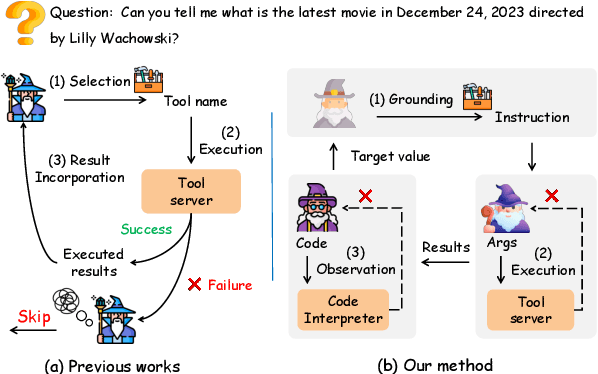
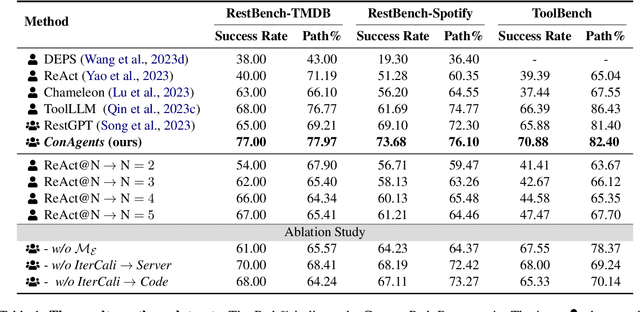
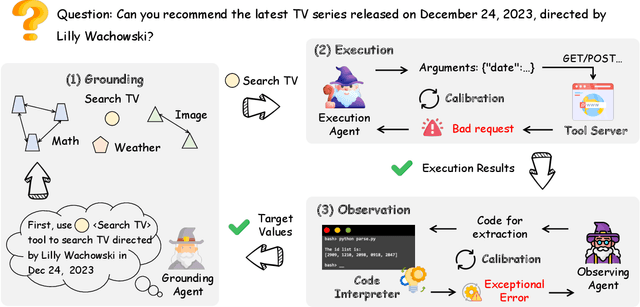
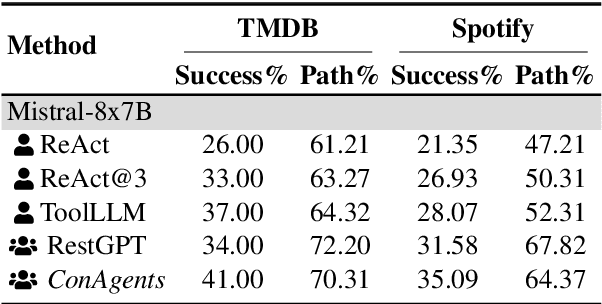
Tool learning empowers large language models (LLMs) as agents to use external tools to extend their capability. Existing methods employ one single LLM-based agent to iteratively select and execute tools, thereafter incorporating the result into the next action prediction. However, they still suffer from potential performance degradation when addressing complex tasks due to: (1) the limitation of the inherent capability of a single LLM to perform diverse actions, and (2) the struggle to adaptively correct mistakes when the task fails. To mitigate these problems, we propose the ConAgents, a Cooperative and interactive Agents framework, which modularizes the workflow of tool learning into Grounding, Execution, and Observing agents. We also introduce an iterative calibration (IterCali) method, enabling the agents to adapt themselves based on the feedback from the tool environment. Experiments conducted on three datasets demonstrate the superiority of our ConAgents (e.g., 6 point improvement over the SOTA baseline). We further provide fine-granularity analysis for the efficiency and consistency of our framework.
KnowTuning: Knowledge-aware Fine-tuning for Large Language Models
Feb 17, 2024Despite their success at many natural language processing (NLP) tasks, large language models (LLMs) still struggle to effectively leverage knowledge for knowledge-intensive tasks, manifesting limitations such as generating incomplete, non-factual, or illogical answers. These limitations stem from inadequate knowledge awareness of LLMs during vanilla fine-tuning. To address these problems, we propose a knowledge-aware fine-tuning (KnowTuning) method to explicitly and implicitly improve the knowledge awareness of LLMs. We devise an explicit knowledge-aware generation stage to train LLMs to explicitly identify knowledge triples in answers. We also propose an implicit knowledge-aware comparison stage to train LLMs to implicitly distinguish between reliable and unreliable knowledge, in three aspects: completeness, factuality, and logicality. Extensive experiments on both generic and medical question answering (QA) datasets confirm the effectiveness of KnowTuning, through automatic and human evaluations, across various sizes of LLMs. Finally, we demonstrate that the improvements of KnowTuning generalize to unseen QA datasets.