 Add to Chrome
 Add to Firefox
 Add to Edge
Towards an Automated Test of LLM Security Knowledge
Jul 20, 2026
Large language models (LLMs) are increasingly used for a range of software, hardware and human-centered security tasks. Consequently, LLM performance on security tasks is an active area of measurement and research, often with a focus on identifying areas in which LLM security ``knowledge'' may be insufficient. Popular strategies for identifying LLM security knowledge gaps include building corpora of challenge questions or task benchmarks, strategies that require substantial manual work and security expertise to design and execute. We introduce a partially-automated method for assessing LLM knowledge of a security area.The method uses authoritative information from Consumer Protection Agencies (CPAs) to identify instability in LLM responses that can be indicative of knowledge gaps. We demonstrate the method for 2 security topics, identity theft and impostor scams, and 5 LLMs in 2 leading LLM families, Gemini and GPT, using publicly available information about identity theft and impostor scams from 6 CPAs.The method distinguishes between models that have and don't have sufficient knowledge to accurately identify the security topics in text narratives.

Research on Limited Buffer Scheduling Problems in Flexible Flow Shops with Setup Times
Dec 07, 2018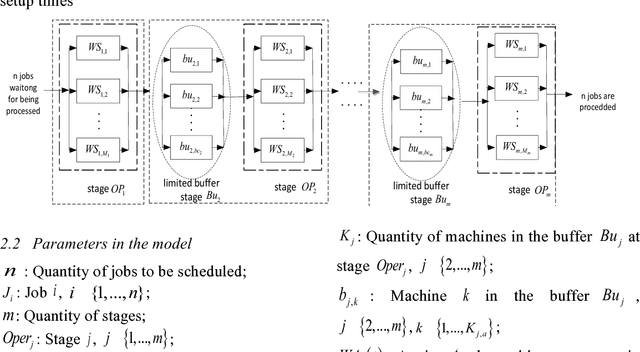
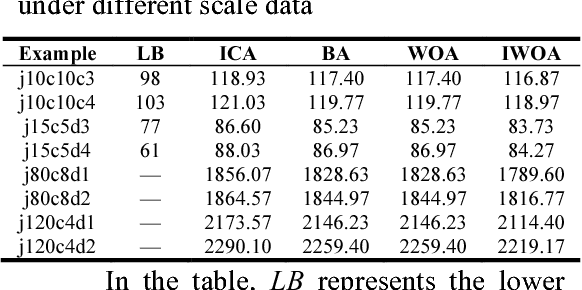
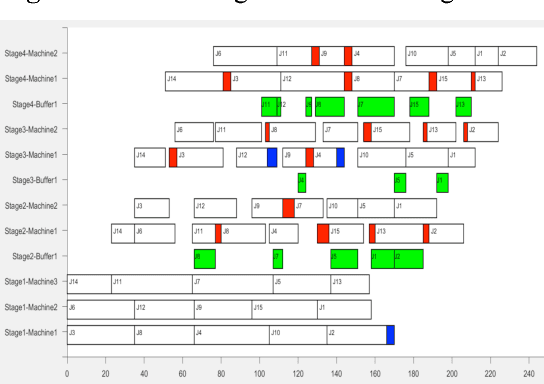
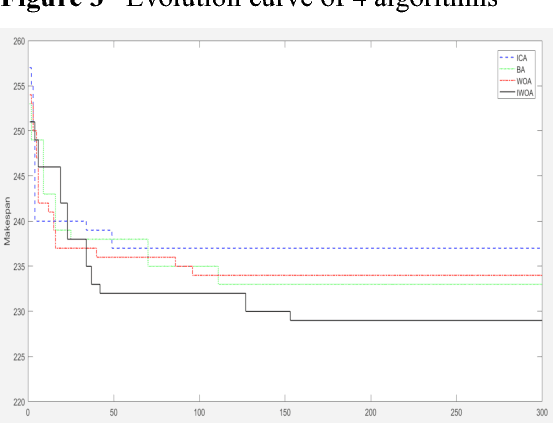
In order to solve the limited buffer scheduling problems in flexible flow shops with setup times, this paper proposes an improved whale optimization algorithm (IWOA) as a global optimization algorithm. Firstly, this paper presents a mathematic programming model for limited buffer in flexible flow shops with setup times, and applies the IWOA algorithm as the global optimization algorithm. Based on the whale optimization algorithm (WOA), the improved algorithm uses Levy flight, opposition-based learning strategy and simulated annealing to expand the search range, enhance the ability for jumping out of local extremum, and improve the continuous evolution of the algorithm. To verify the improvement of the proposed algorithm on the optimization ability of the standard WOA algorithm, the IWOA algorithm is tested by verification examples of small-scale and large-scale flexible flow shop scheduling problems, and the imperialist competitive algorithm (ICA), bat algorithm (BA), and whale optimization algorithm (WOA) are used for comparision. Based on the instance data of bus manufacturer, simulation tests are made on the four algorithms under variouis of practical evalucation scenarios. The simulation results show that the IWOA algorithm can better solve this type of limited buffer scheduling problem in flexible flow shops with setup times compared with the state of the art algorithms.