 Add to Chrome
 Add to Firefox
 Add to Edge
Rethinking Bregman Divergences in Kronecker-Factored Optimizers
May 30, 2026
Shampoo-style optimizers approximate gradient covariance matrices using Kronecker-factored structures. Recent work~\cite{lin2026understanding} showed that such approximations can be viewed as projections under Bregman matrix divergences, leading to different Kronecker-factored preconditioners. However, it remains unclear what role the choice of divergence plays when the covariance is not exactly Kronecker-factored. We study this question through the spectrum of the covariance matrix. We show that Frobenius, von Neumann, and LogDet divergences distribute the unavoidable Kronecker approximation error differently across the covariance spectrum. We further show that their Kronecker factors are governed by divergence-weighted residuals rather than the raw approximation error, explaining how these spectral preferences are realized in the resulting preconditioners. Empirically, we observe that the top covariance eigenspace is substantially better aligned with the Hessian matrix, while the tail spectrum is much noisier and unreliable. Motivated by these findings, we propose a subspace-aware Kronecker optimizer that applies eigenvalue-based preconditioning in the top subspace and uses an adaptive isotropic acceleration constant in the bottom subspace.

The Stability of Singular Distribution: A Spectral Perspective on the Two-Phase Dynamics of Language Model Pre-training
May 26, 2026Large language model pre-training typically exhibits a two-phase trajectory: a fast initial loss drop followed by a prolonged slow improvement. We identify an underlying spectral phenomenon, Stability of Singular Distribution (SoSD), where the trace-normalized singular value spectrum stabilizes early, even as parameter matrices continue to evolve. We demonstrate that synchronization between SoSD and the slow-descent regime is widely observed across diverse architectures (GPT-2, LLaMA) and settings, including various schedules (Step-wise, WSD, Cosine Decay), weight decays, and optimizers (AdamW, Muon). By analyzing a simplified Transformer, we prove that growing weight norms inevitably precipitate an early SoSD threshold, after which the rate of loss decrease becomes theoretically bounded by the variation in the singular distribution. We further interpret strategies like WSD and Muon through their ability to modulate the SoSD scale, offering a spectral lens for understanding efficient pre-training dynamics.
Extra-Merge: Tracing the Rank-1 Subspace of Model Merging in Language Model Pre-Training
May 26, 2026Model merging has emerged as a lightweight paradigm for enhancing Large Language Models (LLMs), yet its underlying mechanisms remain poorly understood. In this work, we analyze late-stage pre-training trajectories and uncover a \textbf{Rank-1 Subspace} phenomenon: while raw optimization steps oscillate violently, consecutive \emph{merged} checkpoints collapse onto a stable, approximately one-dimensional linear manifold. We theoretically ground this observation in a \emph{river-valley} landscape analysis: averaging acts as a geometric low-pass filter that dampens high-curvature noise to reveal the optimal descent direction. Capitalizing on this insight, we propose \textbf{Extra-Merge}, a training-free strategy that extrapolates along this subspace to minimize loss without additional gradient updates. Extensive experiments across GPT-2 and LLaMA families (124M to 2B) demonstrate that Extra-Merge consistently outperforms standard merging baselines. Notably, it yields consistent zero-shot accuracy gains on Pythia-12B downstream tasks and generalizes effectively to the Muon optimizer \citep{jordan2024muon}.
Mimicking the Physicist's Eye:A VLM-centric Approach for Physics Formula Discovery
Aug 24, 2025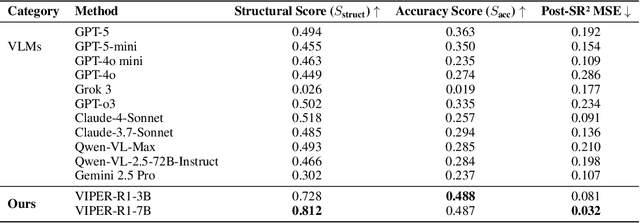
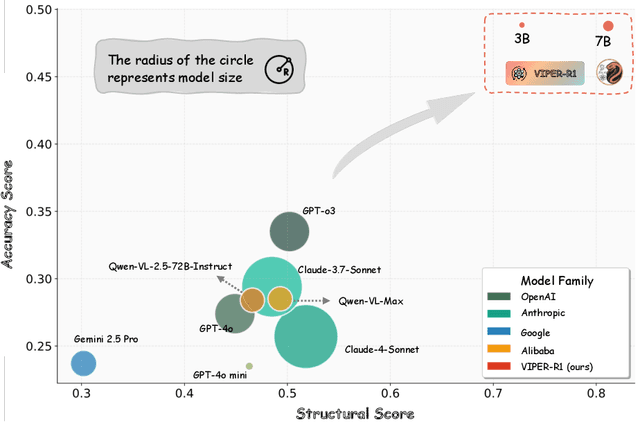
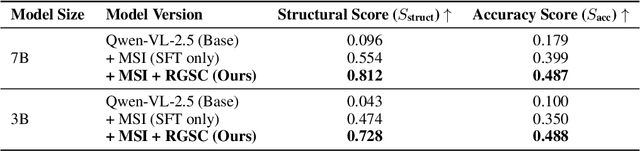
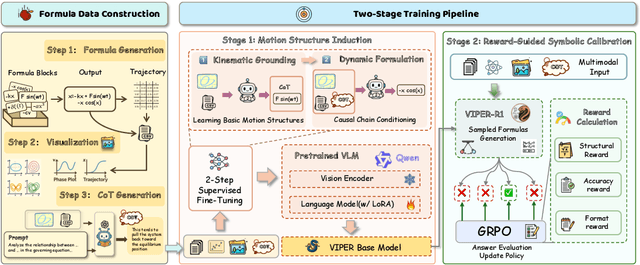
Automated discovery of physical laws from observational data in the real world is a grand challenge in AI. Current methods, relying on symbolic regression or LLMs, are limited to uni-modal data and overlook the rich, visual phenomenological representations of motion that are indispensable to physicists. This "sensory deprivation" severely weakens their ability to interpret the inherent spatio-temporal patterns within dynamic phenomena. To address this gap, we propose VIPER-R1, a multimodal model that performs Visual Induction for Physics-based Equation Reasoning to discover fundamental symbolic formulas. It integrates visual perception, trajectory data, and symbolic reasoning to emulate the scientific discovery process. The model is trained via a curriculum of Motion Structure Induction (MSI), using supervised fine-tuning to interpret kinematic phase portraits and to construct hypotheses guided by a Causal Chain of Thought (C-CoT), followed by Reward-Guided Symbolic Calibration (RGSC) to refine the formula structure with reinforcement learning. During inference, the trained VIPER-R1 acts as an agent: it first posits a high-confidence symbolic ansatz, then proactively invokes an external symbolic regression tool to perform Symbolic Residual Realignment (SR^2). This final step, analogous to a physicist's perturbation analysis, reconciles the theoretical model with empirical data. To support this research, we introduce PhysSymbol, a new 5,000-instance multimodal corpus. Experiments show that VIPER-R1 consistently outperforms state-of-the-art VLM baselines in accuracy and interpretability, enabling more precise discovery of physical laws. Project page: https://jiaaqiliu.github.io/VIPER-R1/
GOVERN: Gradient Orientation Vote Ensemble for Multi-Teacher Reinforced Distillation
May 06, 2024Pre-trained language models have become an integral component of question-answering systems, achieving remarkable performance. For practical deployment, it is critical to carry out knowledge distillation to preserve high performance under computational constraints. In this paper, we address a key question: given the importance of unsupervised distillation for student performance, how does one effectively ensemble knowledge from multiple teachers at this stage without the guidance of ground-truth labels? We propose a novel algorithm, GOVERN, to tackle this issue. GOVERN has demonstrated significant improvements in both offline and online experiments. The proposed algorithm has been successfully deployed in a real-world commercial question-answering system.
EQG-RACE: Examination-Type Question Generation
Dec 11, 2020
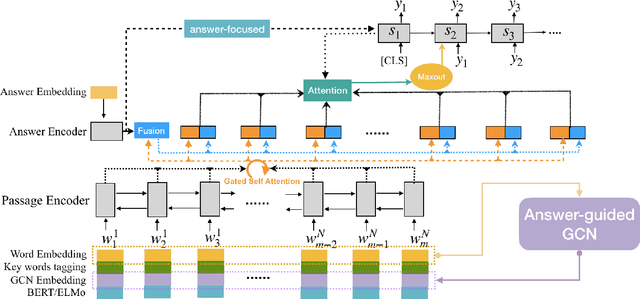

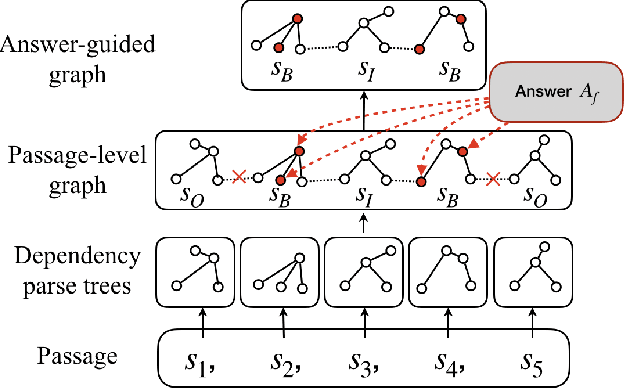
Question Generation (QG) is an essential component of the automatic intelligent tutoring systems, which aims to generate high-quality questions for facilitating the reading practice and assessments. However, existing QG technologies encounter several key issues concerning the biased and unnatural language sources of datasets which are mainly obtained from the Web (e.g. SQuAD). In this paper, we propose an innovative Examination-type Question Generation approach (EQG-RACE) to generate exam-like questions based on a dataset extracted from RACE. Two main strategies are employed in EQG-RACE for dealing with discrete answer information and reasoning among long contexts. A Rough Answer and Key Sentence Tagging scheme is utilized to enhance the representations of input. An Answer-guided Graph Convolutional Network (AG-GCN) is designed to capture structure information in revealing the inter-sentences and intra-sentence relations. Experimental results show a state-of-the-art performance of EQG-RACE, which is apparently superior to the baselines. In addition, our work has established a new QG prototype with a reshaped dataset and QG method, which provides an important benchmark for related research in future work. We will make our data and code publicly available for further research.
Question-type Driven Question Generation
Aug 31, 2019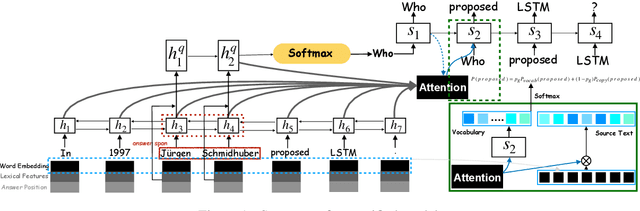

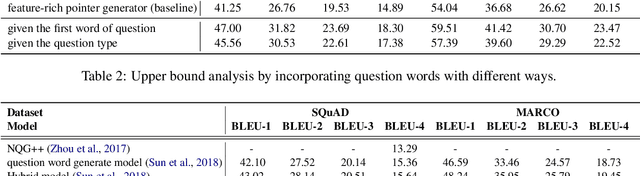
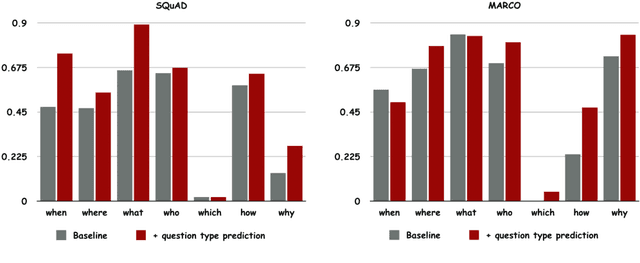
Question generation is a challenging task which aims to ask a question based on an answer and relevant context. The existing works suffer from the mismatching between question type and answer, i.e. generating a question with type $how$ while the answer is a personal name. We propose to automatically predict the question type based on the input answer and context. Then, the question type is fused into a seq2seq model to guide the question generation, so as to deal with the mismatching problem. We achieve significant improvement on the accuracy of question type prediction and finally obtain state-of-the-art results for question generation on both SQuAD and MARCO datasets.
Multi-Task Learning with Language Modeling for Question Generation
Aug 30, 2019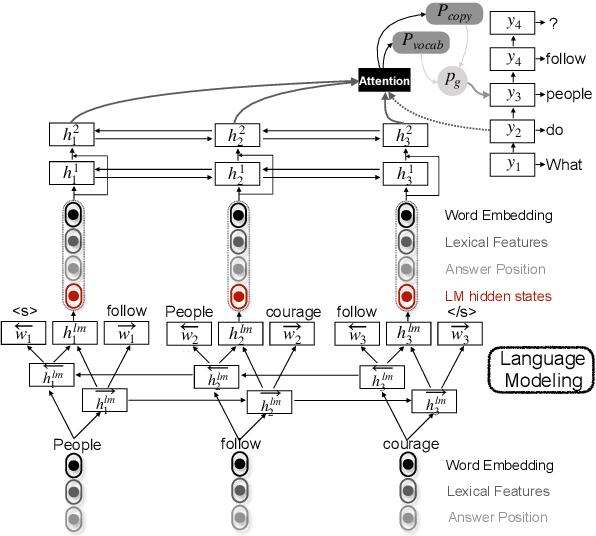
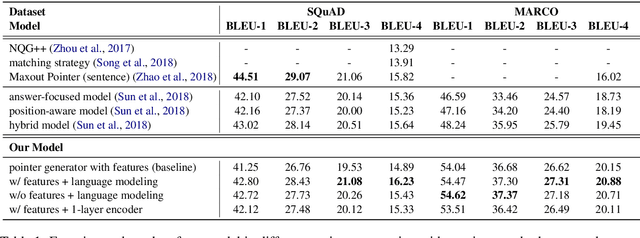
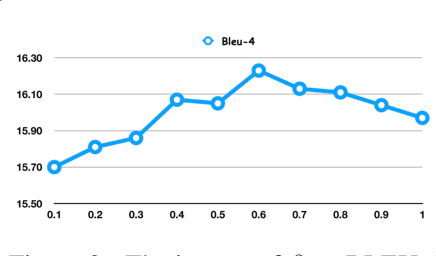

This paper explores the task of answer-aware questions generation. Based on the attention-based pointer generator model, we propose to incorporate an auxiliary task of language modeling to help question generation in a hierarchical multi-task learning structure. Our joint-learning model enables the encoder to learn a better representation of the input sequence, which will guide the decoder to generate more coherent and fluent questions. On both SQuAD and MARCO datasets, our multi-task learning model boosts the performance, achieving state-of-the-art results. Moreover, human evaluation further proves the high quality of our generated questions.