 Add to Chrome
 Add to Firefox
 Add to Edge
Model Selection and Parameter Estimation of Multi-dimensional Gaussian Mixture Model
Mar 20, 2026
In this paper, we study the problem of learning multi-dimensional Gaussian Mixture Models (GMMs), with a specific focus on model order selection and efficient mixing distribution estimation. We first establish an information-theoretic lower bound on the critical sample complexity required for reliable model selection. More specifically, we show that distinguishing a $k$-component mixture from a simpler model necessitates a sample size scaling of $Ω(Δ^{-(4k-4)})$. We then propose a thresholding-based estimation algorithm that evaluates the spectral gap of an empirical covariance matrix constructed from random Fourier measurement vectors. This parameter-free estimator operates with an efficient time complexity of $\mathcal{O}(k^2 n)$, scaling linearly with the sample size. We demonstrate that the sample complexity of our method matches the established lower bound, confirming its minimax optimality with respect to the component separation distance $Δ$. Conditioned on the estimated model order, we subsequently introduce a gradient-based minimization method for parameter estimation. To effectively navigate the non-convex objective landscape, we employ a data-driven, score-based initialization strategy that guarantees rapid convergence. We prove that this method achieves the optimal parametric convergence rate of $\mathcal{O}_p(n^{-1/2})$ for estimating the component means. To enhance the algorithm's efficiency in high-dimensional regimes where the ambient dimension exceeds the number of mixture components (i.e., \(d > k\)), we integrate principal component analysis (PCA) for dimension reduction. Numerical experiments demonstrate that our Fourier-based algorithmic framework outperforms conventional Expectation-Maximization (EM) methods in both estimation accuracy and computational time.

Differentially Private Truncation of Unbounded Data via Public Second Moments
Feb 25, 2026Data privacy is important in the AI era, and differential privacy (DP) is one of the golden solutions. However, DP is typically applicable only if data have a bounded underlying distribution. We address this limitation by leveraging second-moment information from a small amount of public data. We propose Public-moment-guided Truncation (PMT), which transforms private data using the public second-moment matrix and applies a principled truncation whose radius depends only on non-private quantities: data dimension and sample size. This transformation yields a well-conditioned second-moment matrix, enabling its inversion with a significantly strengthened ability to resist the DP noise. Furthermore, we demonstrate the applicability of PMT by using penalized and generalized linear regressions. Specifically, we design new loss functions and algorithms, ensuring that solutions in the transformed space can be mapped back to the original domain. We have established improvements in the models' DP estimation through theoretical error bounds, robustness guarantees, and convergence results, attributing the gains to the conditioning effect of PMT. Experiments on synthetic and real datasets confirm that PMT substantially improves the accuracy and stability of DP models.
$χ_{0}$: Resource-Aware Robust Manipulation via Taming Distributional Inconsistencies
Feb 09, 2026High-reliability long-horizon robotic manipulation has traditionally relied on large-scale data and compute to understand complex real-world dynamics. However, we identify that the primary bottleneck to real-world robustness is not resource scale alone, but the distributional shift among the human demonstration distribution, the inductive bias learned by the policy, and the test-time execution distribution -- a systematic inconsistency that causes compounding errors in multi-stage tasks. To mitigate these inconsistencies, we propose $χ_{0}$, a resource-efficient framework with effective modules designated to achieve production-level robustness in robotic manipulation. Our approach builds off three technical pillars: (i) Model Arithmetic, a weight-space merging strategy that efficiently soaks up diverse distributions of different demonstrations, varying from object appearance to state variations; (ii) Stage Advantage, a stage-aware advantage estimator that provides stable, dense progress signals, overcoming the numerical instability of prior non-stage approaches; and (iii) Train-Deploy Alignment, which bridges the distribution gap via spatio-temporal augmentation, heuristic DAgger corrections, and temporal chunk-wise smoothing. $χ_{0}$ enables two sets of dual-arm robots to collaboratively orchestrate long-horizon garment manipulation, spanning tasks from flattening, folding, to hanging different clothes. Our method exhibits high-reliability autonomy; we are able to run the system from arbitrary initial state for consecutive 24 hours non-stop. Experiments validate that $χ_{0}$ surpasses the state-of-the-art $π_{0.5}$ in success rate by nearly 250%, with only 20-hour data and 8 A100 GPUs. Code, data and models will be released to facilitate the community.
POPL-KF: A Pose-Only Geometric Representation-Based Kalman Filter for Point-Line-Based Visual-Inertial Odometry
Feb 06, 2026Mainstream Visual-inertial odometry (VIO) systems rely on point features for motion estimation and localization. However, their performance degrades in challenging scenarios. Moreover, the localization accuracy of multi-state constraint Kalman filter (MSCKF)-based VIO systems suffers from linearization errors associated with feature 3D coordinates and delayed measurement updates. To improve the performance of VIO in challenging scenes, we first propose a pose-only geometric representation for line features. Building on this, we develop POPL-KF, a Kalman filter-based VIO system that employs a pose-only geometric representation for both point and line features. POPL-KF mitigates linearization errors by explicitly eliminating both point and line feature coordinates from the measurement equations, while enabling immediate update of visual measurements. We also design a unified base-frames selection algorithm for both point and line features to ensure optimal constraints on camera poses within the pose-only measurement model. To further improve line feature quality, a line feature filter based on image grid segmentation and bidirectional optical flow consistency is proposed. Our system is evaluated on public datasets and real-world experiments, demonstrating that POPL-KF outperforms the state-of-the-art (SOTA) filter-based methods (OpenVINS, PO-KF) and optimization-based methods (PL-VINS, EPLF-VINS), while maintaining real-time performance.
Sparse Video Generation Propels Real-World Beyond-the-View Vision-Language Navigation
Feb 05, 2026Why must vision-language navigation be bound to detailed and verbose language instructions? While such details ease decision-making, they fundamentally contradict the goal for navigation in the real-world. Ideally, agents should possess the autonomy to navigate in unknown environments guided solely by simple and high-level intents. Realizing this ambition introduces a formidable challenge: Beyond-the-View Navigation (BVN), where agents must locate distant, unseen targets without dense and step-by-step guidance. Existing large language model (LLM)-based methods, though adept at following dense instructions, often suffer from short-sighted behaviors due to their reliance on short-horimzon supervision. Simply extending the supervision horizon, however, destabilizes LLM training. In this work, we identify that video generation models inherently benefit from long-horizon supervision to align with language instructions, rendering them uniquely suitable for BVN tasks. Capitalizing on this insight, we propose introducing the video generation model into this field for the first time. Yet, the prohibitive latency for generating videos spanning tens of seconds makes real-world deployment impractical. To bridge this gap, we propose SparseVideoNav, achieving sub-second trajectory inference guided by a generated sparse future spanning a 20-second horizon. This yields a remarkable 27x speed-up compared to the unoptimized counterpart. Extensive real-world zero-shot experiments demonstrate that SparseVideoNav achieves 2.5x the success rate of state-of-the-art LLM baselines on BVN tasks and marks the first realization of such capability in challenging night scenes.
Learning Geometrically-Grounded 3D Visual Representations for View-Generalizable Robotic Manipulation
Jan 30, 2026Real-world robotic manipulation demands visuomotor policies capable of robust spatial scene understanding and strong generalization across diverse camera viewpoints. While recent advances in 3D-aware visual representations have shown promise, they still suffer from several key limitations, including reliance on multi-view observations during inference which is impractical in single-view restricted scenarios, incomplete scene modeling that fails to capture holistic and fine-grained geometric structures essential for precise manipulation, and lack of effective policy training strategies to retain and exploit the acquired 3D knowledge. To address these challenges, we present MethodName, a unified representation-policy learning framework for view-generalizable robotic manipulation. MethodName introduces a single-view 3D pretraining paradigm that leverages point cloud reconstruction and feed-forward gaussian splatting under multi-view supervision to learn holistic geometric representations. During policy learning, MethodName performs multi-step distillation to preserve the pretrained geometric understanding and effectively transfer it to manipulation skills. We conduct experiments on 12 RLBench tasks, where our approach outperforms the previous state-of-the-art method by 12.7% in average success rate. Further evaluation on six representative tasks demonstrates strong zero-shot view generalization, with success rate drops of only 22.0% and 29.7% under moderate and large viewpoint shifts respectively, whereas the state-of-the-art method suffers larger decreases of 41.6% and 51.5%.
Enhancing Differentially Private Linear Regression via Public Second-Moment
Aug 25, 2025Leveraging information from public data has become increasingly crucial in enhancing the utility of differentially private (DP) methods. Traditional DP approaches often require adding noise based solely on private data, which can significantly degrade utility. In this paper, we address this limitation in the context of the ordinary least squares estimator (OLSE) of linear regression based on sufficient statistics perturbation (SSP) under the unbounded data assumption. We propose a novel method that involves transforming private data using the public second-moment matrix to compute a transformed SSP-OLSE, whose second-moment matrix yields a better condition number and improves the OLSE accuracy and robustness. We derive theoretical error bounds about our method and the standard SSP-OLSE to the non-DP OLSE, which reveal the improved robustness and accuracy achieved by our approach. Experiments on synthetic and real-world datasets demonstrate the utility and effectiveness of our method.
KineDex: Learning Tactile-Informed Visuomotor Policies via Kinesthetic Teaching for Dexterous Manipulation
May 04, 2025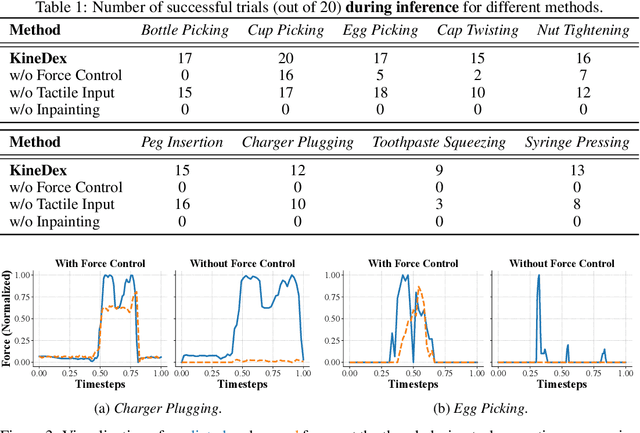
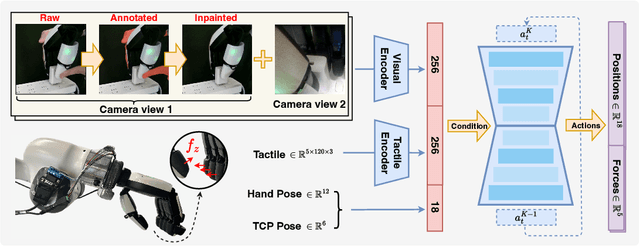
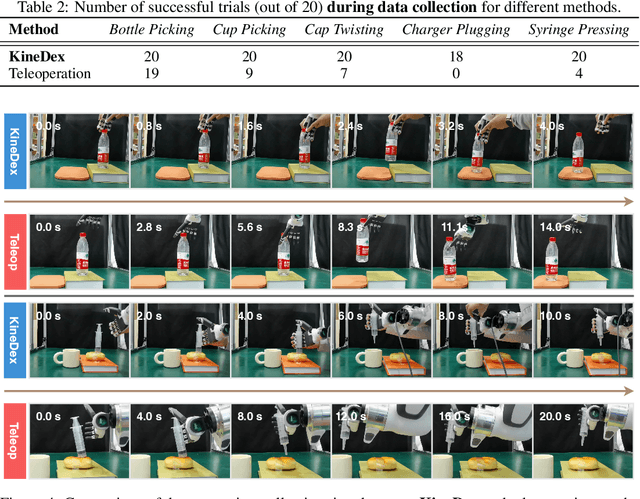
Collecting demonstrations enriched with fine-grained tactile information is critical for dexterous manipulation, particularly in contact-rich tasks that require precise force control and physical interaction. While prior works primarily focus on teleoperation or video-based retargeting, they often suffer from kinematic mismatches and the absence of real-time tactile feedback, hindering the acquisition of high-fidelity tactile data. To mitigate this issue, we propose KineDex, a hand-over-hand kinesthetic teaching paradigm in which the operator's motion is directly transferred to the dexterous hand, enabling the collection of physically grounded demonstrations enriched with accurate tactile feedback. To resolve occlusions from human hand, we apply inpainting technique to preprocess the visual observations. Based on these demonstrations, we then train a visuomotor policy using tactile-augmented inputs and implement force control during deployment for precise contact-rich manipulation. We evaluate KineDex on a suite of challenging contact-rich manipulation tasks, including particularly difficult scenarios such as squeezing toothpaste onto a toothbrush, which require precise multi-finger coordination and stable force regulation. Across these tasks, KineDex achieves an average success rate of 74.4%, representing a 57.7% improvement over the variant without force control. Comparative experiments with teleoperation and user studies further validate the advantages of KineDex in data collection efficiency and operability. Specifically, KineDex collects data over twice as fast as teleoperation across two tasks of varying difficulty, while maintaining a near-100% success rate, compared to under 50% for teleoperation.
SAM-UNet:Enhancing Zero-Shot Segmentation of SAM for Universal Medical Images
Aug 19, 2024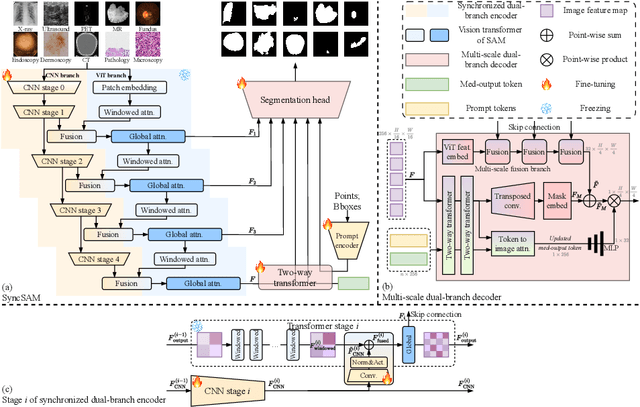
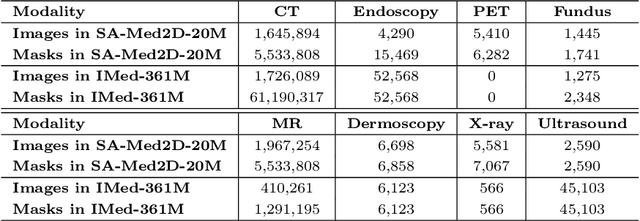
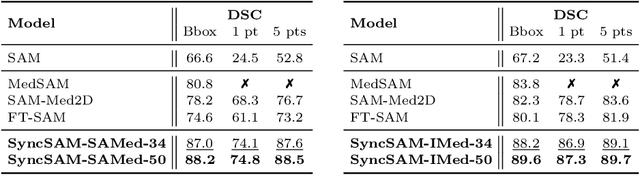
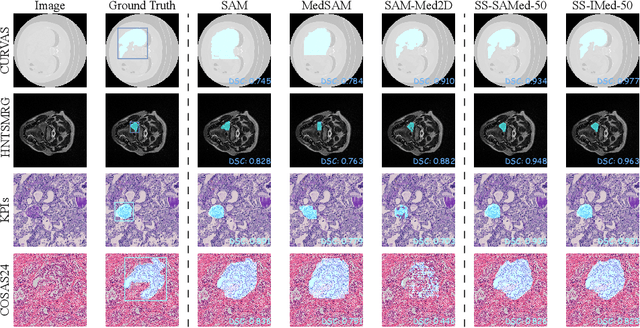
Segment Anything Model (SAM) has demonstrated impressive performance on a wide range of natural image segmentation tasks. However, its performance significantly deteriorates when directly applied to medical domain, due to the remarkable differences between natural images and medical images. Some researchers have attempted to train SAM on large scale medical datasets. However, poor zero-shot performance is observed from the experimental results. In this context, inspired by the superior performance of U-Net-like models in medical image segmentation, we propose SAMUNet, a new foundation model which incorporates U-Net to the original SAM, to fully leverage the powerful contextual modeling ability of convolutions. To be specific, we parallel a convolutional branch in the image encoder, which is trained independently with the vision Transformer branch frozen. Additionally, we employ multi-scale fusion in the mask decoder, to facilitate accurate segmentation of objects with different scales. We train SAM-UNet on SA-Med2D-16M, the largest 2-dimensional medical image segmentation dataset to date, yielding a universal pretrained model for medical images. Extensive experiments are conducted to evaluate the performance of the model, and state-of-the-art result is achieved, with a dice similarity coefficient score of 0.883 on SA-Med2D-16M dataset. Specifically, in zero-shot segmentation experiments, our model not only significantly outperforms previous large medical SAM models across all modalities, but also substantially mitigates the performance degradation seen on unseen modalities. It should be highlighted that SAM-UNet is an efficient and extensible foundation model, which can be further fine-tuned for other downstream tasks in medical community. The code is available at https://github.com/Hhankyangg/sam-unet.
Model-based Super-resolution: Towards a Unified Framework for Super-resolution
Jul 28, 2024In mathematics, a super-resolution problem can be formulated as acquiring high-frequency data from low-frequency measurements. This extrapolation problem in the frequency domain is well-known to be unstable. We propose the model-based super-resolution framework (Model-SR) to address this ill-posedness. Within this framework, we can recover the signal by solving a nonlinear least square problem and achieve the super-resolution. Theoretically, the resolution-enhancing map is proved to have Lipschitz continuity under mild conditions, leading to a stable solution to the super-resolution problem. We apply the general theory to three concrete models and give the stability estimates for each model. Numerical experiments are conducted to show the super-resolution behavior of the proposed framework. The model-based mathematical framework can be extended to problems with similar structures.