 Add to Chrome
 Add to Firefox
 Add to Edge
RoboNaldo: Accurate, Stable and Powerful Humanoid Soccer Shooting via Motion-Guided Curriculum Reinforcement Learning
Jun 09, 2026
Elite humanoid soccer shooting requires whole-body stability, high-impulse whole-body interactions, and accuracy to targets. Motion tracking-driven reinforcement learning (RL) provides stability in whole-body movement coordination, but a fixed reference makes it hard to adapt to varied ball positions and strike timings; in contrast, task reward-driven RL struggles to explore and discover valid kicks from scratch. We therefore introduce RoboNaldo, a three-stage motion-guided curriculum RL framework for high-impulse humanoid interaction. A single human-kick reference is used as a scaffold and progressively shifts optimization towards shooting performance. The curriculum first learns a stable whole-body kicking prior, then adapts the kick to free-kick settings where the ball is stationary at random positions, and finally extends it to moving-ball shooting through a locomotion-command and kick-trigger interface. A high-level heuristic planner controls this interface during training, while alternative high-level controllers can drive the same low-level policy at inference. In simulation, RoboNaldo demonstrates free-kick shot error 48.6% lower and shoot velocity 2.96x than prior work baselines. In real world on a Unitree G1 with onboard perception, RoboNaldo attains 0.73 m and 0.86 m average target shooting error from 3 m away in free-kick and moving-ball cases, accordingly. And the post-contact ball velocity reaches 13.10 m/s, which is 59-71% of reported professional open-play shot speed. Project page: $\href{https://opendrivelab.com/RoboNaldo}{\text{opendrivelab.com/RoboNaldo}}$.

Unified Walking, Running, and Recovery for Humanoids via State-Dependent Adversarial Motion Priors
May 18, 2026We propose a unified reinforcement learning framework that enables a single policy to perform walking, running, and fall recovery on the Unitree G1 humanoid robot, validated on physical hardware without any explicit mode-switching command at deployment. The framework extends Adversarial Motion Priors (AMP) by replacing the conventional global reference distribution with a state-dependent gate that routes each training transition to one of two discriminators: a dedicated recovery discriminator and a velocity-conditioned locomotion discriminator that jointly covers walking and running. The gate is defined by a single fixed threshold on projected gravity: the recovery discriminator is activated when body tilt exceeds approximately $37^\circ$ from vertical ($|g_z+1|>0.6$); otherwise the locomotion discriminator is used, with the normalized commanded velocity serving as a condition that selects the appropriate reference trajectory between walk and run clips. Only three LAFAN1 reference clips are required to regularize the complete behavior set. At deployment, a single frozen ONNX policy executes at 50\,Hz with no runtime mode logic; hardware experiments demonstrate successful recovery from both prone and supine falls and smooth walk-to-run transitions under the same controller.
Sparse Video Generation Propels Real-World Beyond-the-View Vision-Language Navigation
Feb 05, 2026Why must vision-language navigation be bound to detailed and verbose language instructions? While such details ease decision-making, they fundamentally contradict the goal for navigation in the real-world. Ideally, agents should possess the autonomy to navigate in unknown environments guided solely by simple and high-level intents. Realizing this ambition introduces a formidable challenge: Beyond-the-View Navigation (BVN), where agents must locate distant, unseen targets without dense and step-by-step guidance. Existing large language model (LLM)-based methods, though adept at following dense instructions, often suffer from short-sighted behaviors due to their reliance on short-horimzon supervision. Simply extending the supervision horizon, however, destabilizes LLM training. In this work, we identify that video generation models inherently benefit from long-horizon supervision to align with language instructions, rendering them uniquely suitable for BVN tasks. Capitalizing on this insight, we propose introducing the video generation model into this field for the first time. Yet, the prohibitive latency for generating videos spanning tens of seconds makes real-world deployment impractical. To bridge this gap, we propose SparseVideoNav, achieving sub-second trajectory inference guided by a generated sparse future spanning a 20-second horizon. This yields a remarkable 27x speed-up compared to the unoptimized counterpart. Extensive real-world zero-shot experiments demonstrate that SparseVideoNav achieves 2.5x the success rate of state-of-the-art LLM baselines on BVN tasks and marks the first realization of such capability in challenging night scenes.
Bridging Adaptivity and Safety: Learning Agile Collision-Free Locomotion Across Varied Physics
Jan 08, 2025Real-world legged locomotion systems often need to reconcile agility and safety for different scenarios. Moreover, the underlying dynamics are often unknown and time-variant (e.g., payload, friction). In this paper, we introduce BAS (Bridging Adaptivity and Safety), which builds upon the pipeline of prior work Agile But Safe (ABS)(He et al.) and is designed to provide adaptive safety even in dynamic environments with uncertainties. BAS involves an agile policy to avoid obstacles rapidly and a recovery policy to prevent collisions, a physical parameter estimator that is concurrently trained with agile policy, and a learned control-theoretic RA (reach-avoid) value network that governs the policy switch. Also, the agile policy and RA network are both conditioned on physical parameters to make them adaptive. To mitigate the distribution shift issue, we further introduce an on-policy fine-tuning phase for the estimator to enhance its robustness and accuracy. The simulation results show that BAS achieves 50% better safety than baselines in dynamic environments while maintaining a higher speed on average. In real-world experiments, BAS shows its capability in complex environments with unknown physics (e.g., slippery floors with unknown frictions, unknown payloads up to 8kg), while baselines lack adaptivity, leading to collisions or. degraded agility. As a result, BAS achieves a 19.8% increase in speed and gets a 2.36 times lower collision rate than ABS in the real world. Videos: https://adaptive-safe-locomotion.github.io.
Diffusion Models for Reinforcement Learning: A Survey
Nov 02, 2023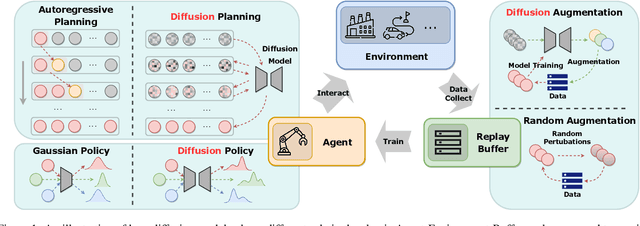
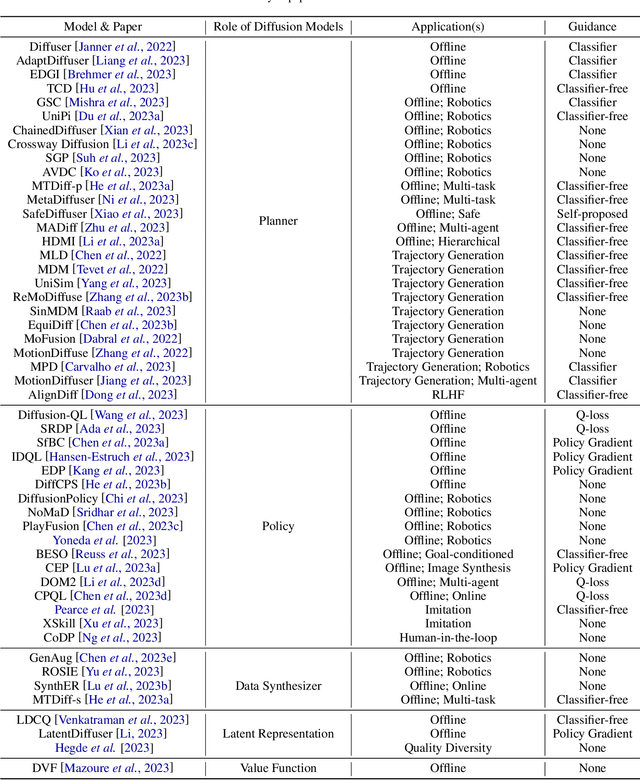
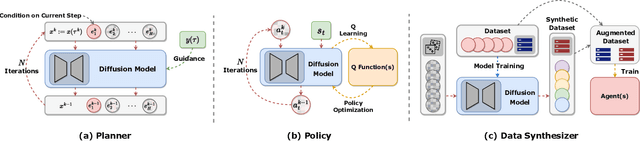
Diffusion models have emerged as a prominent class of generative models, surpassing previous methods regarding sample quality and training stability. Recent works have shown the advantages of diffusion models in improving reinforcement learning (RL) solutions, including as trajectory planners, expressive policy classes, data synthesizers, etc. This survey aims to provide an overview of the advancements in this emerging field and hopes to inspire new avenues of research. First, we examine several challenges encountered by current RL algorithms. Then, we present a taxonomy of existing methods based on the roles played by diffusion models in RL and explore how the existing challenges are addressed. We further outline successful applications of diffusion models in various RL-related tasks while discussing the limitations of current approaches. Finally, we conclude the survey and offer insights into future research directions, focusing on enhancing model performance and applying diffusion models to broader tasks. We are actively maintaining a GitHub repository for papers and other related resources in applying diffusion models in RL: https://github.com/apexrl/Diff4RLSurvey .