 Add to Chrome
 Add to Firefox
 Add to Edge
Attribute-Prompted Kernel Hashing for Unsupervised Data-Efficient Cross-Modal Retrieval
Jul 01, 2026
Unsupervised cross-modal hashing enables efficient retrieval of semantically related instances across different modalities without requiring manual semantic annotation. However, existing unsupervised methods rely heavily on large-scale image-text pairs. Collecting such data can be costly, particularly in scenarios where well-aligned pairs are scarce due to privacy and specialized constraints. More critically, existing methods tend to overfit to seen training data, restricting their generalization performance on unseen categories that the constrained training data cannot cover. To address these limitations, we propose Attribute-Prompted Kernel Hashing (APKH), a novel data-efficient approach that constructs a compact, modality-aligned Hamming space driven by the generalized attribute priors of vision-language foundation models. Specifically, APKH introduces two core modules: Context-optimized Attribute Kernel Mapping (CAKM) and Kernel-Smoothed Contrastive Alignment (KSCA). CAKM formulates cross-modal alignment through hyperspherical Radial Basis Function kernel mapping, optimizing dynamic attribute kernels via prompt learning to capture modality-invariant semantics. Furthermore, KSCA extends conventional point-to-point contrastive learning by modeling limited paired data as continuous kernel distributions. This explicit smoothing of the modality gap alleviates overfitting to sparse pairwise correlations. Extensive experiments demonstrate that APKH outperforms state-of-the-art hashing methods in the challenging cross-modal retrieval tasks from seen to unseen categories under data-constrained scenarios.

Unsupervised Data-Efficient Cross-Modal Retrieval with Global-Neighborhood Alignment Hashing
Jun 30, 2026Compared to supervised cross-modal hashing (CMH), unsupervised CMH reduces the reliance on manual labeling by learning binary codes from unlabeled image-text pairs. However, existing unsupervised CMH methods often rely on large-scale image-text pairs, which are costly to collect. To address this limitation, we propose Global-Neighborhood Alignment Hashing (GNAH), a novel approach that preserves the semantic structure of vision-language foundation models within a compact binary Hamming space using only a limited number of image-text pairs. Specifically, GNAH captures global structural information from the continuous latent space and transfers it into the binary Hamming space through a Prototype-Anchored Global Alignment module. In addition, GNAH extends conventional pairwise contrastive learning by modeling stochastic neighborhood relationships via a Contrastive Stochastic Neighborhood Alignment module, thereby alleviating overfitting to sparse pairwise correlations. Extensive experiments demonstrate that GNAH consistently outperforms existing unsupervised cross-modal retrieval methods under data-constrained settings, offering a practical solution for real-world CMH applications.
SPOTR: Spatio-temporal Pooling One-Token Reconstruction for Universal Physiological Signal Self-supervised Learning
Jun 20, 2026Physiological signals such as EEG, ECG, and PPG are widely used in clinical monitoring. Recent self-supervised learning (SSL) methods offer an attractive way to leverage unlabeled recordings, yet they still fall short in practice. In particular, current SSL methods struggle across heterogeneous datasets, often distorting clinically meaningful structures or learning shortcuts from temporal and cross-channel redundancy. Consequently, existing SSL methods often deliver limited performance under linear probing, a lightweight adaptation setting that better matches real-world medical scenarios. Moreover, most Transformer-based SSL models encode a flattened spatiotemporal token sequence, incurring high computation and memory cost, and are typically developed within a single modality. To address these limitations, we present SPOTR (Spatio-temporal Pooling One-Token Reconstruction), a compress-reconstruct pretraining framework that introduces a single-token global bottleneck for physiological signals. SPOTR compresses each waveform into a single-token representation and reconstructs the signal conditioned only on this representation. Meanwhile, SPOTR introduces an efficient spatio-temporal compaction module to reduce computation and memory cost. Pretrained on 20 datasets spanning EEG, iEEG, ECG, and PPG, SPOTR consistently outperforms the strongest baseline under linear probing, improving average AUC by 18.49%, 21.71%, 17.86%, and 4.64%, respectively. Compared with a representative general-purpose time-series foundation model, SPOTR achieves around 78% lower latency and 52% lower peak GPU memory on average. The code can be found at https://github.com/5GYYYYY/SPOTR.
MedTS-TTT: Test-Time Training for Medical Time Series Classification
Jun 19, 2026Medical time series (MedTS) signals such as electroencephalography (EEG) and electrocardiography (ECG) support many clinical applications. However, substantial subject-level heterogeneity often induces subject-level distribution shift, causing a fixed parameter set to generalize poorly to unseen individuals. Compared with domain adaptation methods that often depend on extra adaptation components or target-batch statistics, Test-Time Training (TTT) provides a more practical solution for sequential clinical data by enabling online adaptation from unlabeled test samples. However, many representative TTT methods require iterative inner-loop optimization, increasing test-time overhead. In this paper, we propose MedTS-TTT, a test-time training framework for medical time series modeling. MedTS-TTT is built upon Closed-Loop Self-Alignment Test-Time Training (CLSA-TTT) and a Gated Convolutional Backbone (GCB). CLSA-TTT constructs a token-level self-supervised target and performs a single-step fast-weight update for intra-layer closed-loop alignment, enabling rapid sample-wise adaptation without iterative inner-loop optimization. GCB combines CLSA-TTT-based fast adaptation and token-level fusion with a gated convolutional branch to balance local dynamic modeling and information-flow control. On 4 public datasets (2 EEG and 2 ECG) with subject-independent splits, MedTS-TTT achieves 11 top-1 rankings out of 12 evaluations across 9 baselines and 3 metrics. The code is publicly available at https://github.com/mingzhi-c/MedTS-TTT.
SeLaR: Selective Latent Reasoning in Large Language Models
Apr 09, 2026Chain-of-Thought (CoT) has become a cornerstone of reasoning in large language models, yet its effectiveness is constrained by the limited expressiveness of discrete token sampling. Recent latent reasoning approaches attempt to alleviate this limitation by replacing discrete tokens with soft embeddings (probability-weighted mixtures of token embeddings) or hidden states, but they commonly suffer from two issues: (1) global activation injects perturbations into high-confidence steps, impairing reasoning stability; and (2) soft embeddings quickly collapse toward the highest-probability token, limiting exploration of alternative trajectories. To address these challenges, we propose SeLaR (Selective Latent Reasoning), a lightweight and training-free framework. SeLaR introduces an entropy-gated mechanism that activates soft embeddings only at low-confidence steps, while preserving discrete decoding at high-confidence steps. Additionally, we propose an entropy-aware contrastive regularization that pushes soft embeddings away from the dominant (highest-probability) token's direction, encouraging sustained exploration of multiple latent reasoning paths. Experiments on five reasoning benchmarks demonstrate that SeLaR consistently outperforms standard CoT and state-of-the-art training-free methods.
DSFedMed: Dual-Scale Federated Medical Image Segmentation via Mutual Distillation Between Foundation and Lightweight Models
Jan 22, 2026Foundation Models (FMs) have demonstrated strong generalization across diverse vision tasks. However, their deployment in federated settings is hindered by high computational demands, substantial communication overhead, and significant inference costs. We propose DSFedMed, a dual-scale federated framework that enables mutual knowledge distillation between a centralized foundation model and lightweight client models for medical image segmentation. To support knowledge distillation, a set of high-quality medical images is generated to replace real public datasets, and a learnability-guided sample selection strategy is proposed to enhance efficiency and effectiveness in dual-scale distillation. This mutual distillation enables the foundation model to transfer general knowledge to lightweight clients, while also incorporating client-specific insights to refine the foundation model. Evaluations on five medical imaging segmentation datasets show that DSFedMed achieves an average 2 percent improvement in Dice score while reducing communication costs and inference time by nearly 90 percent compared to existing federated foundation model baselines. These results demonstrate significant efficiency gains and scalability for resource-limited federated deployments.
Inference Attacks Against Graph Generative Diffusion Models
Jan 07, 2026Graph generative diffusion models have recently emerged as a powerful paradigm for generating complex graph structures, effectively capturing intricate dependencies and relationships within graph data. However, the privacy risks associated with these models remain largely unexplored. In this paper, we investigate information leakage in such models through three types of black-box inference attacks. First, we design a graph reconstruction attack, which can reconstruct graphs structurally similar to those training graphs from the generated graphs. Second, we propose a property inference attack to infer the properties of the training graphs, such as the average graph density and the distribution of densities, from the generated graphs. Third, we develop two membership inference attacks to determine whether a given graph is present in the training set. Extensive experiments on three different types of graph generative diffusion models and six real-world graphs demonstrate the effectiveness of these attacks, significantly outperforming the baseline approaches. Finally, we propose two defense mechanisms that mitigate these inference attacks and achieve a better trade-off between defense strength and target model utility than existing methods. Our code is available at https://zenodo.org/records/17946102.
Feature-Aware One-Shot Federated Learning via Hierarchical Token Sequences
Jan 07, 2026One-shot federated learning (OSFL) reduces the communication cost and privacy risks of iterative federated learning by constructing a global model with a single round of communication. However, most existing methods struggle to achieve robust performance on real-world domains such as medical imaging, or are inefficient when handling non-IID (Independent and Identically Distributed) data. To address these limitations, we introduce FALCON, a framework that enhances the effectiveness of OSFL over non-IID image data. The core idea of FALCON is to leverage the feature-aware hierarchical token sequences generation and knowledge distillation into OSFL. First, each client leverages a pretrained visual encoder with hierarchical scale encoding to compress images into hierarchical token sequences, which capture multi-scale semantics. Second, a multi-scale autoregressive transformer generator is used to model the distribution of these token sequences and generate the synthetic sequences. Third, clients upload the synthetic sequences along with the local classifier trained on the real token sequences to the server. Finally, the server incorporates knowledge distillation into global training to reduce reliance on precise distribution modeling. Experiments on medical and natural image datasets validate the effectiveness of FALCON in diverse non-IID scenarios, outperforming the best OSFL baselines by 9.58% in average accuracy.
Leash: Adaptive Length Penalty and Reward Shaping for Efficient Large Reasoning Model
Dec 25, 2025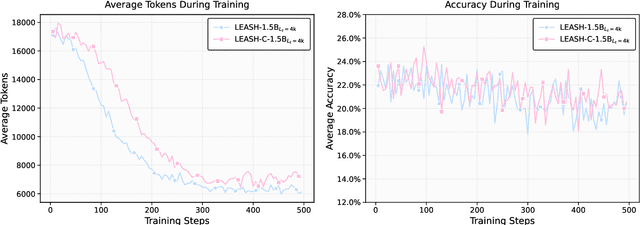
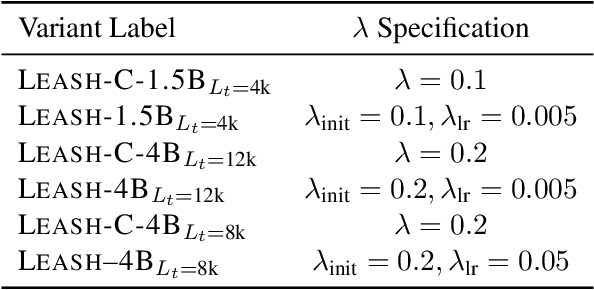
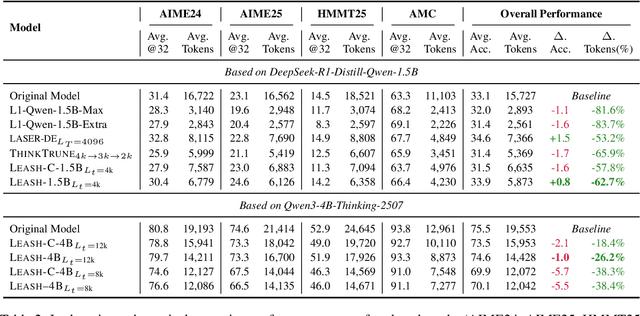

Existing approaches typically rely on fixed length penalties, but such penalties are hard to tune and fail to adapt to the evolving reasoning abilities of LLMs, leading to suboptimal trade-offs between accuracy and conciseness. To address this challenge, we propose Leash (adaptive LEngth penAlty and reward SHaping), a reinforcement learning framework for efficient reasoning in LLMs. We formulate length control as a constrained optimization problem and employ a Lagrangian primal-dual method to dynamically adjust the penalty coefficient. When generations exceed the target length, the penalty is intensified; when they are shorter, it is relaxed. This adaptive mechanism guides models toward producing concise reasoning without sacrificing task performance. Experiments on Deepseek-R1-Distill-Qwen-1.5B and Qwen3-4B-Thinking-2507 show that Leash reduces the average reasoning length by 60% across diverse tasks - including in-distribution mathematical reasoning and out-of-distribution domains such as coding and instruction following - while maintaining competitive performance. Our work thus presents a practical and effective paradigm for developing controllable and efficient LLMs that balance reasoning capabilities with computational budgets.
Attention Distance: A Novel Metric for Directed Fuzzing with Large Language Models
Dec 19, 2025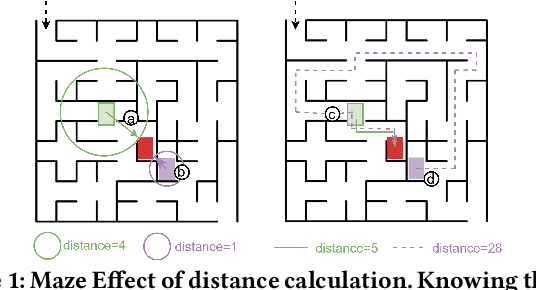
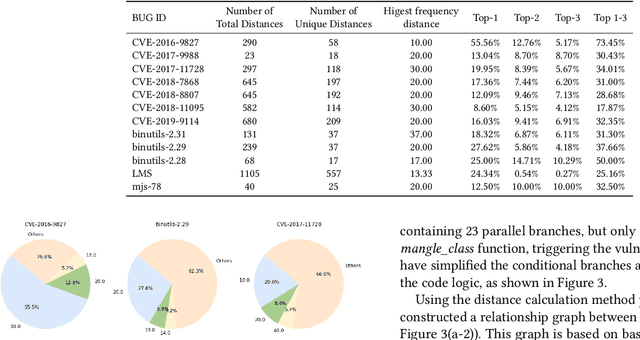
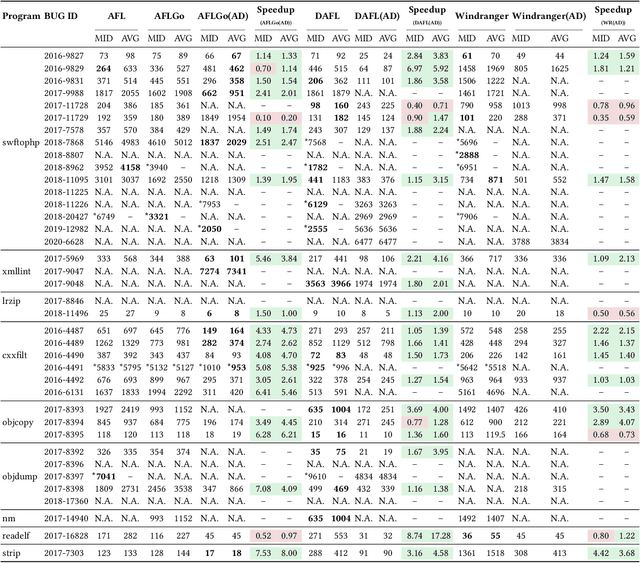
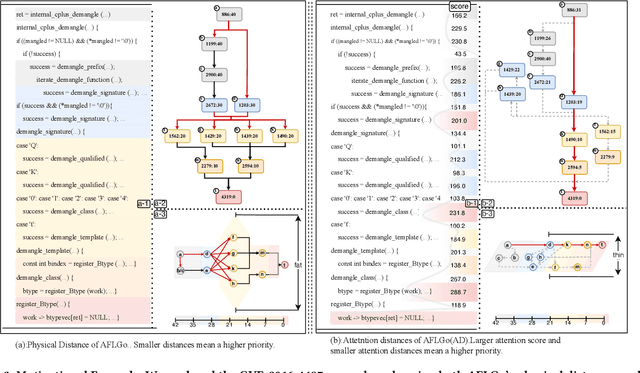
In the domain of software security testing, Directed Grey-Box Fuzzing (DGF) has garnered widespread attention for its efficient target localization and excellent detection performance. However, existing approaches measure only the physical distance between seed execution paths and target locations, overlooking logical relationships among code segments. This omission can yield redundant or misleading guidance in complex binaries, weakening DGF's real-world effectiveness. To address this, we introduce \textbf{attention distance}, a novel metric that leverages a large language model's contextual analysis to compute attention scores between code elements and reveal their intrinsic connections. Under the same AFLGo configuration -- without altering any fuzzing components other than the distance metric -- replacing physical distances with attention distances across 38 real vulnerability reproduction experiments delivers a \textbf{3.43$\times$} average increase in testing efficiency over the traditional method. Compared to state-of-the-art directed fuzzers DAFL and WindRanger, our approach achieves \textbf{2.89$\times$} and \textbf{7.13$\times$} improvements, respectively. To further validate the generalizability of attention distance, we integrate it into DAFL and WindRanger, where it also consistently enhances their original performance. All related code and datasets are publicly available at https://github.com/TheBinKing/Attention\_Distance.git.