 Add to Chrome
 Add to Firefox
 Add to Edge
Attention Distance: A Novel Metric for Directed Fuzzing with Large Language Models
Dec 19, 2025
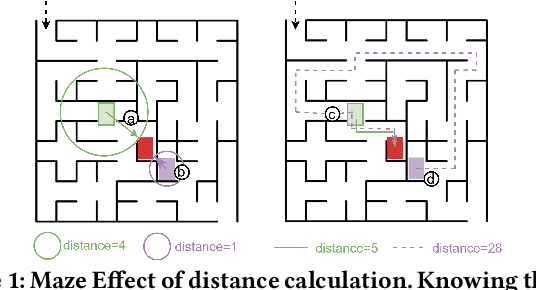
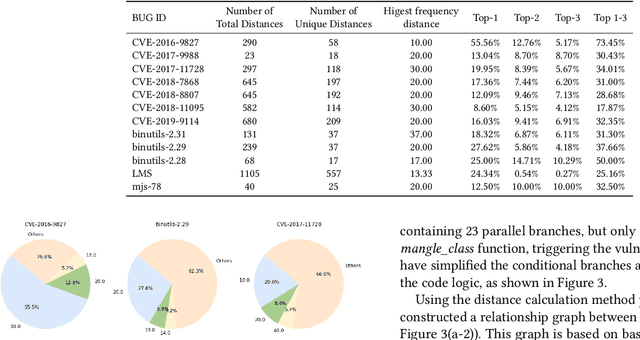
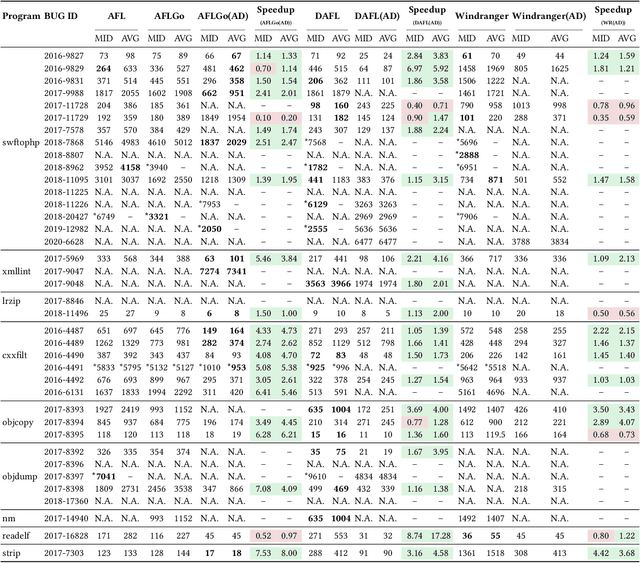
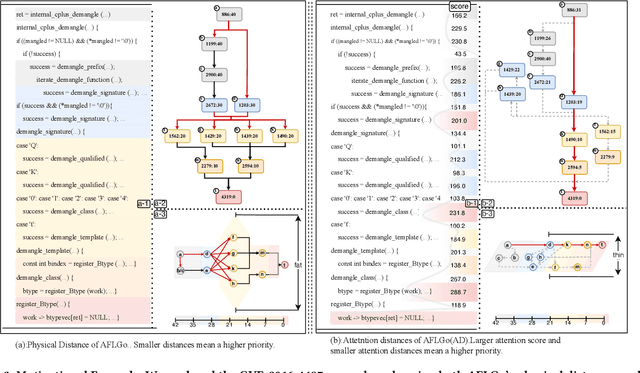
In the domain of software security testing, Directed Grey-Box Fuzzing (DGF) has garnered widespread attention for its efficient target localization and excellent detection performance. However, existing approaches measure only the physical distance between seed execution paths and target locations, overlooking logical relationships among code segments. This omission can yield redundant or misleading guidance in complex binaries, weakening DGF's real-world effectiveness. To address this, we introduce \textbf{attention distance}, a novel metric that leverages a large language model's contextual analysis to compute attention scores between code elements and reveal their intrinsic connections. Under the same AFLGo configuration -- without altering any fuzzing components other than the distance metric -- replacing physical distances with attention distances across 38 real vulnerability reproduction experiments delivers a \textbf{3.43$\times$} average increase in testing efficiency over the traditional method. Compared to state-of-the-art directed fuzzers DAFL and WindRanger, our approach achieves \textbf{2.89$\times$} and \textbf{7.13$\times$} improvements, respectively. To further validate the generalizability of attention distance, we integrate it into DAFL and WindRanger, where it also consistently enhances their original performance. All related code and datasets are publicly available at https://github.com/TheBinKing/Attention\_Distance.git.

Porous Lattice-based Transformer Encoder for Chinese NER
Nov 07, 2019


Incorporating lattices into character-level Chinese named entity recognition is an effective method to exploit explicit word information. Recent works extend recurrent and convolutional neural networks to model lattice inputs. However, due to the DAG structure or the variable-sized potential word set for lattice inputs, these models prevent the convenient use of batched computation, resulting in serious inefficient. In this paper, we propose a porous lattice-based transformer encoder for Chinese named entity recognition, which is capable to better exploit the GPU parallelism and batch the computation owing to the mask mechanism in transformer. We first investigate the lattice-aware self-attention coupled with relative position representations to explore effective word information in the lattice structure. Besides, to strengthen the local dependencies among neighboring tokens, we propose a novel porous structure during self-attentional computation processing, in which every two non-neighboring tokens are connected through a shared pivot node. Experimental results on four datasets show that our model performs up to 9.47 times faster than state-of-the-art models, while is roughly on a par with its performance. The source code of this paper can be obtained from https://github.com/xxx/xxx.