 Add to Chrome
 Add to Firefox
 Add to Edge
R2G: A Multi-View Circuit Graph Benchmark Suite from RTL to GDSII
Apr 09, 2026
Graph neural networks (GNNs) are increasingly applied to physical design tasks such as congestion prediction and wirelength estimation, yet progress is hindered by inconsistent circuit representations and the absence of controlled evaluation protocols. We present R2G (RTL-to-GDSII), a multi-view circuit-graph benchmark suite that standardizes five stage-aware views with information parity (every view encodes the same attribute set, differing only in where features attach) over 30 open-source IP cores (up to $10^6$ nodes/edges). R2G provides an end-to-end DEF-to-graph pipeline spanning synthesis, placement, and routing stages, together with loaders, unified splits, domain metrics, and reproducible baselines. By decoupling representation choice from model choice, R2G isolates a confound that prior EDA and graph-ML benchmarks leave uncontrolled. In systematic studies with GINE, GAT, and ResGatedGCN, we find: (i) view choice dominates model choice, with Test R$^2$ varying by more than 0.3 across representations for a fixed GNN; (ii) node-centric views generalize best across both placement and routing; and (iii) decoder-head depth (3--4 layers) is the primary accuracy driver, turning divergent training into near-perfect predictions (R$^2$$>$0.99). Code and datasets are available at https://github.com/ShenShan123/R2G.

Attention Distance: A Novel Metric for Directed Fuzzing with Large Language Models
Dec 19, 2025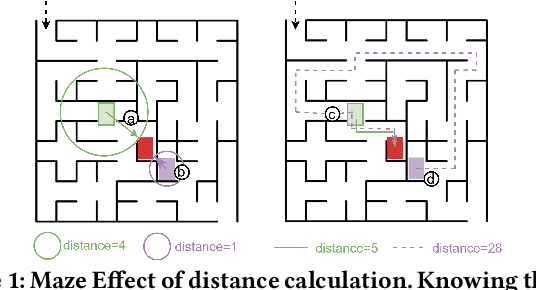
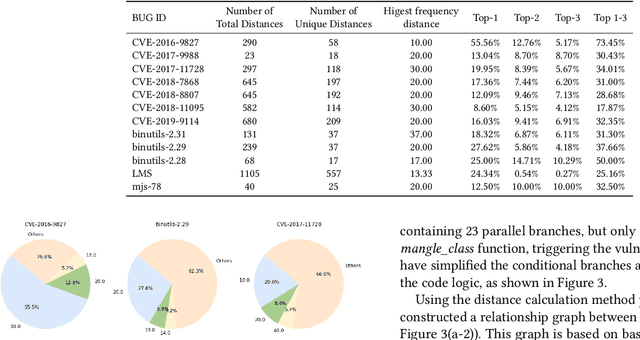
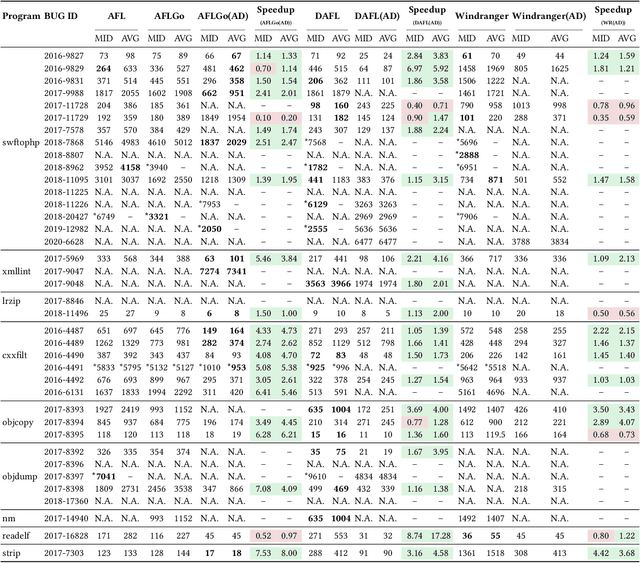
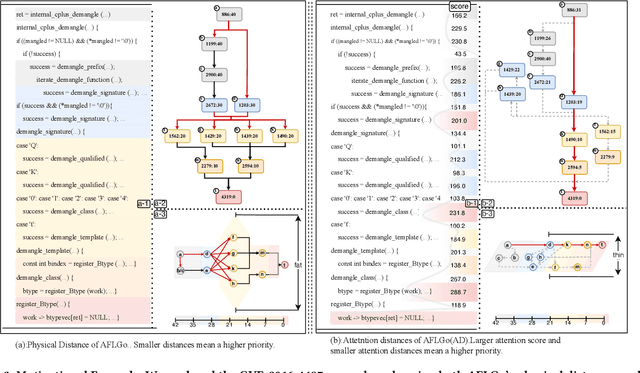
In the domain of software security testing, Directed Grey-Box Fuzzing (DGF) has garnered widespread attention for its efficient target localization and excellent detection performance. However, existing approaches measure only the physical distance between seed execution paths and target locations, overlooking logical relationships among code segments. This omission can yield redundant or misleading guidance in complex binaries, weakening DGF's real-world effectiveness. To address this, we introduce \textbf{attention distance}, a novel metric that leverages a large language model's contextual analysis to compute attention scores between code elements and reveal their intrinsic connections. Under the same AFLGo configuration -- without altering any fuzzing components other than the distance metric -- replacing physical distances with attention distances across 38 real vulnerability reproduction experiments delivers a \textbf{3.43$\times$} average increase in testing efficiency over the traditional method. Compared to state-of-the-art directed fuzzers DAFL and WindRanger, our approach achieves \textbf{2.89$\times$} and \textbf{7.13$\times$} improvements, respectively. To further validate the generalizability of attention distance, we integrate it into DAFL and WindRanger, where it also consistently enhances their original performance. All related code and datasets are publicly available at https://github.com/TheBinKing/Attention\_Distance.git.
Argus: A Multi-Agent Sensitive Information Leakage Detection Framework Based on Hierarchical Reference Relationships
Dec 09, 2025Sensitive information leakage in code repositories has emerged as a critical security challenge. Traditional detection methods that rely on regular expressions, fingerprint features, and high-entropy calculations often suffer from high false-positive rates. This not only reduces detection efficiency but also significantly increases the manual screening burden on developers. Recent advances in large language models (LLMs) and multi-agent collaborative architectures have demonstrated remarkable potential for tackling complex tasks, offering a novel technological perspective for sensitive information detection. In response to these challenges, we propose Argus, a multi-agent collaborative framework for detecting sensitive information. Argus employs a three-tier detection mechanism that integrates key content, file context, and project reference relationships to effectively reduce false positives and enhance overall detection accuracy. To comprehensively evaluate Argus in real-world repository environments, we developed two new benchmarks, one to assess genuine leak detection capabilities and another to evaluate false-positive filtering performance. Experimental results show that Argus achieves up to 94.86% accuracy in leak detection, with a precision of 96.36%, recall of 94.64%, and an F1 score of 0.955. Moreover, the analysis of 97 real repositories incurred a total cost of only 2.2$. All code implementations and related datasets are publicly available at https://github.com/TheBinKing/Argus-Guard for further research and application.
PiCo: Jailbreaking Multimodal Large Language Models via $\textbf{Pi}$ctorial $\textbf{Co}$de Contextualization
Apr 02, 2025Multimodal Large Language Models (MLLMs), which integrate vision and other modalities into Large Language Models (LLMs), significantly enhance AI capabilities but also introduce new security vulnerabilities. By exploiting the vulnerabilities of the visual modality and the long-tail distribution characteristic of code training data, we present PiCo, a novel jailbreaking framework designed to progressively bypass multi-tiered defense mechanisms in advanced MLLMs. PiCo employs a tier-by-tier jailbreak strategy, using token-level typographic attacks to evade input filtering and embedding harmful intent within programming context instructions to bypass runtime monitoring. To comprehensively assess the impact of attacks, a new evaluation metric is further proposed to assess both the toxicity and helpfulness of model outputs post-attack. By embedding harmful intent within code-style visual instructions, PiCo achieves an average Attack Success Rate (ASR) of 84.13% on Gemini-Pro Vision and 52.66% on GPT-4, surpassing previous methods. Experimental results highlight the critical gaps in current defenses, underscoring the need for more robust strategies to secure advanced MLLMs.