 Add to Chrome
 Add to Firefox
 Add to Edge
SPOTR: Spatio-temporal Pooling One-Token Reconstruction for Universal Physiological Signal Self-supervised Learning
Jun 20, 2026
Physiological signals such as EEG, ECG, and PPG are widely used in clinical monitoring. Recent self-supervised learning (SSL) methods offer an attractive way to leverage unlabeled recordings, yet they still fall short in practice. In particular, current SSL methods struggle across heterogeneous datasets, often distorting clinically meaningful structures or learning shortcuts from temporal and cross-channel redundancy. Consequently, existing SSL methods often deliver limited performance under linear probing, a lightweight adaptation setting that better matches real-world medical scenarios. Moreover, most Transformer-based SSL models encode a flattened spatiotemporal token sequence, incurring high computation and memory cost, and are typically developed within a single modality. To address these limitations, we present SPOTR (Spatio-temporal Pooling One-Token Reconstruction), a compress-reconstruct pretraining framework that introduces a single-token global bottleneck for physiological signals. SPOTR compresses each waveform into a single-token representation and reconstructs the signal conditioned only on this representation. Meanwhile, SPOTR introduces an efficient spatio-temporal compaction module to reduce computation and memory cost. Pretrained on 20 datasets spanning EEG, iEEG, ECG, and PPG, SPOTR consistently outperforms the strongest baseline under linear probing, improving average AUC by 18.49%, 21.71%, 17.86%, and 4.64%, respectively. Compared with a representative general-purpose time-series foundation model, SPOTR achieves around 78% lower latency and 52% lower peak GPU memory on average. The code can be found at https://github.com/5GYYYYY/SPOTR.

MedTS-TTT: Test-Time Training for Medical Time Series Classification
Jun 19, 2026Medical time series (MedTS) signals such as electroencephalography (EEG) and electrocardiography (ECG) support many clinical applications. However, substantial subject-level heterogeneity often induces subject-level distribution shift, causing a fixed parameter set to generalize poorly to unseen individuals. Compared with domain adaptation methods that often depend on extra adaptation components or target-batch statistics, Test-Time Training (TTT) provides a more practical solution for sequential clinical data by enabling online adaptation from unlabeled test samples. However, many representative TTT methods require iterative inner-loop optimization, increasing test-time overhead. In this paper, we propose MedTS-TTT, a test-time training framework for medical time series modeling. MedTS-TTT is built upon Closed-Loop Self-Alignment Test-Time Training (CLSA-TTT) and a Gated Convolutional Backbone (GCB). CLSA-TTT constructs a token-level self-supervised target and performs a single-step fast-weight update for intra-layer closed-loop alignment, enabling rapid sample-wise adaptation without iterative inner-loop optimization. GCB combines CLSA-TTT-based fast adaptation and token-level fusion with a gated convolutional branch to balance local dynamic modeling and information-flow control. On 4 public datasets (2 EEG and 2 ECG) with subject-independent splits, MedTS-TTT achieves 11 top-1 rankings out of 12 evaluations across 9 baselines and 3 metrics. The code is publicly available at https://github.com/mingzhi-c/MedTS-TTT.
Improving EEG Classification Through Randomly Reassembling Original and Generated Data with Transformer-based Diffusion Models
Jul 20, 2024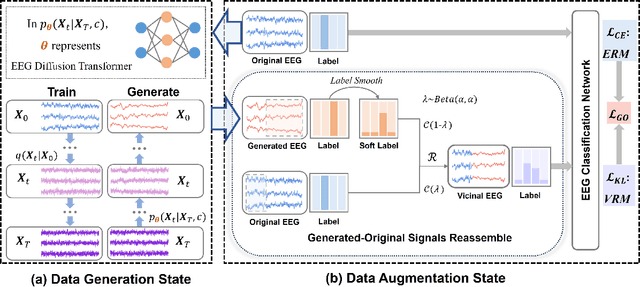


Electroencephalogram (EEG) classification has been widely used in various medical and engineering applications, where it is important for understanding brain function, diagnosing diseases, and assessing mental health conditions. However, the scarcity of EEG data severely restricts the performance of EEG classification networks, and generative model-based data augmentation methods emerging as potential solutions to overcome this challenge. There are two problems with existing such methods: (1) The quality of the generated EEG signals is not high. (2) The enhancement of EEG classification networks is not effective. In this paper, we propose a Transformer-based denoising diffusion probabilistic model and a generated data-based data augmentation method to address the above two problems. For the characteristics of EEG signals, we propose a constant-factor scaling method to preprocess the signals, which reduces the loss of information. We incorporated Multi-Scale Convolution and Dynamic Fourier Spectrum Information modules into the model, improving the stability of the training process and the quality of the generated data. The proposed augmentation method randomly reassemble the generated data with original data in the time-domain to obtain vicinal data, which improves the model performance by minimizing the empirical risk and the vicinal risk. We experiment the proposed augmentation method on five EEG datasets for four tasks and observe significant accuracy performance improvements: 14.00% on the Bonn dataset; 25.83% on the New Delhi epilepsy dataset; 4.98% on the SleepEDF-20 dataset; 9.42% on the FACED dataset; 2.5% on the Shu dataset. We intend to make the code of our method publicly accessible shortly
EEGMamba: Bidirectional State Space Models with Mixture of Experts for EEG Classification
Jul 20, 2024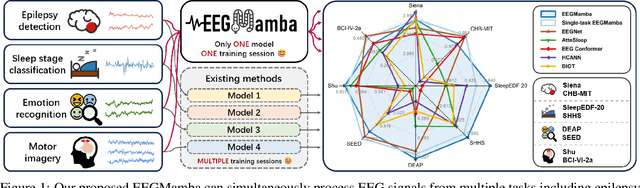
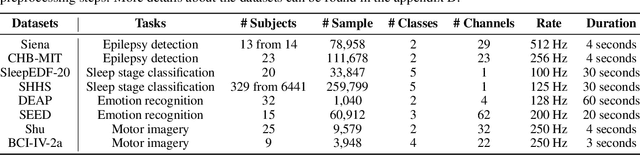
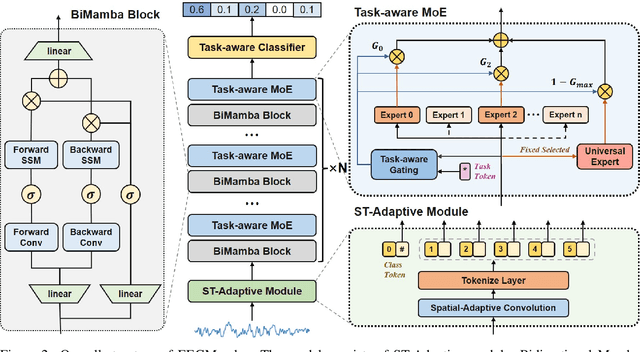
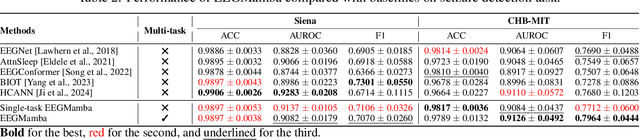
In recent years, with the development of deep learning, electroencephalogram (EEG) classification networks have achieved certain progress. Transformer-based models can perform well in capturing long-term dependencies in EEG signals. However, their quadratic computational complexity leads to significant computational overhead. Moreover, most EEG classification models are only suitable for single tasks, showing poor generalization capabilities across different tasks and further unable to handle EEG data from various tasks simultaneously due to variations in signal length and the number of channels. In this paper, we introduce a universal EEG classification network named EEGMamba, which seamlessly integrates the Spatio-Temporal-Adaptive (ST-Adaptive) module, Bidirectional Mamba, and Mixture of Experts (MoE) into a unified framework for multiple tasks. The proposed ST-Adaptive module performs unified feature extraction on EEG signals of different lengths and channel counts through spatio-adaptive convolution and incorporates a class token to achieve temporal-adaptability. Moreover, we design a bidirectional Mamba particularly suitable for EEG signals for further feature extraction, balancing high accuracy and fast inference speed in processing long EEG signals. In order to better process EEG data for different tasks, we introduce Task-aware MoE with a universal expert, achieving the capture of both differences and commonalities between EEG data from different tasks. We test our model on eight publicly available EEG datasets, and experimental results demonstrate its superior performance in four types of tasks: seizure detection, emotion recognition, sleep stage classification, and motor imagery. The code is set to be released soon.