 Add to Chrome
 Add to Firefox
 Add to Edge
Step 3.5 Flash: Open Frontier-Level Intelligence with 11B Active Parameters
Feb 11, 2026
We introduce Step 3.5 Flash, a sparse Mixture-of-Experts (MoE) model that bridges frontier-level agentic intelligence and computational efficiency. We focus on what matters most when building agents: sharp reasoning and fast, reliable execution. Step 3.5 Flash pairs a 196B-parameter foundation with 11B active parameters for efficient inference. It is optimized with interleaved 3:1 sliding-window/full attention and Multi-Token Prediction (MTP-3) to reduce the latency and cost of multi-round agentic interactions. To reach frontier-level intelligence, we design a scalable reinforcement learning framework that combines verifiable signals with preference feedback, while remaining stable under large-scale off-policy training, enabling consistent self-improvement across mathematics, code, and tool use. Step 3.5 Flash demonstrates strong performance across agent, coding, and math tasks, achieving 85.4% on IMO-AnswerBench, 86.4% on LiveCodeBench-v6 (2024.08-2025.05), 88.2% on tau2-Bench, 69.0% on BrowseComp (with context management), and 51.0% on Terminal-Bench 2.0, comparable to frontier models such as GPT-5.2 xHigh and Gemini 3.0 Pro. By redefining the efficiency frontier, Step 3.5 Flash provides a high-density foundation for deploying sophisticated agents in real-world industrial environments.

DockSmith: Scaling Reliable Coding Environments via an Agentic Docker Builder
Jan 31, 2026Reliable Docker-based environment construction is a dominant bottleneck for scaling execution-grounded training and evaluation of software engineering agents. We introduce DockSmith, a specialized agentic Docker builder designed to address this challenge. DockSmith treats environment construction not only as a preprocessing step, but as a core agentic capability that exercises long-horizon tool use, dependency reasoning, and failure recovery, yielding supervision that transfers beyond Docker building itself. DockSmith is trained on large-scale, execution-grounded Docker-building trajectories produced by a SWE-Factory-style pipeline augmented with a loop-detection controller and a cross-task success memory. Training a 30B-A3B model on these trajectories achieves open-source state-of-the-art performance on Multi-Docker-Eval, with 39.72% Fail-to-Pass and 58.28% Commit Rate. Moreover, DockSmith improves out-of-distribution performance on SWE-bench Verified, SWE-bench Multilingual, and Terminal-Bench 2.0, demonstrating broader agentic benefits of environment construction.
STEP3-VL-10B Technical Report
Jan 15, 2026We present STEP3-VL-10B, a lightweight open-source foundation model designed to redefine the trade-off between compact efficiency and frontier-level multimodal intelligence. STEP3-VL-10B is realized through two strategic shifts: first, a unified, fully unfrozen pre-training strategy on 1.2T multimodal tokens that integrates a language-aligned Perception Encoder with a Qwen3-8B decoder to establish intrinsic vision-language synergy; and second, a scaled post-training pipeline featuring over 1k iterations of reinforcement learning. Crucially, we implement Parallel Coordinated Reasoning (PaCoRe) to scale test-time compute, allocating resources to scalable perceptual reasoning that explores and synthesizes diverse visual hypotheses. Consequently, despite its compact 10B footprint, STEP3-VL-10B rivals or surpasses models 10$\times$-20$\times$ larger (e.g., GLM-4.6V-106B, Qwen3-VL-235B) and top-tier proprietary flagships like Gemini 2.5 Pro and Seed-1.5-VL. Delivering best-in-class performance, it records 92.2% on MMBench and 80.11% on MMMU, while excelling in complex reasoning with 94.43% on AIME2025 and 75.95% on MathVision. We release the full model suite to provide the community with a powerful, efficient, and reproducible baseline.
Leash: Adaptive Length Penalty and Reward Shaping for Efficient Large Reasoning Model
Dec 25, 2025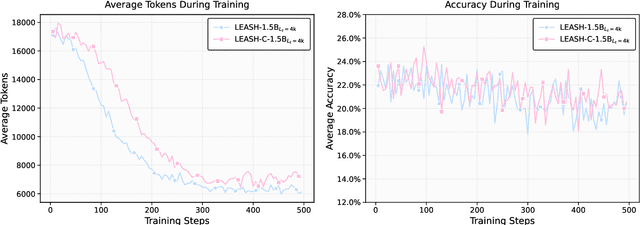
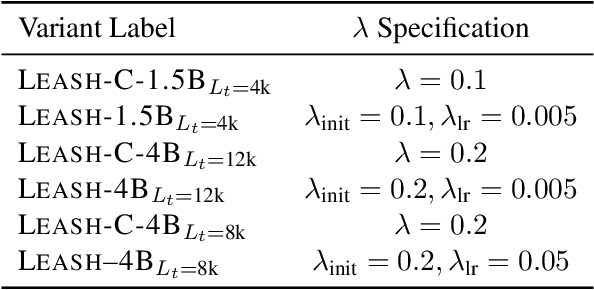
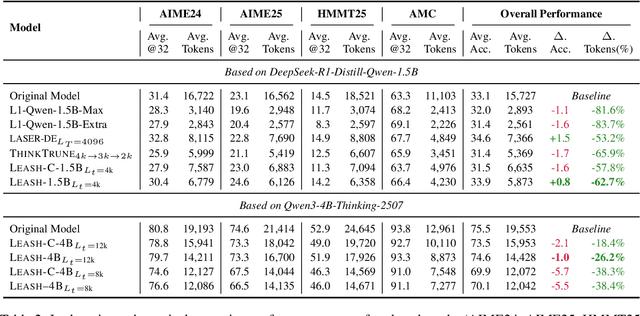

Existing approaches typically rely on fixed length penalties, but such penalties are hard to tune and fail to adapt to the evolving reasoning abilities of LLMs, leading to suboptimal trade-offs between accuracy and conciseness. To address this challenge, we propose Leash (adaptive LEngth penAlty and reward SHaping), a reinforcement learning framework for efficient reasoning in LLMs. We formulate length control as a constrained optimization problem and employ a Lagrangian primal-dual method to dynamically adjust the penalty coefficient. When generations exceed the target length, the penalty is intensified; when they are shorter, it is relaxed. This adaptive mechanism guides models toward producing concise reasoning without sacrificing task performance. Experiments on Deepseek-R1-Distill-Qwen-1.5B and Qwen3-4B-Thinking-2507 show that Leash reduces the average reasoning length by 60% across diverse tasks - including in-distribution mathematical reasoning and out-of-distribution domains such as coding and instruction following - while maintaining competitive performance. Our work thus presents a practical and effective paradigm for developing controllable and efficient LLMs that balance reasoning capabilities with computational budgets.