 Add to Chrome
 Add to Firefox
 Add to Edge
On Revisiting Entropy for Identifying Mislabeled Images
May 29, 2026
Mislabeled samples in training datasets severely degrade the performance of deep networks, as overparameterized models tend to memorize erroneous labels. We address this challenge by proposing a novel approach for mislabeled data detection that leverages training dynamics. Our method is grounded in the key observation that correctly labeled samples exhibit consistent entropy decrease during training, while mislabeled samples maintain relatively high entropy throughout the training process. Building on this insight, we introduce a signed entropy integral (SEI) statistic that captures both the magnitude and temporal trend of prediction entropy across training epochs. SEI is broadly applicable to classification networks and demonstrates particular effectiveness when integrated with contrastive language-image pretraining (CLIP) architectures. Through extensive experiments on four medical imaging datasets -- a domain particularly susceptible to labeling errors due to diagnostic complexity -- spanning diverse modalities and pathologies, we demonstrate that SEI achieves state-of-the-art performance in mislabeled data identification, outperforming existing methods while maintaining computational efficiency and implementation simplicity. Our code is available at https://github.com/MedAITech/SEI.

LoViF 2026 Challenge on Real-World All-in-One Image Restoration: Methods and Results
Apr 21, 2026This paper presents a review for the LoViF Challenge on Real-World All-in-One Image Restoration. The challenge aimed to advance research on real-world all-in-one image restoration under diverse real-world degradation conditions, including blur, low-light, haze, rain, and snow. It provided a unified benchmark to evaluate the robustness and generalization ability of restoration models across multiple degradation categories within a common framework. The competition attracted 124 registered participants and received 9 valid final submissions with corresponding fact sheets, significantly contributing to the progress of real-world all-in-one image restoration. This report provides a detailed analysis of the submitted methods and corresponding results, emphasizing recent progress in unified real-world image restoration. The analysis highlights effective approaches and establishes a benchmark for future research in real-world low-level vision.
NTIRE 2026 The Second Challenge on Day and Night Raindrop Removal for Dual-Focused Images: Methods and Results
Apr 12, 2026This paper presents an overview of the NTIRE 2026 Second Challenge on Day and Night Raindrop Removal for Dual-Focused Images. Building upon the success of the first edition, this challenge attracted a wide range of impressive solutions, all developed and evaluated on our real-world Raindrop Clarity dataset~\cite{jin2024raindrop}. For this edition, we adjust the dataset with 14,139 images for training, 407 images for validation, and 593 images for testing. The primary goal of this challenge is to establish a strong and practical benchmark for the removal of raindrops under various illumination and focus conditions. In total, 168 teams have registered for the competition, and 17 teams submitted valid final solutions and fact sheets for the testing phase. The submitted methods achieved strong performance on the Raindrop Clarity dataset, demonstrating the growing progress in this challenging task.
The Eleventh NTIRE 2026 Efficient Super-Resolution Challenge Report
Apr 03, 2026This paper reviews the NTIRE 2026 challenge on efficient single-image super-resolution with a focus on the proposed solutions and results. The aim of this challenge is to devise a network that reduces one or several aspects, such as runtime, parameters, and FLOPs, while maintaining PSNR of around 26.90 dB on the DIV2K_LSDIR_valid dataset, and 26.99 dB on the DIV2K_LSDIR_test dataset. The challenge had 95 registered participants, and 15 teams made valid submissions. They gauge the state-of-the-art results for efficient single-image super-resolution.
Learning Domain-Aware Task Prompt Representations for Multi-Domain All-in-One Image Restoration
Mar 02, 2026Recently, significant breakthroughs have been made in all-in-one image restoration (AiOIR), which can handle multiple restoration tasks with a single model. However, existing methods typically focus on a specific image domain, such as natural scene, medical imaging, or remote sensing. In this work, we aim to extend AiOIR to multiple domains and propose the first multi-domain all-in-one image restoration method, DATPRL-IR, based on our proposed Domain-Aware Task Prompt Representation Learning. Specifically, we first construct a task prompt pool containing multiple task prompts, in which task-related knowledge is implicitly encoded. For each input image, the model adaptively selects the most relevant task prompts and composes them into an instance-level task representation via a prompt composition mechanism (PCM). Furthermore, to endow the model with domain awareness, we introduce another domain prompt pool and distill domain priors from multimodal large language models into the domain prompts. PCM is utilized to combine the adaptively selected domain prompts into a domain representation for each input image. Finally, the two representations are fused to form a domain-aware task prompt representation which can make full use of both specific and shared knowledge across tasks and domains to guide the subsequent restoration process. Extensive experiments demonstrate that our DATPRL-IR significantly outperforms existing SOTA image restoration methods, while exhibiting strong generalization capabilities. Code is available at https://github.com/GuangluDong0728/DATPRL-IR.
NTIRE 2025 Challenge on Day and Night Raindrop Removal for Dual-Focused Images: Methods and Results
Apr 19, 2025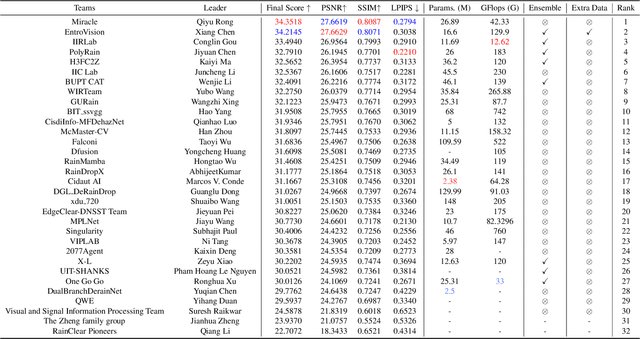
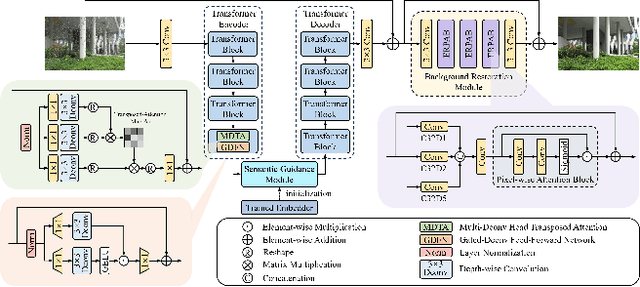
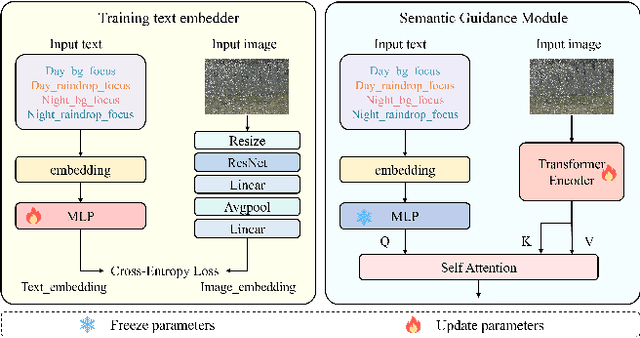
This paper reviews the NTIRE 2025 Challenge on Day and Night Raindrop Removal for Dual-Focused Images. This challenge received a wide range of impressive solutions, which are developed and evaluated using our collected real-world Raindrop Clarity dataset. Unlike existing deraining datasets, our Raindrop Clarity dataset is more diverse and challenging in degradation types and contents, which includes day raindrop-focused, day background-focused, night raindrop-focused, and night background-focused degradations. This dataset is divided into three subsets for competition: 14,139 images for training, 240 images for validation, and 731 images for testing. The primary objective of this challenge is to establish a new and powerful benchmark for the task of removing raindrops under varying lighting and focus conditions. There are a total of 361 participants in the competition, and 32 teams submitting valid solutions and fact sheets for the final testing phase. These submissions achieved state-of-the-art (SOTA) performance on the Raindrop Clarity dataset. The project can be found at https://lixinustc.github.io/CVPR-NTIRE2025-RainDrop-Competition.github.io/.
Exploring Semantic Feature Discrimination for Perceptual Image Super-Resolution and Opinion-Unaware No-Reference Image Quality Assessment
Mar 25, 2025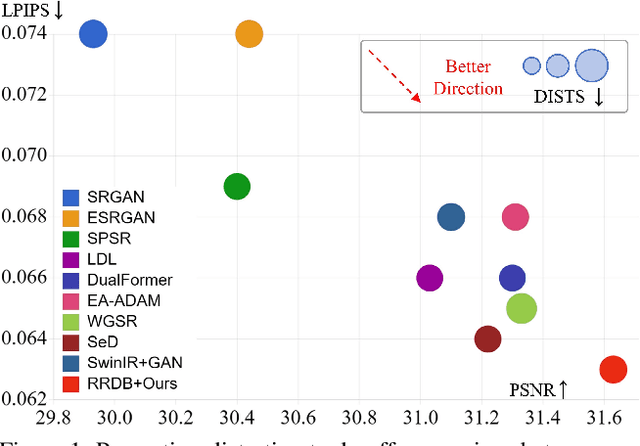
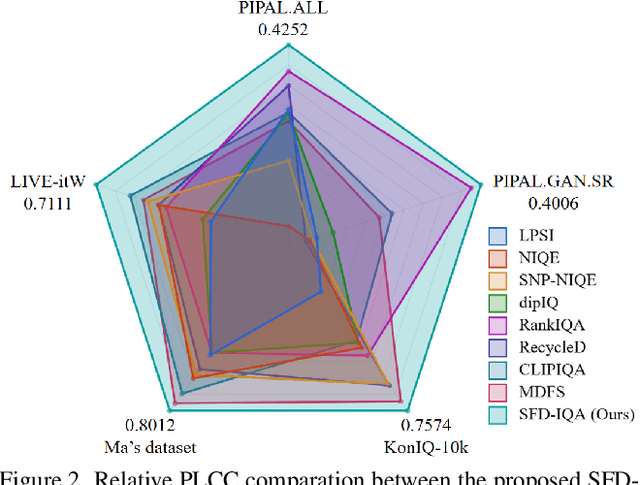
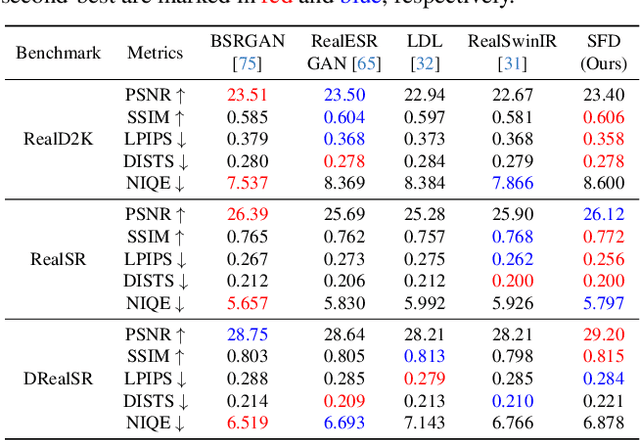
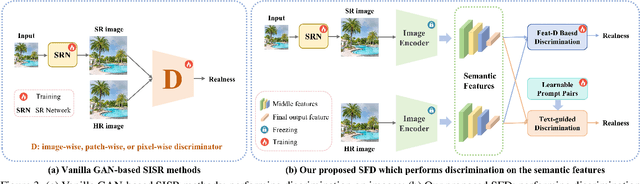
Generative Adversarial Networks (GANs) have been widely applied to image super-resolution (SR) to enhance the perceptual quality. However, most existing GAN-based SR methods typically perform coarse-grained discrimination directly on images and ignore the semantic information of images, making it challenging for the super resolution networks (SRN) to learn fine-grained and semantic-related texture details. To alleviate this issue, we propose a semantic feature discrimination method, SFD, for perceptual SR. Specifically, we first design a feature discriminator (Feat-D), to discriminate the pixel-wise middle semantic features from CLIP, aligning the feature distributions of SR images with that of high-quality images. Additionally, we propose a text-guided discrimination method (TG-D) by introducing learnable prompt pairs (LPP) in an adversarial manner to perform discrimination on the more abstract output feature of CLIP, further enhancing the discriminative ability of our method. With both Feat-D and TG-D, our SFD can effectively distinguish between the semantic feature distributions of low-quality and high-quality images, encouraging SRN to generate more realistic and semantic-relevant textures. Furthermore, based on the trained Feat-D and LPP, we propose a novel opinion-unaware no-reference image quality assessment (OU NR-IQA) method, SFD-IQA, greatly improving OU NR-IQA performance without any additional targeted training. Extensive experiments on classical SISR, real-world SISR, and OU NR-IQA tasks demonstrate the effectiveness of our proposed methods.
Channel Consistency Prior and Self-Reconstruction Strategy Based Unsupervised Image Deraining
Mar 24, 2025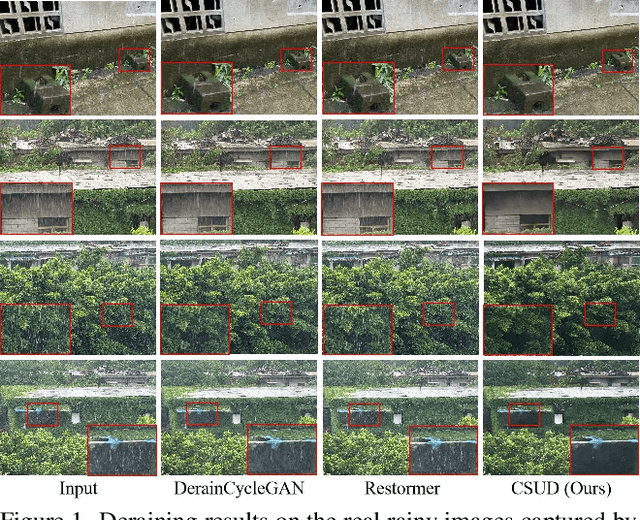
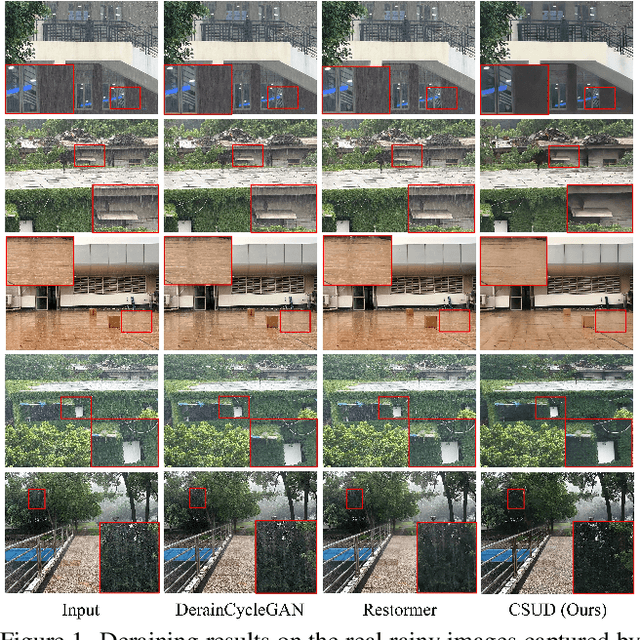
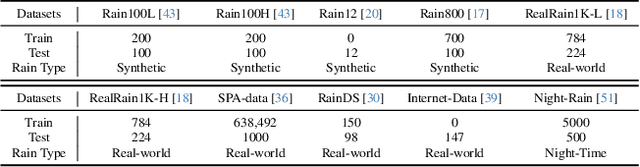
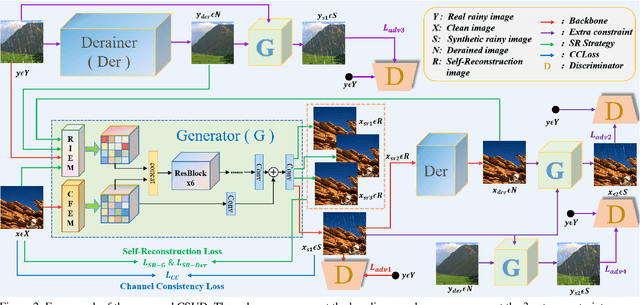
Recently, deep image deraining models based on paired datasets have made a series of remarkable progress. However, they cannot be well applied in real-world applications due to the difficulty of obtaining real paired datasets and the poor generalization performance. In this paper, we propose a novel Channel Consistency Prior and Self-Reconstruction Strategy Based Unsupervised Image Deraining framework, CSUD, to tackle the aforementioned challenges. During training with unpaired data, CSUD is capable of generating high-quality pseudo clean and rainy image pairs which are used to enhance the performance of deraining network. Specifically, to preserve more image background details while transferring rain streaks from rainy images to the unpaired clean images, we propose a novel Channel Consistency Loss (CCLoss) by introducing the Channel Consistency Prior (CCP) of rain streaks into training process, thereby ensuring that the generated pseudo rainy images closely resemble the real ones. Furthermore, we propose a novel Self-Reconstruction (SR) strategy to alleviate the redundant information transfer problem of the generator, further improving the deraining performance and the generalization capability of our method. Extensive experiments on multiple synthetic and real-world datasets demonstrate that the deraining performance of CSUD surpasses other state-of-the-art unsupervised methods and CSUD exhibits superior generalization capability.