 Add to Chrome
 Add to Firefox
 Add to Edge
LiDARDraft: Generating LiDAR Point Cloud from Versatile Inputs
Dec 23, 2025
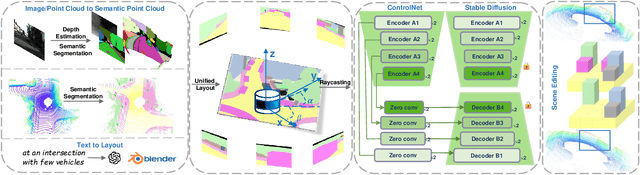
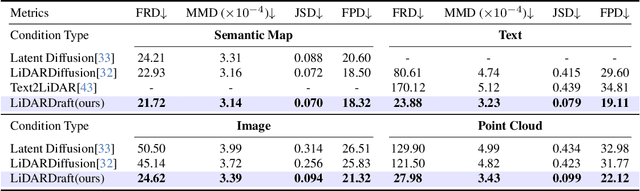
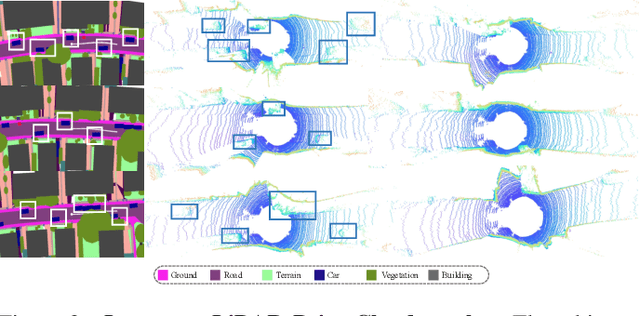
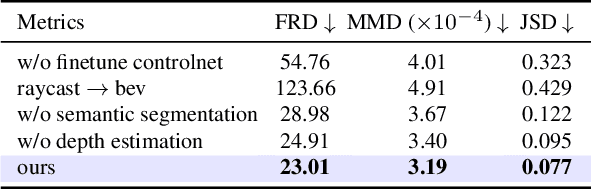
Generating realistic and diverse LiDAR point clouds is crucial for autonomous driving simulation. Although previous methods achieve LiDAR point cloud generation from user inputs, they struggle to attain high-quality results while enabling versatile controllability, due to the imbalance between the complex distribution of LiDAR point clouds and the simple control signals. To address the limitation, we propose LiDARDraft, which utilizes the 3D layout to build a bridge between versatile conditional signals and LiDAR point clouds. The 3D layout can be trivially generated from various user inputs such as textual descriptions and images. Specifically, we represent text, images, and point clouds as unified 3D layouts, which are further transformed into semantic and depth control signals. Then, we employ a rangemap-based ControlNet to guide LiDAR point cloud generation. This pixel-level alignment approach demonstrates excellent performance in controllable LiDAR point clouds generation, enabling "simulation from scratch", allowing self-driving environments to be created from arbitrary textual descriptions, images and sketches.

Point What You Mean: Visually Grounded Instruction Policy
Dec 22, 2025
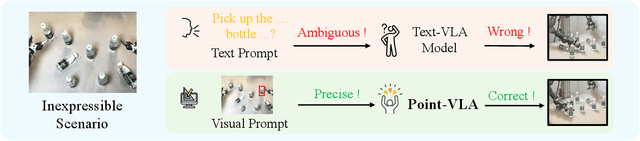
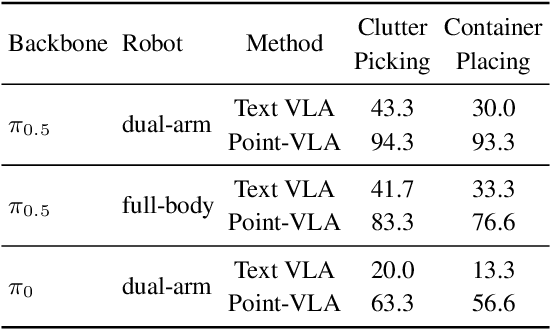
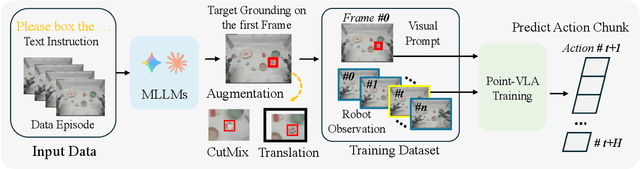
Vision-Language-Action (VLA) models align vision and language with embodied control, but their object referring ability remains limited when relying solely on text prompt, especially in cluttered or out-of-distribution (OOD) scenes. In this study, we introduce the Point-VLA, a plug-and-play policy that augments language instructions with explicit visual cues (e.g., bounding boxes) to resolve referential ambiguity and enable precise object-level grounding. To efficiently scale visually grounded datasets, we further develop an automatic data annotation pipeline requiring minimal human effort. We evaluate Point-VLA on diverse real-world referring tasks and observe consistently stronger performance than text-only instruction VLAs, particularly in cluttered or unseen-object scenarios, with robust generalization. These results demonstrate that Point-VLA effectively resolves object referring ambiguity through pixel-level visual grounding, achieving more generalizable embodied control.
TUMTraf EMOT: Event-Based Multi-Object Tracking Dataset and Baseline for Traffic Scenarios
Dec 20, 2025In Intelligent Transportation Systems (ITS), multi-object tracking is primarily based on frame-based cameras. However, these cameras tend to perform poorly under dim lighting and high-speed motion conditions. Event cameras, characterized by low latency, high dynamic range and high temporal resolution, have considerable potential to mitigate these issues. Compared to frame-based vision, there are far fewer studies on event-based vision. To address this research gap, we introduce an initial pilot dataset tailored for event-based ITS, covering vehicle and pedestrian detection and tracking. We establish a tracking-by-detection benchmark with a specialized feature extractor based on this dataset, achieving excellent performance.
MindDrive: A Vision-Language-Action Model for Autonomous Driving via Online Reinforcement Learning
Dec 16, 2025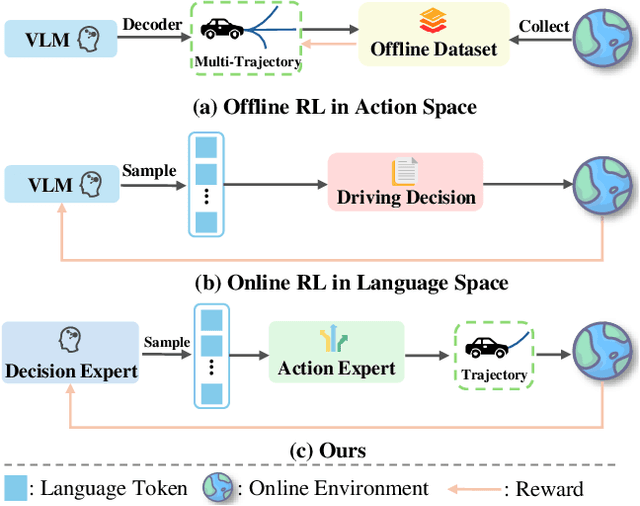
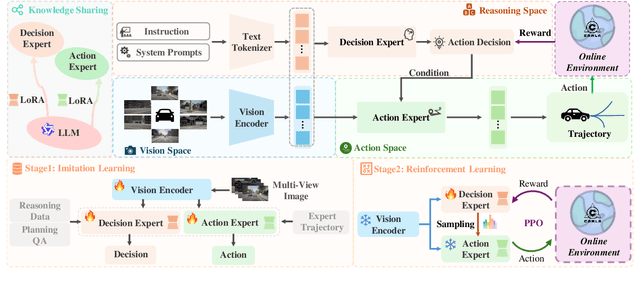
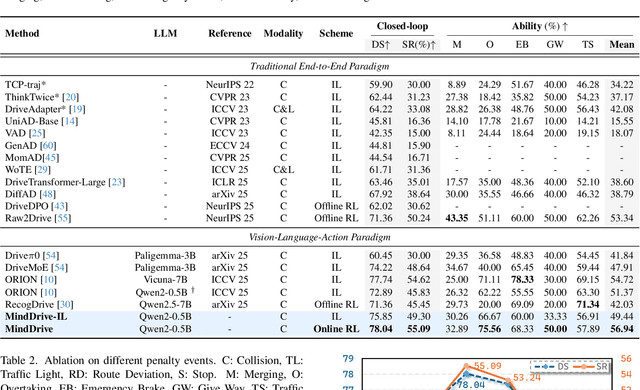
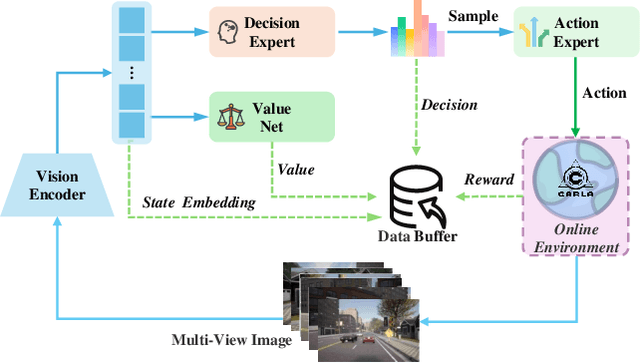
Current Vision-Language-Action (VLA) paradigms in autonomous driving primarily rely on Imitation Learning (IL), which introduces inherent challenges such as distribution shift and causal confusion. Online Reinforcement Learning offers a promising pathway to address these issues through trial-and-error learning. However, applying online reinforcement learning to VLA models in autonomous driving is hindered by inefficient exploration in continuous action spaces. To overcome this limitation, we propose MindDrive, a VLA framework comprising a large language model (LLM) with two distinct sets of LoRA parameters. The one LLM serves as a Decision Expert for scenario reasoning and driving decision-making, while the other acts as an Action Expert that dynamically maps linguistic decisions into feasible trajectories. By feeding trajectory-level rewards back into the reasoning space, MindDrive enables trial-and-error learning over a finite set of discrete linguistic driving decisions, instead of operating directly in a continuous action space. This approach effectively balances optimal decision-making in complex scenarios, human-like driving behavior, and efficient exploration in online reinforcement learning. Using the lightweight Qwen-0.5B LLM, MindDrive achieves Driving Score (DS) of 78.04 and Success Rate (SR) of 55.09% on the challenging Bench2Drive benchmark. To the best of our knowledge, this is the first work to demonstrate the effectiveness of online reinforcement learning for the VLA model in autonomous driving.
DRIVE: Data Curation Best Practices for Reinforcement Learning with Verifiable Reward in Competitive Code Generation
Nov 09, 2025Recent reasoning-first models (e.g., OpenAI o1, DeepSeek R1) have spurred a resurgence of interest in RLVR. Nevertheless, advances are dominated by mathematics (e.g., AIME), with competitive-programming code generation underexplored and data curation receiving less attention than RL algorithm design. We investigate how to construct RLVR datasets (i.e., RL prompts) and present practical training techniques that yield strong performance on competitive-programming code generation. Our pipeline begins with supervised fine-tuning (SFT) distilled from strong open-source models, augmented with general-purpose and reasoning-intensive data. RL then follows a two-stage process with executable, testcase-driven rewards: first, training on a large, uniformly distributed set of competitive-programming problems using Group Relative Policy Optimization (GRPO) with 8 rollouts per prompt and a relatively short response-generation window (e.g., 32k during SFT and 24k in this stage) to expand entropy and mitigate repetition and truncation; second, we perform \textbf{Pre-GRPO}: updating on a small, high-quality set of challenging problems with a large rollout budget (64 rollouts per prompt) under a hard-focus curriculum that continuously retains the most difficult instances throughout training. We implement our method on Qwen2.5-32B and evaluate on LeetCode and Codeforces weekly contests to avoid data leakage. The resulting model achieves state-of-the-art performance among models of similar scale and is comparable to leading systems such as DeepSeek v3.1 and Doubao-1.5-Thinking. We also examine scaling trends and observe strong RL scaling on an internal large-scale MoE model. Our study distills concise best practices for data curation, entropy expansion, and curriculum design in RLVR for competitive-programming code generation.
Rethinking Driving World Model as Synthetic Data Generator for Perception Tasks
Oct 22, 2025Recent advancements in driving world models enable controllable generation of high-quality RGB videos or multimodal videos. Existing methods primarily focus on metrics related to generation quality and controllability. However, they often overlook the evaluation of downstream perception tasks, which are $\mathbf{really\ crucial}$ for the performance of autonomous driving. Existing methods usually leverage a training strategy that first pretrains on synthetic data and finetunes on real data, resulting in twice the epochs compared to the baseline (real data only). When we double the epochs in the baseline, the benefit of synthetic data becomes negligible. To thoroughly demonstrate the benefit of synthetic data, we introduce Dream4Drive, a novel synthetic data generation framework designed for enhancing the downstream perception tasks. Dream4Drive first decomposes the input video into several 3D-aware guidance maps and subsequently renders the 3D assets onto these guidance maps. Finally, the driving world model is fine-tuned to produce the edited, multi-view photorealistic videos, which can be used to train the downstream perception models. Dream4Drive enables unprecedented flexibility in generating multi-view corner cases at scale, significantly boosting corner case perception in autonomous driving. To facilitate future research, we also contribute a large-scale 3D asset dataset named DriveObj3D, covering the typical categories in driving scenarios and enabling diverse 3D-aware video editing. We conduct comprehensive experiments to show that Dream4Drive can effectively boost the performance of downstream perception models under various training epochs. Project: $\href{https://wm-research.github.io/Dream4Drive/}{this\ https\ URL}$
Pixel-Perfect Depth with Semantics-Prompted Diffusion Transformers
Oct 08, 2025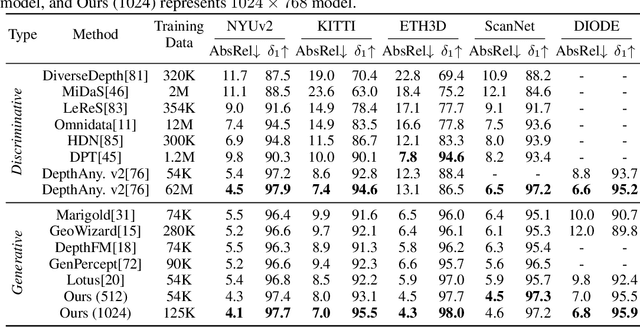
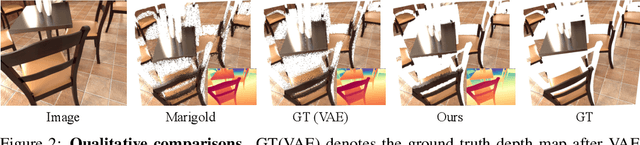
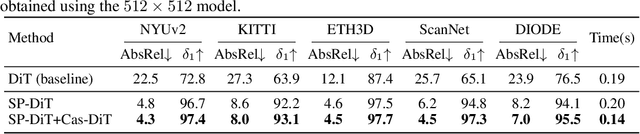
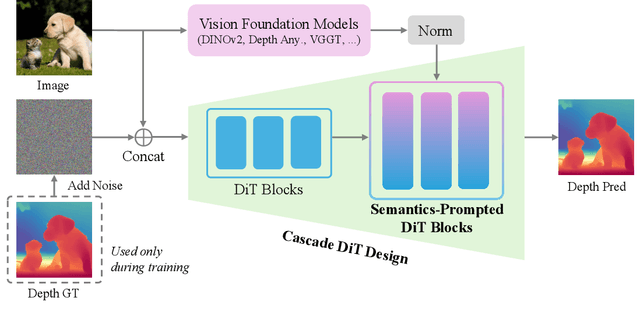
This paper presents Pixel-Perfect Depth, a monocular depth estimation model based on pixel-space diffusion generation that produces high-quality, flying-pixel-free point clouds from estimated depth maps. Current generative depth estimation models fine-tune Stable Diffusion and achieve impressive performance. However, they require a VAE to compress depth maps into latent space, which inevitably introduces \textit{flying pixels} at edges and details. Our model addresses this challenge by directly performing diffusion generation in the pixel space, avoiding VAE-induced artifacts. To overcome the high complexity associated with pixel-space generation, we introduce two novel designs: 1) Semantics-Prompted Diffusion Transformers (SP-DiT), which incorporate semantic representations from vision foundation models into DiT to prompt the diffusion process, thereby preserving global semantic consistency while enhancing fine-grained visual details; and 2) Cascade DiT Design that progressively increases the number of tokens to further enhance efficiency and accuracy. Our model achieves the best performance among all published generative models across five benchmarks, and significantly outperforms all other models in edge-aware point cloud evaluation.
AdamMeme: Adaptively Probe the Reasoning Capacity of Multimodal Large Language Models on Harmfulness
Jul 02, 2025The proliferation of multimodal memes in the social media era demands that multimodal Large Language Models (mLLMs) effectively understand meme harmfulness. Existing benchmarks for assessing mLLMs on harmful meme understanding rely on accuracy-based, model-agnostic evaluations using static datasets. These benchmarks are limited in their ability to provide up-to-date and thorough assessments, as online memes evolve dynamically. To address this, we propose AdamMeme, a flexible, agent-based evaluation framework that adaptively probes the reasoning capabilities of mLLMs in deciphering meme harmfulness. Through multi-agent collaboration, AdamMeme provides comprehensive evaluations by iteratively updating the meme data with challenging samples, thereby exposing specific limitations in how mLLMs interpret harmfulness. Extensive experiments show that our framework systematically reveals the varying performance of different target mLLMs, offering in-depth, fine-grained analyses of model-specific weaknesses. Our code is available at https://github.com/Lbotirx/AdamMeme.
FinLMM-R1: Enhancing Financial Reasoning in LMM through Scalable Data and Reward Design
Jun 16, 2025Large Multimodal Models (LMMs) demonstrate significant cross-modal reasoning capabilities. However, financial applications face challenges due to the lack of high-quality multimodal reasoning datasets and the inefficiency of existing training paradigms for reasoning enhancement. To address these issues, we propose an integrated framework, FinLMM-R1, combining an automated and scalable pipeline for data construction with enhanced training strategies to improve the multimodal reasoning of LMM. The Automated and Scalable Pipeline (ASP) resolves textual-visual misalignment in financial reports through a separate paradigm of question-answer generation and image-question alignment, ensuring data integrity and extraction efficiency. Through ASP, we collect 89,378 aligned image-question pairs from 23,397 financial reports, covering tasks such as arithmetic reasoning, statistics reasoning, financial explanation, and financial knowledge. Moreover, we introduce the Thinking with Adversarial Reward in LMM (TAR-LMM), extending the prior two-stage training framework [1] with additional reward mechanisms. In the first stage, we focus on text-only tasks with format and accuracy rewards to guide the model in generating well-structured thinking contents. In the second stage, we construct multi-image contrastive samples with additional reward components including image selection, thinking content length, and adversarial reward to jointly optimize the LMM across visual perception, reasoning efficiency, and logical coherence. Extensive experiments on 7 benchmarks show ASP-derived dataset and training framework significantly improve answer accuracy and reasoning depth over existing reasoning LMMs in both general and financial multimodal contexts.
ReCogDrive: A Reinforced Cognitive Framework for End-to-End Autonomous Driving
Jun 09, 2025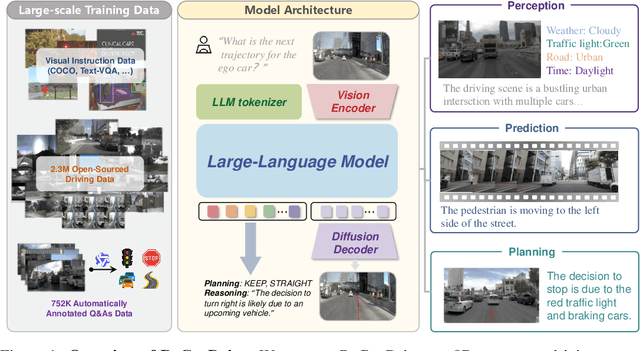
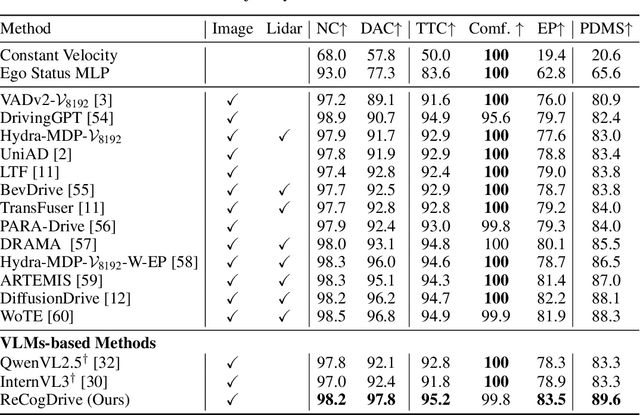
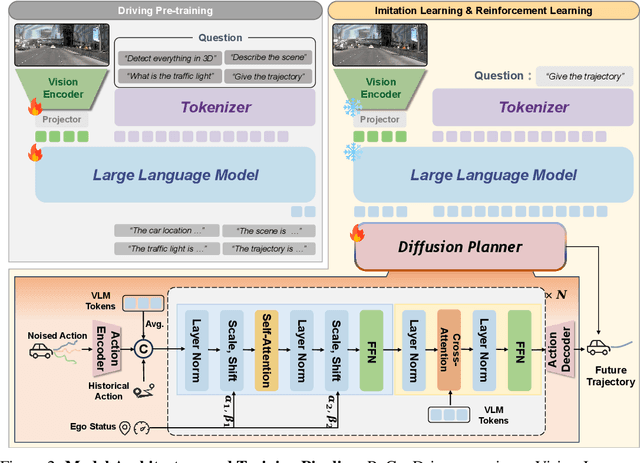
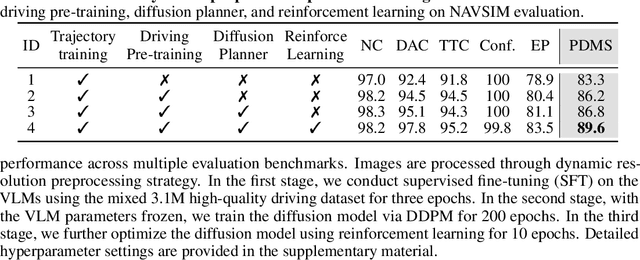
Although end-to-end autonomous driving has made remarkable progress, its performance degrades significantly in rare and long-tail scenarios. Recent approaches attempt to address this challenge by leveraging the rich world knowledge of Vision-Language Models (VLMs), but these methods suffer from several limitations: (1) a significant domain gap between the pre-training data of VLMs and real-world driving data, (2) a dimensionality mismatch between the discrete language space and the continuous action space, and (3) imitation learning tends to capture the average behavior present in the dataset, which may be suboptimal even dangerous. In this paper, we propose ReCogDrive, an autonomous driving system that integrates VLMs with diffusion planner, which adopts a three-stage paradigm for training. In the first stage, we use a large-scale driving question-answering datasets to train the VLMs, mitigating the domain discrepancy between generic content and real-world driving scenarios. In the second stage, we employ a diffusion-based planner to perform imitation learning, mapping representations from the latent language space to continuous driving actions. Finally, we fine-tune the diffusion planner using reinforcement learning with NAVSIM non-reactive simulator, enabling the model to generate safer, more human-like driving trajectories. We evaluate our approach on the planning-oriented NAVSIM benchmark, achieving a PDMS of 89.6 and setting a new state-of-the-art that surpasses the previous vision-only SOTA by 5.6 PDMS.