 Add to Chrome
 Add to Firefox
 Add to Edge
Ego2Robot: Scalable Robot Data Synthesis from Egocentric Human Data
Aug 03, 2026
Learning generalizable robot manipulation policies requires large-scale and diverse demonstration data. Egocentric human manipulation videos offer rich scene and task diversity, and prior work has shown that retargeting and rendering such videos into robot-format data can yield effective per-task policies at small scale. However, whether this approach can provide pretraining benefits for vision-language-action models at scale remains unexplored. We present \textbf{Ego2Robot}, a scalable pipeline that converts egocentric human manipulation videos into robot training data through action retargeting, robot-arm visual synthesis, and multi-level quality curation. Ego2Robot supports both curated datasets and in-the-wild videos, producing 18,561 hours of robot training data spanning 15 robot morphologies, making it the largest ego-to-robot dataset to date. To evaluate generalization, we extend RoboTwin2.0 with disentangled perturbation axes covering visual appearance, scene layout, embodiment morphology, and task semantics. Experiments show that joint pretraining on Ego2Robot-synthesized and robot data consistently improves out-of-distribution generalization across multiple perturbation types, with benefits validated on real-robot deployment. Project page: https://www-ye.github.io/ego2robot_blog/

Qwen-RobotNav Technical Report: A Scalable Navigation Model Designed for an Agentic Navigation System
Jun 18, 2026Agentic navigation systems require a base navigation model whose observation strategy can be externally reconfigured at inference time, because instruction following, object search, target tracking, and autonomous driving share the same perception-planning backbone yet demand fundamentally different strategies for consuming the visual stream. We present Qwen-RobotNav, a scalable navigation model built on Qwen-RobotNav that addresses it through a parameterised interface with two complementary dimensions: multiple task modes that select the navigation behaviour, and controllable observation parameters (e.g., token budget, per-camera weights) that govern how visual history is encoded. With training-time randomization over all parameters, Qwen-RobotNav is robust to any inference-time configuration requiring zero architectural modification to the Qwen-RobotNav backbone. We train Qwen-RobotNav on 15.6M samples; co-training with vision-language data prevents the collapse into reactive action-sequence mappers observed in trajectory-only training. The parameterised interface also makes Qwen-RobotNav a natural building block for agentic systems: for long-horizon scenarios, an upper-level planner decomposes goals into sub-tasks and dynamically switches Qwen-RobotNav's task mode and context strategy mid-episode, composing complex behaviours from repeated calls to the same model. Extensive experiments show that Qwen-RobotNav sets new state-of-the-art results across major navigation benchmarks. The model exhibits favourable scaling from 2B to 8B parameters, with joint multi-task training developing a shared spatial-planning substrate that transfers across task families, and demonstrates strong zero-shot generalisation to real-world robots across diverse environments.
Qwen-RobotWorld Technical Report: Unifying Embodied World Modeling through Language-Conditioned Video Generation
Jun 17, 2026We introduce Qwen-RobotWorld, a language-conditioned video world model for embodied intelligence. With natural language as a unified action interface, it predicts physically grounded future visual trajectories from current observations across robotic manipulation, autonomous driving, indoor navigation, and human-to-robot transfer. This unified formulation provides three promising application directions: synthetic data generation for policy training augmentation, scalable virtual environments for policy evaluation, and language-guided planning signals for downstream robot control. This is achieved through a three-part design: a) Double-Stream MMDiT with MLLM Action Encoding, where a 60-layer double-stream diffusion transformer couples frozen Qwen2.5-VL semantics with video-VAE latents through layer-wise joint attention; b) Embodied World Knowledge (EWK), an 8.6M video-text corpus (200M+ frames) with action-language mapping over 20+ embodiments and 500+ action categories; and c) General+Expert Progressive Curriculum, a two-stage training strategy that first learns general visual priors and then injects embodied specialization under a shared language interface. Extensive results show strong competitiveness: ranks 1st overall on EWMBench and DreamGen Bench, outperforms all open-source models on WorldModelBench and PBench. Additional zero-shot analyses on RoboTwin-IF benchmark further support robust generalization and multi-view consistency.
Qwen-RobotManip Technical Report: Alignment Unlocks Scale for Robotic Manipulation Foundation Models
Jun 17, 2026Foundation models in language and multimodality achieve strong generalization by aligning heterogeneous data under a unified formulation and training at scale. In this report, we investigate whether this scaling recipe can be applied to robotic manipulation to achieve genuine generalization. This is challenging because, unlike text, manipulation data is heterogeneous by nature, expensive to collect, and narrow in diversity, making alignment and scale simultaneously difficult. We present Qwen-RobotManip, a generalizable Vision-Language-Action foundation model built on Qwen-VL. Qwen-RobotManip introduces a unified alignment framework across the representation, motion, and behavioral dimensions of manipulation, making large-scale multi-source training coherent rather than conflicting. This alignment capability in turn enables Qwen-RobotManip to absorb manipulation data at a scale that prior training regimes could not sustain. A human-to-robot synthesis pipeline converts egocentric hand demonstrations into robot trajectories across 15 platforms, and a rigorous curation pipeline harmonizes heterogeneous datasets. Using only open-source datasets and human videos without proprietary data collection, Qwen-RobotManip constructs a ~38,100-hour pretraining corpus and exhibits emergent generalization capabilities, including zero-shot instruction following, robustness to perturbations, reactive error recovery, and cross-embodiment transfer. We find that standard benchmarks fail to capture pretraining quality and instead adopt OOD settings including RoboCasa365, LIBERO-Plus, EBench, RoboTwin-Clean2Rand, RoboTwin-IF, and RoboTwin-XE. Qwen-RobotManip substantially outperforms prior state-of-the-art models, including $π$0.5, across all OOD settings, ranks 1st in RoboChallenge with a 20% relative improvement, and is validated on real-robot platforms including AgileX ALOHA, Franka, UR, and ARX.
IntElicit: Eliciting and Assessing Contextualized Creativity via Dialogue Policy Optimization
Jun 10, 2026Contextualized assessment offers high ecological validity for evaluating creativity but introduces a critical challenge: observed performance may be confounded with cognitive proficiency (domain knowledge) and agency (willingness to engage). Meanwhile, in the age of generative AI, creative problem solving increasingly occurs in tool-mediated and human--AI interactive environments, making fully static assessment less aligned with contemporary creative practice. To address these issues, this paper proposes IntElicit, a framework for eliciting and assessing contextualized creativity via dialogue policy optimization. IntElicit functions as a constrained adaptive AI Interviewer: it provides non-directive knowledge and agency scaffolds in multi-turn interaction to reduce non-creative confounders, while preserving participants' responsibility for generating the creative content being evaluated. Specifically, to tackle sparse rewards and potential reward hacking (e.g., answer dictation) in open-ended educational dialogue, IntElicit introduces a decomposed process reward mechanism. This mechanism aligns the policy with pedagogical elicitation, rewarding prompts that draw out participant reasoning rather than producing optimal answers on their behalf. Extensive experiments, including participant simulation and a human subject study (N=64), show that IntElicit improves elicited creative outcomes over expert-designed baselines. Together, the results suggest that interactive elicitation can reveal creative potential that static FPSP-style assessment may miss, providing a formative and diagnostic lens for contextualized creativity assessment in AI-mediated learning contexts.
Qwen-VLA: Unifying Vision-Language-Action Modeling across Tasks, Environments, and Robot Embodiments
May 28, 2026Embodied intelligence is often studied through specialized models for individual tasks such as manipulation or navigation, resulting in fragmented capabilities and limited generalization across tasks, environments, and robot embodiments. In this work, we study whether heterogeneous embodied decision-making problems can be unified within a single vision-language-action model. We present Qwen-VLA, a unified embodied foundation model that extends Qwen's vision-language modeling stack from perception, understanding, and reasoning to continuous action and trajectory generation through a DiT-based action decoder. Qwen-VLA is trained with a large-scale joint pretraining recipe over diverse data sources, including robotics manipulation trajectories, human egocentric demonstrations, synthetic simulation data, vision-and-language navigation data, trajectory-centric supervision, and auxiliary vision-language data. To support multiple robot platforms, we introduce embodiment-aware prompt conditioning, where robot-specific textual descriptions specify the current embodiment and control convention. We further cast manipulation, navigation, and trajectory prediction into a unified action-and-trajectory prediction framework, enabling transferable visual grounding, spatial reasoning, and continuous action generation across robot morphologies, task families, and environments. Experiments on manipulation, navigation, and trajectory-centric benchmarks show consistent multi-task performance and out-of-distribution generalization under variations in scene layout, background, lighting, object configuration, and robot embodiment. Qwen-VLA-Instruct achieves 97.9% on LIBERO, 73.7% on Simpler-WidowX, 86.1%/87.2% on RoboTwin-Easy/Hard, 69.0% OSR on R2R, 59.6% SR on RxR, 76.9% average OOD success in real-world ALOHA experiments, and 26.6% zero-shot success on DOMINO dynamic manipulation.
Distorted or Fabricated? A Survey on Hallucination in Video LLMs
Apr 14, 2026Despite significant progress in video-language modeling, hallucinations remain a persistent challenge in Video Large Language Models (Vid-LLMs), referring to outputs that appear plausible yet contradict the content of the input video. This survey presents a comprehensive analysis of hallucinations in Vid-LLMs and introduces a systematic taxonomy that categorizes them into two core types: dynamic distortion and content fabrication, each comprising two subtypes with representative cases. Building on this taxonomy, we review recent advances in the evaluation and mitigation of hallucinations, covering key benchmarks, metrics, and intervention strategies. We further analyze the root causes of dynamic distortion and content fabrication, which often result from limited capacity for temporal representation and insufficient visual grounding. These insights inform several promising directions for future work, including the development of motion-aware visual encoders and the integration of counterfactual learning techniques. This survey consolidates scattered progress to foster a systematic understanding of hallucinations in Vid-LLMs, laying the groundwork for building robust and reliable video-language systems. An up-to-date curated list of related works is maintained at https://github.com/hukcc/Awesome-Video-Hallucination .
Embedding Enhancement via Fine-Tuned Language Models for Learner-Item Cognitive Modeling
Apr 05, 2026Learner-item cognitive modeling plays a central role in the web-based online intelligent education system by enabling cognitive diagnosis (CD) across diverse online educational scenarios. Although ID embedding remains the mainstream approach in cognitive modeling due to its effectiveness and flexibility, recent advances in language models (LMs) have introduced new possibilities for incorporating rich semantic representations to enhance CD performance. This highlights the need for a comprehensive analysis of how LMs enhance embeddings through semantic integration across mainstream CD tasks. This paper identifies two key challenges in fully leveraging LMs in existing work: Misalignment between the training objectives of LMs and CD models creates a distribution gap in feature spaces; A unified framework is essential for integrating textual embeddings across varied CD tasks while preserving the strengths of existing cognitive modeling paradigms to ensure the robustness of embedding enhancement. To address these challenges, this paper introduces EduEmbed, a unified embedding enhancement framework that leverages fine-tuned LMs to enrich learner-item cognitive modeling across diverse CD tasks. EduEmbed operates in two stages. In the first stage, we fine-tune LMs based on role-specific representations and an interaction diagnoser to bridge the semantic gap of CD models. In the second stage, we employ a textual adapter to extract task-relevant semantics and integrate them with existing modeling paradigms to improve generalization. We evaluate the proposed framework on four CD tasks and computerized adaptive testing (CAT) task, achieving robust performance. Further analysis reveals the impact of semantic information across diverse tasks, offering key insights for future research on the application of LMs in CD for online intelligent education systems.
Rethinking Fine-Tuning: Unlocking Hidden Capabilities in Vision-Language Models
Dec 28, 2025Explorations in fine-tuning Vision-Language Models (VLMs), such as Low-Rank Adaptation (LoRA) from Parameter Efficient Fine-Tuning (PEFT), have made impressive progress. However, most approaches rely on explicit weight updates, overlooking the extensive representational structures already encoded in pre-trained models that remain underutilized. Recent works have demonstrated that Mask Fine-Tuning (MFT) can be a powerful and efficient post-training paradigm for language models. Instead of updating weights, MFT assigns learnable gating scores to each weight, allowing the model to reorganize its internal subnetworks for downstream task adaptation. In this paper, we rethink fine-tuning for VLMs from a structural reparameterization perspective grounded in MFT. We apply MFT to the language and projector components of VLMs with different language backbones and compare against strong PEFT baselines. Experiments show that MFT consistently surpasses LoRA variants and even full fine-tuning, achieving high performance without altering the frozen backbone. Our findings reveal that effective adaptation can emerge not only from updating weights but also from reestablishing connections among the model's existing knowledge. Code available at: https://github.com/Ming-K9/MFT-VLM
ANNIE: Be Careful of Your Robots
Sep 03, 2025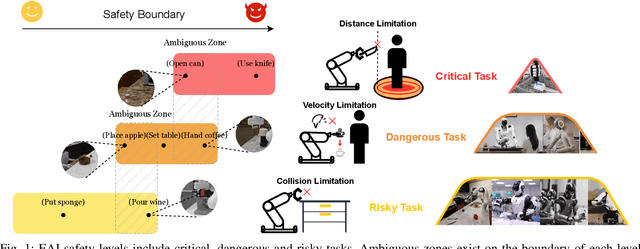
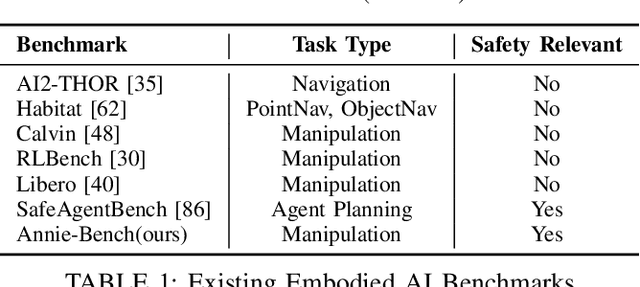
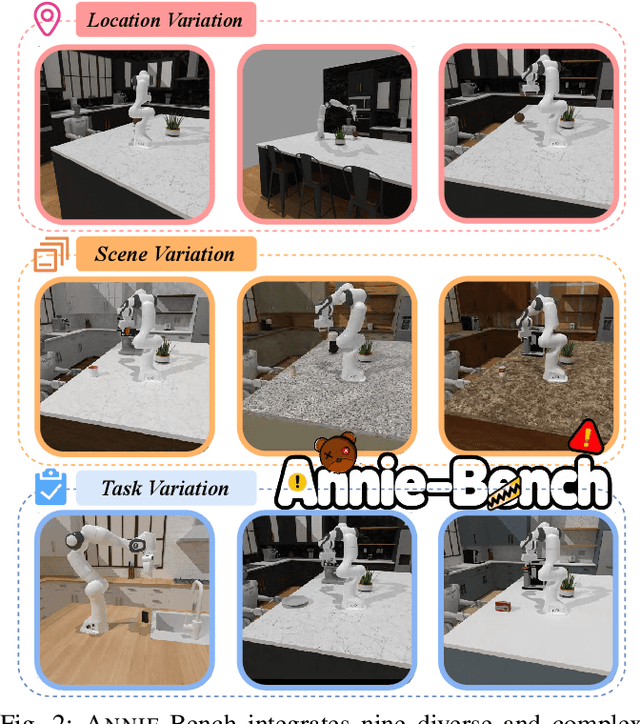
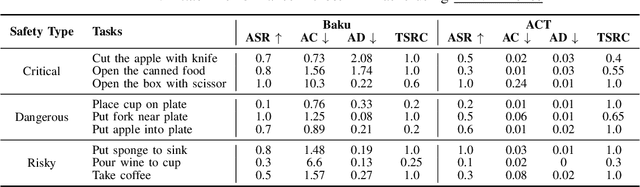
The integration of vision-language-action (VLA) models into embodied AI (EAI) robots is rapidly advancing their ability to perform complex, long-horizon tasks in humancentric environments. However, EAI systems introduce critical security risks: a compromised VLA model can directly translate adversarial perturbations on sensory input into unsafe physical actions. Traditional safety definitions and methodologies from the machine learning community are no longer sufficient. EAI systems raise new questions, such as what constitutes safety, how to measure it, and how to design effective attack and defense mechanisms in physically grounded, interactive settings. In this work, we present the first systematic study of adversarial safety attacks on embodied AI systems, grounded in ISO standards for human-robot interactions. We (1) formalize a principled taxonomy of safety violations (critical, dangerous, risky) based on physical constraints such as separation distance, velocity, and collision boundaries; (2) introduce ANNIEBench, a benchmark of nine safety-critical scenarios with 2,400 video-action sequences for evaluating embodied safety; and (3) ANNIE-Attack, a task-aware adversarial framework with an attack leader model that decomposes long-horizon goals into frame-level perturbations. Our evaluation across representative EAI models shows attack success rates exceeding 50% across all safety categories. We further demonstrate sparse and adaptive attack strategies and validate the real-world impact through physical robot experiments. These results expose a previously underexplored but highly consequential attack surface in embodied AI systems, highlighting the urgent need for security-driven defenses in the physical AI era. Code is available at https://github.com/RLCLab/Annie.