 Add to Chrome
 Add to Firefox
 Add to Edge
Organize then Retrieve: Hierarchical Memory Navigation for Efficient Agents
Jun 10, 2026
Large language model (LLM) agents struggle with long-horizon tasks due to their inherent statelessness, requiring all task-relevant information to be encoded in growing input contexts. The resulting degraded reasoning quality, increased inference cost, and higher latency necessitate efficient working memory mechanisms. However, existing approaches either rely on lossy compression or similarity-based retrieval, which often fail to capture temporal structure and causal dependencies required for multi-step agentic tasks. In this work, we present HORMA, a Hierarchical Organize-and-Retrieve Memory Agent that organizes experience into a file-system-like hierarchical structure, where summarized entities are linked to the corresponding raw trajectories, enabling efficient access without losing detailed information. HORMA decomposes working memory into two stages: structured memory construction and navigation-based retrieval. The construction module iteratively refines how experiences are structured by distinguishing between failures caused by missing information and those caused by misleading or overloaded context. The navigation module retrieves task-relevant context by traversing the hierarchy using a lightweight agent trained with reinforcement learning to select minimal yet sufficient context, thereby reducing latency along the critical execution path. Across ALFWorld, LoCoMo, and LongMemEval, HORMA improves task performance under constrained context budgets while requiring at most 22.17% of the baseline token usage in long conversation tasks. Compared to existing methods, it consistently achieves better efficiency-performance trade-offs and generalizes effectively to unseen tasks.

Learning to Self-Evolve
Mar 19, 2026We introduce Learning to Self-Evolve (LSE), a reinforcement learning framework that trains large language models (LLMs) to improve their own contexts at test time. We situate LSE in the setting of test-time self-evolution, where a model iteratively refines its context from feedback on seen problems to perform better on new ones. Existing approaches rely entirely on the inherent reasoning ability of the model and never explicitly train it for this task. LSE reduces the multi-step evolution problem to a single-step RL objective, where each context edit is rewarded by the improvement in downstream performance. We pair this objective with a tree-guided evolution loop. On Text-to-SQL generation (BIRD) and general question answering (MMLU-Redux), a 4B-parameter model trained with LSE outperforms self-evolving policies powered by GPT-5 and Claude Sonnet 4.5, as well as prompt optimization methods including GEPA and TextGrad, and transfers to guide other models without additional training. Our results highlight the effectiveness of treating self-evolution as a learnable skill.
DARE-bench: Evaluating Modeling and Instruction Fidelity of LLMs in Data Science
Feb 27, 2026The fast-growing demands in using Large Language Models (LLMs) to tackle complex multi-step data science tasks create an emergent need for accurate benchmarking. There are two major gaps in existing benchmarks: (i) the lack of standardized, process-aware evaluation that captures instruction adherence and process fidelity, and (ii) the scarcity of accurately labeled training data. To bridge these gaps, we introduce DARE-bench, a benchmark designed for machine learning modeling and data science instruction following. Unlike many existing benchmarks that rely on human- or model-based judges, all tasks in DARE-bench have verifiable ground truth, ensuring objective and reproducible evaluation. To cover a broad range of tasks and support agentic tools, DARE-bench consists of 6,300 Kaggle-derived tasks and provides both large-scale training data and evaluation sets. Extensive evaluations show that even highly capable models such as gpt-o4-mini struggle to achieve good performance, especially in machine learning modeling tasks. Using DARE-bench training tasks for fine-tuning can substantially improve model performance. For example, supervised fine-tuning boosts Qwen3-32B's accuracy by 1.83x and reinforcement learning boosts Qwen3-4B's accuracy by more than 8x. These significant improvements verify the importance of DARE-bench both as an accurate evaluation benchmark and critical training data.
Agent World Model: Infinity Synthetic Environments for Agentic Reinforcement Learning
Feb 11, 2026Recent advances in large language model (LLM) have empowered autonomous agents to perform complex tasks that require multi-turn interactions with tools and environments. However, scaling such agent training is limited by the lack of diverse and reliable environments. In this paper, we propose Agent World Model (AWM), a fully synthetic environment generation pipeline. Using this pipeline, we scale to 1,000 environments covering everyday scenarios, in which agents can interact with rich toolsets (35 tools per environment on average) and obtain high-quality observations. Notably, these environments are code-driven and backed by databases, providing more reliable and consistent state transitions than environments simulated by LLMs. Moreover, they enable more efficient agent interaction compared with collecting trajectories from realistic environments. To demonstrate the effectiveness of this resource, we perform large-scale reinforcement learning for multi-turn tool-use agents. Thanks to the fully executable environments and accessible database states, we can also design reliable reward functions. Experiments on three benchmarks show that training exclusively in synthetic environments, rather than benchmark-specific ones, yields strong out-of-distribution generalization. The code is available at https://github.com/Snowflake-Labs/agent-world-model.
FedMosaic: Federated Retrieval-Augmented Generation via Parametric Adapters
Feb 05, 2026Retrieval-Augmented Generation (RAG) enhances Large Language Models (LLMs) by grounding generation in external knowledge to improve factuality and reduce hallucinations. Yet most deployments assume a centralized corpus, which is infeasible in privacy aware domains where knowledge remains siloed. This motivates federated RAG (FedRAG), where a central LLM server collaborates with distributed silos without sharing raw documents. In context RAG violates this requirement by transmitting verbatim documents, whereas parametric RAG encodes documents into lightweight adapters that merge with a frozen LLM at inference, avoiding raw-text exchange. We adopt the parametric approach but face two unique challenges induced by FedRAG: high storage and communication from per-document adapters, and destructive aggregation caused by indiscriminately merging multiple adapters. We present FedMosaic, the first federated RAG framework built on parametric adapters. FedMosaic clusters semantically related documents into multi-document adapters with document-specific masks to reduce overhead while preserving specificity, and performs selective adapter aggregation to combine only relevance-aligned, nonconflicting adapters. Experiments show that FedMosaic achieves an average 10.9% higher accuracy than state-of-the-art methods in four categories, while lowering storage costs by 78.8% to 86.3% and communication costs by 91.4%, and never sharing raw documents.
OpenNavMap: Structure-Free Topometric Mapping via Large-Scale Collaborative Localization
Jan 18, 2026Scalable and maintainable map representations are fundamental to enabling large-scale visual navigation and facilitating the deployment of robots in real-world environments. While collaborative localization across multi-session mapping enhances efficiency, traditional structure-based methods struggle with high maintenance costs and fail in feature-less environments or under significant viewpoint changes typical of crowd-sourced data. To address this, we propose OPENNAVMAP, a lightweight, structure-free topometric system leveraging 3D geometric foundation models for on-demand reconstruction. Our method unifies dynamic programming-based sequence matching, geometric verification, and confidence-calibrated optimization to robust, coarse-to-fine submap alignment without requiring pre-built 3D models. Evaluations on the Map-Free benchmark demonstrate superior accuracy over structure-from-motion and regression baselines, achieving an average translation error of 0.62m. Furthermore, the system maintains global consistency across 15km of multi-session data with an absolute trajectory error below 3m for map merging. Finally, we validate practical utility through 12 successful autonomous image-goal navigation tasks on simulated and physical robots. Code and datasets will be publicly available in https://rpl-cs-ucl.github.io/OpenNavMap_page.
CAFEDistill: Learning Personalized and Dynamic Models through Federated Early-Exit Network Distillation
Jan 15, 2026Personalized Federated Learning (PFL) enables collaboratively model training on decentralized, heterogeneous data while tailoring them to each client's unique distribution. However, existing PFL methods produce static models with a fixed tradeoff between accuracy and efficiency, limiting their applicability in environments where inference requirements vary with contexts and resource availability. Early-exit networks (EENs) offer adaptive inference by attaching intermediate classifiers. Yet integrating them into PFL is challenging due to client-wise heterogeneity and depth-wise interference arising from conflicting exit objectives. Prior studies fail to resolve both conflicts simultaneously, leading to suboptimal performance. In this paper, we propose CAFEDistill, a Conflict-Aware Federated Exit Distillation framework that jointly addresses these conflicts and extends PFL to early-exit networks. Through a progressive, depth-prioritized student coordination mechanism, CAFEDistill mitigates interference among shallow and deep exits while allowing effective personalized knowledge transfer across clients. Furthermore, it reduces communication overhead via a client-decoupled formulation. Extensive evaluations show that CAFEDistill outperforms the state-of-the-arts, achieving higher accuracy and reducing inference costs by 30.79%-46.86%.
The Starlink Robot: A Platform and Dataset for Mobile Satellite Communication
Jun 24, 2025The integration of satellite communication into mobile devices represents a paradigm shift in connectivity, yet the performance characteristics under motion and environmental occlusion remain poorly understood. We present the Starlink Robot, the first mobile robotic platform equipped with Starlink satellite internet, comprehensive sensor suite including upward-facing camera, LiDAR, and IMU, designed to systematically study satellite communication performance during movement. Our multi-modal dataset captures synchronized communication metrics, motion dynamics, sky visibility, and 3D environmental context across diverse scenarios including steady-state motion, variable speeds, and different occlusion conditions. This platform and dataset enable researchers to develop motion-aware communication protocols, predict connectivity disruptions, and optimize satellite communication for emerging mobile applications from smartphones to autonomous vehicles. The project is available at https://github.com/StarlinkRobot.
Graph-Reward-SQL: Execution-Free Reinforcement Learning for Text-to-SQL via Graph Matching and Stepwise Reward
May 18, 2025Reinforcement learning (RL) has been widely adopted to enhance the performance of large language models (LLMs) on Text-to-SQL tasks. However, existing methods often rely on execution-based or LLM-based Bradley-Terry reward models. The former suffers from high execution latency caused by repeated database calls, whereas the latter imposes substantial GPU memory overhead, both of which significantly hinder the efficiency and scalability of RL pipelines. To this end, we propose a novel Text-to-SQL RL fine-tuning framework named Graph-Reward-SQL, which employs the GMNScore outcome reward model. We leverage SQL graph representations to provide accurate reward signals while significantly reducing inference time and GPU memory usage. Building on this foundation, we further introduce StepRTM, a stepwise reward model that provides intermediate supervision over Common Table Expression (CTE) subqueries. This encourages both functional correctness and structural clarity of SQL. Extensive comparative and ablation experiments on standard benchmarks, including Spider and BIRD, demonstrate that our method consistently outperforms existing reward models.
Follow Everything: A Leader-Following and Obstacle Avoidance Framework with Goal-Aware Adaptation
May 01, 2025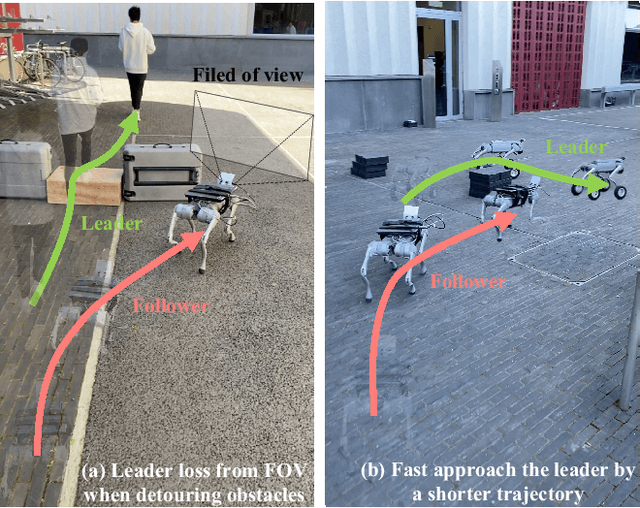
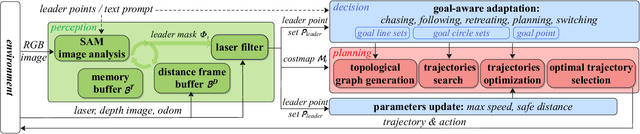
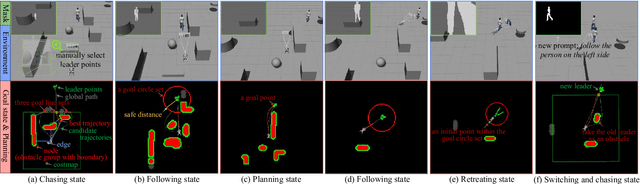
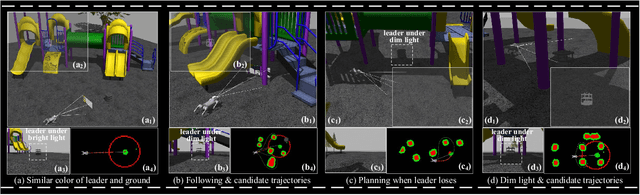
Robust and flexible leader-following is a critical capability for robots to integrate into human society. While existing methods struggle to generalize to leaders of arbitrary form and often fail when the leader temporarily leaves the robot's field of view, this work introduces a unified framework addressing both challenges. First, traditional detection models are replaced with a segmentation model, allowing the leader to be anything. To enhance recognition robustness, a distance frame buffer is implemented that stores leader embeddings at multiple distances, accounting for the unique characteristics of leader-following tasks. Second, a goal-aware adaptation mechanism is designed to govern robot planning states based on the leader's visibility and motion, complemented by a graph-based planner that generates candidate trajectories for each state, ensuring efficient following with obstacle avoidance. Simulations and real-world experiments with a legged robot follower and various leaders (human, ground robot, UAV, legged robot, stop sign) in both indoor and outdoor environments show competitive improvements in follow success rate, reduced visual loss duration, lower collision rate, and decreased leader-follower distance.