 Add to Chrome
 Add to Firefox
 Add to Edge
CRCC: Contrast-Based Robust Cross-Subject and Cross-Site Representation Learning for EEG
Feb 22, 2026
EEG-based neural decoding models often fail to generalize across acquisition sites due to structured, site-dependent biases implicitly exploited during training. We reformulate cross-site clinical EEG learning as a bias-factorized generalization problem, in which domain shifts arise from multiple interacting sources. We identify three fundamental bias factors and propose a general training framework that mitigates their influence through data standardization and representation-level constraints. We construct a standardized multi-site EEG benchmark for Major Depressive Disorder and introduce CRCC, a two-stage training paradigm combining encoder-decoder pretraining with joint fine-tuning via cross-subject/site contrastive learning and site-adversarial optimization. CRCC consistently outperforms state-of-the-art baselines and achieves a 10.7 percentage-point improvement in balanced accuracy under strict zero-shot site transfer, demonstrating robust generalization to unseen environments.

A Bi-Pyramid Multimodal Fusion Method for the Diagnosis of Bipolar Disorders
Jan 15, 2024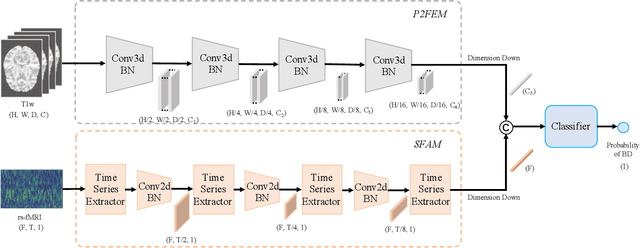
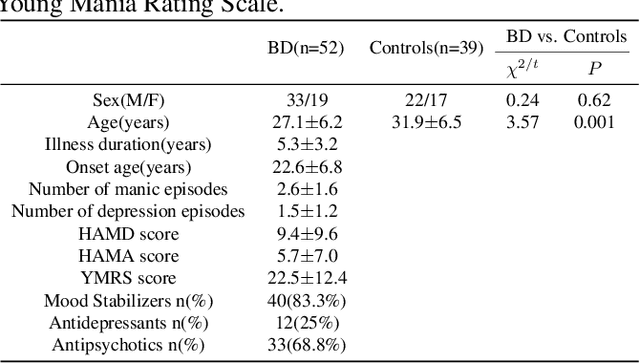
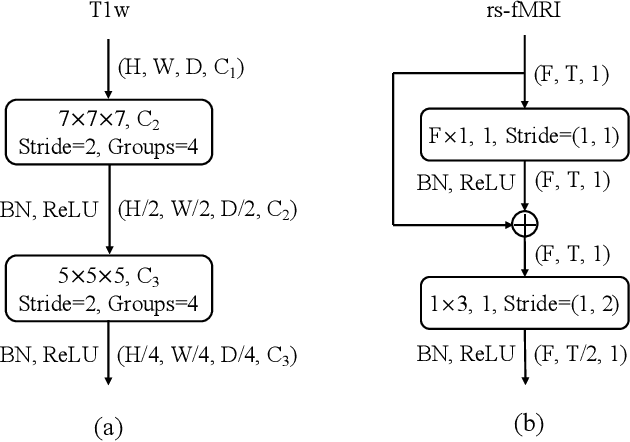
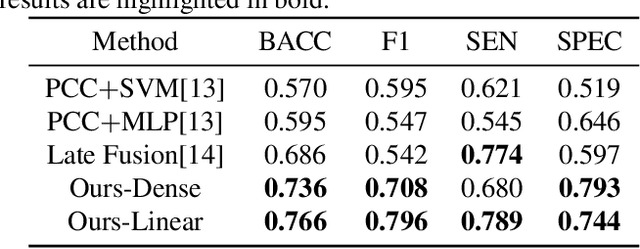
Previous research on the diagnosis of Bipolar disorder has mainly focused on resting-state functional magnetic resonance imaging. However, their accuracy can not meet the requirements of clinical diagnosis. Efficient multimodal fusion strategies have great potential for applications in multimodal data and can further improve the performance of medical diagnosis models. In this work, we utilize both sMRI and fMRI data and propose a novel multimodal diagnosis model for bipolar disorder. The proposed Patch Pyramid Feature Extraction Module extracts sMRI features, and the spatio-temporal pyramid structure extracts the fMRI features. Finally, they are fused by a fusion module to output diagnosis results with a classifier. Extensive experiments show that our proposed method outperforms others in balanced accuracy from 0.657 to 0.732 on the OpenfMRI dataset, and achieves the state of the art.
Multi-Dimension-Embedding-Aware Modality Fusion Transformer for Psychiatric Disorder Clasification
Oct 04, 2023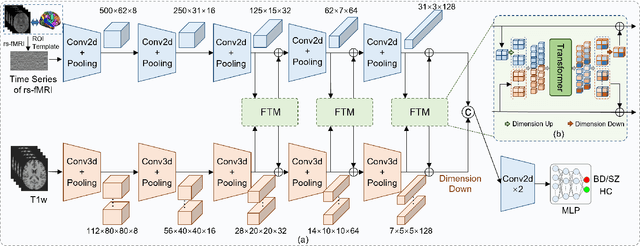
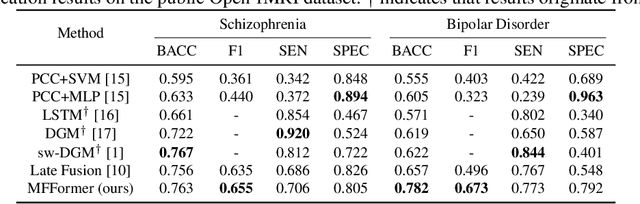
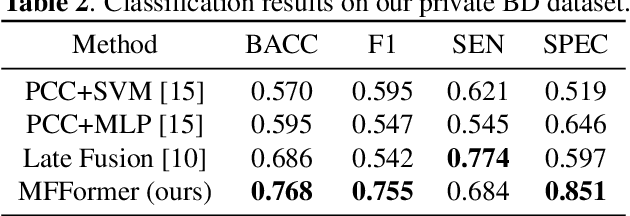
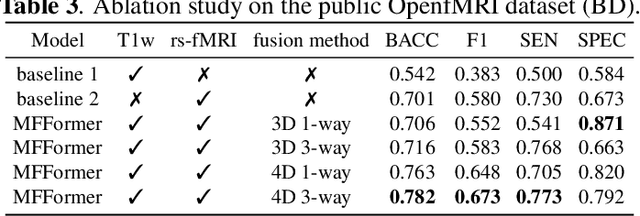
Deep learning approaches, together with neuroimaging techniques, play an important role in psychiatric disorders classification. Previous studies on psychiatric disorders diagnosis mainly focus on using functional connectivity matrices of resting-state functional magnetic resonance imaging (rs-fMRI) as input, which still needs to fully utilize the rich temporal information of the time series of rs-fMRI data. In this work, we proposed a multi-dimension-embedding-aware modality fusion transformer (MFFormer) for schizophrenia and bipolar disorder classification using rs-fMRI and T1 weighted structural MRI (T1w sMRI). Concretely, to fully utilize the temporal information of rs-fMRI and spatial information of sMRI, we constructed a deep learning architecture that takes as input 2D time series of rs-fMRI and 3D volumes T1w. Furthermore, to promote intra-modality attention and information fusion across different modalities, a fusion transformer module (FTM) is designed through extensive self-attention of hybrid feature maps of multi-modality. In addition, a dimension-up and dimension-down strategy is suggested to properly align feature maps of multi-dimensional from different modalities. Experimental results on our private and public OpenfMRI datasets show that our proposed MFFormer performs better than that using a single modality or multi-modality MRI on schizophrenia and bipolar disorder diagnosis.