 Add to Chrome
 Add to Firefox
 Add to Edge
X-LeBench: A Benchmark for Extremely Long Egocentric Video Understanding
Jan 12, 2025
Long-form egocentric video understanding provides rich contextual information and unique insights into long-term human behaviors, holding significant potential for applications in embodied intelligence, long-term activity analysis, and personalized assistive technologies. However, existing benchmark datasets primarily focus on single, short-duration videos or moderately long videos up to dozens of minutes, leaving a substantial gap in evaluating extensive, ultra-long egocentric video recordings. To address this, we introduce X-LeBench, a novel benchmark dataset specifically crafted for evaluating tasks on extremely long egocentric video recordings. Leveraging the advanced text processing capabilities of large language models (LLMs), X-LeBench develops a life-logging simulation pipeline that produces realistic, coherent daily plans aligned with real-world video data. This approach enables the flexible integration of synthetic daily plans with real-world footage from Ego4D-a massive-scale egocentric video dataset covers a wide range of daily life scenarios-resulting in 432 simulated video life logs that mirror realistic daily activities in contextually rich scenarios. The video life-log durations span from 23 minutes to 16.4 hours. The evaluation of several baseline systems and multimodal large language models (MLLMs) reveals their poor performance across the board, highlighting the inherent challenges of long-form egocentric video understanding and underscoring the need for more advanced models.

Artificial Intelligence in Creative Industries: Advances Prior to 2025
Jan 06, 2025The rapid advancements in artificial intelligence (AI), particularly in generative AI and large language models (LLMs), have profoundly impacted the creative industries by enabling innovative content creation, enhancing workflows, and democratizing access to creative tools. This paper explores the significant technological shifts since our previous review in 2022, highlighting how these developments have expanded creative opportunities and efficiency. These technological advancements have enhanced the capabilities of text-to-image, text-to-video, and multimodal generation technologies. In particular, key breakthroughs in LLMs have established new benchmarks in conversational AI, while advancements in image generators have revolutionized content creation. We also discuss AI integration into post-production workflows, which has significantly accelerated and refined traditional processes. Despite these innovations, challenges remain, particularly for the media industry, due to the demands on communication traffic from creative content. We therefore include data compression and quality assessment in this paper. Furthermore, we highlight the trend toward unified AI frameworks capable of addressing multiple creative tasks and underscore the importance of human oversight to mitigate AI-generated inaccuracies. Finally, we explore AI's future potential in the creative sector, stressing the need to navigate emerging challenges to maximize its benefits while addressing associated risks.
FlipedRAG: Black-Box Opinion Manipulation Attacks to Retrieval-Augmented Generation of Large Language Models
Jan 06, 2025Retrieval-Augmented Generation (RAG) addresses hallucination and real-time constraints by dynamically retrieving relevant information from a knowledge database to supplement the LLMs' input. When presented with a query, RAG selects the most semantically similar texts from its knowledge bases and uses them as context for the LLMs to generate more accurate responses. RAG also creates a new attack surface, especially since RAG databases are frequently sourced from public domains. While existing studies have predominantly focused on optimizing RAG's performance and efficiency, emerging research has begun addressing the security concerns associated with RAG. However, these works have some limitations, typically focusing on either white-box methodologies or heuristic-based black-box attacks. Furthermore, prior research has mainly targeted simple factoid question answering, which is neither practically challenging nor resistant to correction. In this paper, we unveil a more realistic and threatening scenario: opinion manipulation for controversial topics against RAG. Particularly, we propose a novel RAG black-box attack method, termed FlipedRAG, which is transfer-based. By leveraging instruction engineering, we obtain partial retrieval model outputs from black-box RAG system, facilitating the training of surrogate models to enhance the effectiveness of opinion manipulation attack. Extensive experimental results confirms that our approach significantly enhances the average success rate of opinion manipulation by 16.7%. It achieves an average of a 50% directional change in the opinion polarity of RAG responses across four themes. Additionally, it induces a 20% shift in user cognition. Furthermore, we discuss the efficacy of potential defense mechanisms and conclude that they are insufficient in mitigating this type of attack, highlighting the urgent need to develop novel defensive strategies.
SGTC: Semantic-Guided Triplet Co-training for Sparsely Annotated Semi-Supervised Medical Image Segmentation
Dec 20, 2024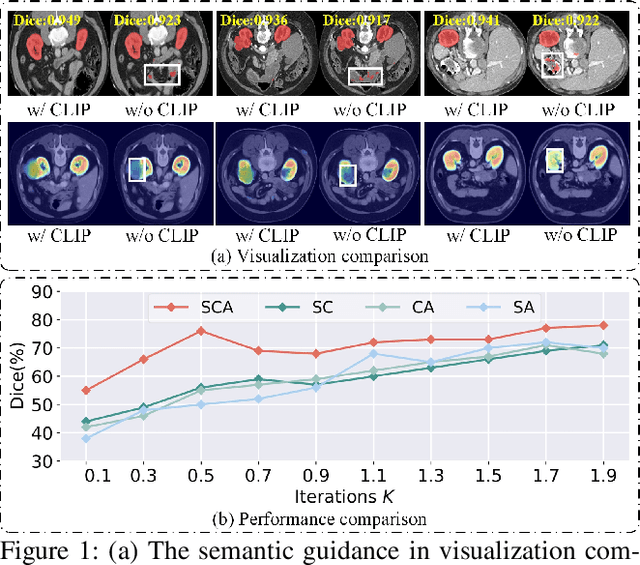

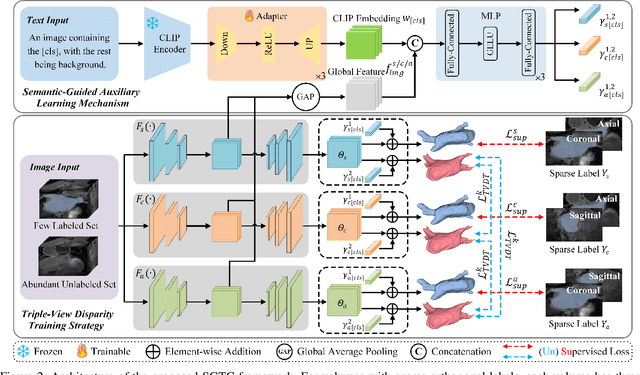

Although semi-supervised learning has made significant advances in the field of medical image segmentation, fully annotating a volumetric sample slice by slice remains a costly and time-consuming task. Even worse, most of the existing approaches pay much attention to image-level information and ignore semantic features, resulting in the inability to perceive weak boundaries. To address these issues, we propose a novel Semantic-Guided Triplet Co-training (SGTC) framework, which achieves high-end medical image segmentation by only annotating three orthogonal slices of a few volumetric samples, significantly alleviating the burden of radiologists. Our method consist of two main components. Specifically, to enable semantic-aware, fine-granular segmentation and enhance the quality of pseudo-labels, a novel semantic-guided auxiliary learning mechanism is proposed based on the pretrained CLIP. In addition, focusing on a more challenging but clinically realistic scenario, a new triple-view disparity training strategy is proposed, which uses sparse annotations (i.e., only three labeled slices of a few volumes) to perform co-training between three sub-networks, significantly improving the robustness. Extensive experiments on three public medical datasets demonstrate that our method outperforms most state-of-the-art semi-supervised counterparts under sparse annotation settings. The source code is available at https://github.com/xmeimeimei/SGTC.
Efficient Quantization-Aware Training on Segment Anything Model in Medical Images and Its Deployment
Dec 15, 2024Medical image segmentation is a critical component of clinical practice, and the state-of-the-art MedSAM model has significantly advanced this field. Nevertheless, critiques highlight that MedSAM demands substantial computational resources during inference. To address this issue, the CVPR 2024 MedSAM on Laptop Challenge was established to find an optimal balance between accuracy and processing speed. In this paper, we introduce a quantization-aware training pipeline designed to efficiently quantize the Segment Anything Model for medical images and deploy it using the OpenVINO inference engine. This pipeline optimizes both training time and disk storage. Our experimental results confirm that this approach considerably enhances processing speed over the baseline, while still achieving an acceptable accuracy level. The training script, inference script, and quantized model are publicly accessible at https://github.com/AVC2-UESTC/QMedSAM.
Continuous Gaussian Process Pre-Optimization for Asynchronous Event-Inertial Odometry
Dec 12, 2024Event cameras, as bio-inspired sensors, are asynchronously triggered with high-temporal resolution compared to intensity cameras. Recent work has focused on fusing the event measurements with inertial measurements to enable ego-motion estimation in high-speed and HDR environments. However, existing methods predominantly rely on IMU preintegration designed mainly for synchronous sensors and discrete-time frameworks. In this paper, we propose a continuous-time preintegration method based on the Temporal Gaussian Process (TGP) called GPO. Concretely, we model the preintegration as a time-indexed motion trajectory and leverage an efficient two-step optimization to initialize the precision preintegration pseudo-measurements. Our method realizes a linear and constant time cost for initialization and query, respectively. To further validate the proposal, we leverage the GPO to design an asynchronous event-inertial odometry and compare with other asynchronous fusion schemes within the same odometry system. Experiments conducted on both public and own-collected datasets demonstrate that the proposed GPO offers significant advantages in terms of precision and efficiency, outperforming existing approaches in handling asynchronous sensor fusion.
Efficient Gravitational Wave Parameter Estimation via Knowledge Distillation: A ResNet1D-IAF Approach
Dec 11, 2024With the rapid development of gravitational wave astronomy, the increasing number of detected events necessitates efficient methods for parameter estimation and model updates. This study presents a novel approach using knowledge distillation techniques to enhance computational efficiency in gravitational wave analysis. We develop a framework combining ResNet1D and Inverse Autoregressive Flow (IAF) architectures, where knowledge from a complex teacher model is transferred to a lighter student model. Our experimental results show that the student model achieves a validation loss of 3.70 with optimal configuration (40,100,0.75), compared to the teacher model's 4.09, while reducing the number of parameters by 43\%. The Jensen-Shannon divergence between teacher and student models remains below 0.0001 across network layers, indicating successful knowledge transfer. By optimizing ResNet layers (7-16) and hidden features (70-120), we achieve a 35\% reduction in inference time while maintaining parameter estimation accuracy. This work demonstrates significant improvements in computational efficiency for gravitational wave data analysis, providing valuable insights for real-time event processing.
Adaptive Epsilon Adversarial Training for Robust Gravitational Wave Parameter Estimation Using Normalizing Flows
Dec 10, 2024Adversarial training with Normalizing Flow (NF) models is an emerging research area aimed at improving model robustness through adversarial samples. In this study, we focus on applying adversarial training to NF models for gravitational wave parameter estimation. We propose an adaptive epsilon method for Fast Gradient Sign Method (FGSM) adversarial training, which dynamically adjusts perturbation strengths based on gradient magnitudes using logarithmic scaling. Our hybrid architecture, combining ResNet and Inverse Autoregressive Flow, reduces the Negative Log Likelihood (NLL) loss by 47\% under FGSM attacks compared to the baseline model, while maintaining an NLL of 4.2 on clean data (only 5\% higher than the baseline). For perturbation strengths between 0.01 and 0.1, our model achieves an average NLL of 5.8, outperforming both fixed-epsilon (NLL: 6.7) and progressive-epsilon (NLL: 7.2) methods. Under stronger Projected Gradient Descent attacks with perturbation strength of 0.05, our model maintains an NLL of 6.4, demonstrating superior robustness while avoiding catastrophic overfitting.
Evaluation Agent: Efficient and Promptable Evaluation Framework for Visual Generative Models
Dec 10, 2024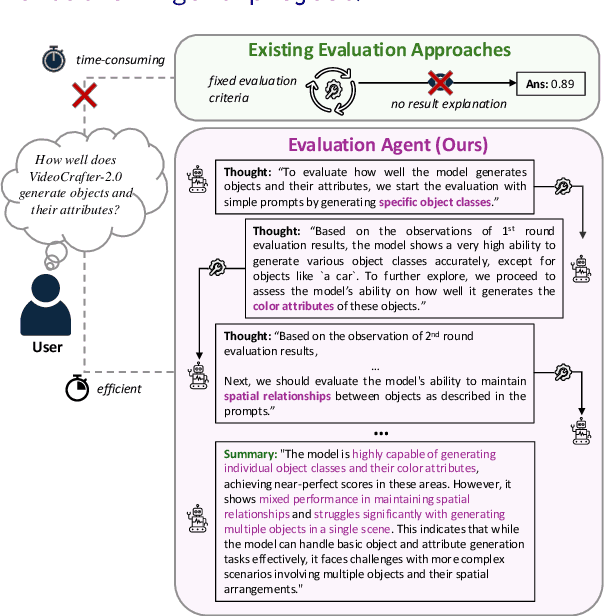

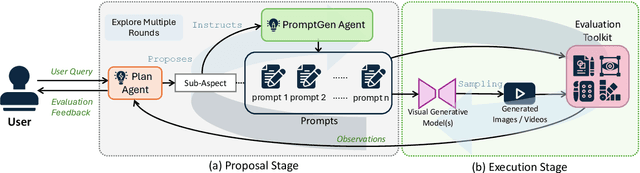
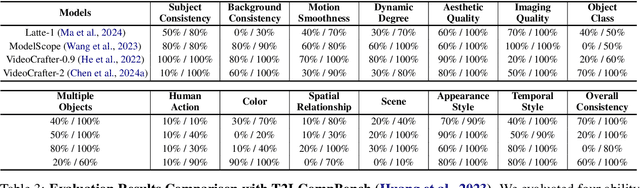
Recent advancements in visual generative models have enabled high-quality image and video generation, opening diverse applications. However, evaluating these models often demands sampling hundreds or thousands of images or videos, making the process computationally expensive, especially for diffusion-based models with inherently slow sampling. Moreover, existing evaluation methods rely on rigid pipelines that overlook specific user needs and provide numerical results without clear explanations. In contrast, humans can quickly form impressions of a model's capabilities by observing only a few samples. To mimic this, we propose the Evaluation Agent framework, which employs human-like strategies for efficient, dynamic, multi-round evaluations using only a few samples per round, while offering detailed, user-tailored analyses. It offers four key advantages: 1) efficiency, 2) promptable evaluation tailored to diverse user needs, 3) explainability beyond single numerical scores, and 4) scalability across various models and tools. Experiments show that Evaluation Agent reduces evaluation time to 10% of traditional methods while delivering comparable results. The Evaluation Agent framework is fully open-sourced to advance research in visual generative models and their efficient evaluation.
Diff5T: Benchmarking Human Brain Diffusion MRI with an Extensive 5.0 Tesla K-Space and Spatial Dataset
Dec 09, 2024

Diffusion magnetic resonance imaging (dMRI) provides critical insights into the microstructural and connectional organization of the human brain. However, the availability of high-field, open-access datasets that include raw k-space data for advanced research remains limited. To address this gap, we introduce Diff5T, a first comprehensive 5.0 Tesla diffusion MRI dataset focusing on the human brain. This dataset includes raw k-space data and reconstructed diffusion images, acquired using a variety of imaging protocols. Diff5T is designed to support the development and benchmarking of innovative methods in artifact correction, image reconstruction, image preprocessing, diffusion modelling and tractography. The dataset features a wide range of diffusion parameters, including multiple b-values and gradient directions, allowing extensive research applications in studying human brain microstructure and connectivity. With its emphasis on open accessibility and detailed benchmarks, Diff5T serves as a valuable resource for advancing human brain mapping research using diffusion MRI, fostering reproducibility, and enabling collaboration across the neuroscience and medical imaging communities.