 Add to Chrome
 Add to Firefox
 Add to Edge
AgentOmnia: Scaling Agentic Models for Full-Scenario Applications
Jul 25, 2026
Large language model agents have advanced rapidly, yet progress remains fragmented across domains, capabilities, task difficulty, and interaction settings. We frame this as full-scenario agentic scaling and present AgentOmnia, a framework coordinating task-space definition, data synthesis, post-training, evaluation, and improvement across To-Consumer (ToC), To-Business (ToB), and To-Employee (ToE) applications. An extensible Domain x Capability x Atomic Difficulty taxonomy aligns these stages and enables fine-grained diagnosis with OmniaBench. AgentOmnia combines bidirectional environment-task synthesis with tool-dependency, program-structured, and solver-based pipelines, constructing 5,018 stateful environments with 255,375 tools and 52,361 tasks. Programs, solvers, and verifiers provide correctness signals, while supervised fine-tuning, online agentic reinforcement learning, and a rollback curriculum support post-training. Evaluation failures translate into Product Requirement Documents (PRDs) for targeted self-evolution. Starting from Qwen3-30B-A3B-Thinking-2507, AgentOmnia raises the pass rate on the OmniaBench challenging subset from 9.16% to 37.11% and the macro-average across OmniaBench, $τ^2$-Bench, DeepPlanning, and VitaBench from 22.86% to 41.69%. Under a unified protocol,it leads the evaluated agentic post-trained baselines on OmniaBench and retains the highest four-benchmark macro-average. It also surpasses Qwen3-235B-A22B-Thinking-2507 on all four benchmarks and exceeds Qwen3.5-35B-A3B on the macro-average. Gains span three application splits, ten capability dimensions, eight atomic-difficulty factors, and 76 of 90 level-1 domains, indicating broad rather than category-specific improvement. A one-round study provides initial evidence for PRD-guided self-evolution, motivating validation at larger scales and in industrial settings.

OmniaBench: Benchmarking General AI Agents Across Diverse Scenarios
Jul 16, 2026Large language models are increasingly evolving from text generators into general agents capable of understanding user requests, invoking external tools, and completing complex tasks through interaction. However, existing agent benchmarks often focus on limited scenarios, tool ecosystems, or interaction formats, making it difficult to systematically characterize model capabilities across heterogeneous application settings. We introduce OmniaBench, a benchmark for evaluating general agents across diverse scenarios with explicit state spaces. We derive application-oriented scenario knowledge from app stores, product documents, industry resources, Web retrieval, and human refinement, forming a hierarchical taxonomy that spans ToC, ToB and ToE with 90 level-1 and 354 level-2 domains. Based on this taxonomy, we construct executable environments and synthesize single-turn and multi-turn tasks through four complementary routes: DAG, DAG-S, Solver, and Program. OmniaBench further introduces a ten-dimensional capability taxonomy and eight compositional atomic difficulty factors to support fine-grained evaluation and analysis. The resulting dataset contains 1,431 tasks, together with a challenging subset of 644 tasks designed to reduce evaluation cost and mitigate potential contamination of the full set after public release. The bench presents substantial challenges to current frontier models, with even Claude-Sonnet-5 and GPT-5.6-Sol achieving Overall Pass@1 scores of only 58.54 and 57.14, respectively. Further analyses reveal clear differences across domains and capabilities, as well as persistent limitations in planning, constraint maintenance, and adaptive correction. OmniaBench provides a broad and diagnostic benchmark for characterizing the capability boundaries of general agents.
Efficient Quantization-Aware Training on Segment Anything Model in Medical Images and Its Deployment
Dec 15, 2024Medical image segmentation is a critical component of clinical practice, and the state-of-the-art MedSAM model has significantly advanced this field. Nevertheless, critiques highlight that MedSAM demands substantial computational resources during inference. To address this issue, the CVPR 2024 MedSAM on Laptop Challenge was established to find an optimal balance between accuracy and processing speed. In this paper, we introduce a quantization-aware training pipeline designed to efficiently quantize the Segment Anything Model for medical images and deploy it using the OpenVINO inference engine. This pipeline optimizes both training time and disk storage. Our experimental results confirm that this approach considerably enhances processing speed over the baseline, while still achieving an acceptable accuracy level. The training script, inference script, and quantized model are publicly accessible at https://github.com/AVC2-UESTC/QMedSAM.
NPR: Nocturnal Place Recognition in Streets
Apr 17, 2023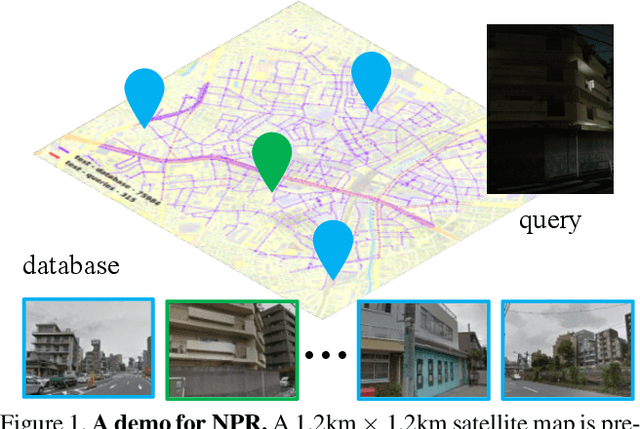
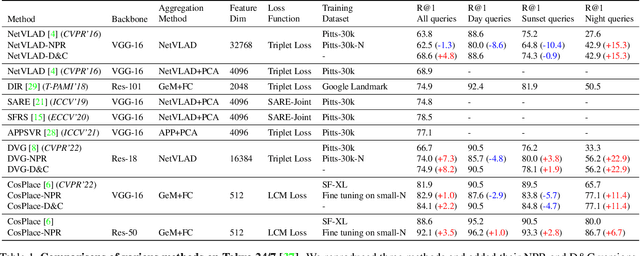
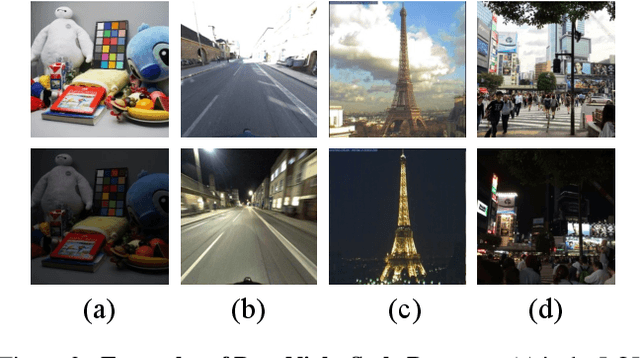

Visual Place Recognition (VPR) is the task of retrieving database images similar to a query photo by comparing it to a large database of known images. In real-world applications, extreme illumination changes caused by query images taken at night pose a significant obstacle that VPR needs to overcome. However, a training set with day-night correspondence for city-scale, street-level VPR does not exist. To address this challenge, we propose a novel pipeline that divides VPR and conquers Nocturnal Place Recognition (NPR). Specifically, we first established a street-level day-night dataset, NightStreet, and used it to train an unpaired image-to-image translation model. Then we used this model to process existing large-scale VPR datasets to generate the VPR-Night datasets and demonstrated how to combine them with two popular VPR pipelines. Finally, we proposed a divide-and-conquer VPR framework and provided explanations at the theoretical, experimental, and application levels. Under our framework, previous methods can significantly improve performance on two public datasets, including the top-ranked method.
Scale-Net: Learning to Reduce Scale Differences for Large-Scale Invariant Image Matching
Dec 20, 2021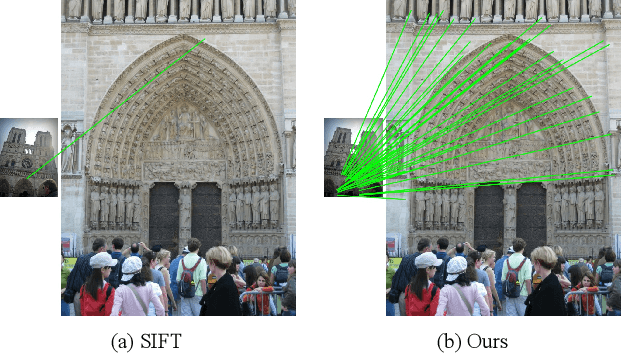
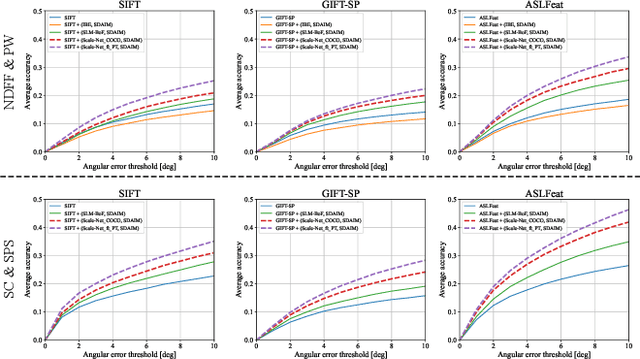
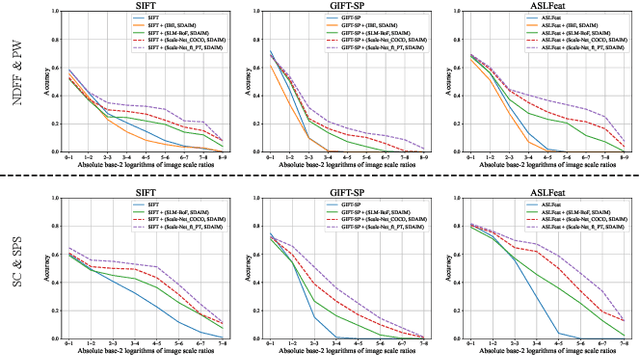
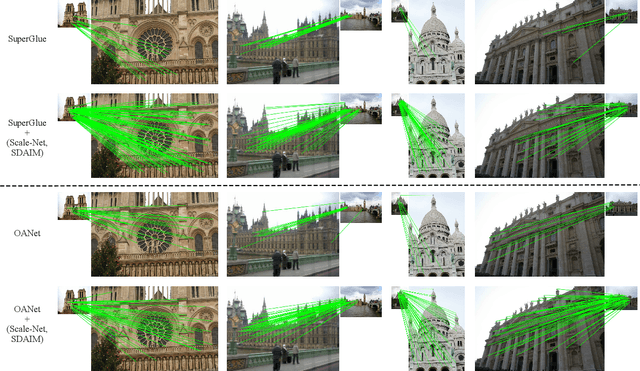
Most image matching methods perform poorly when encountering large scale changes in images. To solve this problem, firstly, we propose a scale-difference-aware image matching method (SDAIM) that reduces image scale differences before local feature extraction, via resizing both images of an image pair according to an estimated scale ratio. Secondly, in order to accurately estimate the scale ratio, we propose a covisibility-attention-reinforced matching module (CVARM) and then design a novel neural network, termed as Scale-Net, based on CVARM. The proposed CVARM can lay more stress on covisible areas within the image pair and suppress the distraction from those areas visible in only one image. Quantitative and qualitative experiments confirm that the proposed Scale-Net has higher scale ratio estimation accuracy and much better generalization ability compared with all the existing scale ratio estimation methods. Further experiments on image matching and relative pose estimation tasks demonstrate that our SDAIM and Scale-Net are able to greatly boost the performance of representative local features and state-of-the-art local feature matching methods.