 Add to Chrome
 Add to Firefox
 Add to Edge
DriveLMM-o1: A Step-by-Step Reasoning Dataset and Large Multimodal Model for Driving Scenario Understanding
Mar 13, 2025
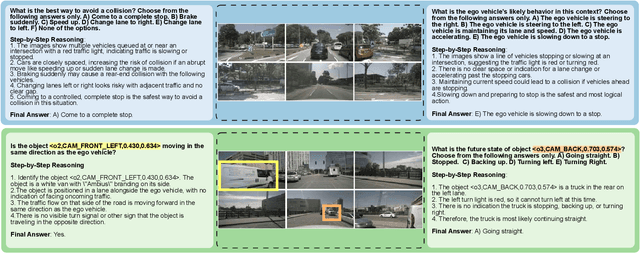
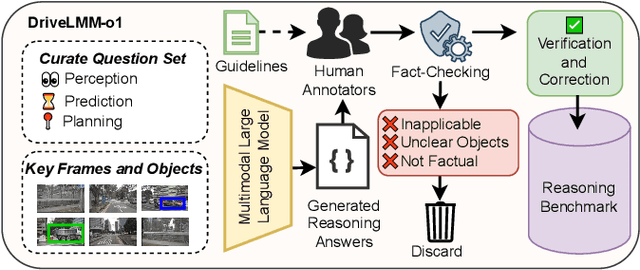
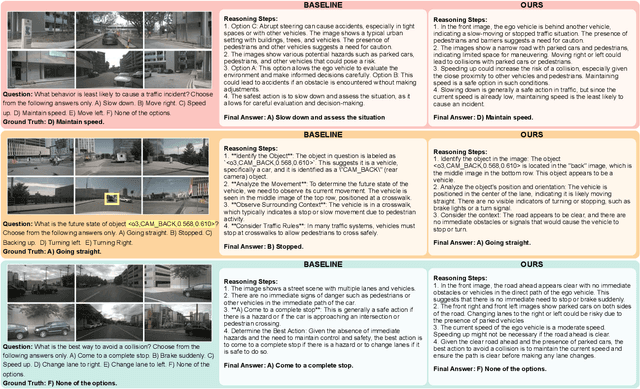
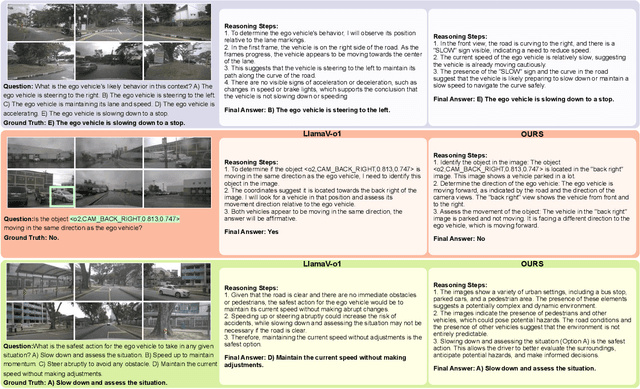
While large multimodal models (LMMs) have demonstrated strong performance across various Visual Question Answering (VQA) tasks, certain challenges require complex multi-step reasoning to reach accurate answers. One particularly challenging task is autonomous driving, which demands thorough cognitive processing before decisions can be made. In this domain, a sequential and interpretive understanding of visual cues is essential for effective perception, prediction, and planning. Nevertheless, common VQA benchmarks often focus on the accuracy of the final answer while overlooking the reasoning process that enables the generation of accurate responses. Moreover, existing methods lack a comprehensive framework for evaluating step-by-step reasoning in realistic driving scenarios. To address this gap, we propose DriveLMM-o1, a new dataset and benchmark specifically designed to advance step-wise visual reasoning for autonomous driving. Our benchmark features over 18k VQA examples in the training set and more than 4k in the test set, covering diverse questions on perception, prediction, and planning, each enriched with step-by-step reasoning to ensure logical inference in autonomous driving scenarios. We further introduce a large multimodal model that is fine-tuned on our reasoning dataset, demonstrating robust performance in complex driving scenarios. In addition, we benchmark various open-source and closed-source methods on our proposed dataset, systematically comparing their reasoning capabilities for autonomous driving tasks. Our model achieves a +7.49% gain in final answer accuracy, along with a 3.62% improvement in reasoning score over the previous best open-source model. Our framework, dataset, and model are available at https://github.com/ayesha-ishaq/DriveLMM-o1.

Hierarchical Self-Supervised Adversarial Training for Robust Vision Models in Histopathology
Mar 13, 2025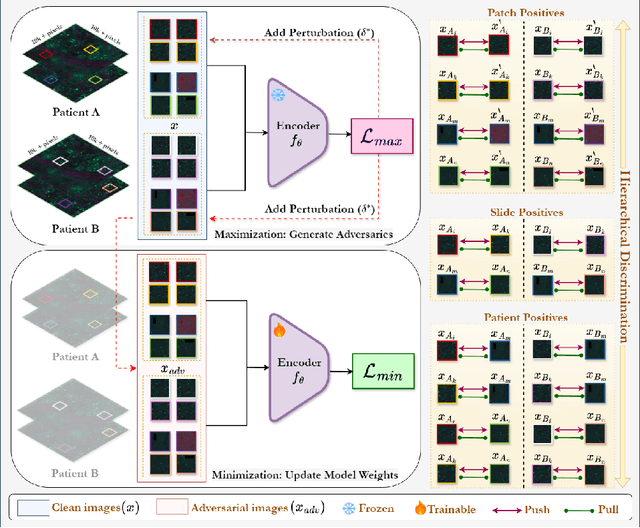
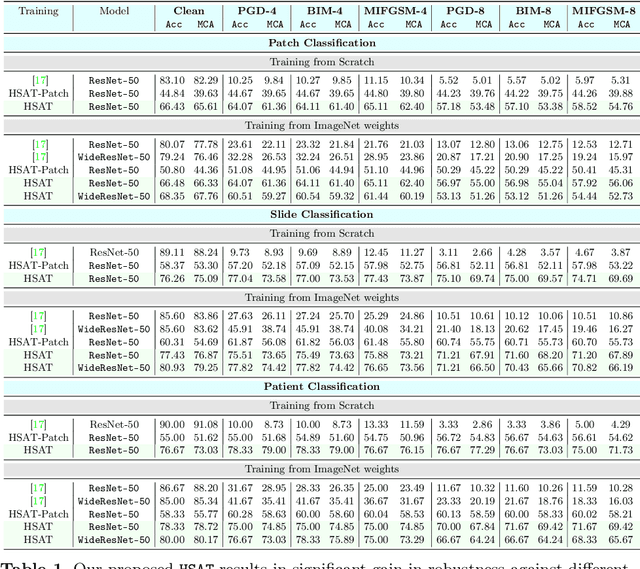
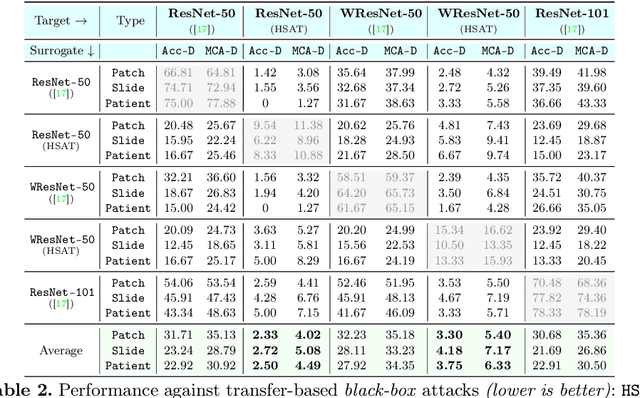
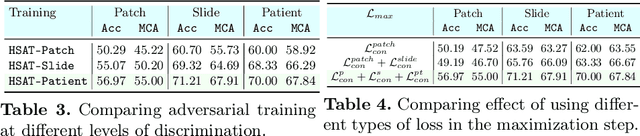
Adversarial attacks pose significant challenges for vision models in critical fields like healthcare, where reliability is essential. Although adversarial training has been well studied in natural images, its application to biomedical and microscopy data remains limited. Existing self-supervised adversarial training methods overlook the hierarchical structure of histopathology images, where patient-slide-patch relationships provide valuable discriminative signals. To address this, we propose Hierarchical Self-Supervised Adversarial Training (HSAT), which exploits these properties to craft adversarial examples using multi-level contrastive learning and integrate it into adversarial training for enhanced robustness. We evaluate HSAT on multiclass histopathology dataset OpenSRH and the results show that HSAT outperforms existing methods from both biomedical and natural image domains. HSAT enhances robustness, achieving an average gain of 54.31% in the white-box setting and reducing performance drops to 3-4% in the black-box setting, compared to 25-30% for the baseline. These results set a new benchmark for adversarial training in this domain, paving the way for more robust models. Our Code for training and evaluation is available at https://github.com/HashmatShadab/HSAT.
LLM Post-Training: A Deep Dive into Reasoning Large Language Models
Feb 28, 2025Large Language Models (LLMs) have transformed the natural language processing landscape and brought to life diverse applications. Pretraining on vast web-scale data has laid the foundation for these models, yet the research community is now increasingly shifting focus toward post-training techniques to achieve further breakthroughs. While pretraining provides a broad linguistic foundation, post-training methods enable LLMs to refine their knowledge, improve reasoning, enhance factual accuracy, and align more effectively with user intents and ethical considerations. Fine-tuning, reinforcement learning, and test-time scaling have emerged as critical strategies for optimizing LLMs performance, ensuring robustness, and improving adaptability across various real-world tasks. This survey provides a systematic exploration of post-training methodologies, analyzing their role in refining LLMs beyond pretraining, addressing key challenges such as catastrophic forgetting, reward hacking, and inference-time trade-offs. We highlight emerging directions in model alignment, scalable adaptation, and inference-time reasoning, and outline future research directions. We also provide a public repository to continually track developments in this fast-evolving field: https://github.com/mbzuai-oryx/Awesome-LLM-Post-training.
C-Drag: Chain-of-Thought Driven Motion Controller for Video Generation
Feb 27, 2025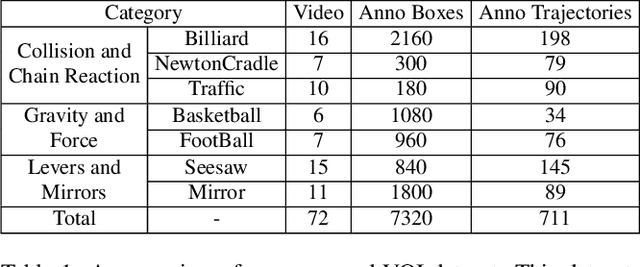
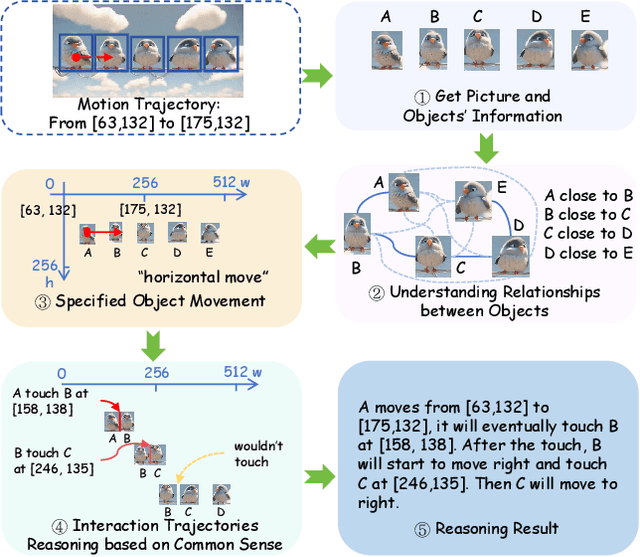
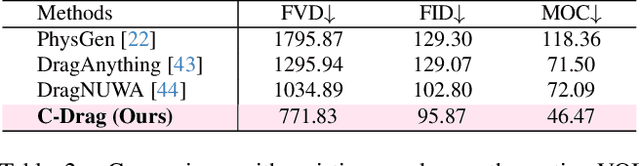
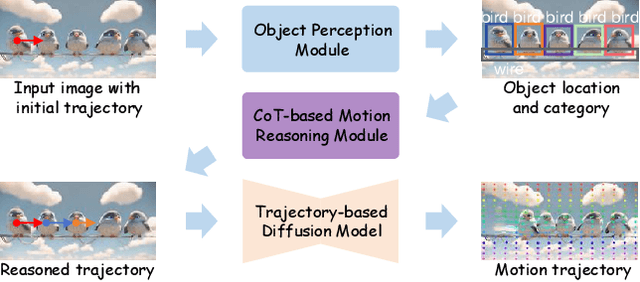
Trajectory-based motion control has emerged as an intuitive and efficient approach for controllable video generation. However, the existing trajectory-based approaches are usually limited to only generating the motion trajectory of the controlled object and ignoring the dynamic interactions between the controlled object and its surroundings. To address this limitation, we propose a Chain-of-Thought-based motion controller for controllable video generation, named C-Drag. Instead of directly generating the motion of some objects, our C-Drag first performs object perception and then reasons the dynamic interactions between different objects according to the given motion control of the objects. Specifically, our method includes an object perception module and a Chain-of-Thought-based motion reasoning module. The object perception module employs visual language models to capture the position and category information of various objects within the image. The Chain-of-Thought-based motion reasoning module takes this information as input and conducts a stage-wise reasoning process to generate motion trajectories for each of the affected objects, which are subsequently fed to the diffusion model for video synthesis. Furthermore, we introduce a new video object interaction (VOI) dataset to evaluate the generation quality of motion controlled video generation methods. Our VOI dataset contains three typical types of interactions and provides the motion trajectories of objects that can be used for accurate performance evaluation. Experimental results show that C-Drag achieves promising performance across multiple metrics, excelling in object motion control. Our benchmark, codes, and models will be available at https://github.com/WesLee88524/C-Drag-Official-Repo.
AirCast: Improving Air Pollution Forecasting Through Multi-Variable Data Alignment
Feb 25, 2025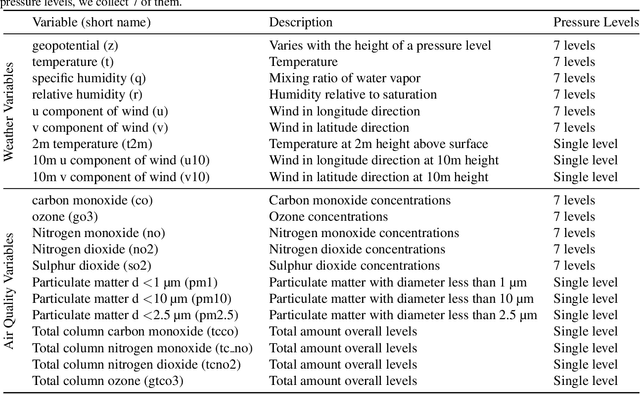
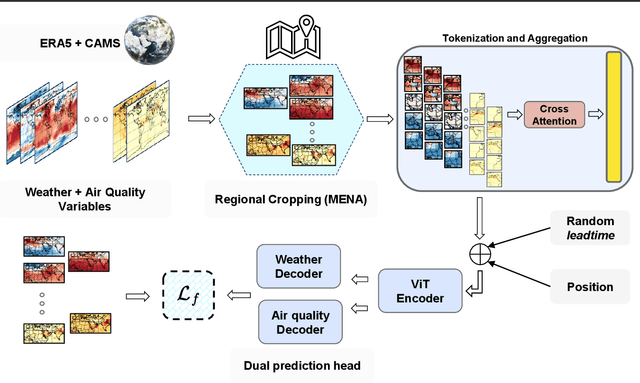
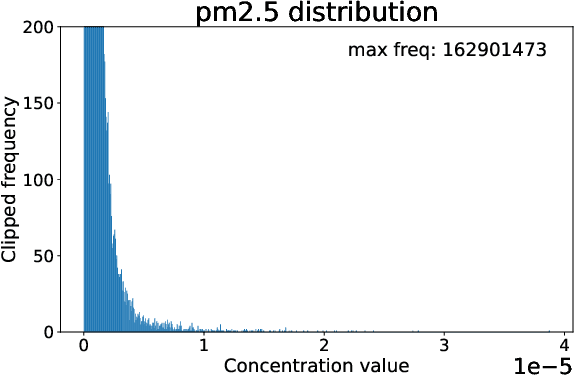
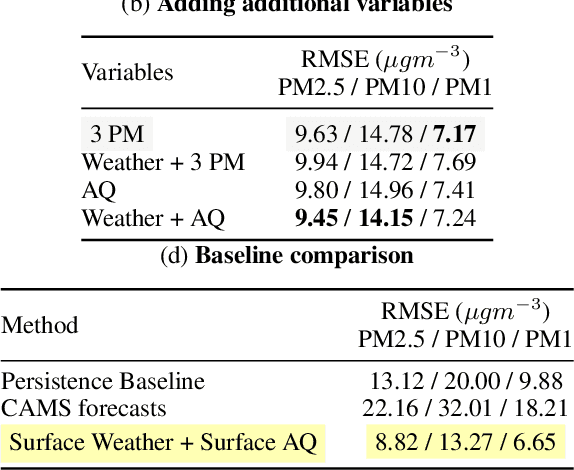
Air pollution remains a leading global health risk, exacerbated by rapid industrialization and urbanization, contributing significantly to morbidity and mortality rates. In this paper, we introduce AirCast, a novel multi-variable air pollution forecasting model, by combining weather and air quality variables. AirCast employs a multi-task head architecture that simultaneously forecasts atmospheric conditions and pollutant concentrations, improving its understanding of how weather patterns affect air quality. Predicting extreme pollution events is challenging due to their rare occurrence in historic data, resulting in a heavy-tailed distribution of pollution levels. To address this, we propose a novel Frequency-weighted Mean Absolute Error (fMAE) loss, adapted from the class-balanced loss for regression tasks. Informed from domain knowledge, we investigate the selection of key variables known to influence pollution levels. Additionally, we align existing weather and chemical datasets across spatial and temporal dimensions. AirCast's integrated approach, combining multi-task learning, frequency weighted loss and domain informed variable selection, enables more accurate pollution forecasts. Our source code and models are made public here (https://github.com/vishalned/AirCast.git)
Time Travel: A Comprehensive Benchmark to Evaluate LMMs on Historical and Cultural Artifacts
Feb 20, 2025Understanding historical and cultural artifacts demands human expertise and advanced computational techniques, yet the process remains complex and time-intensive. While large multimodal models offer promising support, their evaluation and improvement require a standardized benchmark. To address this, we introduce TimeTravel, a benchmark of 10,250 expert-verified samples spanning 266 distinct cultures across 10 major historical regions. Designed for AI-driven analysis of manuscripts, artworks, inscriptions, and archaeological discoveries, TimeTravel provides a structured dataset and robust evaluation framework to assess AI models' capabilities in classification, interpretation, and historical comprehension. By integrating AI with historical research, TimeTravel fosters AI-powered tools for historians, archaeologists, researchers, and cultural tourists to extract valuable insights while ensuring technology contributes meaningfully to historical discovery and cultural heritage preservation. We evaluate contemporary AI models on TimeTravel, highlighting their strengths and identifying areas for improvement. Our goal is to establish AI as a reliable partner in preserving cultural heritage, ensuring that technological advancements contribute meaningfully to historical discovery. Our code is available at: \url{https://github.com/mbzuai-oryx/TimeTravel}.
InterLCM: Low-Quality Images as Intermediate States of Latent Consistency Models for Effective Blind Face Restoration
Feb 04, 2025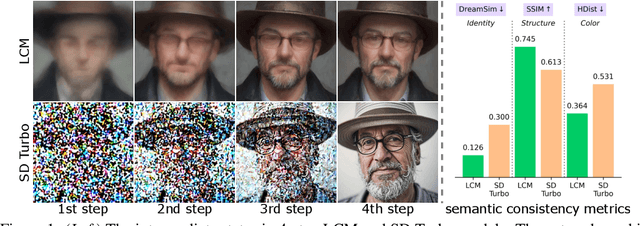
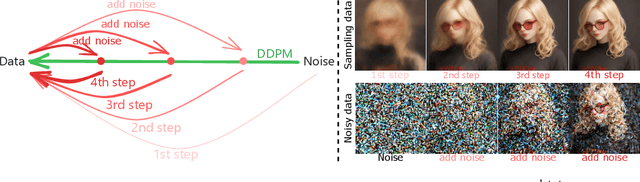
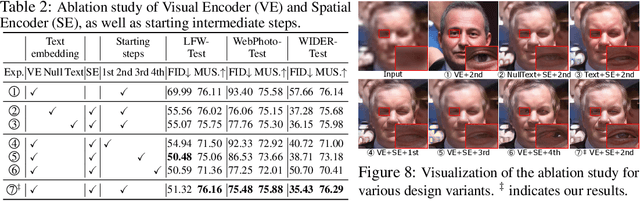
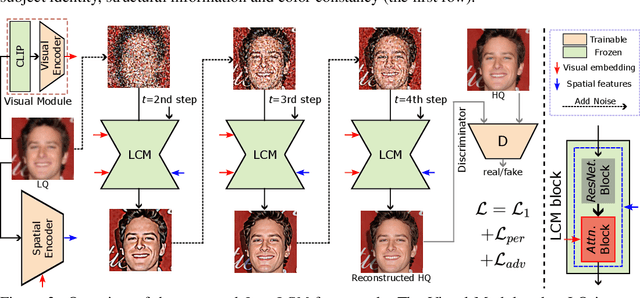
Diffusion priors have been used for blind face restoration (BFR) by fine-tuning diffusion models (DMs) on restoration datasets to recover low-quality images. However, the naive application of DMs presents several key limitations. (i) The diffusion prior has inferior semantic consistency (e.g., ID, structure and color.), increasing the difficulty of optimizing the BFR model; (ii) reliance on hundreds of denoising iterations, preventing the effective cooperation with perceptual losses, which is crucial for faithful restoration. Observing that the latent consistency model (LCM) learns consistency noise-to-data mappings on the ODE-trajectory and therefore shows more semantic consistency in the subject identity, structural information and color preservation, we propose InterLCM to leverage the LCM for its superior semantic consistency and efficiency to counter the above issues. Treating low-quality images as the intermediate state of LCM, InterLCM achieves a balance between fidelity and quality by starting from earlier LCM steps. LCM also allows the integration of perceptual loss during training, leading to improved restoration quality, particularly in real-world scenarios. To mitigate structural and semantic uncertainties, InterLCM incorporates a Visual Module to extract visual features and a Spatial Encoder to capture spatial details, enhancing the fidelity of restored images. Extensive experiments demonstrate that InterLCM outperforms existing approaches in both synthetic and real-world datasets while also achieving faster inference speed.
LlamaV-o1: Rethinking Step-by-step Visual Reasoning in LLMs
Jan 10, 2025


Reasoning is a fundamental capability for solving complex multi-step problems, particularly in visual contexts where sequential step-wise understanding is essential. Existing approaches lack a comprehensive framework for evaluating visual reasoning and do not emphasize step-wise problem-solving. To this end, we propose a comprehensive framework for advancing step-by-step visual reasoning in large language models (LMMs) through three key contributions. First, we introduce a visual reasoning benchmark specifically designed to evaluate multi-step reasoning tasks. The benchmark presents a diverse set of challenges with eight different categories ranging from complex visual perception to scientific reasoning with over 4k reasoning steps in total, enabling robust evaluation of LLMs' abilities to perform accurate and interpretable visual reasoning across multiple steps. Second, we propose a novel metric that assesses visual reasoning quality at the granularity of individual steps, emphasizing both correctness and logical coherence. The proposed metric offers deeper insights into reasoning performance compared to traditional end-task accuracy metrics. Third, we present a new multimodal visual reasoning model, named LlamaV-o1, trained using a multi-step curriculum learning approach, where tasks are progressively organized to facilitate incremental skill acquisition and problem-solving. The proposed LlamaV-o1 is designed for multi-step reasoning and learns step-by-step through a structured training paradigm. Extensive experiments show that our LlamaV-o1 outperforms existing open-source models and performs favorably against close-source proprietary models. Compared to the recent Llava-CoT, our LlamaV-o1 achieves an average score of 67.3 with an absolute gain of 3.8\% across six benchmarks while being 5 times faster during inference scaling. Our benchmark, model, and code are publicly available.
Mask Factory: Towards High-quality Synthetic Data Generation for Dichotomous Image Segmentation
Dec 26, 2024Dichotomous Image Segmentation (DIS) tasks require highly precise annotations, and traditional dataset creation methods are labor intensive, costly, and require extensive domain expertise. Although using synthetic data for DIS is a promising solution to these challenges, current generative models and techniques struggle with the issues of scene deviations, noise-induced errors, and limited training sample variability. To address these issues, we introduce a novel approach, \textbf{\ourmodel{}}, which provides a scalable solution for generating diverse and precise datasets, markedly reducing preparation time and costs. We first introduce a general mask editing method that combines rigid and non-rigid editing techniques to generate high-quality synthetic masks. Specially, rigid editing leverages geometric priors from diffusion models to achieve precise viewpoint transformations under zero-shot conditions, while non-rigid editing employs adversarial training and self-attention mechanisms for complex, topologically consistent modifications. Then, we generate pairs of high-resolution image and accurate segmentation mask using a multi-conditional control generation method. Finally, our experiments on the widely-used DIS5K dataset benchmark demonstrate superior performance in quality and efficiency compared to existing methods. The code is available at \url{https://qian-hao-tian.github.io/MaskFactory/}.
Discriminative Image Generation with Diffusion Models for Zero-Shot Learning
Dec 23, 2024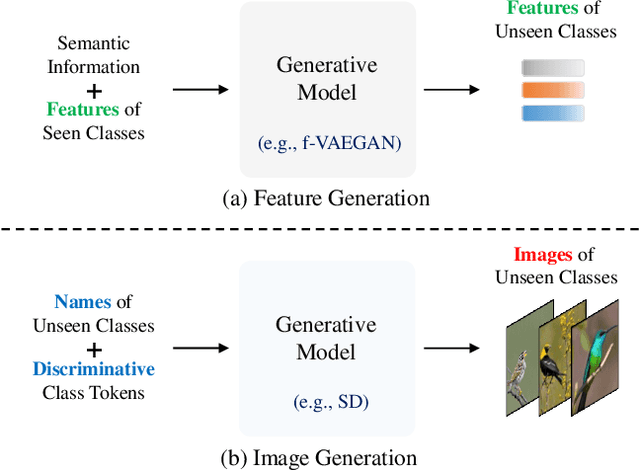


Generative Zero-Shot Learning (ZSL) methods synthesize class-related features based on predefined class semantic prototypes, showcasing superior performance. However, this feature generation paradigm falls short of providing interpretable insights. In addition, existing approaches rely on semantic prototypes annotated by human experts, which exhibit a significant limitation in their scalability to generalized scenes. To overcome these deficiencies, a natural solution is to generate images for unseen classes using text prompts. To this end, We present DIG-ZSL, a novel Discriminative Image Generation framework for Zero-Shot Learning. Specifically, to ensure the generation of discriminative images for training an effective ZSL classifier, we learn a discriminative class token (DCT) for each unseen class under the guidance of a pre-trained category discrimination model (CDM). Harnessing DCTs, we can generate diverse and high-quality images, which serve as informative unseen samples for ZSL tasks. In this paper, the extensive experiments and visualizations on four datasets show that our DIG-ZSL: (1) generates diverse and high-quality images, (2) outperforms previous state-of-the-art nonhuman-annotated semantic prototype-based methods by a large margin, and (3) achieves comparable or better performance than baselines that leverage human-annotated semantic prototypes. The codes will be made available upon acceptance of the paper.