 Add to Chrome
 Add to Firefox
 Add to Edge
CEPO: RLVR Self-Distillation using Contrastive Evidence Policy Optimization
May 19, 2026
When a model produces a correct solution under reinforcement learning with verifiable rewards (RLVR), every token receives the same reward signal regardless of whether it was a decisive reasoning step or a grammatical filler. A natural fix is to condition the model on the correct answer as a teacher, identifying tokens it would have generated differently had it known the answer. Prior work shows this either corrupts training by leaking the answer into the gradient, or produces a weak signal that cannot distinguish decisive steps from filler, since both look equally surprising relative to the model's baseline. We propose Contrastive Evidence Policy Optimization (CEPO), which asks a sharper question at every token: not just "does the correct answer favor this token?" but "does the correct answer favor it while the wrong answer disfavors it?" A token satisfying both is a genuine reasoning step; one satisfying neither is filler. The wrong-answer teacher is constructed from rejected rollouts already in the training batch, incurring no additional sampling cost. We prove CEPO inherits all structural safety guarantees of the prior state of the art while strictly sharpening credit at decisive tokens, with the improvement vanishing exactly at filler positions. Empirically, CEPO achieves 43.43% and 60.56% average accuracy across five multimodal mathematical reasoning benchmarks at 2B and 4B scale, respectively, versus 41.17% and 57.43% for GRPO under identical training budgets. Distribution-matching self-distillation methods (OPSD, SDPO) fall below the untrained baseline, empirically confirming the information leakage our theory predicts. Our code is available at https://github.com/ahmedheakl/CEPO.

DocAtlas: Multilingual Document Understanding Across 80+ Languages
May 12, 2026Multilingual document understanding remains limited for low-resource languages due to scarce training data and model-based annotation pipelines that perpetuate existing biases. We introduce DocAtlas, a framework that constructs high-fidelity OCR datasets and benchmarks covering 82 languages and 9 evaluation tasks. Our dual pipelines, differential rendering of native DOCX documents and synthetic LaTeX-based generation for right-to-left scripts produce precise structural annotations in a unified DocTag format encoding layout, text, and component types, without learned models for core annotation. Evaluating 16 state-of-the-art models reveals persistent gaps in low-resource scripts. We show that Direct Preference Optimization (DPO) using rendering-derived ground truth as positive signal achieves stable multilingual adaptation, improving both in-domain (+1.9%) and out-of-domain (+1.8%) accuracy without measurable base-language degradation, where supervised fine-tuning degrades out-of-domain performance by up to 21%. Our best variant, DocAtlas-DeepSeek, improves +1.7% over the strongest baseline.
The Geometry of Forgetting: Temporal Knowledge Drift as an Independent Axis in LLM Representations
May 09, 2026Large language models confidently produce outdated answers, and no existing method can detect them. We show this is not an engineering failure but a structural one: temporal drift, whether a stored fact has changed since training, is encoded as a direction in the residual stream geometrically orthogonal to both correctness and uncertainty. Any method operating on correctness or uncertainty signals is therefore blind to drift by construction. We verify this across six instruction-tuned models. A linear probe trained directly on drift labels achieves AUROC $0.83$--$0.95$; methods based on token entropy, semantic entropy, CCS, and SAPLMA all remain near chance ($0.49$--$0.57$). Five tests confirm the geometric orthogonality: weight cosines ($|\cos| \leq 0.14$), score correlations ($|r| \leq 0.20$), bidirectional null-space projection ($|Δ| \leq 0.008$), iterative null-space projection with $k{=}10$, and difference-of-means dissociation. Mechanistically, the MLP retrieval circuit produces identical dynamics for stale recall and confabulation ($r > 0.81$, six models), explaining why output confidence cannot separate them. A cross-cutoff experiment holds inputs constant and varies only the model: the probe fires on the model whose training predates the fact's transition and stays silent otherwise ($P(A{>}B) = 0.975$--$0.998$, twelve model pairs), confirming it reads model-internal knowledge state rather than input properties. Our code and datasets will be publicly released.
SAHM: A Benchmark for Arabic Financial and Shari'ah-Compliant Reasoning
Apr 21, 2026English financial NLP has progressed rapidly through benchmarks for sentiment, document understanding, and financial question answering, while Arabic financial NLP remains comparatively under-explored despite strong practical demand for trustworthy finance and Islamic-finance assistants. We introduce SAHM, a document-grounded benchmark and instruction-tuning dataset for Arabic financial NLP and Shari'ah-compliant reasoning. SAHM contains 14,380 expert-verified instances spanning seven tasks: AAOIFI standards QA, fatwa-based QA/MCQ, accounting and business exams, financial sentiment analysis, extractive summarization, and event-cause reasoning, curated from authentic regulatory, juristic, and corporate sources. We evaluate 19 strong open and proprietary LLMs using task-specific metrics and rubric-based scoring for open-ended outputs, and find that Arabic fluency does not reliably translate to evidence-grounded financial reasoning: models are substantially stronger on recognition-style tasks than on generation and causal reasoning, with the largest gaps on event-cause reasoning. We release the benchmark, evaluation framework, and an instruction-tuned model to support future research on trustworthy Arabic financial NLP.
* 29 page
WorldCache: Content-Aware Caching for Accelerated Video World Models
Mar 23, 2026Diffusion Transformers (DiTs) power high-fidelity video world models but remain computationally expensive due to sequential denoising and costly spatio-temporal attention. Training-free feature caching accelerates inference by reusing intermediate activations across denoising steps; however, existing methods largely rely on a Zero-Order Hold assumption i.e., reusing cached features as static snapshots when global drift is small. This often leads to ghosting artifacts, blur, and motion inconsistencies in dynamic scenes. We propose \textbf{WorldCache}, a Perception-Constrained Dynamical Caching framework that improves both when and how to reuse features. WorldCache introduces motion-adaptive thresholds, saliency-weighted drift estimation, optimal approximation via blending and warping, and phase-aware threshold scheduling across diffusion steps. Our cohesive approach enables adaptive, motion-consistent feature reuse without retraining. On Cosmos-Predict2.5-2B evaluated on PAI-Bench, WorldCache achieves \textbf{2.3$\times$} inference speedup while preserving \textbf{99.4\%} of baseline quality, substantially outperforming prior training-free caching approaches. Our code can be accessed on \href{https://umair1221.github.io/World-Cache/}{World-Cache}.
Latent-DARM: Bridging Discrete Diffusion And Autoregressive Models For Reasoning
Mar 10, 2026Most multi-agent systems rely exclusively on autoregressive language models (ARMs) that are based on sequential generation. Although effective for fluent text, ARMs limit global reasoning and plan revision. On the other hand, Discrete Diffusion Language Models (DDLMs) enable non-sequential, globally revisable generation and have shown strong planning capabilities, but their limited text fluency hinders direct collaboration with ARMs. We introduce Latent-DARM, a latent-space communication framework bridging DDLM (planners) and ARM (executors), maximizing collaborative benefits. Across mathematical, scientific, and commonsense reasoning benchmarks, Latent-DARM outperforms text-based interfaces on average, improving accuracy from 27.0% to 36.0% on DART-5 and from 0.0% to 14.0% on AIME2024. Latent-DARM approaches the results of state-of-the-art reasoning models while using less than 2.2% of its token budget. This work advances multi-agent collaboration among agents with heterogeneous models.
MASEval: Extending Multi-Agent Evaluation from Models to Systems
Mar 09, 2026The rapid adoption of LLM-based agentic systems has produced a rich ecosystem of frameworks (smolagents, LangGraph, AutoGen, CAMEL, LlamaIndex, i.a.). Yet existing benchmarks are model-centric: they fix the agentic setup and do not compare other system components. We argue that implementation decisions substantially impact performance, including choices such as topology, orchestration logic, and error handling. MASEval addresses this evaluation gap with a framework-agnostic library that treats the entire system as the unit of analysis. Through a systematic system-level comparison across 3 benchmarks, 3 models, and 3 frameworks, we find that framework choice matters as much as model choice. MASEval allows researchers to explore all components of agentic systems, opening new avenues for principled system design, and practitioners to identify the best implementation for their use case. MASEval is available under the MIT licence https://github.com/parameterlab/MASEval.
Mobile-O: Unified Multimodal Understanding and Generation on Mobile Device
Feb 24, 2026Unified multimodal models can both understand and generate visual content within a single architecture. Existing models, however, remain data-hungry and too heavy for deployment on edge devices. We present Mobile-O, a compact vision-language-diffusion model that brings unified multimodal intelligence to a mobile device. Its core module, the Mobile Conditioning Projector (MCP), fuses vision-language features with a diffusion generator using depthwise-separable convolutions and layerwise alignment. This design enables efficient cross-modal conditioning with minimal computational cost. Trained on only a few million samples and post-trained in a novel quadruplet format (generation prompt, image, question, answer), Mobile-O jointly enhances both visual understanding and generation capabilities. Despite its efficiency, Mobile-O attains competitive or superior performance compared to other unified models, achieving 74% on GenEval and outperforming Show-O and JanusFlow by 5% and 11%, while running 6x and 11x faster, respectively. For visual understanding, Mobile-O surpasses them by 15.3% and 5.1% averaged across seven benchmarks. Running in only ~3s per 512x512 image on an iPhone, Mobile-O establishes the first practical framework for real-time unified multimodal understanding and generation on edge devices. We hope Mobile-O will ease future research in real-time unified multimodal intelligence running entirely on-device with no cloud dependency. Our code, models, datasets, and mobile application are publicly available at https://amshaker.github.io/Mobile-O/
Dr.LLM: Dynamic Layer Routing in LLMs
Oct 14, 2025Large Language Models (LLMs) process every token through all layers of a transformer stack, causing wasted computation on simple queries and insufficient flexibility for harder ones that need deeper reasoning. Adaptive-depth methods can improve efficiency, but prior approaches rely on costly inference-time search, architectural changes, or large-scale retraining, and in practice often degrade accuracy despite efficiency gains. We introduce Dr.LLM, Dynamic routing of Layers for LLMs, a retrofittable framework that equips pretrained models with lightweight per-layer routers deciding to skip, execute, or repeat a block. Routers are trained with explicit supervision: using Monte Carlo Tree Search (MCTS), we derive high-quality layer configurations that preserve or improve accuracy under a compute budget. Our design, windowed pooling for stable routing, focal loss with class balancing, and bottleneck MLP routers, ensures robustness under class imbalance and long sequences. On ARC (logic) and DART (math), Dr.LLM improves accuracy by up to +3.4%p while saving 5 layers per example on average. Routers generalize to out-of-domain tasks (MMLU, GSM8k, AIME, TruthfulQA, SQuADv2, GPQA, PIQA, AGIEval) with only 0.85% accuracy drop while retaining efficiency, and outperform prior routing methods by up to +7.7%p. Overall, Dr.LLM shows that explicitly supervised routers retrofit frozen LLMs for budget-aware, accuracy-driven inference without altering base weights.
How Good are Foundation Models in Step-by-Step Embodied Reasoning?
Sep 18, 2025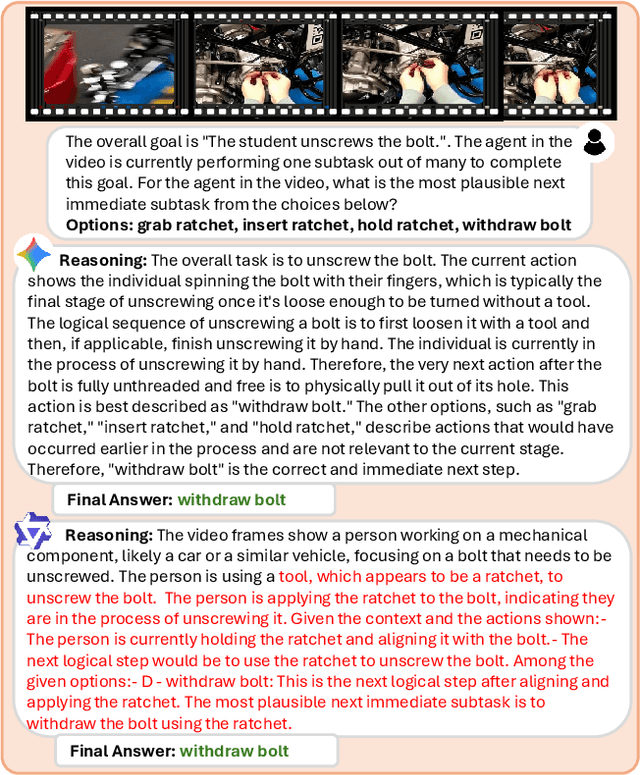
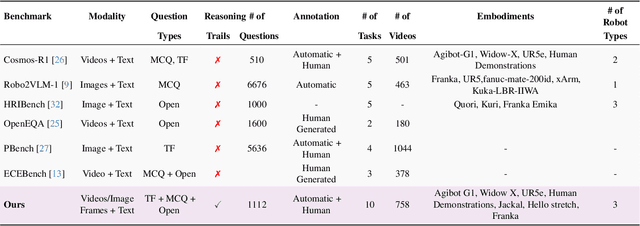
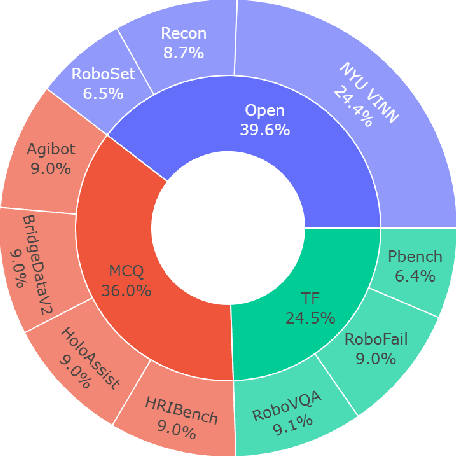
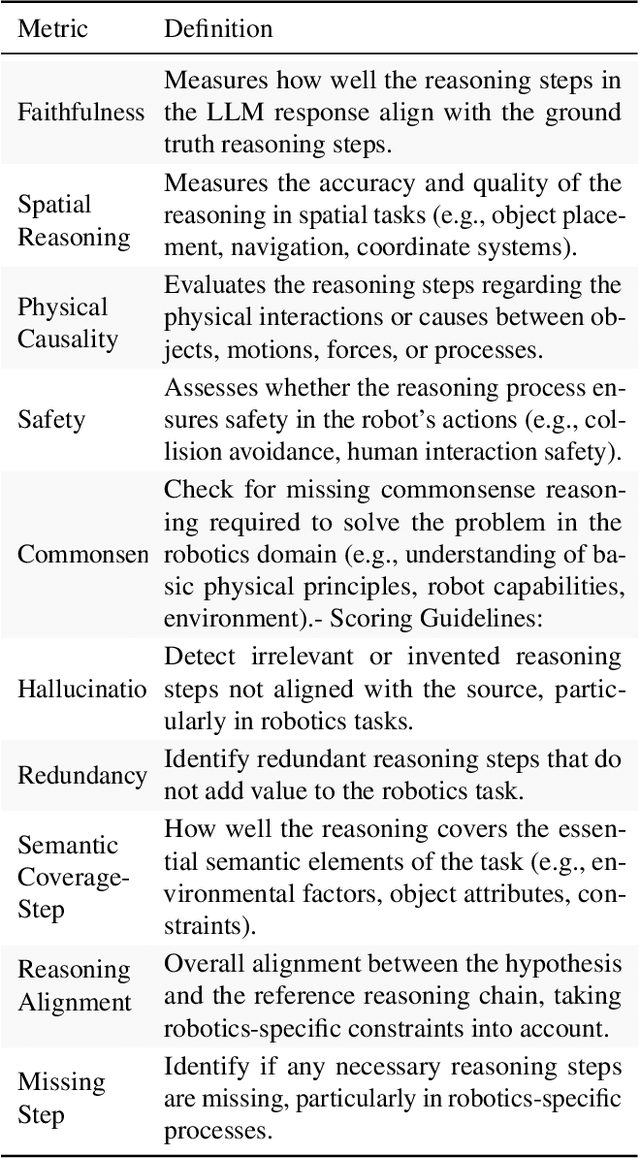
Embodied agents operating in the physical world must make decisions that are not only effective but also safe, spatially coherent, and grounded in context. While recent advances in large multimodal models (LMMs) have shown promising capabilities in visual understanding and language generation, their ability to perform structured reasoning for real-world embodied tasks remains underexplored. In this work, we aim to understand how well foundation models can perform step-by-step reasoning in embodied environments. To this end, we propose the Foundation Model Embodied Reasoning (FoMER) benchmark, designed to evaluate the reasoning capabilities of LMMs in complex embodied decision-making scenarios. Our benchmark spans a diverse set of tasks that require agents to interpret multimodal observations, reason about physical constraints and safety, and generate valid next actions in natural language. We present (i) a large-scale, curated suite of embodied reasoning tasks, (ii) a novel evaluation framework that disentangles perceptual grounding from action reasoning, and (iii) empirical analysis of several leading LMMs under this setting. Our benchmark includes over 1.1k samples with detailed step-by-step reasoning across 10 tasks and 8 embodiments, covering three different robot types. Our results highlight both the potential and current limitations of LMMs in embodied reasoning, pointing towards key challenges and opportunities for future research in robot intelligence. Our data and code will be made publicly available.