 Add to Chrome
 Add to Firefox
 Add to Edge
SafeDiffusion-R1: Online Reward Steering for Safe Diffusion Post-Training
May 18, 2026
Diffusion models have been widely studied for removing unsafe content learned during pre-training. Existing methods require expensive supervised data, either unsafe-text paired with safe-image groundtruth or negative/positive image pairs, making them impractical to scale. Furthermore, offline reinforcement learning and supervised fine-tuning approaches that generate synthetic data offline suffer from catastrophic forgetting, degrading generation quality. We propose a novel online reinforcement learning framework that addresses both data scarcity and model degradation through post-training with Group Relative Policy Optimization (GRPO) on both negative and positive text prompts. To eliminate the need for fine-tuning specialized safe/unsafe reward models, we introduce a \textit{steering reward mechanism} that exploits an inherent property of CLIP embeddings: steering text representations toward positive safety directions and away from negative ones in the embedding space. Our online-policy approach enables the model to learn from diverse prompts, including explicit unsafe content, without catastrophic forgetting. Extensive experiments demonstrate that our method reduces inappropriate content to 18.07\% (vs. 48.9\% for SD v1.4) and nudity detections to 15 (vs. 646 baseline) while improving compositional generation quality from 42.08\% to 47.83\% on GenEval. Remarkably, these safety gains generalize to out-of-domain unsafe prompts across seven harm categories, achieving state-of-the-art performance without supervised paired data or reward tuning. Github: https://github.com/MAXNORM8650/SafeDiffusion-R1.

Paper Circle: An Open-source Multi-agent Research Discovery and Analysis Framework
Apr 07, 2026The rapid growth of scientific literature has made it increasingly difficult for researchers to efficiently discover, evaluate, and synthesize relevant work. Recent advances in multi-agent large language models (LLMs) have demonstrated strong potential for understanding user intent and are being trained to utilize various tools. In this paper, we introduce Paper Circle, a multi-agent research discovery and analysis system designed to reduce the effort required to find, assess, organize, and understand academic literature. The system comprises two complementary pipelines: (1) a Discovery Pipeline that integrates offline and online retrieval from multiple sources, multi-criteria scoring, diversity-aware ranking, and structured outputs; and (2) an Analysis Pipeline that transforms individual papers into structured knowledge graphs with typed nodes such as concepts, methods, experiments, and figures, enabling graph-aware question answering and coverage verification. Both pipelines are implemented within a coder LLM-based multi-agent orchestration framework and produce fully reproducible, synchronized outputs including JSON, CSV, BibTeX, Markdown, and HTML at each agent step. This paper describes the system architecture, agent roles, retrieval and scoring methods, knowledge graph schema, and evaluation interfaces that together form the Paper Circle research workflow. We benchmark Paper Circle on both paper retrieval and paper review generation, reporting hit rate, MRR, and Recall at K. Results show consistent improvements with stronger agent models. We have publicly released the website at https://papercircle.vercel.app/ and the code at https://github.com/MAXNORM8650/papercircle.
CoME-VL: Scaling Complementary Multi-Encoder Vision-Language Learning
Apr 03, 2026Recent vision-language models (VLMs) typically rely on a single vision encoder trained with contrastive image-text objectives, such as CLIP-style pretraining. While contrastive encoders are effective for cross-modal alignment and retrieval, self-supervised visual encoders often capture richer dense semantics and exhibit stronger robustness on recognition and understanding tasks. In this work, we investigate how to scale the fusion of these complementary visual representations for vision-language modeling. We propose CoME-VL: Complementary Multi-Encoder Vision-Language, a modular fusion framework that integrates a contrastively trained vision encoder with a self-supervised DINO encoder. Our approach performs representation-level fusion by (i) entropy-guided multi-layer aggregation with orthogonality-constrained projections to reduce redundancy, and (ii) RoPE-enhanced cross-attention to align heterogeneous token grids and produce compact fused visual tokens. The fused tokens can be injected into a decoder-only LLM with minimal changes to standard VLM pipelines. Extensive experiments across diverse vision-language benchmarks demonstrate that CoME-VL consistently outperforms single-encoder baselines. In particular, we observe an average improvement of 4.9% on visual understanding tasks and 5.4% on grounding tasks. Our method achieves state-of-the-art performance on RefCOCO for detection while improving over the baseline by a large margin. Finally, we conduct ablation studies on layer merging, non-redundant feature mixing, and fusion capacity to evaluate how complementary contrastive and self-supervised signals affect VLM performance.
MedMO: Grounding and Understanding Multimodal Large Language Model for Medical Images
Feb 06, 2026Multimodal large language models (MLLMs) have rapidly advanced, yet their adoption in medicine remains limited by gaps in domain coverage, modality alignment, and grounded reasoning. In this work, we introduce MedMO, a medical foundation model built upon a generalized MLLM architecture and trained exclusively on large-scale, domain-specific data. MedMO follows a multi-stage training recipe: (i) cross-modal pretraining to align heterogeneous visual encoders with a medical language backbone; (ii) instruction tuning on multi-task supervision that spans captioning, VQA, report generation, retrieval, and grounded disease localization with bounding boxes; and (iii) reinforcement learning with verifiable rewards that combine factuality checks with a box-level GIoU reward to strengthen spatial grounding and step-by-step reasoning in complex clinical scenarios. MedMO consistently outperforms strong open-source medical MLLMs across multiple modalities and tasks. On VQA benchmarks, MedMO achieves an average accuracy improvement of +13.7% over the baseline and performs within 1.9% of the SOTA Fleming-VL. For text-based QA, it attains +6.9% over the baseline and +14.5% over Fleming-VL. In medical report generation, MedMO delivers significant gains in both semantic and clinical accuracy. Moreover, it exhibits strong grounding capability, achieving an IoU improvement of +40.4 over the baseline and +37.0% over Fleming-VL, underscoring its robust spatial reasoning and localization performance. Evaluations across radiology, ophthalmology, and pathology-microscopy confirm MedMO's broad cross-modality generalization. We release two versions of MedMO: 4B and 8B. Project is available at https://genmilab.github.io/MedMO-Page
Self-Evolving Multi-Agent Simulations for Realistic Clinical Interactions
Mar 28, 2025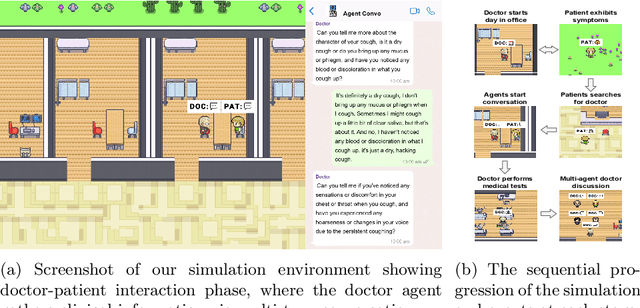
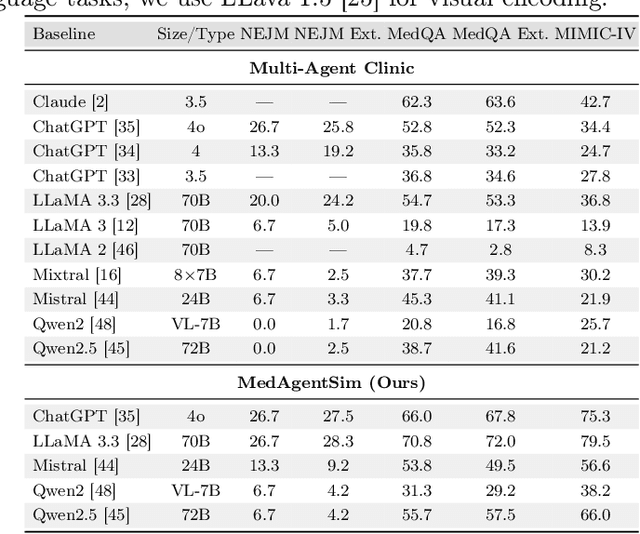
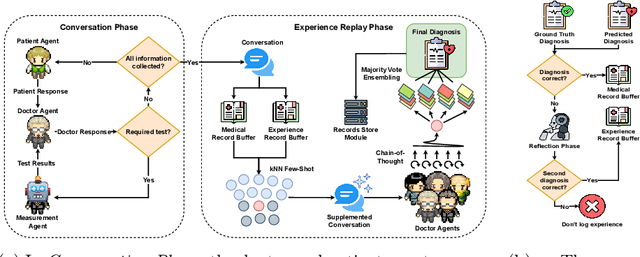
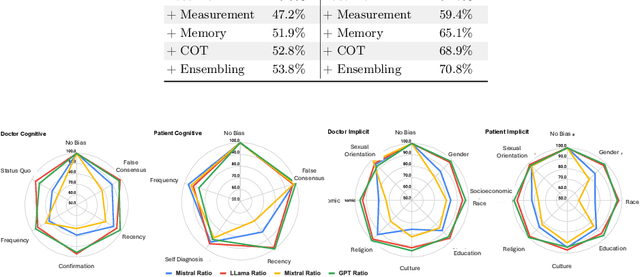
In this work, we introduce MedAgentSim, an open-source simulated clinical environment with doctor, patient, and measurement agents designed to evaluate and enhance LLM performance in dynamic diagnostic settings. Unlike prior approaches, our framework requires doctor agents to actively engage with patients through multi-turn conversations, requesting relevant medical examinations (e.g., temperature, blood pressure, ECG) and imaging results (e.g., MRI, X-ray) from a measurement agent to mimic the real-world diagnostic process. Additionally, we incorporate self improvement mechanisms that allow models to iteratively refine their diagnostic strategies. We enhance LLM performance in our simulated setting by integrating multi-agent discussions, chain-of-thought reasoning, and experience-based knowledge retrieval, facilitating progressive learning as doctor agents interact with more patients. We also introduce an evaluation benchmark for assessing the LLM's ability to engage in dynamic, context-aware diagnostic interactions. While MedAgentSim is fully automated, it also supports a user-controlled mode, enabling human interaction with either the doctor or patient agent. Comprehensive evaluations in various simulated diagnostic scenarios demonstrate the effectiveness of our approach. Our code, simulation tool, and benchmark are available at \href{https://medagentsim.netlify.app/}.
LLM Post-Training: A Deep Dive into Reasoning Large Language Models
Feb 28, 2025Large Language Models (LLMs) have transformed the natural language processing landscape and brought to life diverse applications. Pretraining on vast web-scale data has laid the foundation for these models, yet the research community is now increasingly shifting focus toward post-training techniques to achieve further breakthroughs. While pretraining provides a broad linguistic foundation, post-training methods enable LLMs to refine their knowledge, improve reasoning, enhance factual accuracy, and align more effectively with user intents and ethical considerations. Fine-tuning, reinforcement learning, and test-time scaling have emerged as critical strategies for optimizing LLMs performance, ensuring robustness, and improving adaptability across various real-world tasks. This survey provides a systematic exploration of post-training methodologies, analyzing their role in refining LLMs beyond pretraining, addressing key challenges such as catastrophic forgetting, reward hacking, and inference-time trade-offs. We highlight emerging directions in model alignment, scalable adaptation, and inference-time reasoning, and outline future research directions. We also provide a public repository to continually track developments in this fast-evolving field: https://github.com/mbzuai-oryx/Awesome-LLM-Post-training.