 Add to Chrome
 Add to Firefox
 Add to Edge
How Good are Foundation Models in Longitudinal MRI Disease Progression Reasoning?
Aug 13, 2026
Magnetic Resonance Imaging (MRI) interpretation is fundamental to clinical decision-making, requiring radiologists to integrate multi-view anatomical planes across sequential timepoints while precisely localizing interval changes. However, existing vision-language benchmarks remain confined to single-timepoint, single-view interpretation, failing to capture the temporal-spatial reasoning essential to radiologic practice. We introduce the Time-Aware Multi-View MRI Benchmark, an evaluation framework unifying multi-view anatomical input, temporal reasoning across longitudinal scans, and structured localization guidance. The benchmark comprises 3,920 expert-verified question-answer pairs derived from 890 patients across over 3,200 longitudinal MRI timepoints, drawn from seven clinical cohorts covering glioblastoma, neurodegeneration, vestibular schwannoma, and brain metastases, in open-ended, multiple-choice, and binary formats, requiring models to identify anatomical regions of maximal change, characterize progression across sequences and views, and provide structured guidance specifying boundaries, imaging features, and confounders. Experiments across 16 vision-language models reveal moderate temporal alignment but systematic failure on change direction recognition and volumetric quantification, while multi-view inputs improve spatial localization yet degrade temporal reasoning in compact architectures. Our benchmark provides a systematic framework for evaluating progression tracking, interval change localization, and temporal ordering, which are essential for clinical deployment. Code, evaluation splits, and the dataset are available at: https://github.com/wafaAlghallabi/Time-Aware-MRI.

Perception Before Supervision: Self-Contained Visual Distillation from Counterfactual Blind Spots
Aug 10, 2026Self-improvement for multimodal large language models (MLLMs) is typically driven by reward-based methods that provide only coarse scalar feedback. Distillation offers a richer alternative through dense token-level supervision, but in the visual domain it usually depends on privileged context constructed using external annotations and tools, or stronger models. We introduce \textbf{CVPD} (Contrastive Counterfactual Visual Process Distillation), which, to the best of our knowledge, is the first fully self-contained framework for dense, on-policy, token-level visual self-distillation for MLLMs. CVPD identifies visual blind spots where zooming into a region changes and sharpens the model's answer distribution, while removing the same region leaves the full-image behavior largely unchanged. Such regions reveal perceptual information that the model can encode but fails to consistently utilize under full-image conditioning. We propose a three-gate Counterfactual Criterion that identifies these regions directly from the model's own responses and converts them into dense contrastive supervision for self-distillation. On Qwen3-VL-8B-Instruct, CVPD outperforms six self-evolving baselines across twelve benchmarks, including methods that rely on external GPT-4o supervision, without a single regression. It achieves gains of $+3.60$ on OCRBench, $+3.38$ on MMStar Fine-Grained Perception, and $+3.08$ on MMStar Logical Reasoning, while maintaining or improving performance on broader multimodal benchmarks.
Ask, Solve, Generate: Self-Evolving Unified Multimodal Understanding and Generation via Self-Consistency Rewards
Jun 25, 2026Most unified large multimodal models (LMMs) that support both visual understanding and image generation still rely on curated post-training supervision, such as human annotations, preference labels, or external reward models. We ask whether a unified LMM can improve both abilities autonomously using only unlabeled images. We propose a self-evolving training framework with three internal roles: a Proposer that generates visual questions, a Solver that answers and evaluates them, and a Generator that synthesizes images. Training uses only self-derived consistency signals, without human annotations, preference labels, or task-trained external reward/judge models. To stabilize learning, we introduce Solver Token Entropy (STE), a continuous difficulty signal based on token-level prediction uncertainty that remains useful even when sample-level consistency becomes unreliable. For image generation, we design a multi-scale internal evaluation scheme that combines question-answer fidelity scoring with cycle-consistent captioning. This creates a solver-mediated coupling, where better visual understanding enables more reliable generation assessment and stronger internal training signals. The framework preserves the same role decomposition, reward logic, and training schedule across diffusion-based BLIP3o, rectified-flow BAGEL, and autoregressive VARGPT-v1.1 architectures, requiring only each backbone's native prompting and generation interface. Across eight understanding metrics, our method consistently improves over the corresponding base models. On BAGEL, it achieves a $+3.5\%$ absolute gain on MMMU and improves GenEval image generation performance from $82\%$ to $85\%$. Code and models are publicly released.
Paying More Attention to Visual Tokens in Self-Evolving Large Multimodal Models
Jun 25, 2026Recently, self-evolving large multimodal models (LMMs) have received attention for improving visual reasoning in a purely unsupervised setting. However, multi-role self-play and self-consistency reward schemes in existing self-evolving LMMs optimize answer agreement without ensuring the decoder attends to visual content, relying instead on statistical language priors to produce self consistent outputs. This leads to a persistent failure mode we term visual under-conditioning, where the decoder relies on language priors rather than the image during generation, manifesting as insufficient attention to visual tokens. As a result, current self-evolving LMMs struggle on vision--language understanding tasks such as image captioning and visual question answering. To address this, we propose VISE (Visual Invariance Self-Evolution), a purely unsupervised self-evolving framework that directly regularizes the model's visual conditioning policy through two complementary invariance-based rewards: a geometric invariance reward that enforces spatial consistency under known transformations, and a semantic invariance reward that penalizes evidence-agnostic generation by requiring the model to recognize the absence of evidence when predicted regions are perturbed. VISE operates within a single model without specialist roles, external reward models, or annotations, and is trained on raw unlabeled images. Experiments on 18 benchmarks demonstrate the efficacy of our approach. Using Qwen3-VL-2B as the base model, VISE achieves gains of $+16.85$ CIDEr on COCO and $+19.66$ CIDEr on TextCaps, reduces object hallucination by $5.0$ Chair-I points, and generalizes across four model families and scales. Our code and models are available at https://mbzuai-oryx.github.io/VISE
Mobile-O: Unified Multimodal Understanding and Generation on Mobile Device
Feb 24, 2026Unified multimodal models can both understand and generate visual content within a single architecture. Existing models, however, remain data-hungry and too heavy for deployment on edge devices. We present Mobile-O, a compact vision-language-diffusion model that brings unified multimodal intelligence to a mobile device. Its core module, the Mobile Conditioning Projector (MCP), fuses vision-language features with a diffusion generator using depthwise-separable convolutions and layerwise alignment. This design enables efficient cross-modal conditioning with minimal computational cost. Trained on only a few million samples and post-trained in a novel quadruplet format (generation prompt, image, question, answer), Mobile-O jointly enhances both visual understanding and generation capabilities. Despite its efficiency, Mobile-O attains competitive or superior performance compared to other unified models, achieving 74% on GenEval and outperforming Show-O and JanusFlow by 5% and 11%, while running 6x and 11x faster, respectively. For visual understanding, Mobile-O surpasses them by 15.3% and 5.1% averaged across seven benchmarks. Running in only ~3s per 512x512 image on an iPhone, Mobile-O establishes the first practical framework for real-time unified multimodal understanding and generation on edge devices. We hope Mobile-O will ease future research in real-time unified multimodal intelligence running entirely on-device with no cloud dependency. Our code, models, datasets, and mobile application are publicly available at https://amshaker.github.io/Mobile-O/
How Good are Foundation Models in Step-by-Step Embodied Reasoning?
Sep 18, 2025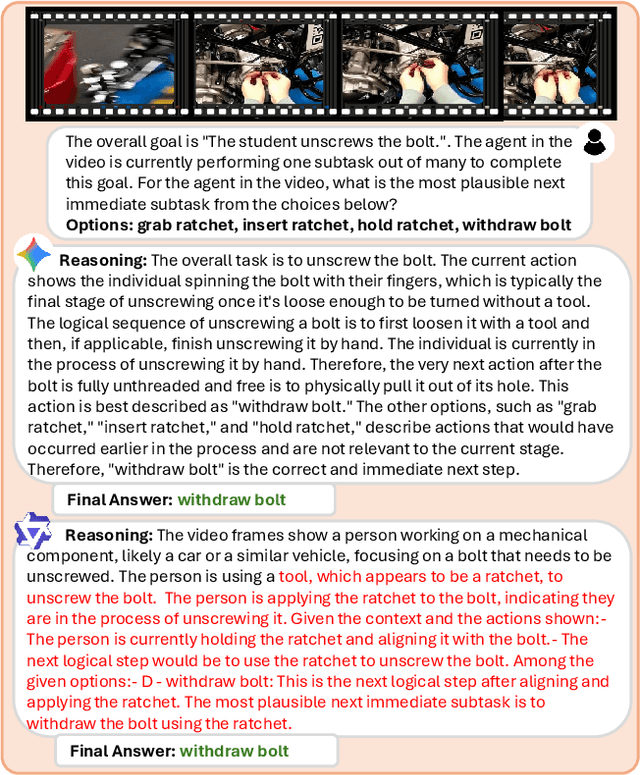
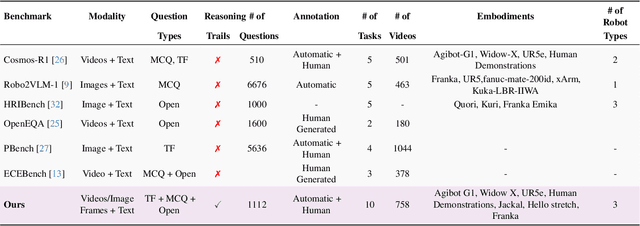
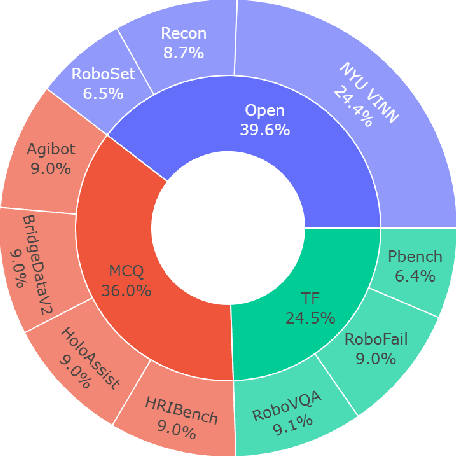
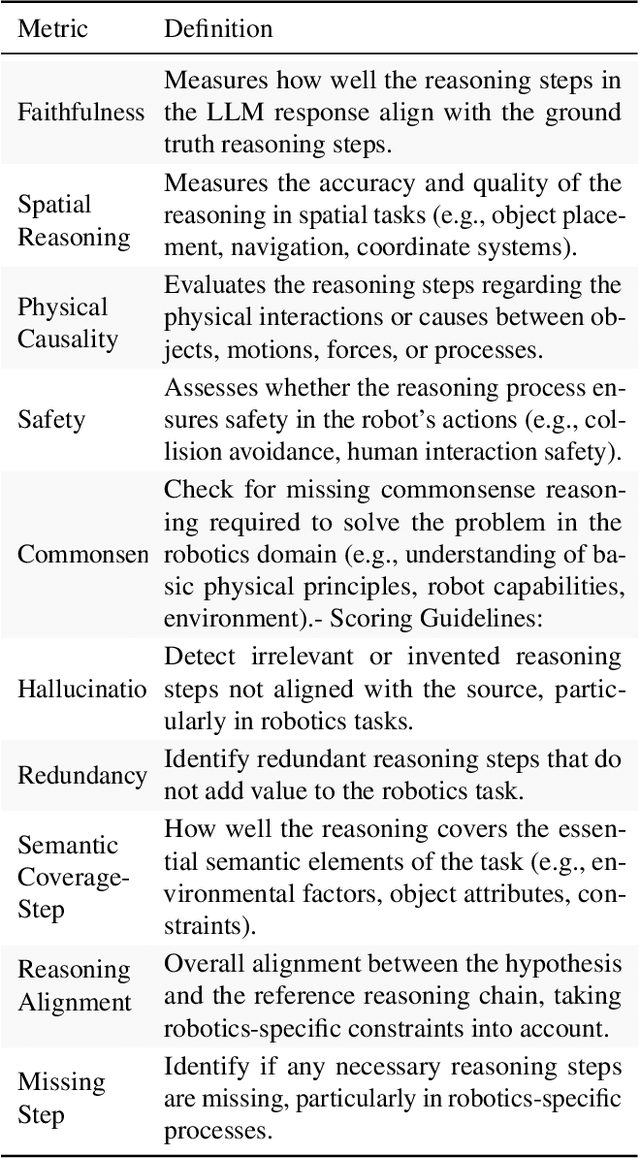
Embodied agents operating in the physical world must make decisions that are not only effective but also safe, spatially coherent, and grounded in context. While recent advances in large multimodal models (LMMs) have shown promising capabilities in visual understanding and language generation, their ability to perform structured reasoning for real-world embodied tasks remains underexplored. In this work, we aim to understand how well foundation models can perform step-by-step reasoning in embodied environments. To this end, we propose the Foundation Model Embodied Reasoning (FoMER) benchmark, designed to evaluate the reasoning capabilities of LMMs in complex embodied decision-making scenarios. Our benchmark spans a diverse set of tasks that require agents to interpret multimodal observations, reason about physical constraints and safety, and generate valid next actions in natural language. We present (i) a large-scale, curated suite of embodied reasoning tasks, (ii) a novel evaluation framework that disentangles perceptual grounding from action reasoning, and (iii) empirical analysis of several leading LMMs under this setting. Our benchmark includes over 1.1k samples with detailed step-by-step reasoning across 10 tasks and 8 embodiments, covering three different robot types. Our results highlight both the potential and current limitations of LMMs in embodied reasoning, pointing towards key challenges and opportunities for future research in robot intelligence. Our data and code will be made publicly available.
Beyond Simple Edits: Composed Video Retrieval with Dense Modifications
Aug 19, 2025Composed video retrieval is a challenging task that strives to retrieve a target video based on a query video and a textual description detailing specific modifications. Standard retrieval frameworks typically struggle to handle the complexity of fine-grained compositional queries and variations in temporal understanding limiting their retrieval ability in the fine-grained setting. To address this issue, we introduce a novel dataset that captures both fine-grained and composed actions across diverse video segments, enabling more detailed compositional changes in retrieved video content. The proposed dataset, named Dense-WebVid-CoVR, consists of 1.6 million samples with dense modification text that is around seven times more than its existing counterpart. We further develop a new model that integrates visual and textual information through Cross-Attention (CA) fusion using grounded text encoder, enabling precise alignment between dense query modifications and target videos. The proposed model achieves state-of-the-art results surpassing existing methods on all metrics. Notably, it achieves 71.3\% Recall@1 in visual+text setting and outperforms the state-of-the-art by 3.4\%, highlighting its efficacy in terms of leveraging detailed video descriptions and dense modification texts. Our proposed dataset, code, and model are available at :https://github.com/OmkarThawakar/BSE-CoVR
Fann or Flop: A Multigenre, Multiera Benchmark for Arabic Poetry Understanding in LLMs
May 26, 2025
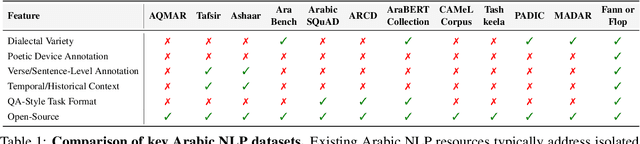
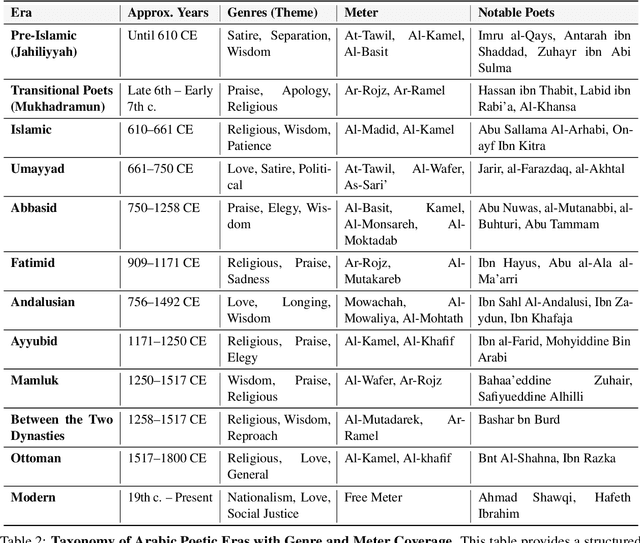
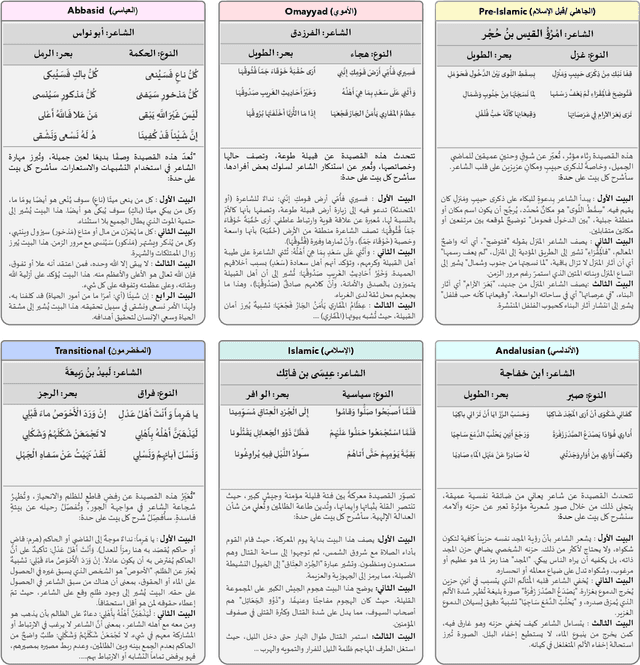
Arabic poetry is one of the richest and most culturally rooted forms of expression in the Arabic language, known for its layered meanings, stylistic diversity, and deep historical continuity. Although large language models (LLMs) have demonstrated strong performance across languages and tasks, their ability to understand Arabic poetry remains largely unexplored. In this work, we introduce \emph{Fann or Flop}, the first benchmark designed to assess the comprehension of Arabic poetry by LLMs in 12 historical eras, covering 14 core poetic genres and a variety of metrical forms, from classical structures to contemporary free verse. The benchmark comprises a curated corpus of poems with explanations that assess semantic understanding, metaphor interpretation, prosodic awareness, and cultural context. We argue that poetic comprehension offers a strong indicator for testing how good the LLM understands classical Arabic through Arabic poetry. Unlike surface-level tasks, this domain demands deeper interpretive reasoning and cultural sensitivity. Our evaluation of state-of-the-art LLMs shows that most models struggle with poetic understanding despite strong results on standard Arabic benchmarks. We release "Fann or Flop" along with the evaluation suite as an open-source resource to enable rigorous evaluation and advancement for Arabic language models. Code is available at: https://github.com/mbzuai-oryx/FannOrFlop.
DriveLMM-o1: A Step-by-Step Reasoning Dataset and Large Multimodal Model for Driving Scenario Understanding
Mar 13, 2025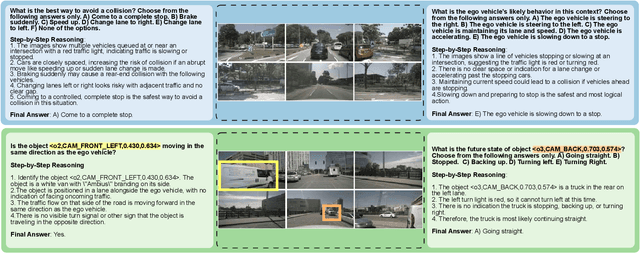
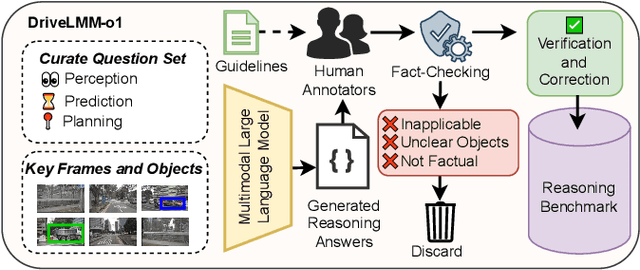
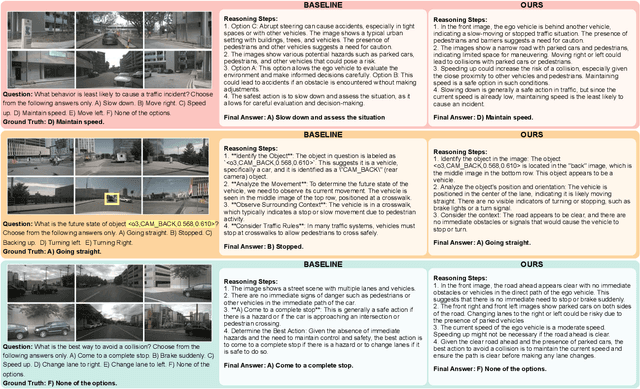
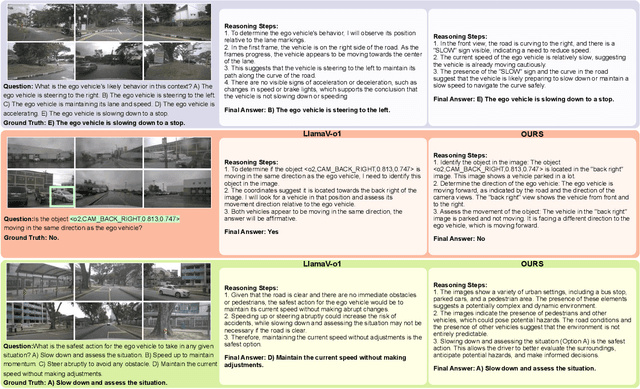
While large multimodal models (LMMs) have demonstrated strong performance across various Visual Question Answering (VQA) tasks, certain challenges require complex multi-step reasoning to reach accurate answers. One particularly challenging task is autonomous driving, which demands thorough cognitive processing before decisions can be made. In this domain, a sequential and interpretive understanding of visual cues is essential for effective perception, prediction, and planning. Nevertheless, common VQA benchmarks often focus on the accuracy of the final answer while overlooking the reasoning process that enables the generation of accurate responses. Moreover, existing methods lack a comprehensive framework for evaluating step-by-step reasoning in realistic driving scenarios. To address this gap, we propose DriveLMM-o1, a new dataset and benchmark specifically designed to advance step-wise visual reasoning for autonomous driving. Our benchmark features over 18k VQA examples in the training set and more than 4k in the test set, covering diverse questions on perception, prediction, and planning, each enriched with step-by-step reasoning to ensure logical inference in autonomous driving scenarios. We further introduce a large multimodal model that is fine-tuned on our reasoning dataset, demonstrating robust performance in complex driving scenarios. In addition, we benchmark various open-source and closed-source methods on our proposed dataset, systematically comparing their reasoning capabilities for autonomous driving tasks. Our model achieves a +7.49% gain in final answer accuracy, along with a 3.62% improvement in reasoning score over the previous best open-source model. Our framework, dataset, and model are available at https://github.com/ayesha-ishaq/DriveLMM-o1.
Time Travel: A Comprehensive Benchmark to Evaluate LMMs on Historical and Cultural Artifacts
Feb 20, 2025Understanding historical and cultural artifacts demands human expertise and advanced computational techniques, yet the process remains complex and time-intensive. While large multimodal models offer promising support, their evaluation and improvement require a standardized benchmark. To address this, we introduce TimeTravel, a benchmark of 10,250 expert-verified samples spanning 266 distinct cultures across 10 major historical regions. Designed for AI-driven analysis of manuscripts, artworks, inscriptions, and archaeological discoveries, TimeTravel provides a structured dataset and robust evaluation framework to assess AI models' capabilities in classification, interpretation, and historical comprehension. By integrating AI with historical research, TimeTravel fosters AI-powered tools for historians, archaeologists, researchers, and cultural tourists to extract valuable insights while ensuring technology contributes meaningfully to historical discovery and cultural heritage preservation. We evaluate contemporary AI models on TimeTravel, highlighting their strengths and identifying areas for improvement. Our goal is to establish AI as a reliable partner in preserving cultural heritage, ensuring that technological advancements contribute meaningfully to historical discovery. Our code is available at: \url{https://github.com/mbzuai-oryx/TimeTravel}.