 Add to Chrome
 Add to Firefox
 Add to Edge
RGB-D Video Generation for Improving Human-to-Robot Object Handover Prediction
Aug 13, 2026
Human-to-robot (H2R) object handover is a fundamental capability for human-robot collaboration, yet progress is hindered by the scarcity of large-scale, human-centric datasets and the significant sim-to-real gap. To address these challenges, we introduce Hand2Bot, an RGB-D video dataset that provides rich contextual information such as body posture and facial expressions, specifically collected for handover scenarios with real-world noise patterns. We further propose PassGen, a generative pipeline that leverages stable video diffusion and an Intention-Aware Temporal Face Encoder to synthesize realistic handover sequences while ensuring hand-object consistency. To bridge the sim-to-real gap, we implement a morphology-based depth editing strategy that replicates realistic sensor noise found in physical depth maps. Experimental evaluations demonstrate that our framework achieves high intention identification accuracy and low false trigger rates in both ablation studies and real-world deployment on a physical robot platform. Our results confirm that training on PassGen allows for robust zero-shot transfer and earlier intention anticipation compared to traditional hand-centric baselines, effectively enabling socially aware robotic behavior in shared workspaces.

Sekai2: From World Exploration to Interactive World Modeling
Aug 11, 2026Video world models must capture how scenes evolve over time and across viewpoints. Training them for long-horizon generation and camera control therefore benefits from long videos paired with camera trajectories and temporally grounded semantics. Existing corpora rarely offer the three together: large-scale web video provides broad visual diversity but no trajectories or time-aligned text, while pose-annotated datasets are typically short-range or reconstruction-oriented. We introduce Sekai2, a multi-source real-world video dataset that carries the world-exploration footage of Sekai toward interactive world modeling. The release contains 128,892 clips totaling 2,826 hours from 10,428 source videos across 113 countries or regions, and is deliberately weighted toward sustained observation: under a common 120-second decomposition, 43,594 segments reach the full two minutes and account for 51.4% of all footage. Every clip includes a released camera trajectory and hierarchical annotations disentangling subject motion, environment dynamics, static scene content, and camera behavior, resulting in 649,597 temporally grounded segments. Crucially, we further introduce 982 panoramic sequences captured along non-linear trajectories with loops and revisits. These revisits provide repeated observations of the same locations across time and viewpoints, offering essential supervision for learning persistent scene representations, long-term spatial memory, and geometrically consistent world models. Corpus-scale analyses demonstrate complete pose-and-caption coverage, broad geographic and semantic diversity, varied camera trajectories, and highly non-redundant temporal descriptions. Together, these properties make Sekai2 a scalable resource for long-horizon video generation, camera-controllable synthesis, and interactive world-model pre-training.
WISERouter: LLM Routing with Workload Budget Constraint
Jul 26, 2026Large language models (LLMs) achieve impressive performance across multiple domains, but using the most capable model for every query is prohibitive at scale. LLM routing exploits diversity in model capability and cost by assigning each query to a suitable model to balance utility and budget. Current methods have two limitations: (i) they either use heuristics that do not always enforce the budget constraint or impose a fixed per-query budget that cannot adapt across the workload and leads to suboptimal performance; (ii) they require supervised learning on a dense dataset with statistics for every query-model pair, which is expensive to collect. To address these challenges, we formulate LLM routing as a constrained contextual multi-armed bandit problem and introduce WISERouter (WR for short), a framework that supports offline learning from historical interactions as well as online learning with exploration. We further prove that WR-Online achieves a sublinear regret bound of $O(\sqrt{T})$ over a time horizon $T$. Empirical results on RouterBench and SWE-Bench demonstrate that (i) WR-Offline surpasses existing baselines in performance under a fixed budget and adheres more closely to budget constraints, and (ii) WR-Online achieves comparable performance to the baselines, while using substantially less exploration data.
AlayaWorld: Interactive Long-Horizon World Modeling -- Full Technical Report
Jul 20, 2026Unlike conventional video game development, which relies on labor-intensive pipelines for asset production, animation, physics, and programming, video world models generate interactive environments from user inputs instantly. It enable us to create customized, explorable, and continuously evolving virtual world from text, an image, or video. Realizing this vision requires four tightly coupled capabilities: interaction, persistent spatiotemporal consistency, stable long-horizon generation, and efficient response. We present AlayaWorld, an interactive long-horizon video world model that generates 24-fps video at 540p and 720p. Built on a 15B video diffusion transformer, AlayaWorld generates short latent chunks autoregressively under camera trajectories and switchable text prompts. Its bounded visual context combines a persistent sink frame, compressed temporal history, geometry-aligned spatial memory, and recent-frame conditioning. To reduce long-term drift, the model is trained with corrupted histories and prediction residuals collected from its own roll-outs. We further introduce a discrete autoregressive distillation formulation that combines distribution-matching distillation, self-forcing++, and consistency distillation, reducing inference from approximately 30 sampling steps to four steps per chunk. On iWorld-Bench, AlayaWorld achieves the best performance over long-horizon generation. Conceived as a full-stack, open-source, and long-term project, AlayaWorld is intended to provide an extensible foundation for future research on interactive video world models.
AlayaWorld: Long-Horizon and Playable Video World Generation
Jul 07, 2026Game worlds have traditionally been built through labor-intensive production pipelines, making them costly to develop, difficult to customization, and expensive to modify after deployment. Recent advances in video world models offer a fundamentally different paradigm. Rather than explicitly authoring every component of a virtual environment, these models autoregressively synthesize future observations conditioned on the current world state and user interactions, enabling playable worlds to be generated online. Trained on both gameplay recordings and real-world videos, they can capture diverse visual appearances and physical dynamics, opening new opportunities for interactive applications beyond gaming, including embodied intelligence. In this paper, we present \textbf{AlayaWorld}, a full-stack open-source framework for building interactive generative worlds. AlayaWorld enables open-ended real-time interaction, allowing users to freely navigate and perform diverse actions such as combat, spell casting, and monster summoning. The framework unifies the complete development-from data preparation model architecture, model training, inference acceleration, and deployment-within a modular and extensible architecture. Alongside the framework, we release reproducible pipelines, reference implementations, evaluation tools, and comprehensive documentation, establishing a practical foundation for future research and real-time applications of generative world models.
Scalable Adaptation of 3D Geometric Foundation Models via Weak Supervision from Internet Video
Feb 08, 2026Geometric foundation models show promise in 3D reconstruction, yet their progress is severely constrained by the scarcity of diverse, large-scale 3D annotations. While Internet videos offer virtually unlimited raw data, utilizing them as a scaling source for geometric learning is challenging due to the absence of ground-truth geometry and the presence of observational noise. To address this, we propose SAGE, a framework for Scalable Adaptation of GEometric foundation models from raw video streams. SAGE leverages a hierarchical mining pipeline to transform videos into training trajectories and hybrid supervision: (1) Informative training trajectory selection; (2) Sparse Geometric Anchoring via SfM point clouds for global structural guidance; and (3) Dense Differentiable Consistency via 3D Gaussian rendering for multi-view constraints. To prevent catastrophic forgetting, we introduce a regularization strategy using anchor data. Extensive experiments show that SAGE significantly enhances zero-shot generalization, reducing Chamfer Distance by 20-42% on unseen benchmarks (7Scenes, TUM-RGBD, Matterport3D) compared to state-of-the-art baselines. To our knowledge, SAGE pioneers the adaptation of geometric foundation models via Internet video, establishing a scalable paradigm for general-purpose 3D learning.
WiseAD: Knowledge Augmented End-to-End Autonomous Driving with Vision-Language Model
Dec 13, 2024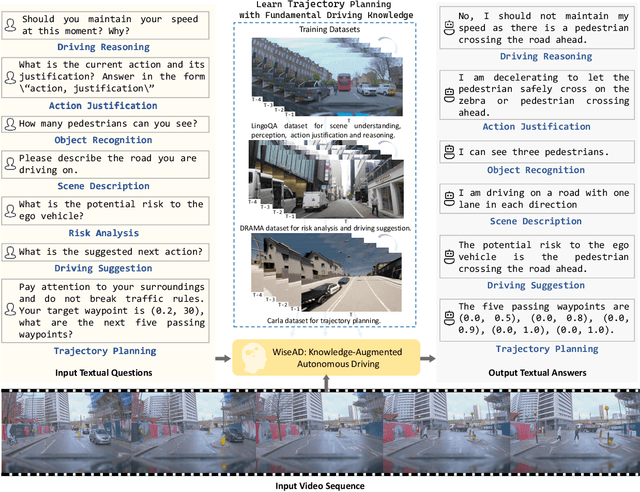
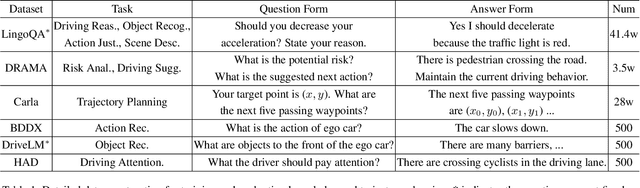
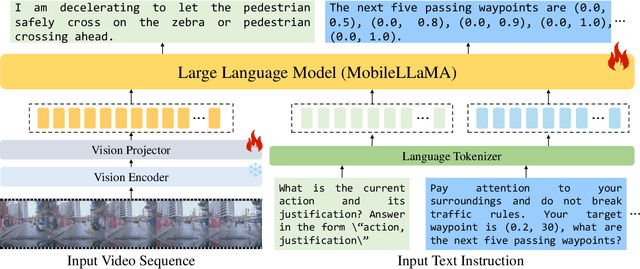
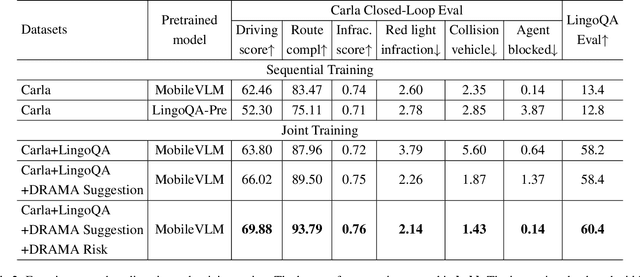
The emergence of general human knowledge and impressive logical reasoning capacity in rapidly progressed vision-language models (VLMs) have driven increasing interest in applying VLMs to high-level autonomous driving tasks, such as scene understanding and decision-making. However, an in-depth study on the relationship between knowledge proficiency, especially essential driving expertise, and closed-loop autonomous driving performance requires further exploration. In this paper, we investigate the effects of the depth and breadth of fundamental driving knowledge on closed-loop trajectory planning and introduce WiseAD, a specialized VLM tailored for end-to-end autonomous driving capable of driving reasoning, action justification, object recognition, risk analysis, driving suggestions, and trajectory planning across diverse scenarios. We employ joint training on driving knowledge and planning datasets, enabling the model to perform knowledge-aligned trajectory planning accordingly. Extensive experiments indicate that as the diversity of driving knowledge extends, critical accidents are notably reduced, contributing 11.9% and 12.4% improvements in the driving score and route completion on the Carla closed-loop evaluations, achieving state-of-the-art performance. Moreover, WiseAD also demonstrates remarkable performance in knowledge evaluations on both in-domain and out-of-domain datasets.